


25 Mar India’s TB Elimination Drive: Progress, Challenges and the Road Ahead
This article covers “Daily Current Affairs” and From India’s TB Elimination Drive: Progress, Challenges and the Road Ahead
SYLLABUS MAPPING
GS-2- Governance & Social Sector- India’s TB Elimination Drive: Progress, Challenges and the Road Ahead
FOR PRELIMS
What is Tuberculosis?
FOR MAINS
What are the key initiatives taken by India to eliminate Tuberculosis?
Why in the News?
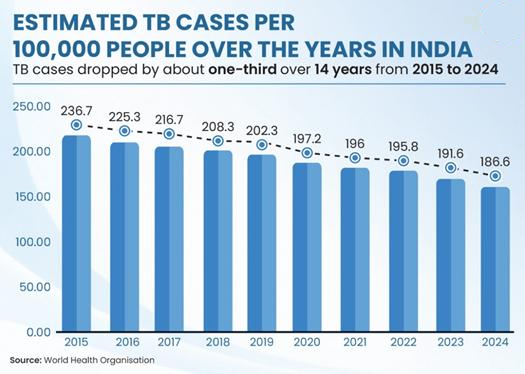
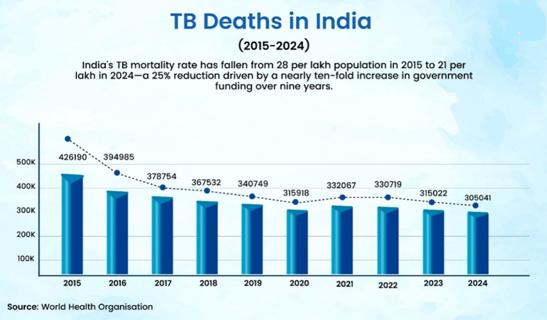
On World Tuberculosis Day (March 24, 2026), the Government of India highlighted significant progress in its elimination efforts. According to the WHO Global Tuberculosis Report 2025, TB incidence in India dropped by 21% (from 237 per lakh in 2015 to 187 per lakh in 2024), nearly double the global rate of decline. Furthermore, TB-related mortality saw a 28% reduction during the same period.
Defining Tuberculosis (TB)
Tuberculosis is an infectious disease caused by the bacterium Mycobacterium tuberculosis. While it primarily impacts the lungs, it can also affect the brain, kidneys, or spine. The disease is transmitted through the air (coughing, sneezing) but is completely curable with the correct drug regimen.
Institutional and Strategic Framework
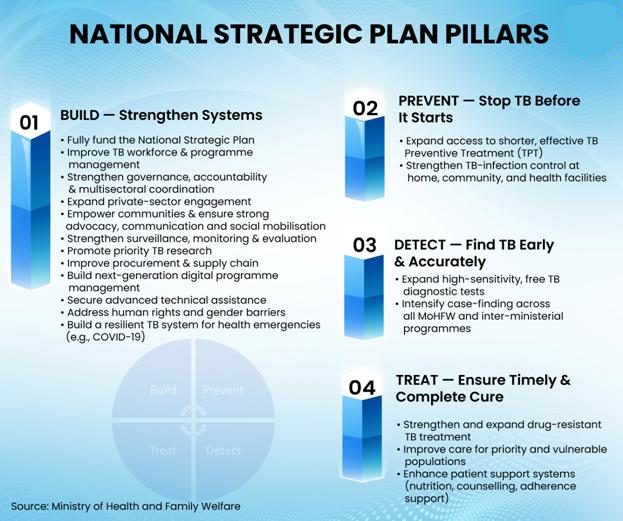
1. National TB Elimination Programme (NTEP): Renamed from the RNTCP in 2020, it shifted focus from “control” to “elimination” through the four pillars of Detect, Treat, Prevent, and Build.
2. National Strategic Plan (NSP) 2020-25: A multi-pronged approach focusing on early diagnosis, private sector engagement, and patient-centric support.
3. Pradhan Mantri TB Mukt Bharat Abhiyaan (PM-TBMBA): Launched in 2022 to transform TB elimination into a Jan Andolan (people’s movement).
4. 100-Day TB Mukt Bharat Abhiyaan: An intensive drive launched in late 2024 across 347 high-priority districts, resulting in the screening of 20 crore people and the diagnosis of 28 lakh patients.
Significance of Recent Interventions
1. Community Decentralization: Over 46,118 Gram Panchayats achieved “TB-free” certification in 2024, highlighting the role of grassroots governance in health management.
2. Local Ownership: Increased involvement of local bodies has improved accountability and faster identification of TB cases.
3. Social Support Systems: The Ni-kshay Mitra initiative has mobilized over 6.7 lakh individuals and organizations to support TB patients.
4. Nutritional & Vocational Aid: Volunteers provide nutritional supplements and skill-based support, improving recovery outcomes.
5. Financial Inclusion: The Nikshay Poshan Yojana now provides ₹1,000 per month (earlier ₹500) via DBT for better nutrition.
6. Improved Treatment Adherence: Financial and social support reduces dropout rates and ensures completion of TB treatment.
Economic, Social, and Environmental Impact
1. Economic Impact: TB often affects the most productive age groups. By reducing incidence and mortality, India protects its demographic dividend and reduces the “out-of-pocket expenditure” (OOPE) that often pushes families into poverty.
2 Social Impact: The focus on vulnerable populations (children, elderly, and those with weaker immune systems) promotes inclusive growth.
3. Environmental/Living Conditions: The programme emphasizes Airborne Infection Control, highlighting the need for better ventilation in housing and public spaces to curb transmission.
Technological Breakthroughs: The AI Frontier
1. Acoustic AI: The “Cough Against TB” (CATB) app analyzes cough patterns via smartphones, increasing case yields by 12–16%.
2. Radiology AI (DeepCXR): Automated reading of chest X-rays to identify presumptive cases in areas lacking specialists.
3. Predictive Analytics: AI identifies patients at high risk of treatment failure, leading to a 27% decline in adverse outcomes.
4. BPaLM Regimen: A new, shorter 6-month treatment for drug-resistant TB, replacing longer, more toxic regimens.
Key Issues and Challenges
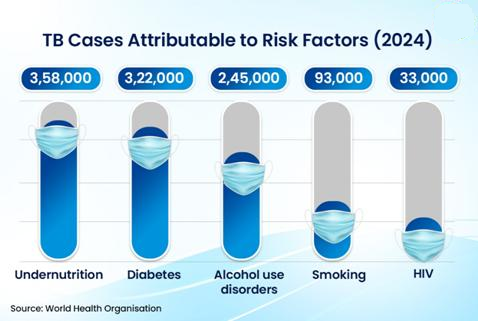
1. Drug Resistance: Multi-Drug Resistant (MDR) TB remains a major clinical challenge, requiring advanced treatment regimens like BPaLM.
2. Complex Treatment: MDR-TB treatment is longer, more expensive, and has more side effects compared to regular TB treatment.
3. Asymptomatic Cases: Around 9 lakh asymptomatic cases were detected during the 100-day drive, indicating hidden transmission.
4. Undetected Spread: Asymptomatic individuals contribute to a large “missing” pool, continuing the spread of TB unknowingly.
5. Last-Mile Access: Delivering healthcare services in remote regions like Gurez Valley in Kashmir is difficult.
6. Logistical Challenges: Ensuring availability of mobile testing units, staff, and infrastructure in hard-to-reach areas remains a major hurdle.
Way Forward
1. Scaling AI Integration: Expand AI-enabled handheld X-ray units (500+) to all districts for faster and accurate TB screening, especially in remote areas.
2. Improving Early Detection: Use advanced technologies like AI to reduce diagnostic delays and identify cases at an early stage.
3. Strengthening Primary Healthcare: Utilize 1.84 lakh Ayushman Arogya Mandirs as the first contact point for TB screening and diagnosis.
4. Decentralized Health Services: Empower primary health centers to provide accessible and affordable TB care at the grassroots level.
5. Multi-Sectoral Approach: Involve ministries and corporate partners (CSR) to tackle social determinants like malnutrition, poverty, and poor housing.
6. Focus on Latent TB: Expand TB Preventive Treatment (TPT) among household contacts to stop latent TB from becoming active disease.
Conclusion
India’s progress in TB elimination is a testament to the power of a “Whole-of-Government” and “Whole-of-Society” approach. By blending technological innovation with community-led compassion (Ni-kshay Mitras), India is not only pursuing SDG 3 but also reinforcing inclusive growth and democratic governance. Achieving a TB-Free India is a vital milestone in the journey toward Viksit Bharat 2047, ensuring that the nation’s progress is built on the foundation of a healthy and resilient population
Best ias coaching in delhi Best ias coaching in chandigarh
Prelims question:
Q. With reference to Tuberculosis (TB) elimination efforts in India, consider the following statements:
1. The National TB Elimination Programme (NTEP) focuses on four pillars: Detect, Treat, Prevent, and Build.
2. The Nikshay Poshan Yojana provides ₹1,000 per month to TB patients through Direct Benefit Transfer.
3. The BPaLM regimen is used for treating drug-sensitive TB cases.
Which of the statements given above are correct?
A) 1 and 2 only
B) 2 and 3 only
C) 1 and 3 only
D) 1, 2 and 3
Answer: A
Q. India’s fight against Tuberculosis reflects a comprehensive approach combining technology, community participation, and policy support. Discuss the key initiatives, challenges, and the way forward in achieving a TB-Mukt Bharat.
(250 words)

- RBI’s Shrinking Real-Rate Cushion Amid Rising Inflation and Strong Demand - September 21, 2026
- India’s NGOs at a New Funding Crossroads - September 21, 2026
- Deep-Sea Discovery, Environmental Responsibility - September 19, 2026

No Comments