


10 Apr World Homoeopathy Day 2026: Advancing Sustainable and Integrative Healthcare
This article covers “Daily Current Affairs” and From World Homoeopathy Day 2026: Advancing Sustainable and Integrative Healthcare
SYLLABUS MAPPING
GS-2- Social Sector- World Homoeopathy Day 2026: Advancing Sustainable and Integrative Healthcare
FOR PRELIMS
What are the benefits and problems of homoeopathy in India?
FOR MAINS
What is the role of homoeopathy in India’s healthcare system?
Why in the News?
Every year on April 10, the world observes World Homoeopathy Day to commemorate the birth anniversary of Samuel Hahnemann. In 2026, the theme “Homoeopathy for Sustainable Health” has brought renewed attention to the role of homoeopathy in promoting affordable, accessible, and inclusive healthcare systems. In India, where homoeopathy has a vast network of practitioners and institutions, the occasion is marked by nationwide awareness campaigns, seminars, and free health camps under the aegis of the Ministry of AYUSH. The observance highlights India’s efforts to integrate traditional systems of medicine into mainstream healthcare and underscores the growing importance of homoeopathy in preventive care, chronic disease management, and public health delivery.
Foundational Principles of Homoeopathy
Homoeopathy derives from the Greek words Homois (similar) and Pathos (suffering), and rests on two core doctrines:
1. Like cures like (Similia Similibus Curentur)
2. Law of minimum dose (ultra-dilution and potentisation)
3. These principles are codified in Hahnemann’s Organon of Medicine. A defining strength of homoeopathy lies in its individualised and holistic approach, focusing on the patient’s physical, mental, and emotional state.
Historical Journey: From Colonial Roots to Policy Priority
| Phase | Key Developments | Details / Examples |
|---|---|---|
| Early Expansion | Introduction in India | Around 1810 |
| Popularisation | By John Martin Honigberger | |
| Royal Patronage | Treatment of Maharaja Ranjit Singh | |
| Indian Proponents | Rajendra Lal Dutta, Mahendra Lal Sircar | |
| Institutionalisation Phase | Regulatory Body | 1973: Central Council of Homoeopathy (CCH) |
| Research Body | 1978: Central Council for Research in Homoeopathy (CCRH) | |
| Modern Policy Push | Ministry Formation | 2014: Ministry of AYUSH created |
| Policy Shift | From alternative therapy → mainstream healthcare policy component |
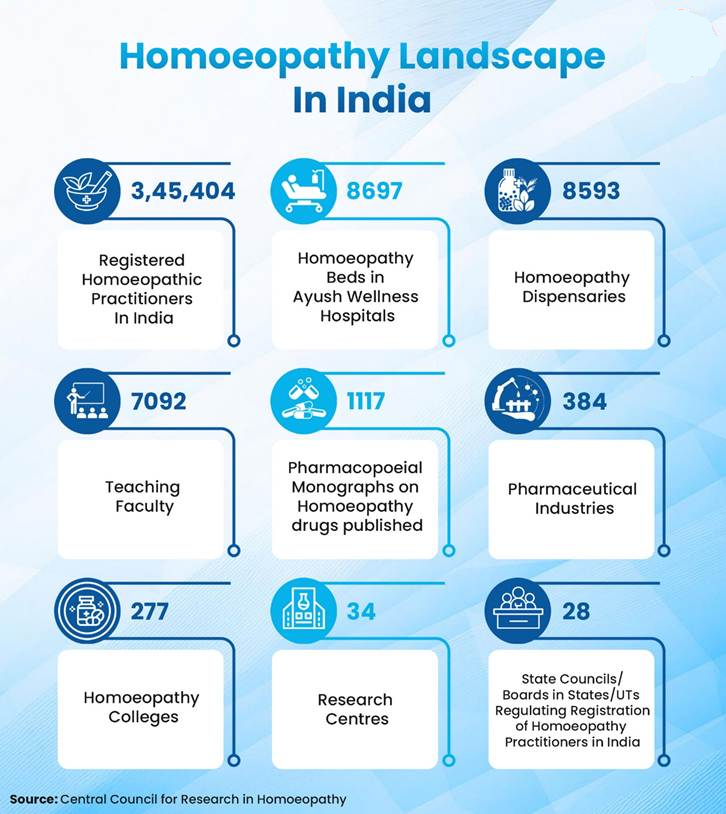
Regulatory Architecture: Strengthening Governance
| Aspect | Details |
|---|---|
| Regulatory Body | National Commission for Homoeopathy (NCH) |
| Legal Basis | Established under the National Commission for Homoeopathy Act, 2020 |
| Replaced Body | Replaced Central Council of Homoeopathy (CCH) |
| Objective | Strengthening governance and standardisation in homoeopathy sector |
Government Schemes: A Multi-Dimensional Policy Approach
1. National AYUSH Mission (NAM): Flagship scheme to integrate AYUSH at PHCs/CHCs, strengthen infrastructure, and link with programmes like NHM.
2. AYURSWASTHYA: Promotes research, Centres of Excellence, and evidence-based validation.
3. AYURGYAN: Focuses on capacity building, faculty development, and digital learning.
4. AOGUSY: Ensures quality control, WHO-GMP compliance, and export promotion.
5. IEC Initiatives: Promote awareness, preventive healthcare, and healthy lifestyles.
Homoeopathy in Public Health and Epidemics
Homoeopathy has been used as a complementary approach in epidemic management.
Case Examples:
1. AES (Uttar Pradesh): Preventive distribution
2. Chikungunya (Kerala): Reported high recovery rates
3. Dengue (Cuba): Reduced hospitalisation
4. COVID-19: Prophylactic use
Advantages:
1. Low cost
2. Easy scalability
3. Effective community-level outreach
Significance in India’s Healthcare System
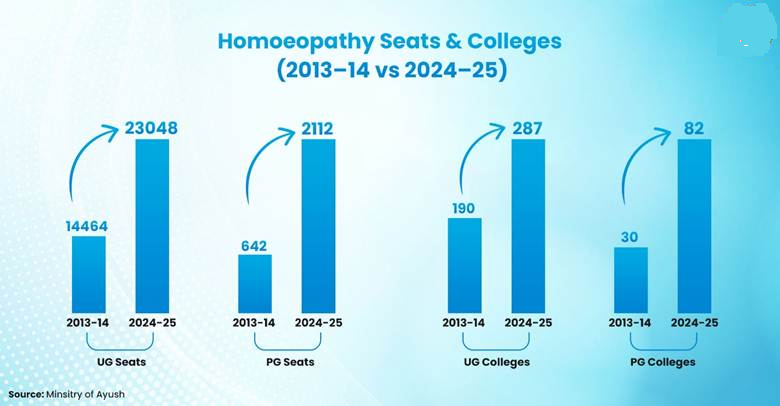
1. Accessibility: Widely available across rural and urban areas through AYUSH centres, improving last-mile healthcare delivery.
2. Affordability: Low-cost treatment reduces out-of-pocket expenditure, especially benefiting economically weaker sections.
3. Preventive Care: Emphasises holistic and long-term wellness, aligning with preventive and promotive healthcare goals.
4. Cultural Acceptance: Deep-rooted trust in traditional systems enhances community participation and treatment adherence.
5. Reduced Burden on Allopathy: Acts as a complementary system, easing pressure on conventional healthcare infrastructure.
6. Public Health Outreach: Useful in mass preventive interventions during epidemics due to easy distribution and scalability.
Challenges and Critical Concerns
1. Scientific Validity: Limited large-scale RCT evidence; ongoing debate over ultra-dilution and mechanism of action.
2. Standardisation Issues: Variations in education, training, and clinical practices across institutions.
3. Quality Control: Rapid institutional expansion raises concerns; requires stronger regulatory oversight.
4. Misuse Risks: Risk of substitution for evidence-based treatments in serious illnesses.
5. Integration Barriers: Limited coordination and acceptance within the allopathic healthcare system.
Way Forward
1. Strengthening Scientific Evidence: Promote large-scale clinical trials and collaboration with modern medical institutions.
2. Integrative Healthcare Model: Position homoeopathy as complementary, integrating it into multidisciplinary care.
3. Regulatory Vigilance: Ensure strict accreditation, continuous monitoring by the National Commission for Homoeopathy, and robust pharmacovigilance.
4. Digital Integration: Leverage AI, big data, and expand telemedicine for better treatment analysis and outreach.
5. Capacity Building: Enhance practitioner training and strengthen schemes like AYURGYAN.
6. Public Awareness & Rational Use: Promote evidence-based usage and prevent misuse through IEC campaigns
7. Global Positioning: Boost exports and foster international collaborations for wider recognition.
Conclusion
Q. With reference to Homoeopathy in India, consider the following statements:
1. The National Commission for Homoeopathy was established under the National Commission for Homoeopathy Act, 2020.
2. The principle of “like cures like” forms the basis of homoeopathy.
3. The Central Council for Research in Homoeopathy is responsible for regulating homoeopathic education in India.
Which of the statements given above is/are correct?
(a) 1 and 2 only
(b) 2 and 3 only
(c) 1 only
(d) 1, 2 and 3
Answer: A
Q. Homoeopathy in India reflects a convergence of traditional healing and modern policy support.” Discuss its role in public health. Also examine the challenges and suggest measures for its effective integration into the healthcare system.
(250 words)

- Before New Taxes, Make Every Rupee Count: Fiscal Discipline and Outcome-Based Governance in Tamil Nadu - August 20, 2026
- A Palestinian State as the Foundation for Regional Peace - August 20, 2026
- A Vision for an Inclusive Bangladesh: Democracy, Minority Rights and India’s Neighbourhood - August 19, 2026

No Comments