


27 Apr Same Latitude, Different Heat: Why India Is Burning Hotter?
This article covers “Daily Current Affairs”
SYLLABUS MAPPING : GS 3 : Environment
FOR PRELIMS : Heat Waves Conditions, Heat Action Plans, Reasons for India’s heat anomaly.
FOR MAINS : India shares its tropical latitudes with several African and South American nations, yet consistently records higher surface temperatures than its latitude peers. Analyse the geographical, ecological, and anthropogenic factors responsible for this anomaly.
Why in New ?
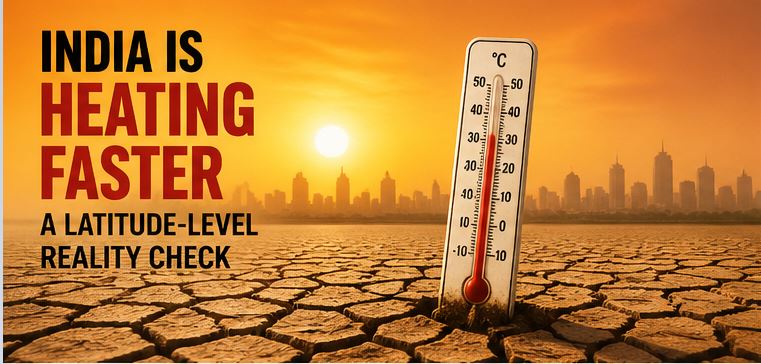
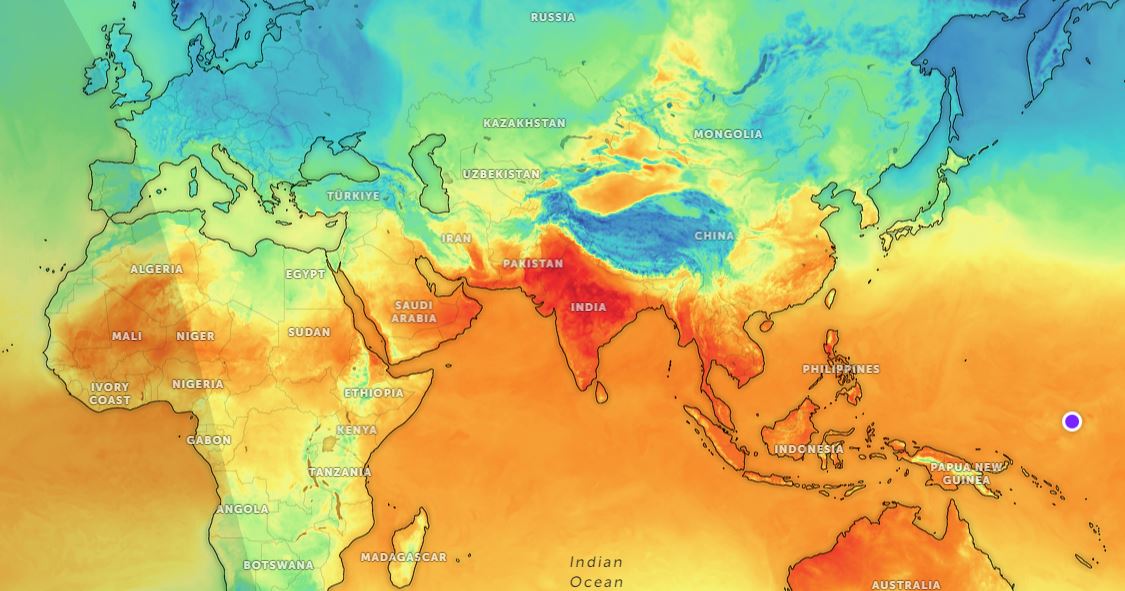
A viral heat map in April 2026 stunned millions online: India — not the Sahara, not the Arabian Peninsula — appeared hotter than most of Africa on the same day. Nineteen of the world’s twenty hottest cities were in India. This is not a coincidence. It is a convergence of geography, climate physics, ecological breakdown, and policy failure — and its consequences are rapidly becoming irreversible.
Lets understand the reason behind all this Chaos :
Global warming on a uniquely vulnerable landmass
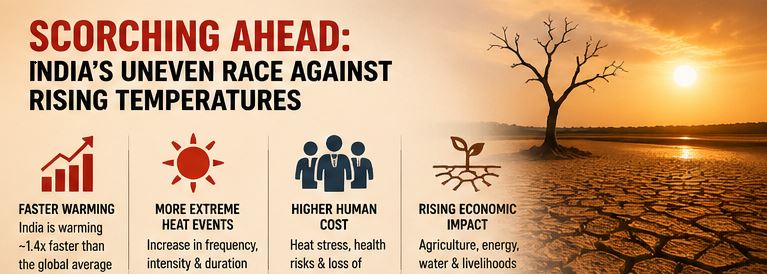
India’s land area warms faster than the global average because land surfaces have low thermal inertia compared to oceans. The decade 2016–2025 was India’s warmest on record, with an average anomaly of +0.32°C. Since 1901, India’s mean temperature has risen by 0.68°C per century, with maximum temperatures rising faster (+0.89°C/century). The Intergovernmental Panel on Climate Change (IPCC)’s Sixth Assessment Report confirms India is one of the most thermally exposed major nations on Earth.
A warming Indian Ocean that paradoxically dries the land
The Indian Ocean has warmed up to 1.2°C in the western regions over the past century — among the fastest of any ocean basin. Counterintuitively, this weakens the land-sea thermal contrast that drives the monsoon, causing subsidence of dry air over the subcontinent. The result: reduced rainfall over central India (down 10–20%) and a drying of the very land that desperately needs moisture. Less cloud cover and soil moisture means more solar radiation reaches and heats the surface, creating a dangerous feedback loop.
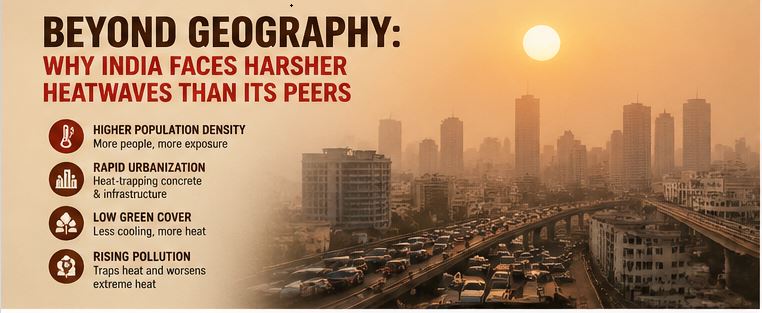
Runaway urbanisation and the Urban Heat Island effect
More than 60% of Indian urban areas experience a daytime Urban Cool Island paradox by day (irrigated rural fields are cooler than cities), but at night, 90% of urban areas experience Urban Heat Island (UHI) warming — making nights increasingly lethal. The concrete, asphalt, and steel of India’s rapidly expanding cities absorb and trap solar radiation, re-releasing it as longwave radiation throughout the night. This denies the urban poor — who lack air conditioning — any physiological recovery from daytime heat stress.
Deforestation and loss of green cover
Despite official statistics showing marginal increases in forest cover, the quality of India’s forests — particularly in the Western Ghats and Northeast — is declining sharply. Globally, deforested areas warm on average +0.70°C more than forested areas. India’s forest clearance for infrastructure projects, combined with degradation of urban green spaces, eliminates the evapotranspiration and shading effects that forests provide. The viral debate ignited by the heat map specifically highlighted this: government agencies issuing forest clearances while simultaneously calling for afforestation.
Disrupted monsoon and declining pre-monsoon rainfall
The weakening of the Mascarene High — a semi-permanent subtropical high-pressure system in the South Indian Ocean that drives cross-equatorial winds toward India — has delayed and weakened monsoon onset. Coupled with a declining meridional SST gradient, the intensity of the southwest monsoon circulation has slackened. February 2025 was also one of India’s driest in years, with less than half the normal rainfall, ensuring pre-monsoon soil moisture was critically low — leaving the land baking and unprotected entering summer.
Rising night-time temperatures: the silent killer
While daytime heatwaves attract headlines, the accelerating rise in minimum (night-time) temperatures is the more insidious trend. India’s minimum temperatures rose by 0.47°C per century overall, but the rate is accelerating — and warm nights now occur weeks earlier than previously recorded. On February 12–20, 2025, ten states recorded night temperatures 5.1°C above normal. Without nocturnal cooling, the human body cannot recover from daytime heat stress, dramatically increasing mortality risk for outdoor workers, the elderly, and the sick.
Multidimensional Impact on India :
Economic : $194 billion in lost labour income (2024)
India lost 247 billion potential labour hours in 2024 — 124% more than in the 1990s. Agriculture absorbed 66% of losses; construction 20%. McKinsey projects GDP losses of 2.5–4.5% by 2030 if adaptation lags. Informal workers in Delhi earned 40% less during peak heatwaves.
Public Health : 44,000+ heatstroke cases in 2024
Heatwaves caused over 24,000 deaths from 1992–2015. Mortality rates from heatwaves rose 62.2% in four decades. Warm temperatures accelerate bacterial growth in food and water, driving spikes in diarrhoea, cholera, and dengue. Bihar’s low death-registration rate means the true toll is vastly undercounted.
Agriculture & Food : Wheat yields fall 5.2% per 1°C rise
Mango, lychee, and wheat crops in Bihar suffered extensive damage weeks before harvest in April 2025. Heat stress reduces crop yields, increases irrigation demand, depletes soil moisture, and disrupts sowing cycles — directly threatening food security for hundreds of millions.
Environment : Coral bleaching, water scarcity, biodiversity loss
Rising Sea Surface Temperatures trigger coral bleaching in Gulf of Kachchh and Lakshadweep. Warming temperatures accelerate groundwater depletion by increasing irrigation demand. 21 major cities including Delhi, Bengaluru, and Chennai risk running out of groundwater by 2030 (NITI Aayog). Forest fires rose, causing 10,200 PM2.5-related deaths per year (2020–24 avg).
Social Equity : Informal workers 17x more at risk
Informal sector workers in South India face a 17-fold higher risk of heat-related productivity loss compared to formal sector employees at the same temperature. Women are biologically more vulnerable due to hydration avoidance. School closures disrupted education for millions — an invisible “heat learning gap” compounding intergenerational poverty.
Energy & Infrastructure : Grid stress and cascading failuresPeak electricity demand hit record highs in 2024, straining generation capacity. Extended power outages — up to 16 hours daily in parts of Balochistan, a pattern mirrored in Indian heatwave corridors — eliminated access to cooling during the most critical periods, killing the most vulnerable.
What India Has — and Where the Gaps Are
- Heat Action Plans (HAPs): Implemented across 23 heatwave-prone states in collaboration with NDMA and IMD. Cities like Ahmedabad (India’s first, 2013) and Jodhpur are global models — but most HAPs focus on emergency measures rather than structural adaptation.
- IMD colour-coded alert system: Graded yellow/orange/red warnings now enable anticipatory action by state disaster management authorities and health departments.
- Cooling centres and hydration infrastructure: Delhi’s 2025 HAP deployed 22 cooling centres, 3,000–4,000 water ATMs, and 1,800+ Aapda Mitra volunteers for emergency outreach.
- Hospital preparedness: Dedicated heatwave wards with air conditioning, stockpiling of ORS, IV fluids, and training of medical staff under the National Programme on Climate Change and Human Health (NPCCHH).
- India Cooling Action Plan (ICAP): A long-term policy framework targeting a 25–30% reduction in cooling energy demand and a 25–30% reduction in refrigerant demand by 2037–38.
- Green India Mission: Targets afforestation of 5 million hectares by 2030, with urban tree-planting and restoration of degraded forest corridors.
- Cool roofs and urban greening: Some city HAPs propose cool roof installation and green cover expansion to reduce the UHI effect; however, implementation remains patchy.
- Jal Jeevan Mission: Aims to provide piped drinking water to all households — critical for hydration during extreme heat — though timelines have slipped in several states.
- Early warning and IHIP surveillance: The Integrated Health Information Platform (IHIP) now enables digital tracking of heat illness cases for real-time public health response.
Why More — and Faster — Effort Is Required
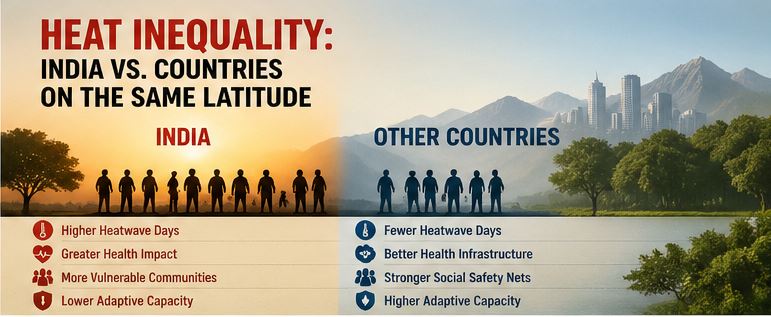
- India is not merely experiencing hotter summers; it is approaching what climate scientists call a “survivability threshold.” By mid-century, parts of India could be among the first regions on Earth to regularly exceed wet-bulb temperatures of 31°C — the point at which even a healthy, resting human in the shade begins to lose thermal regulation. This is not a projection for 2100. It is a trajectory already in motion.
- The structural gaps are profound. Heat is still not classified as a State-Specific Natural Disaster, which would unlock dedicated disaster funds and enforce accountability. There is no national repository of HAPs, no standardised heat-mortality reporting, and no mandatory “heat-resilience” building codes for new urban construction.
- Africa, which shares similar latitudes with India, has large portions of savannah, desert, and forest that create different moisture and albedo regimes. India’s dense population, intensive agriculture, rapidly expanding impervious urban surfaces, and now-drying monsoon all compound thermal stress in ways that make latitude comparisons deeply unfair — and deeply alarming. India is not just hotter than its latitude peers. It is structurally less equipped to cope, and getting hotter faster.
- The CEEW recommends that India: go beyond daytime temperatures to include night-time temperature thresholds in heatwave definitions; notify heatwaves as state-specific disasters; promote heat insurance for informal workers; publish an annual “Heat Ledger” in the Economic Survey; and urgently create a National Heat-Resilient Infrastructure Mission. Climate science, public health evidence, and economic analysis all agree: the window to act at manageable cost is narrow and closing.
Prelims Question
Consider the following statements regarding heatwaves in India:
1. The India Meteorological Department declares a heatwave when the departure from normal maximum temperature is at least 4.5°C for plains and 6°C for hilly regions.
2. The warming of the Indian Ocean weakens the Indian summer monsoon by enhancing convection over the equatorial ocean and causing compensatory subsidence of dry air over the subcontinent.
3. The Urban Heat Island (UHI) effect in Indian cities is predominantly a daytime phenomenon, with over 90% of Indian cities recording positive UHI during the day.
4. The wet-bulb temperature threshold beyond which the human body begins to lose thermal regulation is 35°C, as established by all major climate studies.
Which of the above statements is/are correct?
Answer: (d) 2 only
Statement 1 is partially incorrect — the 4.5°C departure threshold applies for severe heatwaves on plains, while normal heatwave requires at least 4.5°C departure or actual temp ≥45°C. Statement 3 is incorrect — research shows only 60% of Indian urban areas experience daytime UHI; at night, 90% do. Statement 4 is incorrect — recent studies have revised the critical wet-bulb threshold downward to ~31°C under hot-humid conditions, not 35°C. Only Statement 2 is correct, consistent with findings from multiple peer-reviewed studies on Indian Ocean–monsoon interaction.
Mains question
“India’s extreme heat crisis is not merely a meteorological event but a structural socio-economic emergency with disproportionate consequences for its most vulnerable.” Critically examine this statement in the context of recent heatwave data and India’s existing policy frameworks. (15 M , 250 words).

- India’s Youth Unemployment and Education Crisis - August 5, 2026
- India’s Sports Infrastructure and the 2036 Olympics Ambition - August 5, 2026
- Critical Minerals: The Foundation of Strategic Power - August 4, 2026

No Comments