


27 Apr Indo-Kiwi Trade Pact: Bridging Oceans, Boosting Growth.
SYLLABUS MAPPING : GS 2&3 : Economy & IR
FOR PRELIMS : Total FTAs and PTAs of India , Key Provisions of Recent FTAs
FOR MAINS : “Free Trade Agreements (FTAs) are often seen as double-edged swords for India’s economy.” Critically examine the benefits and challenges of FTAs signed by India, and suggest a balanced strategy to maximize gains in the evolving global trade landscape.
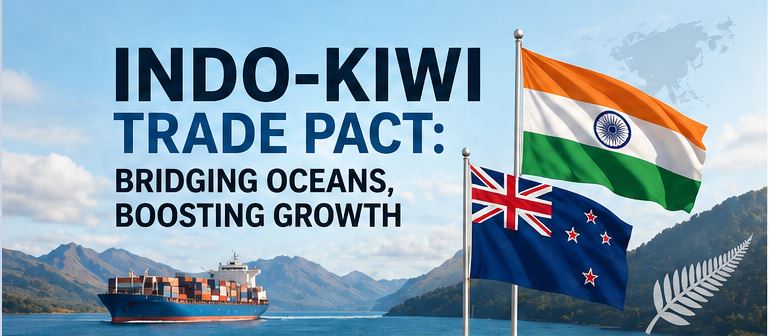
Why in New ?
India and New Zealand inked their Free Trade Agreement in New Delhi on April 27, 2026 — a deal negotiated in just nine months, making it one of the fastest concluded pacts in India’s trade history. Against the backdrop of a week that also saw the India–UK FTA formalised, it signals that India has entered an era of aggressive trade architecture-building, one that is reshaping its position in the global economic order.
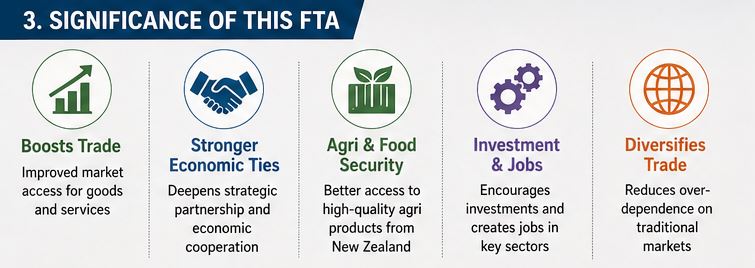
Significance of India-new zealand fta :
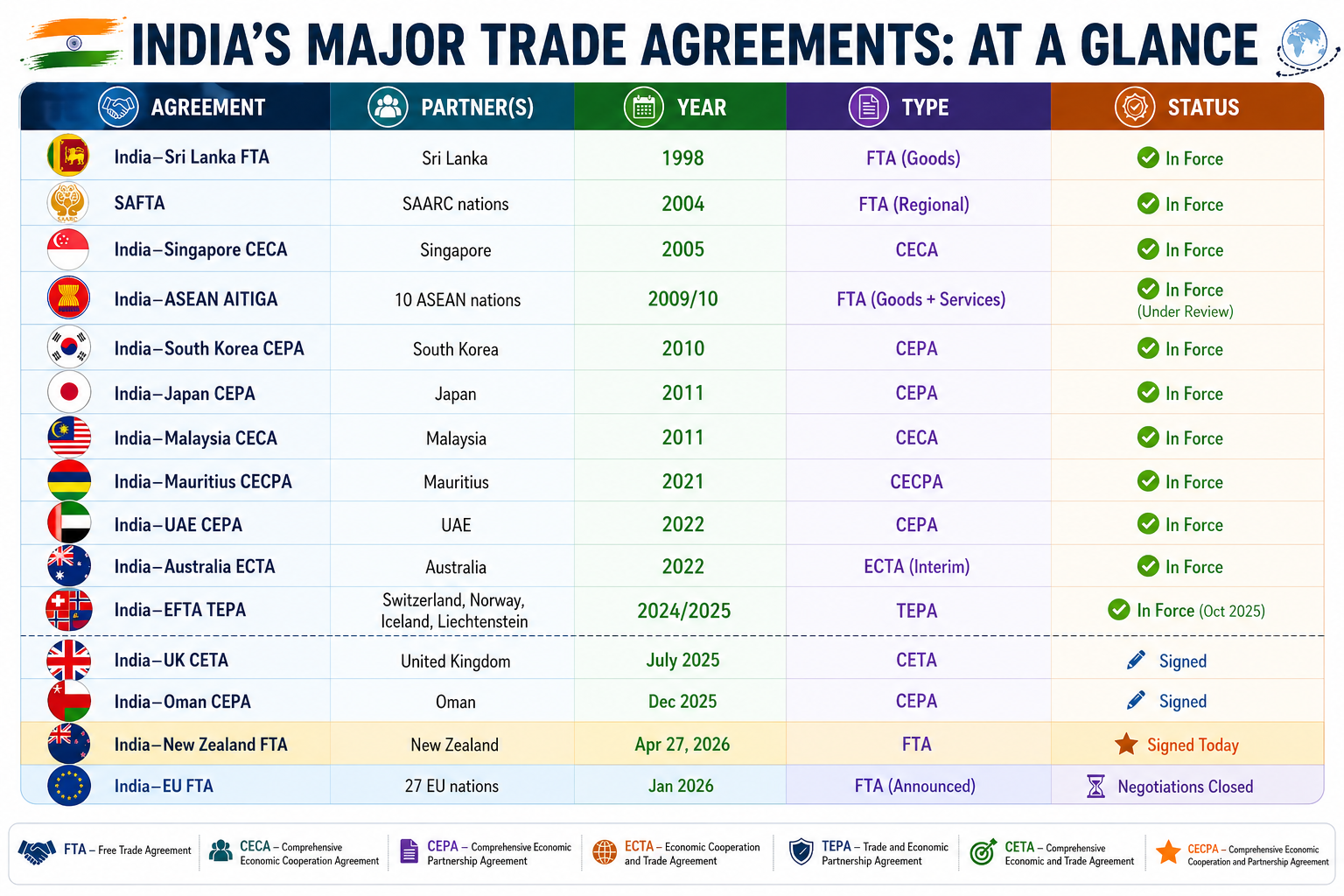
India’ FTA and PTA network:
Has Trade Agreements benefited India ?
A mixed but improving scorecard:
The honest answer is: the older FTAs have been deeply mixed, while the newer generation FTAs — signed post-2021 — are showing significantly better design and early outcomes.
The generational shift in FTA design is notable. New agreements now include: binding investment commitments (not promises), mutual recognition agreements on pharma regulators, dedicated services and mobility chapters, explicit exclusion of sensitive domestic sectors, digital trade frameworks, and Financial Services annexes beyond GATS. India’s FTA utilisation rate however remains under 25% (ADB), one of the lowest in Asia — meaning the legal gains on paper are not reaching actual exporters on the ground.
Prelims Question
Consider the following statements regarding India’s trade agreements:
1. A Preferential Trade Agreement (PTA) uses a negative list approach, meaning tariffs are reduced on all goods except those listed, while a Free Trade Agreement (FTA) uses a positive list of products for which duty reductions apply.
2. India’s first FTA was signed with Sri Lanka in 1998, while India’s first Comprehensive Economic Cooperation Agreement (CECA) was with Singapore in 2005.
3. The India–EFTA Trade and Economic Partnership Agreement (TEPA) is the first trade agreement where a trading partner has made a binding investment commitment of $100 billion to India.
4. India opted out of the Regional Comprehensive Economic Partnership (RCEP) primarily due to concerns about its services sector being unable to compete with ASEAN counterparts.
- (a) 2 and 3 only
- (b) 1 and 4 only
- (c) 1, 2 and 4 only
- (d) 2, 3 and 4 only
Answer: (a) 2 and 3 only
Statement 1 is incorrect — the definitions are reversed. A PTA uses a positive list (specific products on which duty is reduced), while an FTA uses a negative list (duty is reduced on everything except listed items) — making FTAs far more ambitious in coverage. Statement 4 is incorrect — India’s RCEP exit was driven primarily by concerns over cheap Chinese goods flooding the market through other RCEP members (goods trade), not services sector competition. India’s services sector is actually competitive globally, and India had sought better services and mobility commitments in RCEP negotiations. Statements 2 and 3 are correct.
Mains question
“India’s Free Trade Agreements post-2021 represent a qualitative generational shift from earlier agreements, yet utilisation challenges and supply side gaps continue to blunt their impact.” Critically evaluate this statement with examples from India’s recent trade agreements.
(15 M , 250 words).

- India’s Youth Unemployment and Education Crisis - August 5, 2026
- India’s Sports Infrastructure and the 2036 Olympics Ambition - August 5, 2026
- Critical Minerals: The Foundation of Strategic Power - August 4, 2026

No Comments