


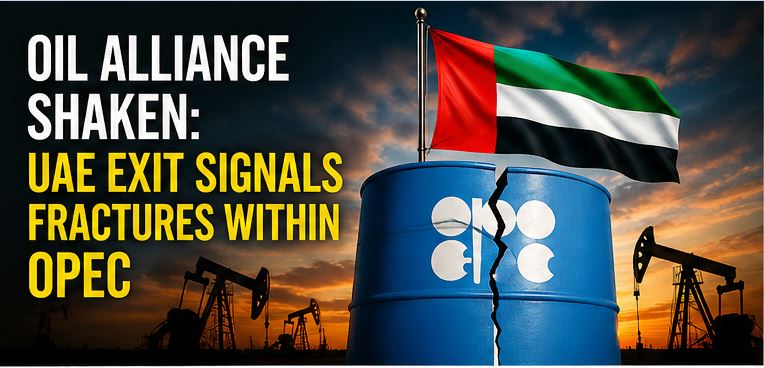
30 Apr Oil Alliance Shaken: UAE Exit Signals Fractures Within OPEC
SYLLABUS MAPPING : GS 2&3 : Economy & IR
FOR PRELIMS : OPEC group details, Petroleum reserves by countries, Implications on India, etc.
FOR MAINS : Examine the implications of weakening OPEC cohesion on global oil prices and energy security, with special reference to India.
Why in New ?
- UAE announced its exit from OPEC (and OPEC+) effective May 1, 2026, ending nearly 60 years of membership.
- It is one of the largest oil producers (~3.4 million bpd) within the cartel.
- The move is being seen as a major geopolitical + economic shift in global energy governance.
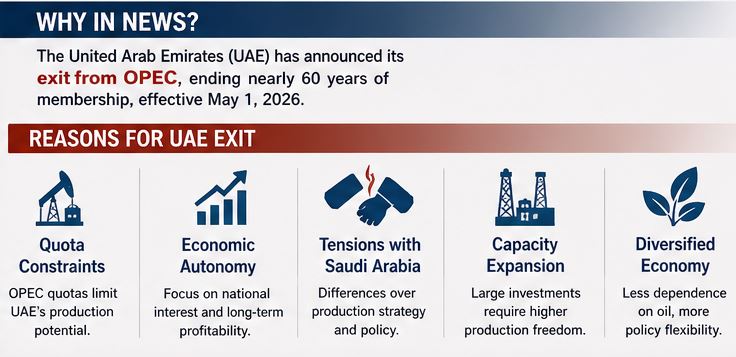
Reasons Behind UAE’s Exit
| Factor | Explanation |
|---|---|
| ⚙️ Production Constraints | UAE felt “constrained by OPEC quotas” and wants to increase output up to ~5 million bpd. |
| 💰 National Interest First | Decision based on long-term strategic and economic goals. |
| ⚔️ Geopolitical Rivalry | Growing tensions with Saudi Arabia (OPEC leader) over oil strategy. |
| 🏗️ Capacity Expansion | Massive investments in oil infrastructure demand higher production freedom. |
| 🌍 Energy Transition Strategy | Diversified economy (77% non-oil GDP) → less dependence on cartel discipline. |
| 🔥 Regional Conflicts | Iran-related disruptions changed strategic calculations. |
OPEC & Its Working
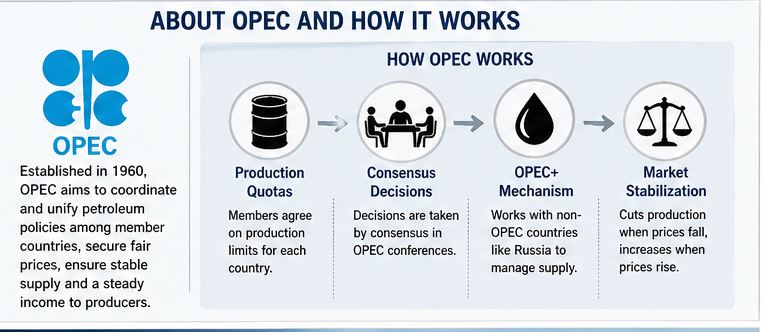
What is OPEC?
- An intergovernmental organization (cartel-like) of major oil-exporting countries.
- Founded in 1960 (Baghdad Conference) by Iran, Iraq, Kuwait, Saudi Arabia, Venezuela.
- HQ: Vienna, Austria
Core Objectives
- Coordinate petroleum policies among members
- Stabilize global oil prices
- Ensure regular supply to consumers + steady revenue to producers
How OPEC Works (Concept + Mechanism)
1. 🛢️ Production Quota System (Core Tool)
- OPEC sets a total output ceiling, then distributes it among members.
- Each country gets a barrels/day limit based on capacity & reserves.
2. 🤝 Consensus-Based Decision Making
- Decisions taken at OPEC Conferences (ministerial meetings)
- Requires unanimity / broad agreement
3. 🌐 OPEC+ Framework (Extended Cartel)
- Formed in 2016 (Declaration of Cooperation)
- Includes non-members like Russia, Kazakhstan etc.
4. 📉 Market Stabilization Mechanism
- Based on demand–supply assessment:
- During price crash → OPEC cuts production
- During shortage/price rise → increases output
5. 📊 Monitoring & Compliance
- Uses independent agencies (Kpler, OilX etc.) to track production
- However: Members often cheat quotas for extra revenue
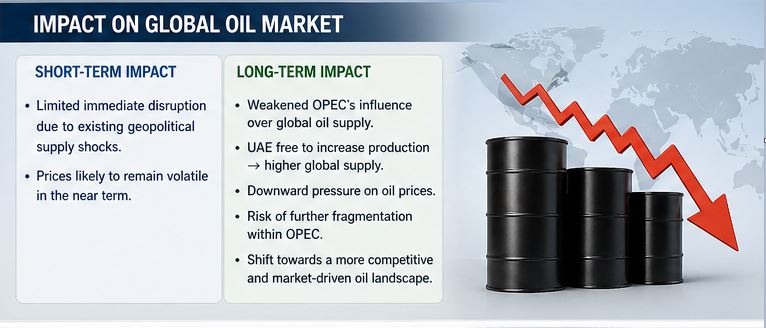
Impact on Global Oil Market
Short-Term
- Limited immediate disruption (due to geopolitical supply shocks)
- Markets remain volatile (~$110+ per barrel)
Long-Term Impacts
| Impact | Explanation |
|---|---|
| 📉 Weakened OPEC Control | Loss of major producer reduces cartel power |
| ⛽ Higher Supply Potential | UAE free to produce more oil |
| 💸 Possible Price Decline | Increased supply → downward pressure on prices |
| ⚠️ Cartel Fragmentation | Other members may reconsider membership |
| 🌐 Shift to Multipolar Energy Order | Rise of independent producers |
Impact on India
India’s Position
- 3rd largest oil importer globally
- Highly dependent on Gulf suppliers
📊 Positive Impacts
| Benefit | Explanation |
|---|---|
| 💰 Cheaper Oil Imports | Increased UAE supply → lower prices |
| 🤝 Better Bilateral Deals | Flexible pricing outside OPEC quotas |
| 🔐 Energy Security | Diversified supply sources |
| 📉 Reduced Inflation | Lower fuel → lower CPI |
⚠️ Risks for India
- 🌪️ Increased market volatility
- ⚔️ Geopolitical instability in West Asia
- 🔄 Supply disruptions (Strait of Hormuz concerns)
How India Can Turn This into Opportunity
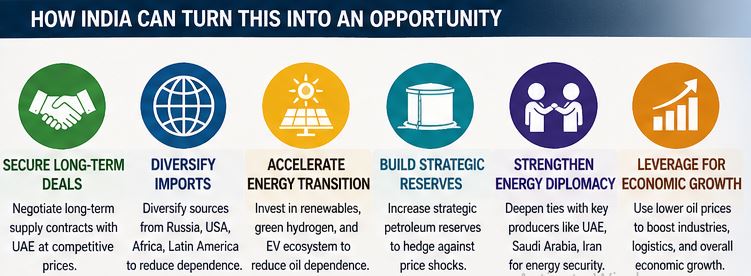
🔑 Strategic Roadmap
1. 🛢️ Long-Term Contracts with UAE : Lock in discounted oil deals
2. 🌍 Diversification Strategy : Balance imports from: Middle East, Russia , USA
3. ⚡ Accelerate Energy Transition : Invest in: Solar , Green Hydrogen , EV ecosystem
4. 🏗️ Strategic Petroleum Reserves : Fill reserves when prices fall
5. 🤝 Energy Diplomacy : Strengthen ties with: UAE , Saudi Arabia , Iran
Prelims Question
Q. Consider the following statements regarding OPEC:
- OPEC determines global oil prices directly through pricing mechanisms.
- Production quotas are the primary tool used by OPEC to influence oil prices.
- All major oil-producing countries are members of OPEC.
Which of the statements is/are correct?
(a) 1 and 2 only
(b) 2 only
(c) 2 and 3 only
(d) 1, 2 and 3
Answer: (b)
Explanation:
- OPEC does not directly fix prices (Statement 1 )
- Uses production quotas to influence supply (Statement 2 )
- Many major producers (USA, Russia) are not members (Statement 3 )
Mains Questions
“The exit of the UAE from OPEC marks a structural shift in global energy geopolitics.” Discuss. (15 Marks)

- India’s Youth Unemployment and Education Crisis - August 5, 2026
- India’s Sports Infrastructure and the 2036 Olympics Ambition - August 5, 2026
- Critical Minerals: The Foundation of Strategic Power - August 4, 2026

No Comments