


30 Apr NITI Aayog Launches DPI@2047 Roadmap
This article covers “Daily Current Affairs”
SYLLABUS MAPPING : GS Paper 2 (Government Policies & Interventions, e-Governance), GS Paper 3 (Indian Economy, Growth & Development, Infrastructure).
FOR PRELIMS :DPI Meaning, DPI’s of India, Its use in foreign nations
FOR MAINS : Evaluate the role of India’s DPI in enhancing financial inclusion and strengthening welfare delivery mechanisms.
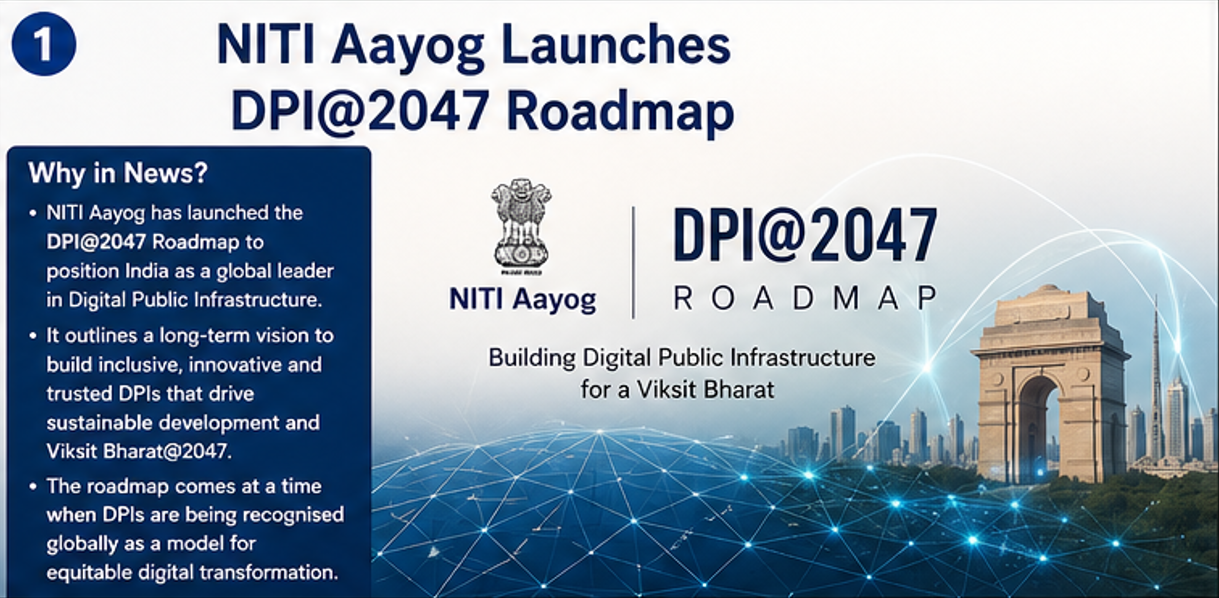
Why in News?
In late April 2026, NITI Aayog released a landmark policy document titled DPI@2047: The Roadmap to Prosperity, charting India’s long-term digital transformation strategy aligned with the Viksit Bharat 2047 vision. The report was prepared by the NITI Frontier Tech Hub in collaboration with EkStep Foundation and Deloitte.
The release is significant because it marks a conceptual shift — India’s digital ambition is no longer about simply connecting citizens to services. It is now about using digital infrastructure as a direct engine of productivity, income growth, and economic empowerment at scale.
What is DPI? What Comes Under It?
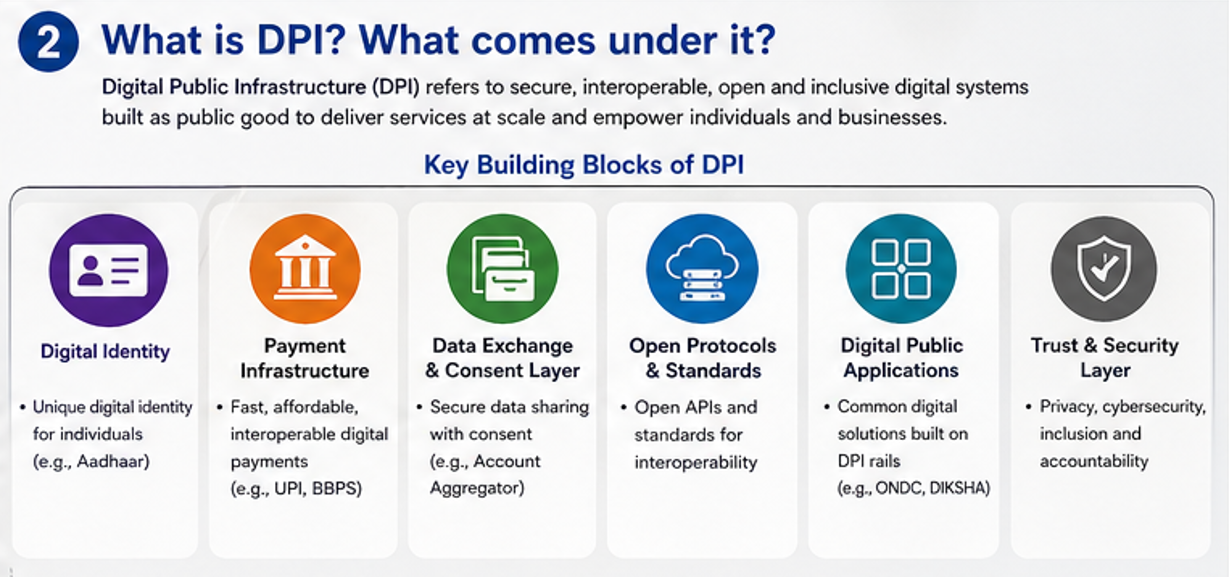
Concept
Digital Public Infrastructure refers to a set of open, interoperable, population-scale digital systems built and governed as public goods. Unlike private technology platforms, DPI is designed to be non-exclusionary — anyone can access it, any developer can build on top of it, and no single commercial entity controls it.
The analogy often used is that of physical infrastructure. Just as roads, ports, and electricity grids enabled economic activity across all sectors, DPI creates digital “rails” on which governance, commerce, finance, and social services can run efficiently.
The India Stack — Three Foundational Layers
Identity Layer — Aadhaar (2009): A biometric-based unique identity system covering over 1.3 billion residents. It enables instant verification for government services, banking, telecom, and welfare delivery. Before Aadhaar, nearly one-third of India’s population had no recognised identity proof, excluding them from the formal economy entirely.
Payments Layer — UPI (2016): A real-time, interoperable digital payments system that allows fund transfers across banks using just a mobile number or QR code, with zero transaction cost. It dismantled the dominance of cash and credit/debit cards within a decade.
Data Layer — DEPA & DigiLocker: The Data Empowerment and Protection Architecture (DEPA) allows citizens to share their own data — financial records, academic certificates, health history — with consented third parties through Account Aggregator frameworks. DigiLocker provides secure cloud-based document storage linked to Aadhaar.
Key DPI Platforms in India
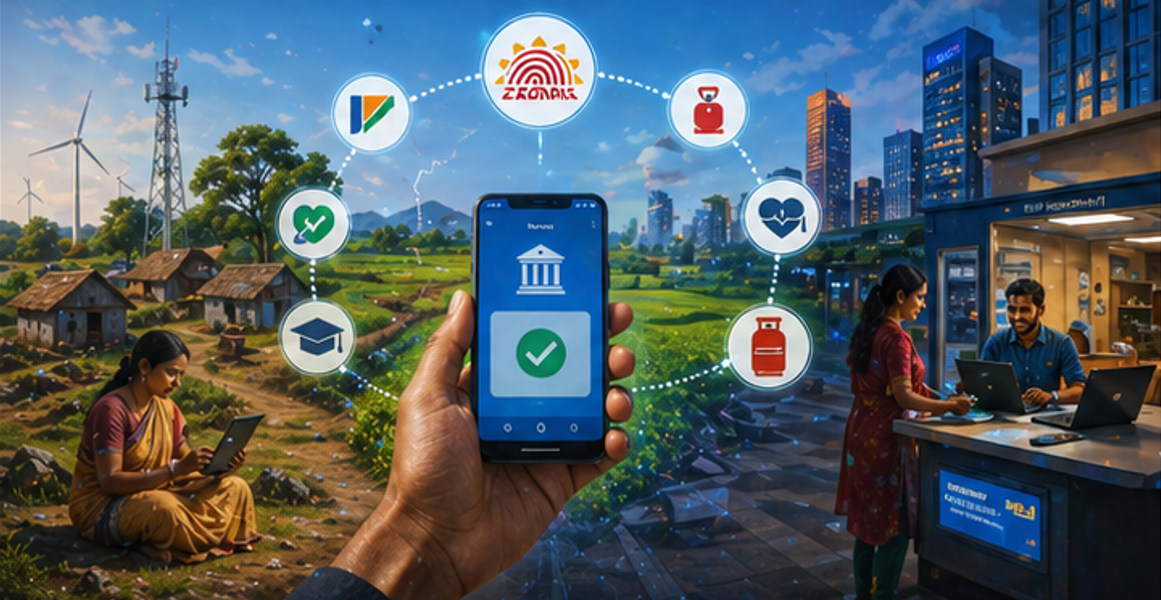
- ONDC — Open Network for Digital Commerce; an open e-commerce protocol breaking the monopoly of large private marketplaces
- GeM — Government e-Marketplace for transparent public procurement
- e-Sanjeevani— Telemedicine platform for remote health consultations
- DIKSHA — Digital education content platform for school students
- CoWIN — Vaccination management and certificate platform (proven globally during COVID-19)
- UMANG — Unified Mobile Application for New-age Governance; a single app gateway to hundreds of government services
- FASTag — Electronic toll collection system
- PM GatiShakti — Integrated geospatial infrastructure planning platform
- eCourts — Digital judiciary management system
NITI Aayog DPI@2047 Roadmap — In Detail : The Evolutionary Arc: DPI 1.0 → 2.0 → 3.0
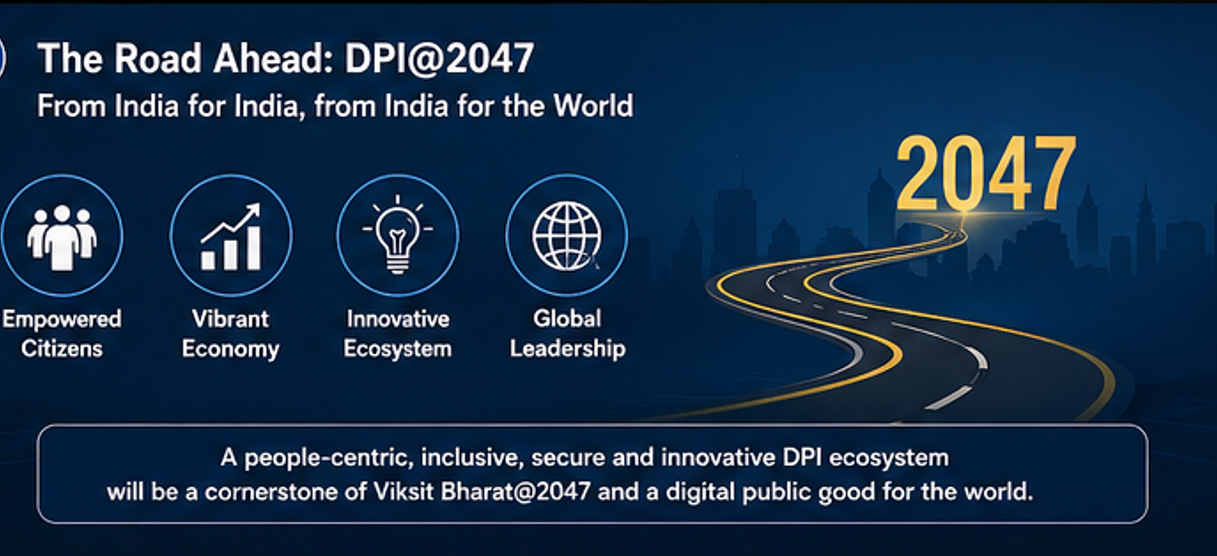
DPI 1.0 — The Foundation Era (approximately 2009–2024)
The primary objective of this phase was digital inclusion — bringing the excluded into the formal system. Key achievements included universal biometric identity through Aadhaar, mass financial inclusion via Jan Dhan–Aadhaar–Mobile (JAM Trinity), real-time digital payments through UPI, and pandemic-era welfare disbursement through Direct Benefit Transfer. The success of DPI 1.0 is measurable: banking penetration rose from roughly 25% in 2008 to over 80% by 2023.
However, inclusion alone does not generate prosperity. A citizen with a bank account and a digital identity is included but not necessarily empowered economically. This limitation defines why DPI 2.0 is necessary.
DPI 2.0 — The Productivity Era (2025–2035)
This is the centrepiece of the current roadmap. The core idea is that digital infrastructure must now actively raise productivity, incomes, and enterprise output — not merely enable access. The focus shifts from “can a citizen use a digital service?” to “has digital infrastructure made that citizen more economically capable?”
DPI 2.0 identifies eight critical sectoral transformations where structural bottlenecks must be dissolved through targeted digital interventions:
- Agriculture — Digital crop advisory, soil health digitisation, Agristack for farmer identity and land records, direct market linkages bypassing exploitative middlemen
- MSMEs — Digital credit access through cash-flow-based lending, e-commerce integration through ONDC, formalisation via GST data
- Education — Personalised learning through AI-assisted platforms, skill credentialling, vocational certification digitisation
- Healthcare — Unified Health ID (ABHA), Ayushman Bharat Digital Mission, integrated health records for continuity of care
- Financial Systems — Account Aggregators enabling formal credit for the informal sector, embedded insurance, pension portability
- Energy Systems — Decentralised renewable energy management through digital grids, smart metering, and distributed solar platforms
- Welfare Systems — AI-based targeting to eliminate ghost beneficiaries, real-time grievance redress, outcome-linked benefit delivery
- Market Platforms & Productivity Systems — ONDC-type open networks for logistics, labour markets, and gig economy formalisation
DPI 3.0 — The Prosperity Era (2035–2047)
By this phase, the aspiration is to have digital infrastructure so deeply embedded in the economy that grassroots innovation and high-value local enterprise creation become organic. The targets are bold: a $30 trillion economy and a per capita income of $18,000 by the centenary of independence.
India’s Progress in DPI and Its Impact

Domestic Impact
Financial Inclusion Revolution The JAM Trinity — Jan Dhan accounts, Aadhaar, and Mobile connectivity — fundamentally restructured how India delivers welfare. Direct Benefit Transfer (DBT) eliminated layers of bureaucratic intermediaries, saving the exchequer an estimated ₹2.7 lakh crore in leakages between 2013 and 2021. This is not merely an administrative achievement; it represents a structural assault on entrenched corruption networks.
UPI’s Transformative Scale From virtually zero in 2016, UPI now processes over 172 billion transactions annually, amounting to over $2 trillion in value. It has displaced cash as the dominant mode of retail transaction, brought small kirana stores and street vendors into the formal financial system, and created verifiable transaction histories that can serve as credit proxies for previously unbanked populations.
Health & Education The Ayushman Bharat Digital Mission is building a universal health record system, while CoWIN demonstrated during COVID-19 that India’s DPI could manage population-scale vaccination logistics that many advanced nations found difficult. DIKSHA has provided free, curriculum-aligned digital content to tens of millions of school students, partially addressing the learning infrastructure gap in under-resourced states.
Economic Multiplier Effect DPI’s contribution to GDP is estimated to grow from approximately 0.9% in 2022 to nearly 4.2% by 2030, as second-generation platforms like ONDC, Account Aggregators, and open health networks mature.
DPI and Foreign Diplomacy
India has consciously transformed its DPI success into a tool of soft power and strategic influence — a form of techno-diplomacy that complements traditional diplomatic instruments.
G20 Presidency — Setting the Global Agenda During its G20 presidency in 2023, India successfully placed DPI at the centre of the multilateral development discourse. The G20 reached historic consensus on defining DPI as a global public good, establishing the Global DPI Repository and a Social Impact Fund to finance DPI adoption in low- and middle-income countries. This positioned India not merely as a technology success story but as a rule-setter in the emerging digital governance order.
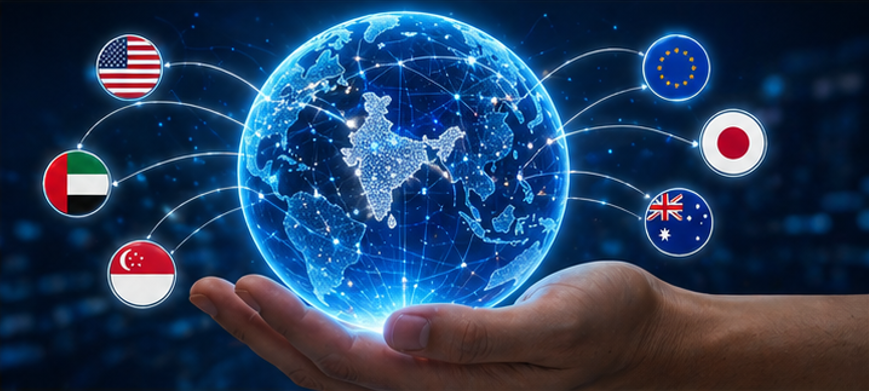
UPI’s International Footprint UPI is now operationally live in over eight countries — UAE, Singapore, Bhutan, Nepal, Sri Lanka, France, Mauritius, and Qatar. Through Operation Rupee Global, NPCI International aims to extend UPI to 20 countries by 2028–29. This has multiple strategic implications: it strengthens India’s financial connectivity with its diaspora, enables bilateral trade settlements bypassing dollar-denominated systems like SWIFT, and extends Indian fintech influence into Gulf, Southeast Asian, and European markets.
23-Country DPI Cooperation Framework India has signed MoUs on DPI cooperation with 23 nations spanning Africa, Latin America, the Pacific, and South Asia — including Kenya, Tanzania, Ethiopia, Cuba, Brazil, Fiji, and the Maldives. These agreements cover digital identity, digital payments, data exchange, and service delivery. They represent India’s strategic positioning as a development partner rather than a donor — offering replicable technology models rather than mere financial aid.
Persistent Challenges
1. The Digital Divide Remains Structurally Deep Despite impressive aggregate numbers, significant disparities persist across geography, gender, caste, and age. Rural penetration of smartphones remains insufficient, particularly in tribal districts of Jharkhand, Chhattisgarh, Odisha, and the Northeast. Without resolving last-mile connectivity, DPI 2.0’s productivity promises will predominantly benefit urban and peri-urban populations, deepening existing inequalities rather than resolving them.
2. Data Privacy Without a Tested Legal Architecture India’s Digital Personal Data Protection Act, 2023 exists on paper but its institutional infrastructure — the Data Protection Board, sectoral regulations, and enforcement mechanisms — remains nascent. Citizens are being enrolled into increasingly intrusive digital systems without commensurate legal protections. This creates a trust deficit that could constrain voluntary adoption of future DPI platforms.
3. Biometric Exclusion Aadhaar-based authentication has systematically failed elderly citizens, manual labourers, and persons with disabilities whose fingerprints are either worn or difficult to scan. In welfare delivery, this has translated into denial of food rations and pensions — a technological failure with life-threatening consequences for the most vulnerable.
4. Algorithmic Opacity and Accountability Gaps As AI is integrated into credit scoring, benefit targeting, and fraud detection, decisions affecting citizens’ lives are being made by systems that are neither transparent nor contestable. Without mandatory algorithmic audits and accessible grievance mechanisms, DPI risks becoming a new form of technocratic exclusion.
5. Language and Literacy Barriers The majority of DPI platforms are designed predominantly in English and Hindi. India’s linguistic diversity — 22 scheduled languages and hundreds of dialects — demands that DPI be truly multilingual from the design stage, not retrofitted through translation. Literacy barriers compound this, as text-heavy interfaces remain inaccessible to large sections of the rural poor.
6. Cybersecurity Vulnerabilities The centralisation of data in large government repositories creates high-value targets for cyberattacks. Several large-scale Aadhaar data leaks have already occurred. As DPI expands into health, agriculture, and financial records, the surface area for breaches grows. India lacks a dedicated, empowered national cybersecurity institution with clear authority over civilian digital infrastructure.
7. Over-Centralisation Risks Civic Freedoms The same infrastructure that enables efficient welfare delivery can also enable mass surveillance, behavioural profiling, and suppression of dissent. Without independent judicial oversight and civil society checks, DPI can slide from a tool of empowerment into a tool of control — a tension that must be resolved through institutional design rather than trust in executive restraint.
8. Uneven State Capacity DPI’s effectiveness is ultimately determined by state-level implementation capacity. A platform like ONDC or e-Sanjeevani is only as useful as the local administration that promotes it, the connectivity that supports it, and the grievance mechanisms that back it. States with weak administrative infrastructure — often the same states with the most to gain from DPI — risk being left behind.
The Way Forward
Universal Connectivity as Foundational Infrastructure BharatNet must be treated with the same urgency as highway construction. High-speed, affordable internet access must be declared a basic right, with dedicated funding, timelines, and accountability mechanisms for every gram panchayat.
Operationalising Data Protection The Data Protection Board must be constituted swiftly, made genuinely independent of executive influence, and equipped with enforcement powers. Sectoral data rules for health, finance, and agriculture must be notified urgently to create regulatory certainty for both citizens and innovators.
Inclusive Design as a Non-Negotiable Standard All new DPI platforms should undergo mandatory accessibility audits before deployment — covering regional language support, low-bandwidth optimisation, offline functionality, and alternative authentication for those unable to use biometrics. Inclusive design cannot be an afterthought.
Federated Governance with District Accountability The roadmap’s emphasis on district-led demand aggregation is well-placed. State governments and district administrations must be given the resources, training, and autonomy to adapt DPI implementations to local economic realities. A one-size-fits-all national platform will never address the specificity of Santhal Pargana’s MFP economy or Bundelkhand’s water-stressed agriculture.
Ethical AI Governance Framework India needs a National AI Governance Framework that mandates transparency, explainability, bias audits, and human review mechanisms for AI systems deployed in welfare, credit, and judicial contexts. The IndiaAI Mission provides a starting point, but sector-specific rules are needed.
Multilateral Norm Leadership Having established credibility through G20 DPI consensus, India must actively participate in setting international standards for DPI governance through the ITU, UNDP, and emerging plurilateral digital governance forums. This is India’s opportunity to write the rules of the digital order rather than merely comply with them.
Responsible Tech Diplomacy India’s DPI exports must be accompanied by transparent data sovereignty agreements, open-source commitments, and human rights impact assessments. The goal should be genuine co-development — building local capacity in partner nations — rather than creating technological dependency on India, which would undermine the very inclusive model India claims to represent.
Prelims
Q. With reference to Digital Public Infrastructure (DPI) in India, consider the following statements:
- DPI systems in India are based on proprietary closed standards to ensure security.
- The Account Aggregator framework enables consent-based sharing of financial data.
- ONDC is aimed at creating an open network for digital commerce.
- DPI is limited only to government welfare delivery systems.
Which of the statements given above is/are correct?
(a) 2 and 3 only
(b) 1 and 4 only
(c) 2, 3 and 4 only
(d) 1, 2 and 3 only
Answer: (a) 2 and 3 only
Mains
“Digital Public Infrastructure (DPI) is emerging as a key pillar of India’s governance and economic transformation.” Discuss with suitable examples. (250 words)

- India’s Youth Unemployment and Education Crisis - August 5, 2026
- India’s Sports Infrastructure and the 2036 Olympics Ambition - August 5, 2026
- Critical Minerals: The Foundation of Strategic Power - August 4, 2026

No Comments