


07 May Hantavirus Outbreak on Cruise Ship MV Hondius
This article covers “Daily Current Affairs”
SYLLABUS MAPPING : GS Paper 3 : Environment
FOR PRELIMS : Hantavirus infection , Ways of Spreading , Symptoms, Stages, and Mortality
FOR MAINS : “The MV Hondius hantavirus outbreak is a case study in the complexity of managing public health emergencies that cross multiple national jurisdictions.” Critically examine the role of the International Health Regulations (IHR) 2005 and the World Health Organization in coordinating the response to this outbreak, and evaluate the gaps in global health governance revealed by the event. (15 M)
Why in News?
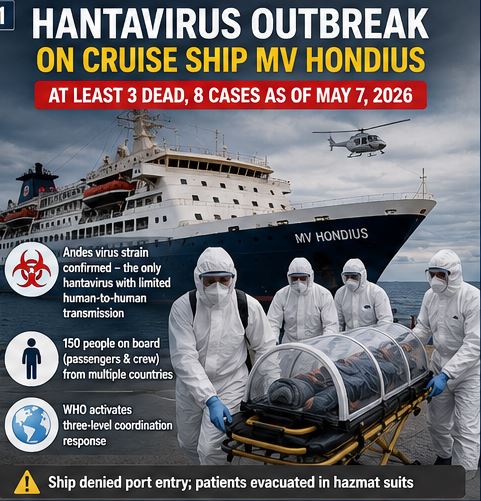
A cluster of severe respiratory illness cases — confirmed as Hantavirus infection — has emerged aboard the Dutch-flagged cruise ship MV Hondius in the Atlantic Ocean, sparking an international public health response. As of May 6–7, 2026, at least three people have died and eight cases (three laboratory confirmed, five suspected) have been identified among the 150 passengers and crew aboard the vessel. Health authorities wearing hazmat suits evacuated critically ill passengers, the ship was refused entry to ports, and the World Health Organization (WHO) activated a multi-level coordination response. Crucially, the outbreak has been linked to the Andes strain of hantavirus — the only known hantavirus strain capable of limited human-to-human transmission — raising international alarm.
Key Facts About the Ship
-
-
- MV Hondius is operated by Oceanwide Expeditions, a Dutch company specialising in polar and remote-region cruise voyages.
- At time of outbreak, the ship carried 147–150 people including passengers and crew.
- Passengers included nationals from the Netherlands, Germany, UK, USA (17 Americans), Switzerland, Ireland, and other countries — making this a multinational public health event requiring international coordination under the International Health Regulations (IHR) 2005.
-
What is Hantavirus? — Detailed Biology and Classification
Basic Virology
-
-
- Hantaviruses are enveloped, negative-sense, single-stranded RNA viruses belonging to the family Hantaviridae, order Bunyavirales.
- Their genome has three segments — Small (S), Medium (M), and Large (L) — encoding the nucleoprotein, surface glycoproteins, and the RNA-dependent RNA polymerase respectively.
- Hantaviruses are classified as zoonotic viruses — they naturally infect rodents and are occasionally transmitted to humans.
- In their rodent hosts, hantaviruses typically cause a persistent, asymptomatic (lifelong) infection — the rodent is a carrier but does not get sick.
- The virus was first identified and named after the Hantan River in South Korea, near where American soldiers became ill during the Korean War (1950–53), though its existence was confirmed scientifically only in the 1970s.
-
Two Major Disease Groups in Humans
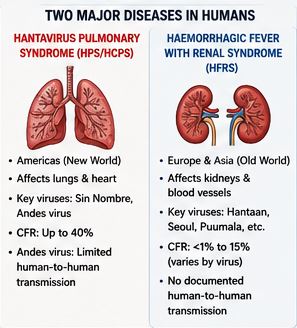
| Feature | Hantavirus Pulmonary Syndrome (HPS) / Hantavirus Cardiopulmonary Syndrome (HCPS) | Haemorrhagic Fever with Renal Syndrome (HFRS) |
|---|---|---|
| Geographic distribution | Americas (New World) | Europe and Asia (Old World) |
| Primary organ affected | Lungs and Heart | Kidneys and blood vessels |
| Key viruses | Sin Nombre virus, Andes virus | Hantaan, Seoul, Dobrava-Belgrade, Puumala viruses |
| Rodent reservoir | Deer mouse, pygmy rice rat | Various rodent species depending on region |
| Case Fatality Rate | Up to 40% | <1% to 15% (varies by virus) |
| Human-to-human transmission | Only Andes virus — limited | Not documented |
| First documented | 1993 (Four Corners region, USA) | 1950s (Korean War era) |
How Does Hantavirus Spread?
Primary Transmission — Rodent to Human
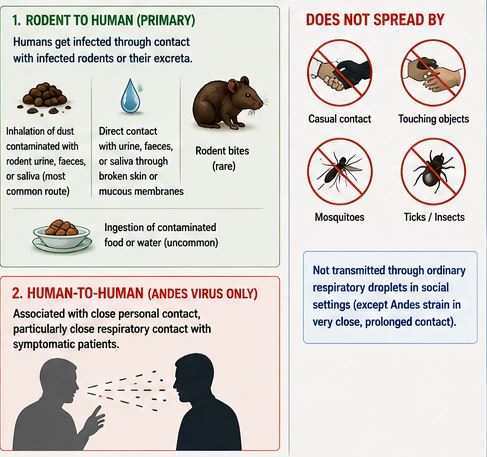
Hantavirus is primarily a zoonotic disease — humans contract it through contact with infected rodents or their excreta:
-
-
- Inhalation of aerosols from infected rodent urine, faeces, or saliva — the most common route (e.g., disturbing dry rodent droppings while cleaning).
- Direct contact with infected rodent urine, droppings, or saliva through broken skin or mucous membranes.
- Rodent bites — rare.
- Ingestion of contaminated food or water — uncommon.
-
The Andes Virus Exception — Human-to-Human Transmission
-
-
- Andes virus is the only known hantavirus with documented (though limited) human-to-human transmission.
- Transmission is associated with close personal contact — particularly close respiratory contact with symptomatic patients.
- This is what makes the MV Hondius outbreak particularly concerning: the Andes strain was confirmed, and WHO acknowledged that some human-to-human transmission may have occurred aboard the vessel.
- However, WHO also stated the global public health risk remains LOW and that there is “no need for panic or travel restrictions.”
-
What Does NOT Spread Hantavirus
-
-
- Hantavirus is NOT transmitted through casual contact, touching objects, mosquitoes, ticks, or other insects.
- Unlike COVID-19 or influenza, it does not spread through ordinary respiratory droplets in social settings (except for the Andes strain in very close, prolonged contact).
-
Clinical Profile — Stages and Mortality
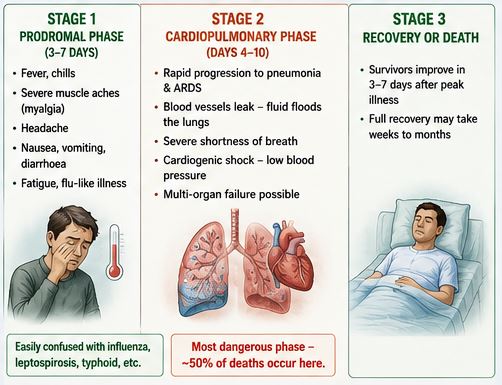
Stage 1 — Prodromal Phase (3–7 days):
-
-
- Fever, chills, severe muscle aches (myalgia), headache.
- Gastrointestinal symptoms: nausea, vomiting, diarrhoea.
- General flu-like malaise.
- At this stage, hantavirus is easily confused with influenza, leptospirosis, typhoid, and other viral fevers.
-
Stage 2 — Cardiopulmonary Phase (Days 4–10):
-
-
- Rapid progression to pneumonia and acute respiratory distress syndrome (ARDS).
- Microvascular leakage — blood vessels become “leaky,” flooding the lungs with fluid.
- Severe shortness of breath; patients cannot breathe without mechanical ventilation.
- Cardiogenic shock — reduced heart pumping capacity, dangerously low blood pressure.
- Multi-organ failure can occur rapidly.
- This is the most dangerous phase — approximately 50% of deaths occur here.
-
Stage 3 — Recovery or Death:
-
-
- Patients who survive the cardiopulmonary phase typically begin improving within 3–7 days of peak illness,.
- Case Fatality Rate for HPS/HCPS: approximately 35–40% globally; some outbreaks have shown CFR as high as 50%.
-
Diagnosis and Treatment
Diagnosis
-
-
- RT-PCR (Reverse Transcriptase Polymerase Chain Reaction): The gold standard for early-stage detection of hantavirus RNA in blood or tissue.
- Serology (ELISA): Detection of IgM/IgG antibodies — most reliable after the first few days of illness.
- Sequencing and metagenomics: Used in the MV Hondius outbreak to identify the specific strain (Andes virus confirmed via sequencing).
- Laboratory confirmation was conducted by South Africa’s National Institute for Communicable Diseases (NICD) and samples were also sent to the Institut Pasteur de Dakar, Senegal.
-
Treatment
-
-
- There is currently no approved specific antiviral treatment or vaccine for hantavirus disease outside China (which has HFRS-specific vaccines for its domestic strains).
- Treatment is entirely supportive, focusing on:
- Close clinical monitoring in ICU settings.
- Mechanical ventilation for respiratory failure.
- ECMO (Extra-Corporeal Membrane Oxygenation) in severe cases.
- Fluid and electrolyte management.
- Haemodynamic support for shock.
- Ribavirin (an antiviral drug) has shown some promise in HFRS but evidence for HPS remains inconclusive.
- Early hospitalisation is critical — patients who reach full cardiopulmonary distress before admission have significantly worse outcomes.
-
Broader Significance — Key Issues Raised
Zoonotic Disease and Global Travel
-
-
- This outbreak demonstrates how zoonotic diseases (diseases transmitted from animals to humans) can rapidly become global public health events in an era of mass international travel.
- Passengers likely acquired the infection through rodent contact in South America (Argentina and Patagonia are endemic areas for Andes virus) before boarding the ship.
- As global biodiversity loss forces rodent populations into closer proximity with humans, the frequency of zoonotic spillover events is expected to increase.
-
The Andes Virus and Human-to-Human Transmission Risk
-
-
- The confirmation of Andes virus raises the most significant scientific concern: unlike all other hantaviruses, Andes can spread between people.
- Past Andes virus outbreaks in Chile and Argentina (1995–2011) have shown secondary transmission rates of 10–25% among close household contacts of index cases.
- This makes infection control, patient isolation, and PPE protocols critically important — and explains the hazmat suits worn by evacuating health workers.
-
Governance of International Voyages and Health Screening
-
-
- The outbreak highlights gaps in pre-boarding health screening for cruise passengers, particularly those returning from endemic zoonotic disease regions (Patagonia, Amazon basin, etc.).
- It also raises questions about ship-board medical capacity for managing rapidly progressing severe respiratory illness in remote ocean locations.
-
India’s Relevance
-
-
- India is not a known endemic country for hantavirus, but Seoul virus (carried by the common Norway rat, globally distributed) has been detected in India in rodent populations.
- The outbreak is relevant to India’s surveillance systems at ports and airports, and to Indian nationals travelling to South America, Europe, or Andes-endemic regions.
- The event underscores India’s obligations under the IHR 2005 and the importance of the Integrated Disease Surveillance Programme (IDSP) and National Centre for Disease Control (NCDC) for monitoring rare zoonotic importations.
-
Prelims Question
Q. With reference to hantavirus, consider the following statements:
- Hantaviruses are zoonotic RNA viruses primarily transmitted to humans through contact with infected rodents or their excreta.
- The Andes virus is the only known hantavirus capable of limited human-to-human transmission.
- In Europe and Asia, hantaviruses typically cause Hantavirus Pulmonary Syndrome (HPS), while in the Americas they cause Haemorrhagic Fever with Renal Syndrome (HFRS).
- There is currently no approved specific antiviral drug or licensed vaccine for hantavirus disease for global use.
Which of the statements given above are correct?
(a) 1, 2 and 3 only
(b) 2, 3 and 4 only
(c) 1, 2 and 4 only
(d) 1, 2, 3 and 4
Correct Answer: (c) 1, 2 and 4 only
Explanation:
- Statement 1 is CORRECT. Hantaviruses are enveloped RNA viruses classified as zoonotic — naturally infecting rodents and transmitted to humans primarily through inhalation of aerosols from infected rodent urine, faeces, or saliva.
- Statement 2 is CORRECT. The Andes virus, found predominantly in South America (Chile and Argentina), is the only hantavirus for which human-to-human transmission has been documented — though it is limited and linked to close contact. This is the strain confirmed in the 2026 MV Hondius cruise ship outbreak.
- Statement 3 is INCORRECT. The disease syndromes are the reverse of what is stated. In Europe and Asia (Old World), hantaviruses cause Haemorrhagic Fever with Renal Syndrome (HFRS), which primarily affects the kidneys. In the Americas (New World), hantaviruses like Sin Nombre and Andes cause Hantavirus Pulmonary Syndrome (HPS), which primarily attacks the lungs and heart.
- Statement 4 is CORRECT. There is no globally approved specific antiviral treatment or vaccine for hantavirus (China has HFRS-specific vaccines for domestic use, but no globally available treatment exists). Management is entirely supportive — ICU care, mechanical ventilation, and haemodynamic support.
Mains Questions
The 2026 Hantavirus outbreak aboard the MV Hondius has highlighted the growing threat of zoonotic diseases in an era of global travel and ecological disruption. Discuss the biology of hantavirus, the factors that led to this outbreak, and the measures needed to strengthen India’s and the world’s preparedness for zoonotic disease events. (15 M)

- India’s Youth Unemployment and Education Crisis - August 5, 2026
- India’s Sports Infrastructure and the 2036 Olympics Ambition - August 5, 2026
- Critical Minerals: The Foundation of Strategic Power - August 4, 2026

No Comments