


03 Jul German Allegation on Nord Stream Sabotage: Geopolitics, Energy Security and International Law
|
SUBJECT MAPPING ✦ GS Paper II — International Relations, India and the World ✦ GS Paper III — Energy Security, Infrastructure, Internal Security ✦ Prelims — Europe, Russia–Ukraine Conflict, Energy Security, Pipelines, Baltic Sea, International Law |
Why Is It in the News?
According to a recent report in The Hindu, German federal prosecutors have alleged that the 2022 sabotage of the Nord Stream gas pipelines was carried out by a Ukrainian military officer acting under the direction of Ukrainian state authorities. The accused has been charged in Germany, while Ukraine has said it is awaiting full details of the case and has not accepted the allegations. The matter remains part of an ongoing legal process.
This development has renewed international attention on:
✦ The Russia–Ukraine conflict
✦ Europe’s energy security
✦ Protection of critical undersea infrastructure
✦ International law governing attacks on civilian infrastructure
|
WHY THIS MATTERS FOR UPSC ✦ This topic combines several themes — Russia–Ukraine conflict, European geopolitics, global energy security, natural gas transportation, international maritime infrastructure, hybrid warfare, and critical infrastructure protection. ✦ Questions may appear in both Prelims and GS-II / GS-III Mains. |
What Is the Nord Stream Pipeline?
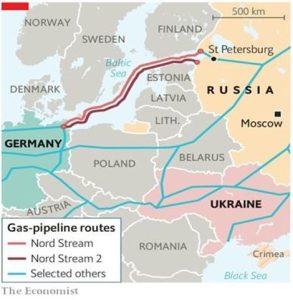
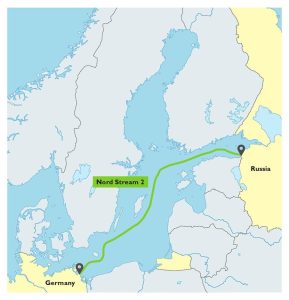
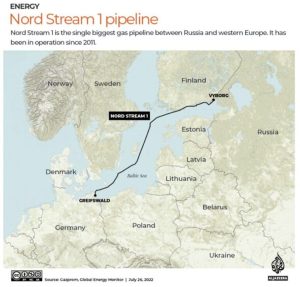
The Nord Stream pipelines are underwater natural gas pipelines connecting Russia directly to Germany through the Baltic Sea, bypassing transit countries such as Ukraine and Poland. They were built primarily to transport Russian natural gas to European markets.

Fig. 1 — Schematic route of the Nord Stream pipelines under the Baltic Sea, bypassing Ukraine and Poland, with the approximate 2022 sabotage site marked.
|
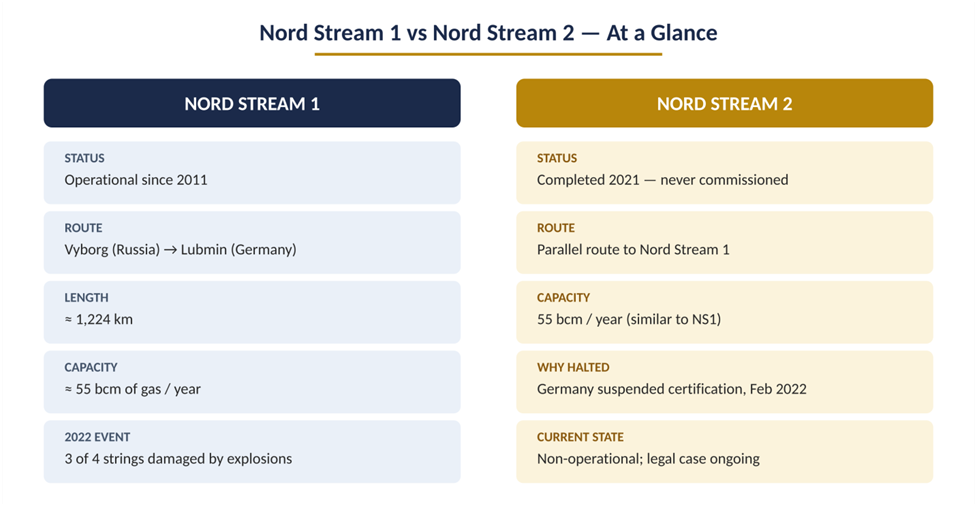
NORD STREAM 1 |
|
|
Status |
Operational since 2011 |
|
Connects |
Russia (Vyborg) – Germany (Lubmin) |
|
Length |
About 1,224 km |
|
Capacity |
Around 55 billion cubic metres (bcm) per year |
|
Purpose |
Direct export of Russian natural gas to Europe |
|
NORD STREAM 2 |
|
|
Status |
Parallel pipeline to Nord Stream 1; completed in 2021 |
|
Capacity |
Similar capacity — 55 bcm annually |
|
Commercial Operation |
Never entered commercial operation |
|
Reason |
After Russia’s invasion of Ukraine in February 2022, Germany suspended its certification, preventing the pipeline from starting operations |
Countries connected: Russia and Germany. The pipeline passes beneath the Baltic Sea.
2022 Nord Stream Sabotage
|
KEY DATE ✦ 26 September 2022 — Several underwater explosions damaged three of the four Nord Stream pipeline strings. |
Consequences
✦ Massive methane leakage
✦ Suspension of gas transportation
✦ Sharp increase in European energy concerns
✦ Heightened geopolitical tensions
The incident was one of the largest attacks on civilian energy infrastructure in recent history.
Why Was the Pipeline Strategically Important?
1. Energy Security
Europe depended heavily on Russian gas; before the Ukraine war, Russia supplied a significant share of Europe’s natural gas.
2. Economic Importance
The pipeline generated billions of dollars through Russian gas exports.
3. Political Influence
The pipeline strengthened Russia’s energy leverage over Europe.
4. Bypassing Transit Countries
It reduced dependence on pipeline routes passing through Ukraine and Poland.
Significance of the Current News
Germany’s Legal Action
The latest indictment is significant because it is the first time German prosecutors have formally alleged that the sabotage was carried out on behalf of Ukrainian state authorities. Ukraine has not accepted these allegations and says it needs more information. The case will ultimately be tested through judicial proceedings.
Impact on Europe
✦ May influence European politics
✦ Raises questions about protecting critical infrastructure
✦ Could affect future energy cooperation and security planning
International Law — Issues Involved
✦ Protection of civilian infrastructure during armed conflict
✦ Accountability for sabotage
✦ State responsibility if official involvement is established by courts
Impact on Global Energy Markets and India
|
GLOBAL ENERGY MARKETS |
IMPACT ON INDIA |
|
• Increased LNG imports by Europe • Greater diversification away from Russian gas • Growth of renewable energy investments • Increased energy prices after the 2022 incident |
• Higher global crude oil and gas prices • Inflationary pressures • Increased fertilizer costs • Supply-chain disruptions • Greater emphasis on diversified energy imports and energy security |
India was not directly connected to Nord Stream, but it experienced these indirect effects through global energy markets.
Important Terms for UPSC
Hybrid Warfare
Use of military and non-military means — cyber attacks, economic pressure, information warfare, and infrastructure sabotage.
Critical Infrastructure
Infrastructure essential for national security — examples include pipelines, ports, electricity grids, communication cables, and satellites.
Energy Security
Reliable, affordable, accessible, and sustainable energy supply.
LNG (Liquefied Natural Gas)
Natural gas cooled to −162°C for easier transportation by ships.
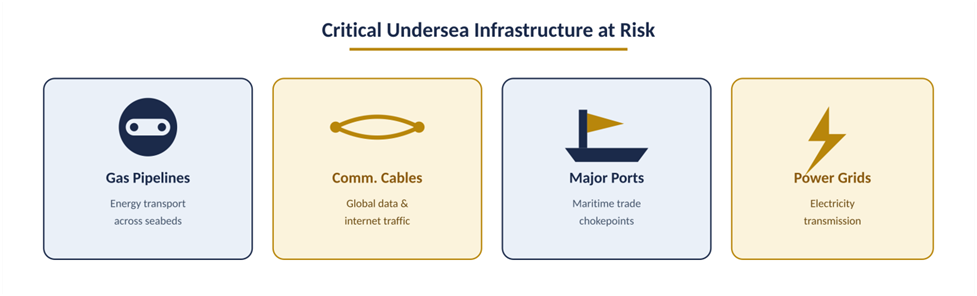
Fig. 3 — Examples of critical undersea and energy infrastructure that hybrid-warfare tactics can target.
Nord Stream: Previous UPSC-Relevant Developments
|
Year |
Event |
UPSC Importance |
|
2011 |
Nord Stream 1 became operational |
Europe–Russia energy ties |
|
2021 |
Nord Stream 2 completed |
Energy geopolitics |
|
2022 |
Germany suspended Nord Stream 2 certification after Russia’s invasion of Ukraine |
International relations |
|
Sept. 2022 |
Undersea explosions damaged Nord Stream pipelines |
Energy security, hybrid warfare |
|
2024 |
Sweden and Denmark closed their investigations without identifying perpetrators, while Germany continued its investigation |
International investigations |
|
2026 |
German prosecutors formally charged a Ukrainian suspect and alleged action on behalf of Ukrainian state authorities |
Current affairs, international law, critical infrastructure |
|
UPSC PRELIMS FOCUS AREAS — REMEMBER ✦ Location of the Baltic Sea ✦ Russia–Germany pipeline route ✦ Natural gas transportation and LNG ✦ Energy security and hybrid warfare ✦ Critical infrastructure ✦ Russia–Ukraine conflict ✦ European energy diversification |
Relevance for UPSC Mains
|
GS PAPER II |
GS PAPER III |
|
• India–Europe relations • Russia–Ukraine conflict • International law • Global diplomacy |
• Energy security • Infrastructure protection • Strategic resources • Internal and external security |
Way Forward
✦ Strengthen international cooperation for protecting undersea infrastructure.
✦ Diversify energy sources to reduce overdependence on any single supplier.
✦ Improve monitoring and surveillance of submarine pipelines and communication cables.
✦ Promote diplomatic mechanisms to resolve disputes while respecting international law.
✦ Accelerate investment in renewable energy and resilient energy systems.
|
KEY TAKEAWAYS FOR UPSC ✦ Nord Stream consists of two major natural gas pipeline systems linking Russia and Germany through the Baltic Sea. ✦ Nord Stream 1 operated from 2011; Nord Stream 2 was completed but never commissioned. ✦ The 2022 sabotage transformed European debates on energy security and critical infrastructure. ✦ The latest German allegations are part of an ongoing legal process; responsibility has not been finally determined by a court. ✦ The issue connects international relations, energy security, hybrid warfare, and international law. |
UPSC Prelims Practice Questions
|
Question 1 — With reference to the Nord Stream pipelines, consider the following statements: |
|
1. Nord Stream pipelines connect Russia directly with Germany through the Baltic Sea. |
|
2. Nord Stream 2 entered commercial operation before the Russia–Ukraine war. |
|
3. The pipelines transport natural gas. |
|
A. 1 only B. 1 and 3 only C. 2 and 3 only D. 1, 2 and 3 |
|
Answer: B |
|
Question 2 — Which of the following are considered examples of critical infrastructure? |
|
1. Natural gas pipelines |
|
2. Electricity transmission grids |
|
3. Submarine communication cables |
|
4. Major ports |
|
A. 1 and 2 only B. 2, 3 and 4 only C. 1, 3 and 4 only D. 1, 2, 3 and 4 |
|
Answer: D |
UPSC Mains Practice Question
|
MAINS — 15 MARKS ✦ “The sabotage of the Nord Stream pipelines has highlighted the strategic importance of energy infrastructure in contemporary geopolitics. Discuss the implications of attacks on critical infrastructure for international security, energy security, and global diplomacy.” |
Suggested Structure for Answer
✦ Introduction: Briefly outline the Nord Stream sabotage and the recent German indictment as the trigger event.
✦ Body – International Security: Hybrid warfare, deniability, and the vulnerability of undersea infrastructure such as cables and pipelines.
✦ Body – Energy Security: Europe’s diversification toward LNG and renewables; price volatility and its global spillovers, including on India
✦ Body – Global Diplomacy: State responsibility under international law, strain on Germany–Ukraine relations, and implications for the Russia–Ukraine peace process..
✦ Way Forward: Multilateral frameworks for protecting critical undersea infrastructure; strengthened attribution mechanisms; India’s stake in energy diversification and maritime security.
✦ Conclusion: Link back to the broader theme of infrastructure as a new frontier of geopolitical contestation.

- RBI’s Shrinking Real-Rate Cushion Amid Rising Inflation and Strong Demand - September 21, 2026
- India’s NGOs at a New Funding Crossroads - September 21, 2026
- Deep-Sea Discovery, Environmental Responsibility - September 19, 2026

No Comments