


15 Jul मंत्रिमंडल ने ओडिशा-झारखंड में ₹3907 करोड़ की मल्टीट्रैकिंग परियोजनाओं को दी मंजूरी
Subject Relevance — Where This Topic Fits
- GS Paper I — Geography (Resources, Transport) | GS Paper III — Economy (Infrastructure, Investment Models, Logistics, Industrial Policy) | GS Paper III — Environment (Climate Change, Sustainable Transport)
- Prelims: Multi-tracking projects, Dedicated Freight Corridors, PM Gati Shakti, Logistics Performance Index, Railways infrastructure, Eastern India development, Mineral transportation, Carbon emissions reduction, Economic Corridors, Public Sector Investment
- Essay: Infrastructure as the Backbone of India’s Economic Growth and Regional Equity, Sustainable Development Goals and the Role of Green Transportation in India’s Future
Quick Revision: The Cabinet’s approval of ₹3,907 crore multi-tracking railway projects in Odisha and Jharkhand aims to boost logistics efficiency, foster regional development, and advance environmental sustainability by adding 145 km to the network and 44 MTPA freight capacity, aligning with PM Gati Shakti and India’s climate goals.
Why is this in the news?
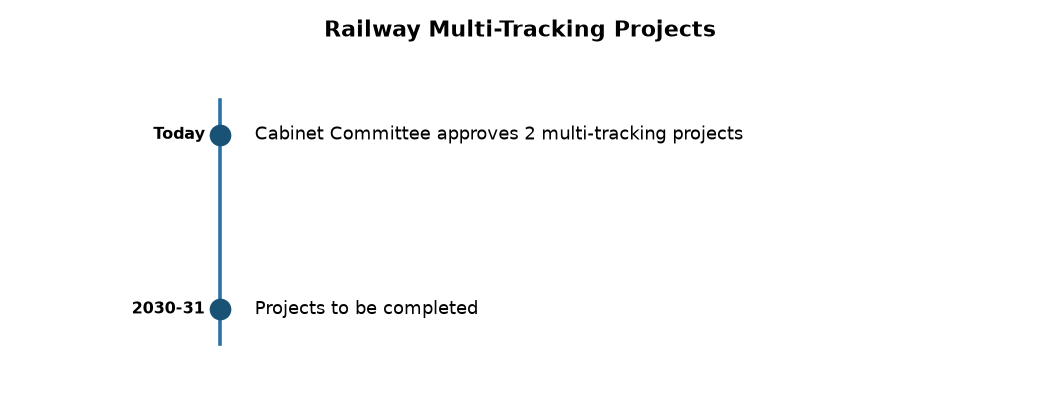
The Cabinet Committee on Economic Affairs (CCEA), chaired by Prime Minister Shri Narendra Modi, has recently approved two significant multi-tracking railway projects in Odisha and Jharkhand, with an estimated cost of ₹3,907 crore. These projects, slated for completion by 2030-31, aim to augment the Indian Railways’ network by approximately 145 kilometers, thereby enhancing operational efficiency, reducing congestion, and bolstering regional connectivity in key mineral-rich areas.
Background
- Indian Railways, a vital artery of the nation, plays a crucial role in freight and passenger movement, contributing significantly to economic growth and national integration.
- The Eastern region of India, particularly Odisha and Jharkhand, is endowed with rich mineral resources like coal, iron ore, and bauxite, necessitating robust transportation infrastructure for their efficient evacuation.
- Existing railway lines in these regions often face severe congestion due to high freight traffic, impacting operational efficiency and increasing logistics costs.
- The Government of India has been actively promoting infrastructure development, particularly in railways, through initiatives like the National Rail Plan (NRP) 2030 and PM Gati Shakti National Master Plan, to achieve a ‘New India’ vision.
- Multi-tracking projects are essential for increasing line capacity, segregating freight and passenger traffic, and improving average speeds, which are critical for enhancing India’s Logistics Performance Index (LPI) ranking.
- The push for sustainable and energy-efficient transportation modes like railways aligns with India’s climate commitments and targets for reducing carbon emissions.
What are Multi-Tracking Railway Projects?
- Multi-tracking railway projects involve the construction of additional railway lines (e.g., doubling, tripling, or quadrupling) alongside existing single or double lines.
- The primary objective is to enhance the carrying capacity of a railway section, allowing for a greater volume of trains to operate simultaneously.
- These projects are crucial for decongesting high-density routes, especially those catering to significant freight movement or connecting major industrial hubs and ports.
- By adding tracks, railways can segregate different types of traffic (e.g., fast passenger trains, slower freight trains), leading to improved punctuality and reduced transit times.
- They are integral to modernizing railway infrastructure, improving operational flexibility, and increasing the overall efficiency and reliability of the rail network.
- Such projects often involve significant civil engineering works, including bridge construction, earthwork, signaling upgrades, and electrification.
- The two approved projects include the Paradip – Haridaspur doubling and the Rajkharsawan – Dangoaposi 4th line, targeting specific bottlenecks in Odisha and Jharkhand.
- These initiatives are aligned with the broader vision of creating a seamless multi-modal transport network under the PM Gati Shakti National Master Plan.
Key Features
| Feature | Significance |
|---|---|
| Total Cost: ₹3,907 Crore | Substantial public investment demonstrating commitment to infrastructure development and economic growth. |
| Completion Target: 2030-31 | Provides a clear timeline for project execution, enabling strategic planning and resource allocation. |
| Network Expansion: ~145 km | Directly increases railway network length, enhancing connectivity and reach in critical regions. |
| Projects: Paradip-Haridaspur (Doubling), Rajkharsawan-Dangoaposi (4th Line) | Addresses specific high-traffic corridors, vital for mineral evacuation and port connectivity. |
| Additional Freight Capacity: 44 Million Tonnes Per Annum (MTPA) | Significant boost to freight movement, crucial for industrial growth and reducing logistics costs. |
| Coverage: 4 districts in Odisha & Jharkhand | Directly benefits specific regions, fostering balanced regional development and employment. |
Why it Matters
Economic Development and Logistics Efficiency
- The projects will significantly enhance the capacity for transporting critical commodities like coal, iron ore, dolomite, and limestone, which are vital for core industries.
- Improved rail connectivity will reduce logistics costs for industries in the region, making them more competitive and attracting further investment.
- The additional 44 MTPA freight capacity will streamline supply chains, reduce transit times, and improve the overall efficiency of goods movement.
- Enhanced railway infrastructure is a cornerstone for economic corridors, facilitating trade and industrial growth in Eastern India.
Regional Growth and Employment Generation
- These projects are expected to improve connectivity for approximately 1,526 villages, impacting around 14 lakh people, fostering inclusive growth.
- Direct and indirect employment opportunities will be created during the construction phase and subsequent operational stages, contributing to local livelihoods.
- Better rail access to major tourist destinations like Lalitgiri Buddhist Complex and Shri Baladevjew Temple will boost tourism and associated service sectors.
- The projects align with the ‘New India’ vision by promoting comprehensive regional development and self-reliance (Atmanirbhar Bharat) through enhanced infrastructure.
Environmental Sustainability and Climate Action
- Railways are an environmentally friendly and energy-efficient mode of transport compared to road, contributing to India’s climate goals.
- The projects are projected to reduce oil imports by 6 crore liters and cut carbon dioxide emissions by 29 crore kilograms annually, equivalent to planting 1 crore trees.
- Shifting freight from road to rail helps in reducing traffic congestion, air pollution, and fuel consumption, aligning with sustainable development objectives.
- This initiative underscores India’s commitment to achieving its Nationally Determined Contributions (NDCs) under the Paris Agreement by promoting green infrastructure.
Operational Efficiency and Safety
- Multi-tracking will significantly improve the operational efficiency and service reliability of Indian Railways by decongesting existing lines.
- It allows for better segregation of passenger and freight traffic, leading to improved punctuality for passenger trains and faster movement of goods.
- Reduced congestion also contributes to enhanced safety by minimizing the chances of operational bottlenecks and potential accidents.
- The projects are integral to the modernization of the railway network, ensuring seamless movement of people, goods, and services.
Challenges
1. Land Acquisition and Resettlement
- Acquiring land for new railway lines, especially in densely populated or ecologically sensitive areas, often faces significant delays and social resistance.
- Ensuring fair compensation and adequate resettlement and rehabilitation (R&R) for affected populations is a complex and time-consuming process.
UPSC Link: GS Paper II — Government Policies and Interventions; GS Paper III — Infrastructure
2. Funding and Financial Viability
- Large-scale infrastructure projects require substantial capital outlay, and ensuring timely availability of funds can be a challenge.
- Cost overruns due to delays, inflation, or unforeseen circumstances can impact the financial viability and completion timelines of projects.
UPSC Link: GS Paper III — Indian Economy and Issues Relating to Planning, Mobilization of Resources
3. Environmental Clearances and Sustainability
- Obtaining various environmental and forest clearances can be a lengthy process, particularly in mineral-rich regions which often have significant forest cover.
- Balancing development needs with ecological preservation requires careful planning and adherence to environmental regulations.
UPSC Link: GS Paper III — Conservation, Environmental Pollution and Degradation, Environmental Impact Assessment
4. Project Management and Execution
- Effective coordination among multiple stakeholders, including central and state governments, railway authorities, and contractors, is crucial for timely execution.
- Challenges in procurement, skilled labor availability, and managing complex engineering tasks can lead to delays and quality issues.
UPSC Link: GS Paper III — Infrastructure: Energy, Ports, Roads, Airports, Railways etc.
5. Inter-State Coordination
- Projects spanning across multiple states (Odisha and Jharkhand in this case) require robust inter-state coordination for smooth implementation, land acquisition, and regulatory approvals.
- Differences in state policies or administrative procedures can sometimes create bottlenecks.
UPSC Link: GS Paper II — Functions and Responsibilities of the Union and the States
Challenges — UPSC Perspective
| Issue | Concern |
|---|---|
| Land Acquisition | Delays due to social resistance, compensation disputes, and R&R complexities. |
| Funding & Cost Overruns | Timely fund availability and managing unforeseen cost escalations. |
| Environmental Clearances | Lengthy approval processes, especially in ecologically sensitive or forest areas. |
| Inter-Agency Coordination | Ensuring seamless collaboration between central, state, and railway entities. |
| Skilled Manpower | Availability of specialized labor and technical expertise for complex railway construction. |
| Geological Challenges | Dealing with varied terrain, soil conditions, and potential seismic activity in the project areas. |
Government Initiatives — Must-Memorise for Prelims
- PM Gati Shakti National Master Plan
- National Rail Plan (NRP) 2030
- Dedicated Freight Corridors (DFCs)
- Sagarmala Programme (for port connectivity)
- Bharatmala Pariyojana (for road connectivity, complementary to rail)
- National Infrastructure Pipeline (NIP)
- Atmanirbhar Bharat Abhiyan
- Make in India initiative
- Green Railways Mission
- Vision 2024 for Indian Railways
Way Forward
- Expedite land acquisition processes through proactive engagement with local communities and fair compensation mechanisms, leveraging technology for transparent land records.
- Ensure robust financial planning and timely release of funds, exploring innovative financing models like Public-Private Partnerships (PPPs) where feasible.
- Streamline environmental and forest clearance procedures through single-window clearances and concurrent approvals, while strictly adhering to sustainability norms.
- Enhance inter-ministerial and inter-state coordination through dedicated task forces and digital platforms for real-time monitoring and issue resolution.
- Adopt advanced project management techniques, including critical path method and Building Information Modeling (BIM), to minimize delays and optimize resource utilization.
- Invest in skill development programs for local youth to ensure availability of skilled manpower for construction and maintenance, fostering local employment.
- Prioritize the integration of these projects with other infrastructure initiatives under PM Gati Shakti for truly multi-modal connectivity and logistics efficiency.
- Regularly monitor project progress against key performance indicators (KPIs) and implement a robust grievance redressal mechanism for stakeholders.
UPSC Value Addition
Keywords for Mains Answer-Writing
Multi-tracking infrastructure · Logistics efficiency · PM Gati Shakti · Regional development · Mineral evacuation · Sustainable transport · Carbon footprint reduction · Atmanirbhar Bharat · Operational reliability · Economic corridors · Inter-modal connectivity · Infrastructure financing
Constitutional & Policy Linkages
- Seventh Schedule (Union List – Entry 22: Railways)
- Article 282 (Union and States making grants for public purposes)
- Article 301 (Freedom of Trade, Commerce and Intercourse)
- Environment (Protection) Act, 1986 (for clearances)
- Right to Fair Compensation and Transparency in Land Acquisition, Rehabilitation and Resettlement Act, 2013
- National Transport Policy (guiding framework)
Concept Flow
Increased Rail Capacity (Multi-tracking) → Reduced Congestion & Faster Transit → Lower Logistics Costs & Enhanced Efficiency → Boost to Industrial Growth & Trade → Regional Economic Development & Employment → Reduced Carbon Emissions & Sustainable Transport → Achieving ‘New India’ Vision & Climate Goals
Prelims Practice Questions
Q1. Consider the following statements regarding the recently approved multi-tracking railway projects in Odisha and Jharkhand:
1. The projects aim to increase the Indian Railways’ network by approximately 145 kilometers.
2. They are designed to primarily facilitate passenger movement between major cities.
3. The projects are aligned with the objectives of the PM Gati Shakti National Master Plan.
Which of the statements given above is/are correct?
- 1 only
- 2 and 3 only
- 1 and 3 only
- 1, 2 and 3
Answer: 1 and 3 only — Statement 1 is correct as the projects will add approximately 145 km to the network. Statement 2 is incorrect; while passenger movement might indirectly benefit, the primary objective is to enhance freight capacity for mineral transportation and reduce congestion. Statement 3 is correct as the PIB release explicitly mentions alignment with PM Gati Shakti for integrated planning and logistics efficiency.
Q2. Which of the following is NOT a direct benefit projected from the multi-tracking railway projects in Odisha and Jharkhand?
(A) Reduction in oil imports and carbon emissions.
(B) Improvement in connectivity for numerous villages and their population.
(C) Significant increase in additional freight carrying capacity.
(D) Direct funding for local agricultural subsidies.
- A
- B
- C
- D
Answer: D — Options A, B, and C are explicitly mentioned as direct benefits in the news release (reduction in oil imports/CO2, improved village connectivity, increased freight capacity). Option D, direct funding for local agricultural subsidies, is not a stated direct benefit of these railway infrastructure projects, although indirect economic benefits might accrue to the agricultural sector.
Mains Practice Question
✍ The recent approval of multi-tracking railway projects in Odisha and Jharkhand underscores India’s commitment to infrastructure-led growth. Analyze how these projects contribute to enhancing logistics efficiency, fostering regional development, and achieving environmental sustainability, in line with the vision of ‘New India’ and PM Gati Shakti. Discuss the potential challenges in their implementation and suggest a way forward. (250 words)
Approach: Begin by briefly introducing the projects and their significance. In the first part, elaborate on how multi-tracking enhances logistics efficiency (reduced transit time, increased freight capacity, lower costs). Then, discuss its role in regional development (employment, connectivity to villages and tourist sites, mineral evacuation). Subsequently, explain the environmental benefits (reduced carbon emissions, shift to green transport). Link these contributions to the ‘New India’ vision and PM Gati Shakti. In the second part, identify key challenges such as land acquisition, funding, environmental clearances, and inter-state coordination. Conclude by offering actionable solutions for effective implementation, emphasizing integrated planning and sustainable practices.
Source: PIB (Press Information Bureau)

- सीबीआईसी का विशेष अभियान 6: स्वच्छता, ई-कचरा निपटान और लंबित मामलों पर ध्यान, 2 अक्टूबर से - September 19, 2026
- CBIC’s Special Campaign 6: Key Focus Areas for UPSC & State PCS 2026-27 - September 19, 2026
- मानसून सत्र: ओडिशा विधानसभा में विपक्ष का प्रमुख मुद्दा एमएमडीआर बिल - September 19, 2026

No Comments