


16 Jul E-VSP Portal Launched: Digital Access to Hindi Legal Literature
Subject Relevance — Where This Topic Fits
- GS Paper II — Governance, Social Justice, Government Policies and Interventions | GS Paper I — Indian Culture and Heritage | GS Paper III — Science and Technology Developments and their Applications
- Prelims: E-VSP Portal, Vidhi Sahitya Prakashan, Digital India, Official Language Policy, Legal Aid, Judicial Accessibility, National Informatics Centre (NIC), Legislative Department
- Essay: Digital Transformation as a Catalyst for Inclusive Governance and Social Justice, The Role of Language in Preserving Cultural Heritage and Fostering National Unity
Quick Revision: The E-VSP Portal, launched by the Ministry of Law and Justice, is a digital initiative to provide online access to Hindi legal literature, aiming to enhance judicial accessibility and promote linguistic inclusivity in the legal system.
Why is this in the news?
Union Minister of State (Independent Charge) for Law and Justice, Shri Arjun Ram Meghwal, launched the E-VSP Portal on July 15, 2026, in New Delhi. This digital platform, developed by Vidhi Sahitya Prakashan (VSP), aims to provide online access to significant judgments of the Supreme Court and High Courts, legal journals, reference books, and other legal literature in Hindi, thereby expanding digital access to statutory knowledge and promoting the use of simple, accessible, and citizen-friendly Hindi in the legal domain.
Background
- India’s legal system, while robust, has historically faced challenges in accessibility for the common citizen due to complex legal jargon and the predominance of English.
- The vision of ‘Digital India’ emphasizes leveraging technology to make governance more transparent, efficient, and inclusive, extending to the legal sector.
- The Official Language Policy of India, enshrined in the Constitution, promotes the use of Hindi as the Official Language of the Union, alongside English.
- Vidhi Sahitya Prakashan (VSP), an autonomous body under the Ministry of Law and Justice, has been instrumental in publishing legal literature in Hindi.
- There has been a persistent demand from legal professionals, students, and the general public for easier access to legal resources in regional languages, particularly Hindi.
- The launch aligns with the broader governmental thrust towards enhancing ‘Ease of Justice’ and ensuring that legal processes are comprehensible to all sections of society.
What is the E-VSP Portal?
- The E-VSP Portal is a dedicated digital platform launched by Vidhi Sahitya Prakashan (VSP) under the Ministry of Law and Justice.
- It is hosted on the domain www.vsp.gov.in and developed with technical assistance from the National Informatics Centre (NIC).
- The portal provides seamless digital access to a vast repository of legal literature, including significant judgments of the Supreme Court and High Courts, legal journals, reference books, and other law-related materials.
- Its primary objective is to make this extensive legal knowledge available online in the Hindi language, thereby democratizing access to legal information.
- It serves as a single digital platform for law students, teachers, advocates, members of the judiciary, researchers, and other legal stakeholders to easily access and download VSP’s legal publications.
- The initiative underscores the government’s commitment to promoting the use of simple, accessible, and citizen-friendly Hindi in the legal field, aligning with the Digital India vision.
- It aims to bridge the linguistic gap in legal understanding, making the legal system more accessible and inclusive for the common populace.
Key Features
| Feature | Significance |
|---|---|
| Centralized Digital Repository | Consolidates diverse legal literature (judgments, journals, books) onto a single platform, simplifying access and reducing search time for users. |
| Hindi Language Focus | Specifically provides legal content in Hindi, making complex legal concepts understandable for a wider, non-English speaking audience and promoting linguistic inclusivity. |
| Seamless Access and Download | Enables users to easily access and download publications, facilitating research, study, and professional practice without geographical or temporal barriers. |
| Targeted User Base | Designed to cater to law students, teachers, advocates, judiciary members, and researchers, ensuring relevant and specialized content for the legal fraternity. |
| Geographical Reach Expansion | Overcomes limitations of physical distribution, making Hindi legal publications available to readers across India and globally, fostering wider engagement. |
| User-Friendly Interface | Aims for ease of use, ensuring that even those less familiar with digital platforms can navigate and utilize the portal effectively, enhancing citizen-centricity. |
Why it Matters
Enhancing Judicial Accessibility and Inclusivity
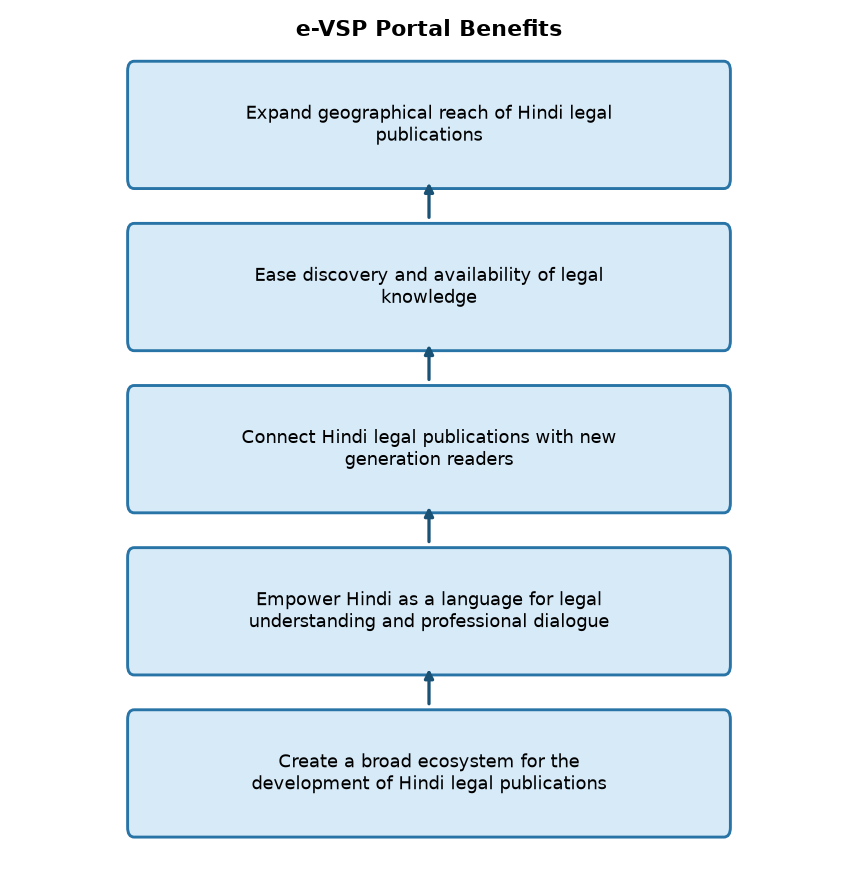
- By providing legal literature in Hindi, the portal makes the judicial system more comprehensible and approachable for the vast Hindi-speaking population, thereby promoting ‘Ease of Justice’.
- It empowers citizens to understand their rights and legal processes better, fostering greater trust and participation in the justice delivery mechanism.
Promoting Official Language and Cultural Heritage
- The initiative strengthens the role of Hindi as an official language in the legal domain, aligning with constitutional provisions and national language policy.
- It helps preserve and promote India’s rich cultural heritage by ensuring that legal discourse is also conducted and documented in an indigenous language, reflecting national values.
Empowering Legal Professionals and Academia
- Law students, teachers, and researchers gain unprecedented access to a wealth of Hindi legal resources, facilitating deeper study and research in their native language.
- Advocates and judicial members can leverage these resources for better case preparation and informed decision-making, especially in regions where Hindi is predominant.
Digital Transformation and Governance
- The portal is a significant step towards realizing the vision of Digital India in the legal sector, demonstrating how technology can be harnessed for public good.
- It exemplifies a citizen-centric approach to governance, making essential services and information digitally available and easily consumable.
Fostering a Comprehensive Legal Ecosystem
- By expanding the reach and availability of Hindi legal publications, the portal contributes to the development of a broader ecosystem for legal understanding and professional dialogue in Hindi.
- It encourages further creation and dissemination of legal content in Hindi, enriching the overall legal knowledge base.
Challenges
1. Digital Divide and Connectivity
- Despite advancements, a significant portion of the population, especially in rural areas, still lacks reliable internet access or digital literacy.
- This can limit the actual reach and utility of the portal for those who need it most.
UPSC Link: GS Paper III — Challenges to internal security through communication networks
2. Quality and Standardization of Translation
- Translating complex legal terminology and nuances from English to Hindi accurately and consistently is a significant challenge.
- Ensuring the quality and legal precision of translated content is crucial to avoid misinterpretations and maintain the integrity of legal information.
UPSC Link: GS Paper II — Governance, Transparency and Accountability
3. Content Updation and Maintenance
- The legal landscape is dynamic, with new judgments, amendments, and literature emerging constantly.
- Regular and timely updates of the portal with the latest content, while maintaining accuracy, will require substantial resources and dedicated effort.
UPSC Link: GS Paper II — Government policies and interventions for development in various sectors
4. User Adoption and Awareness
- Despite the portal’s launch, widespread awareness among the target audience (legal professionals, students, and general public) needs to be built.
- Encouraging adoption, especially among those accustomed to traditional methods or English resources, will require sustained outreach and training.
UPSC Link: GS Paper II — Welfare schemes for vulnerable sections of the population
5. Technical Infrastructure and Security
- Ensuring the portal’s robust technical infrastructure, scalability, and cybersecurity against potential threats is paramount.
- Data privacy and protection of sensitive legal information must be guaranteed.
UPSC Link: GS Paper III — Cyber security; e-governance
Challenges — UPSC Perspective
| Issue | Concern |
|---|---|
| Digital Divide | Limited internet access and digital literacy in remote areas hinder equitable access to the portal. |
| Translation Quality | Maintaining accuracy and legal precision in Hindi translations of complex legal texts is a continuous challenge. |
| Content Dynamics | Ensuring timely and comprehensive updates of new judgments and legal literature requires significant resources. |
| User Engagement | Building awareness and encouraging widespread adoption among diverse user groups, including those less digitally savvy. |
| Technical Resilience | Ensuring robust infrastructure, scalability, and cybersecurity to protect legal data and ensure uninterrupted service. |
Government Initiatives — Must-Memorise for Prelims
- Digital India Mission
- National e-Governance Plan (NeGP)
- e-Courts Project
- Tele-Law Scheme
- Nyaya Bandhu (Pro Bono Legal Services)
- Legal Aid Services (NALSA)
- BharatNet Project
- UMANG (Unified Mobile Application for New-age Governance)
Way Forward
- Launch comprehensive awareness campaigns, especially in rural and semi-urban areas, to educate potential users about the portal’s benefits and usage.
- Implement robust quality control mechanisms for translation, potentially involving legal experts and linguists, to ensure accuracy and consistency of Hindi legal content.
- Develop user-friendly tutorials and support services, including regional language helplines, to assist users in navigating and utilizing the portal effectively.
- Continuously update the portal with the latest judgments, legislative amendments, and legal literature, ensuring its relevance and comprehensiveness.
- Explore integration with other e-governance platforms and legal aid services to create a more holistic and interconnected digital legal ecosystem.
- Invest in enhancing digital infrastructure and connectivity, particularly in underserved regions, to bridge the digital divide and ensure equitable access.
- Incorporate feedback mechanisms to iteratively improve the portal’s features, content, and user experience based on stakeholder input.
- Consider expanding the portal’s content to include other major regional languages in a phased manner, further enhancing linguistic inclusivity in the legal domain.
UPSC Value Addition
Keywords for Mains Answer-Writing
Digital India · Judicial Accessibility · Linguistic Inclusivity · Official Language Policy · Citizen-Centric Governance · Legal Literacy · Cultural Preservation · e-Governance · Digital Divide · Access to Justice · Legal Empowerment · Information Dissemination
Constitutional & Policy Linkages
- Article 343: Official Language of the Union (Hindi in Devanagari script)
- Article 348: Language to be used in the Supreme Court and in the High Courts
- Article 351: Directive for development of the Hindi language
- Article 39A: Equal Justice and Free Legal Aid (promotes accessibility)
- Official Languages Act, 1963: Provides for the languages which may be used for official purposes of the Union
- Digital India Programme: Government’s flagship programme to transform India into a digitally empowered society and knowledge economy
Concept Flow
Complex Legal Language/English Dominance → Limited Public Comprehension/Access to Justice → Digital India Vision/Official Language Policy → E-VSP Portal Launch (Hindi Legal Literature) → Enhanced Judicial Accessibility/Legal Literacy → Citizen Empowerment/Inclusive Governance
Prelims Practice Questions
Q1. With reference to the E-VSP Portal, consider the following statements:
1. It is launched by the Ministry of Electronics and Information Technology.
2. Its primary objective is to provide online access to legal literature in Hindi.
3. It is hosted on the domain www.vsp.gov.in.
Which of the statements given above is/are correct?
- A. 1 and 2 only
- B. 2 and 3 only
- C. 3 only
- D. 1, 2 and 3
Answer: B. 2 and 3 only — Statement 1 is incorrect: The E-VSP Portal is launched by the Ministry of Law and Justice, specifically by Vidhi Sahitya Prakashan under it. Statement 2 is correct: Its primary objective is indeed to provide online access to legal literature, including judgments and journals, in Hindi. Statement 3 is correct: The portal is hosted on the domain www.vsp.gov.in.
Q2. Which of the following government initiatives align with the broader vision of enhancing digital access to legal information and promoting ‘Ease of Justice’ in India?
1. e-Courts Project
2. Tele-Law Scheme
3. BharatNet Project
4. UMANG App
- A. 1 and 2 only
- B. 1, 2 and 3 only
- C. 2, 3 and 4 only
- D. 1, 2, 3 and 4
Answer: D. 1, 2, 3 and 4 — All the listed initiatives contribute to enhancing digital access to legal information and promoting ‘Ease of Justice’. The e-Courts Project digitizes court processes, Tele-Law provides legal advice through CSCs, BharatNet provides broadband connectivity to rural areas which is essential for digital access, and the UMANG App offers various government services, including some related to justice, on a single platform.
Mains Practice Question
✍ The launch of the E-VSP Portal marks a significant stride towards democratizing legal knowledge and fostering an inclusive justice system. Critically analyze the potential benefits and challenges associated with leveraging digital platforms for enhancing legal accessibility in India, with particular reference to linguistic diversity.
Approach: Begin by introducing the E-VSP Portal and its core objective of providing Hindi legal literature. In the first part, elaborate on the potential benefits, such as enhanced judicial accessibility, promotion of official languages, empowerment of legal professionals, and alignment with Digital India. In the second part, critically analyze the challenges, including the digital divide, quality of translation, content management, and user adoption, especially considering India’s linguistic diversity. Conclude by suggesting a comprehensive way forward that addresses these challenges to maximize the portal’s impact and ensure equitable access to justice for all.
Source: PIB (Press Information Bureau)


No Comments