


16 Jul Revised UDAN Scheme: Minister Inaugurates Stakeholder Workshop
Subject Relevance — Where This Topic Fits
- GS Paper II — Government Policies and Interventions for Development in various sectors and Issues arising out of their Design and Implementation | GS Paper III — Indian Economy and issues relating to Planning, Mobilization of Resources, Growth, Development and Employment; Infrastructure: Energy, Ports, Roads, Airports, Railways etc.
- Prelims: UDAN Scheme, Regional Connectivity Scheme (RCS), National Civil Aviation Policy 2016, Viability Gap Funding (VGF), Airport Authority of India (AAI), Unserved/Underserved Airports, Airfare Caps, Balanced Regional Development
- Essay: The Role of Infrastructure in India’s Economic Growth and Social Equity, From ‘Hawaai Chappal’ to ‘Hawaai Jahaz’: India’s Inclusive Growth Story
Quick Revision: UDAN, a core component of NCAP 2016, is a market-driven RCS leveraging VGF and airfare caps to enhance regional air connectivity, fostering balanced economic development and social inclusion by connecting unserved and underserved airports across India.
Why is this in the news?
The Union Minister for Civil Aviation, Shri K. Rammohan Naidu, inaugurated a stakeholders’ workshop on the ‘Revised UDAN Scheme’ in New Delhi. This workshop, held at Vigyan Bhawan, brought together key aviation sector stakeholders to deliberate on the future planning of regional air connectivity in India. The revised scheme was officially launched by Prime Minister Shri Narendra Modi on July 4, 2026, from Jodhpur Airport, underscoring the government’s continued commitment to expanding aviation access and promoting balanced regional development.
Background
- India’s civil aviation sector has witnessed remarkable growth, transitioning from a niche mode of transport to a significant driver of economic activity and connectivity.
- Prior to 2014, air traffic was predominantly concentrated in metropolitan cities, leaving Tier-2 and Tier-3 cities with limited or no air services.
- The National Civil Aviation Policy (NCAP) 2016 laid the foundational framework for transforming India’s aviation landscape, with UDAN as a flagship component.
- The UDAN (Ude Desh ka Aam Naagrik) scheme was launched in 2016 with the vision of making air travel affordable and widespread, connecting unserved and underserved airports.
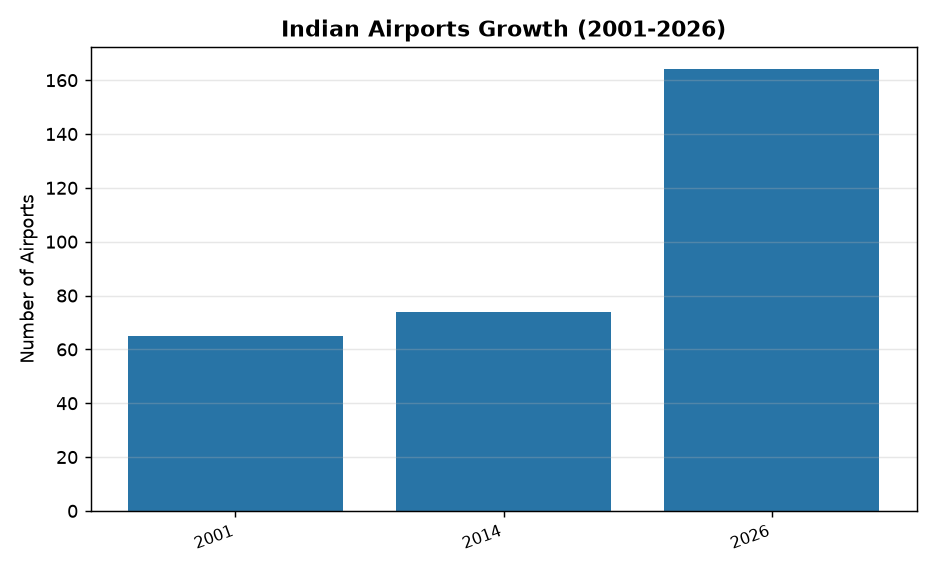
- The scheme has successfully operationalized over 90 new airports/heliports/water aerodromes in the last 12 years, significantly increasing the number of operational airports from 74 in 2014 to 164 currently.
- This expansion has propelled India to become the world’s third-largest domestic civil aviation market, demonstrating a paradigm shift in accessibility and public perception towards air travel.
What is the UDAN (Ude Desh ka Aam Naagrik) Scheme?
- UDAN is a regional airport development and ‘Regional Connectivity Scheme’ (RCS) of the Government of India, aimed at making air travel affordable and accessible to the common man.
- It seeks to connect unserved and underserved airports by reviving existing airstrips and airports, and developing new ones.
- The scheme operates on a market-based mechanism where airlines bid for routes, and Viability Gap Funding (VGF) is provided to cover operational losses on selected RCS routes.
- A key feature is the capping of airfares for a certain percentage of seats on UDAN flights, ensuring affordability for passengers.
- The scheme is a component of the National Civil Aviation Policy (NCAP) 2016, which outlines the broader vision for the Indian aviation sector.
- It aims to promote inclusive economic growth by enhancing trade, commerce, and tourism in regional areas.
- The Airports Authority of India (AAI) is the implementing agency for the UDAN scheme, responsible for identifying and developing airports.
- The ‘Revised UDAN Scheme’ signifies an evolution of the original framework, incorporating lessons learned and adapting to future needs for sustained growth and broader impact.
Key Features
| Feature | Significance |
|---|---|
| Viability Gap Funding (VGF) | Subsidizes airlines operating on regional routes, making them economically viable despite lower passenger volumes. |
| Airfare Caps | Ensures affordability for the common man by setting maximum fares for a proportion of seats on UDAN flights. |
| Focus on Unserved/Underserved Airports | Revives dormant airports and develops new ones, extending air connectivity to remote and smaller towns. |
| Market-Driven Route Allocation | Airlines bid for routes, promoting competition and efficient resource allocation based on demand and operational feasibility. |
| Exclusivity for Airlines | Selected airlines receive exclusive rights to operate on UDAN routes for a specified period, incentivizing investment. |
| Concessions by State Governments | States offer reduced VAT on aviation fuel, security, and utility charges, further lowering operational costs for airlines. |
Why it Matters
Economic Development and Regional Growth
- Facilitates trade and commerce by providing faster transport links, as exemplified by Darbhanga’s litchi reaching global markets and Kishangarh’s marble industry revival.
- Boosts tourism by improving accessibility to religious sites like Pushkar and Ajmer, and other tourist destinations.
- Attracts investment to Tier-2 and Tier-3 cities, fostering local entrepreneurship and job creation.
Social Inclusion and Equity
- Makes air travel accessible to the ‘common man’ (Aam Aadmi), fulfilling the vision of ‘Hawaai Chappal se Hawaai Jahaz’.
- Reduces travel time and enhances convenience for citizens in remote areas, improving quality of life.
- Promotes balanced regional development by integrating peripheral regions into the national economic mainstream.
Strategic and Infrastructure Development
- Strengthens India’s overall aviation infrastructure by operationalizing new airports and upgrading existing ones.
- Enhances disaster response capabilities by providing quicker access to remote areas during emergencies.
- Contributes to India’s ambition of becoming a global aviation hub by expanding its domestic network.
Shifting Public Perception
- Transforms the mindset of the common populace towards air travel, making it a viable and aspirational mode of transport.
- The introduction of affordable amenities like ‘UDAN Passenger Cafes’ further normalizes air travel for the middle class.
Challenges
1. Sustainability of VGF
- Reliance on Viability Gap Funding (VGF) raises questions about the long-term financial sustainability of routes once subsidies expire.
- Ensuring routes become self-sufficient post-VGF period is crucial for continued operations.
UPSC Link: GS Paper III — Mobilization of Resources
2. Infrastructure Development and Maintenance
- Developing and maintaining airports in remote areas, often with limited resources and challenging terrain, poses significant logistical and financial hurdles.
- Ensuring adequate ground infrastructure, including last-mile connectivity, is vital for passenger convenience.
UPSC Link: GS Paper III — Infrastructure
3. Airline Participation and Fleet Availability
- Attracting sufficient airline participation, especially from major carriers, for less lucrative regional routes can be challenging.
- Availability of suitable smaller aircraft for regional operations and pilot shortages can constrain expansion.
UPSC Link: GS Paper III — Industrial Policy
4. Inter-State Coordination
- Variations in state government support, such as VAT on ATF and security provisions, can create inconsistencies and affect route viability.
- Effective coordination between central and state governments is essential for seamless implementation.
UPSC Link: GS Paper II — Centre-State Relations
5. Demand Generation and Awareness
- Generating consistent passenger demand in newly connected regions requires effective marketing and awareness campaigns.
- Cultural shifts and affordability perceptions need to be addressed to ensure sustained ridership.
UPSC Link: GS Paper III — Growth and Development
Challenges — UPSC Perspective
| Issue | Concern |
|---|---|
| Financial Viability of Routes | Dependency on VGF and potential for routes to become unviable after subsidy period. |
| Operational Constraints | Limited availability of smaller aircraft, pilot shortages, and maintenance infrastructure in remote areas. |
| Regulatory Hurdles | Complexities in obtaining clearances and approvals for airport development and operations. |
| Last-Mile Connectivity | Lack of adequate road/rail connectivity to regional airports, diminishing overall travel convenience. |
| Environmental Impact | Increased carbon footprint from expanded air travel and challenges in sustainable airport development. |
| Security Concerns | Ensuring robust security infrastructure and personnel at a rapidly expanding network of regional airports. |
Government Initiatives — Must-Memorise for Prelims
- National Civil Aviation Policy (NCAP) 2016
- Regional Connectivity Scheme (RCS) – UDAN
- Krishi UDAN Scheme
- International UDAN Scheme
- DigiYatra Initiative
- National Logistics Policy
- Bharatmala Pariyojana (for road connectivity to airports)
- Sagarmala Pariyojana (for coastal/water aerodromes)
- PM Gati Shakti National Master Plan
- Greenfield Airports Policy
Way Forward
- Develop a robust framework for VGF exit strategies, fostering self-sustaining routes through market growth and diversified revenue streams.
- Invest in advanced regional aircraft technology and training programs to address fleet and pilot shortages effectively.
- Strengthen inter-ministerial and centre-state coordination to streamline regulatory processes and ensure consistent support.
- Prioritize last-mile connectivity to regional airports through integrated multi-modal transport planning under PM Gati Shakti.
- Promote sustainable aviation practices, including green airport development and adoption of sustainable aviation fuels (SAFs).
- Leverage digital technologies for enhanced passenger experience, operational efficiency, and data-driven route planning.
- Encourage private sector participation in airport development and operations through attractive concession models.
- Focus on demand generation through targeted tourism promotion and economic development initiatives in connected regions.
UPSC Value Addition
Keywords for Mains Answer-Writing
Regional Connectivity Scheme · Viability Gap Funding · Balanced Regional Development · Inclusive Growth · Aviation Infrastructure · National Civil Aviation Policy · Economic Multiplier Effect · Last-Mile Connectivity · Sustainable Aviation · Public-Private Partnership · Socio-Economic Transformation · Tier-2 and Tier-3 Cities
Constitutional & Policy Linkages
- Seventh Schedule, List I (Union List) — Entry 29: Airways; aircraft and air navigation; provision of aerodromes; regulation and organisation of air traffic and of aerodromes; provision for aeronautical education and training and regulation of ports of entry and departure for air traffic.
- Article 301 — Freedom of Trade, Commerce, and Intercourse (facilitated by improved connectivity).
- Directive Principles of State Policy (DPSP) — Article 38: State to secure a social order for the promotion of welfare of the people (UDAN contributes to welfare by enhancing connectivity and economic opportunities).
- National Civil Aviation Policy 2016 — Policy framework for aviation sector.
- Aircraft Act, 1934 and Aircraft Rules, 1937 — Governing aviation safety and operations.
Concept Flow
National Civil Aviation Policy 2016 (Vision) → Launch of UDAN Scheme (Implementation Strategy) → VGF & Airfare Caps (Affordability & Viability) → Revival of Unserved/Underserved Airports (Infrastructure Expansion) → Increased Regional Air Connectivity (Accessibility) → Boost to Trade, Tourism, & Investment (Economic Impact) → Balanced Regional Development & Social Inclusion (Outcome)
Prelims Practice Questions
Q1. With reference to the UDAN Scheme, consider the following statements:
1. It is a part of the National Civil Aviation Policy 2016.
2. The scheme aims to connect only unserved airports in the country.
3. Viability Gap Funding (VGF) is provided to airlines operating on selected UDAN routes.
Which of the statements given above is/are correct?
- A. 1 only
- B. 1 and 2 only
- C. 1 and 3 only
- D. 1, 2 and 3
Answer: C. 1 and 3 only — Statement 1 is correct: UDAN is indeed a key component of the National Civil Aviation Policy 2016. Statement 2 is incorrect: The scheme aims to connect both unserved and underserved airports. Statement 3 is correct: VGF is a core mechanism of UDAN to make regional routes financially viable for airlines.
Q2. Which of the following bodies is the implementing agency for the UDAN Scheme?
- A. Directorate General of Civil Aviation (DGCA)
- B. Ministry of Civil Aviation
- C. Airports Authority of India (AAI)
- D. Bureau of Civil Aviation Security (BCAS)
Answer: C. Airports Authority of India (AAI) — The Airports Authority of India (AAI) is the designated implementing agency for the UDAN (Ude Desh ka Aam Naagrik) scheme, responsible for identifying and developing airports under the scheme.
Mains Practice Question
✍ The UDAN scheme has been instrumental in transforming India’s regional air connectivity and fostering inclusive growth. Critically examine its successes and the persistent challenges that need to be addressed for its long-term sustainability and broader impact. (250 words)
Approach: Begin by introducing UDAN as a flagship initiative under NCAP 2016, aimed at enhancing regional air connectivity. In the first part, discuss its successes, citing examples like increased airport operationalization, economic benefits to Tier-2/3 cities (e.g., Darbhanga, Kishangarh), and improved social inclusion. In the second part, critically examine challenges such as the sustainability of Viability Gap Funding (VGF), infrastructure development and maintenance in remote areas, airline participation, and last-mile connectivity. Conclude with a forward-looking perspective, emphasizing the need for robust VGF exit strategies, integrated multi-modal planning, and sustainable aviation practices for UDAN’s continued success.
Source: PIB (Press Information Bureau)
Generated by AanyaAi for educational purpose.

- माई भारत अभियान: ग्राम सेवा एवं खेल दिवस के तहत गांवों में Nasha Mukt Yuva Abhiyan - October 24, 2026
- Odisha’s Zero Casualty Plan as Cyclone Threatens: UPSC Geography Insights - October 24, 2026
- आरबीआई का ओडिशा डेटा सेंटर: अर्थव्यवस्था के लिए क्यों है महत्वपूर्ण? - October 24, 2026

No Comments