


17 Jul New Index of Core Industries (ICI) with 2022-23 Base Year Released
Subject Relevance — Where This Topic Fits
- GS Paper III — Indian Economy and issues relating to Planning, Mobilization of Resources, Growth, Development and Employment; Government Budgeting; Industrial Policy
- Prelims: Index of Core Industries (ICI), Office of Economic Adviser (OEA), Department for Promotion of Industry and Internal Trade (DPIIT), Index of Industrial Production (IIP), Base Year Revision, Core Sector Industries, Iron Ore Inclusion, Gross Production Data, Double Counting
- Essay: The Role of Data Accuracy in Economic Governance and Policy Effectiveness, Measuring India’s Industrial Pulse: Evolution and Challenges
Quick Revision: The revision of the Index of Core Industries (ICI) to a 2022-23 base year, with the inclusion of Iron Ore and refined methodologies, aims to provide a more accurate and relevant measure of India’s industrial performance for informed policy-making and economic analysis.
Why is this in the news?
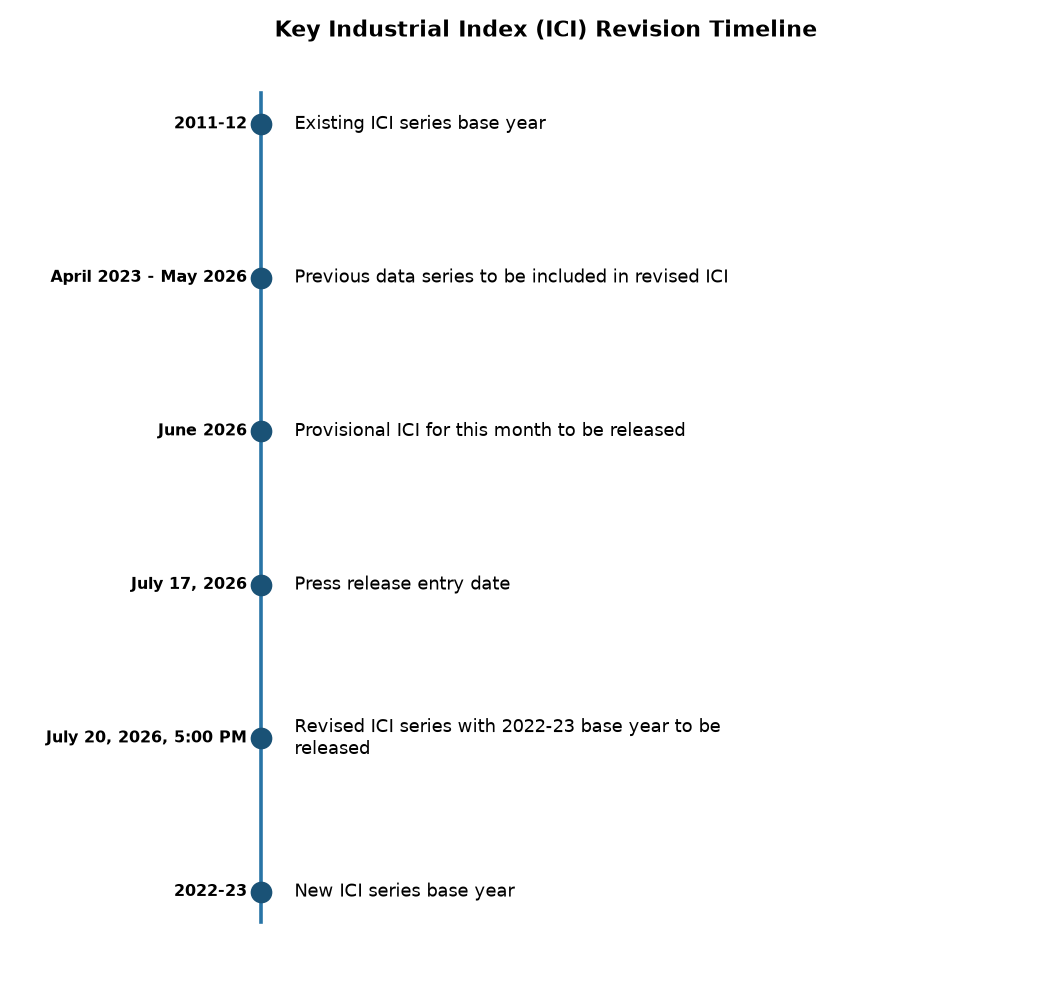
The Office of Economic Adviser (OEA), under the Department for Promotion of Industry and Internal Trade (DPIIT), Ministry of Commerce & Industry, is set to release a revised series of the Index of Core Industries (ICI) on July 20, 2026. This revision will adopt 2022-23 as the new base year, replacing the existing 2011-12 series, and will incorporate significant methodological changes, including the addition of Iron Ore as a core industry, thereby increasing the total number of core industries from eight to nine.
Background
- The Index of Core Industries (ICI) serves as a vital short-term indicator of industrial performance in India, reflecting the output trends of key infrastructure sectors.
- Historically, the ICI has undergone periodic revisions to its base year and methodology to ensure its relevance and accuracy in capturing the evolving structure of the Indian economy.
- The previous base year for the ICI was 2011-12, aligned with the Index of Industrial Production (IIP), which also uses the same base year.
- The revision process involves updating the weights of constituent industries, incorporating new industries, and refining data collection and compilation methodologies.
- Such revisions are crucial for providing policymakers with a more precise and contemporary understanding of economic activity, enabling informed decision-making.
- The move to a 2022-23 base year reflects the need to account for structural shifts, technological advancements, and changes in the relative importance of various industrial sectors over the past decade.
What is the Index of Core Industries (ICI)?
- The Index of Core Industries (ICI) is a monthly production volume index that measures the collective and individual performance of key infrastructure sectors in India.
- It is compiled and released by the Office of Economic Adviser (OEA), Department for Promotion of Industry and Internal Trade (DPIIT), Ministry of Commerce & Industry.
- The ICI is considered a lead indicator of industrial activity, often preceding the broader Index of Industrial Production (IIP).
- The eight core industries in the previous series (2011-12 base) were Coal, Crude Oil, Natural Gas, Refinery Products, Fertilizers, Steel, Cement, and Electricity.
- These industries collectively account for a significant proportion of the weight in the Index of Industrial Production (IIP).
- The weights for ICI items are derived from the weights of corresponding items in the IIP and then proportionately redistributed to sum up to 100.
- The ICI provides insights into the health of the manufacturing sector, infrastructure development, and overall economic growth trends.
- Its data is crucial for economic analysis, forecasting, and policy formulation by government agencies, businesses, and researchers.
Key Features
| Feature | Significance |
|---|---|
| New Base Year: 2022-23 | Replaces 2011-12, providing a more contemporary and accurate reflection of the current economic structure and industrial landscape. Aligns with the latest economic census data. |
| Inclusion of Iron Ore | Increases the number of core industries from 8 to 9. Recognizes Iron Ore’s extensive use in industrial production and its significant contribution to industrial development, particularly in the steel sector. |
| Use of Gross Production Data for Steel | Replaces net production data used in the 2011-12 series. Ensures consistency with the methodology of the Index of Industrial Production (IIP) and provides a more comprehensive measure of steel output. |
| Refined Coal Sector Measurement | Only raw coal is included, excluding middlings and washed coal to prevent double-counting. These refined products are derived from raw coal, and their separate inclusion would distort actual production figures. |
| Alignment with IIP Weights | Weights for the ICI (2022-23) series are derived from the IIP (2022-23) series weights, ensuring methodological consistency and comparability between the two crucial industrial indices. |
| Monthly Compilation and Data Release | Continues the practice of monthly compilation, providing timely insights into industrial performance. The release will include provisional data for June 2026 and revised historical series from April 2023 to May 2026. |
Why it Matters
Enhanced Accuracy and Relevance
- The updated base year (2022-23) will provide a more accurate representation of the current industrial structure, reflecting changes in production patterns, technological advancements, and the relative importance of different sectors since 2011-12.
- Improved data quality and methodological consistency with the IIP will lead to more reliable economic indicators, reducing measurement errors and providing a clearer picture of industrial health.
Informed Policy Formulation
- Policymakers will have access to more precise and contemporary data, enabling them to formulate targeted and effective industrial and economic policies.
- Better understanding of sector-specific performance will aid in identifying areas requiring intervention, investment, or regulatory support, fostering sustainable industrial growth.
Broader Economic Insights
- The inclusion of Iron Ore acknowledges its foundational role in the manufacturing value chain, particularly for the steel industry, and provides a more holistic view of the primary industrial inputs.
- Refinements in data collection, such as using gross production for steel and avoiding double-counting in coal, will offer a more comprehensive and less distorted view of output in these critical sectors.
Investment and Business Confidence
- Reliable economic data is crucial for investor confidence. A robust and updated ICI can attract both domestic and foreign investment by providing clear signals about the health and potential of India’s industrial sectors.
- Businesses can leverage these refined indices for better strategic planning, demand forecasting, and operational adjustments, leading to more efficient resource allocation.
Challenges
1. Data Collection and Granularity
- Ensuring the timely and accurate collection of granular data from diverse industrial units, especially from the unorganized sector, remains a persistent challenge.
- The quality and consistency of raw data inputs directly impact the reliability of the final index, necessitating robust data validation mechanisms.
UPSC Link: GS Paper III — Data Management; Statistical Systems
2. Weighting Mechanism Adjustments
- Assigning appropriate weights to different industries is complex, requiring careful consideration of their contribution to overall industrial output and value addition.
- Frequent structural changes in the economy necessitate continuous review and potential adjustments to weighting methodologies to maintain relevance.
UPSC Link: GS Paper III — Economic Statistics; Index Compilation
3. Comparability with Historical Data
- While a new base year enhances relevance, it can complicate direct comparisons with long-term historical trends based on older series.
- Users need to be adequately informed about the methodological changes to interpret historical data and new series accurately, often requiring linking factors or back-casting.
UPSC Link: GS Paper III — Economic Analysis; Time Series Data
4. Scope and Coverage
- Despite revisions, the ICI, like the IIP, primarily focuses on the organized manufacturing sector, potentially underrepresenting the contribution of the unorganized sector and emerging industries.
- The dynamic nature of industrial development means that new sectors and products constantly emerge, posing a challenge for their timely inclusion and appropriate weighting.
UPSC Link: GS Paper III — Industrial Growth; Sectoral Analysis
Challenges — UPSC Perspective
| Issue | Concern |
|---|---|
| Data Lag and Provisional Nature | Initial releases are provisional and subject to revision, which can affect real-time policy responses and business decisions. Timeliness versus accuracy trade-off. |
| Representativeness of Core Industries | While critical, the nine core industries may not fully capture the breadth and depth of India’s diverse industrial landscape, potentially overlooking significant growth drivers in other sectors. |
| Impact of Global Economic Volatility | External shocks and global supply chain disruptions can significantly influence core sector performance, making it challenging to isolate domestic policy impacts from external factors. |
| Capacity Utilization vs. Production | The ICI measures production volume, but it does not directly indicate capacity utilization, which is a crucial metric for assessing investment cycles and future growth potential. |
| Methodological Transparency and Communication | Ensuring that all stakeholders fully understand the revised methodology, including base year changes, new inclusions, and data treatment, is essential for trust and effective utilization of the data. |
Government Initiatives — Must-Memorise for Prelims
- Make in India
- Production Linked Incentive (PLI) Scheme
- National Infrastructure Pipeline (NIP)
- PM Gati Shakti National Master Plan
- National Manufacturing Policy
- Startup India
- Ease of Doing Business Initiative
- National Logistics Policy
- Scheme for Promotion of Manufacturing of Electronic Components and Semiconductors (SPECS)
- National Steel Policy
Way Forward
- Regular and timely base year revisions should be institutionalized to ensure that economic indices remain relevant and reflective of the evolving economic structure.
- Invest in strengthening data collection mechanisms, leveraging technology and big data analytics to improve the granularity, accuracy, and timeliness of industrial statistics.
- Explore the feasibility of expanding the coverage of the ICI to include other emerging and strategically important sectors, while maintaining its ‘core’ focus.
- Enhance methodological transparency and stakeholder engagement through detailed technical notes, workshops, and public consultations during index revisions.
- Develop robust back-casting methodologies to ensure seamless comparability between new and old series, facilitating long-term trend analysis.
- Promote inter-agency coordination between statistical bodies (like MoSPI) and economic ministries (like DPIIT) to ensure consistency and coherence across various economic indicators.
- Focus on capacity building for data analysts and policymakers to effectively interpret and utilize the revised indices for evidence-based decision-making.
- Continuously assess and refine the weighting structure to accurately reflect the dynamic contribution of each core industry to the overall economy.
UPSC Value Addition
Keywords for Mains Answer-Writing
Industrial Production Index · Core Sector Performance · Economic Indicators · Base Year Revision · Methodological Refinements · Policy Formulation · Industrial Growth Drivers · Data Accuracy · Sectoral Contribution · Economic Measurement · Infrastructure Development · Statistical Coherence
Constitutional & Policy Linkages
- Article 292: Borrowing by the Government of India (indirectly linked to economic health)
- Seventh Schedule (Union List, Entry 52): Industries, the control of which by the Union is declared by Parliament by law to be expedient in the public interest (governance of industries)
- Statistical Act, 2008: Provides for collection of statistics on economic activities (legal framework for data collection)
- National Statistical Commission: Apex advisory body on statistical matters (institutional oversight)
Concept Flow
Economic Restructuring & Growth → Need for Updated Economic Indicators → Base Year Revision of ICI (2022-23) → Methodological Changes (e.g., Iron Ore inclusion, gross production) → Improved Accuracy & Relevance of ICI → Enhanced Policy Formulation & Economic Analysis → Sustainable Industrial Development
Prelims Practice Questions
Q1. Consider the following statements regarding the Index of Core Industries (ICI):
1. The ICI is compiled and released by the Ministry of Statistics and Programme Implementation (MoSPI).
2. The revised ICI series will include Iron Ore as a core industry, increasing the total count to nine.
3. The weights for the ICI items are derived from the corresponding items in the Index of Industrial Production (IIP).
Which of the statements given above is/are correct?
- A. 1 and 2 only
- B. 2 and 3 only
- C. 1 and 3 only
- D. 1, 2 and 3
Answer: B. 2 and 3 only — Statement 1 is incorrect: The ICI is compiled and released by the Office of Economic Adviser (OEA), DPIIT, Ministry of Commerce & Industry. Statement 2 is correct: The revised series will include Iron Ore, making it nine core industries. Statement 3 is correct: The weights for ICI items are indeed derived from the IIP series.
Q2. With reference to the recent revision of the Index of Core Industries (ICI), which of the following changes has been incorporated?
1. The base year has been shifted from 2011-12 to 2022-23.
2. The steel index will now be compiled using net production data instead of gross production data.
3. Only raw coal will be included in the coal sector, excluding middlings and washed coal.
Select the correct answer using the code given below:
- A. 1 only
- B. 1 and 2 only
- C. 1 and 3 only
- D. 1, 2 and 3
Answer: C. 1 and 3 only — Statement 1 is correct: The base year is indeed shifted to 2022-23. Statement 2 is incorrect: The revised ICI series will use gross production data for steel, replacing net production data. Statement 3 is correct: To avoid double-counting, only raw coal will be included, excluding derived products like middlings and washed coal.
Mains Practice Question
✍ The revision of the Index of Core Industries (ICI) with a new base year and methodological changes signifies a crucial step towards enhancing the accuracy of economic measurement. Discuss the significance of these revisions for policy formulation and economic analysis in India. What challenges might arise in implementing and utilizing the revised index effectively?
Approach: Begin by introducing the ICI and the context of its revision, including the new base year (2022-23) and key changes like Iron Ore inclusion. In the first part, elaborate on the significance of these revisions for policy formulation (e.g., informed decision-making, targeted interventions) and economic analysis (e.g., accurate representation, investor confidence). In the second part, discuss potential challenges such as data collection, comparability with historical series, scope limitations, and methodological transparency. Conclude with a forward-looking perspective on the importance of continuous improvement in statistical systems for robust economic governance.
Source: PIB (Press Information Bureau)
Generated by AanyaAi for educational purpose.

- आंध्र प्रदेश में चार नए पुलिस आयुक्तालयों को कैबिनेट की मंजूरी, जानिए क्या होंगे फायदे - September 23, 2026
- Andhra Pradesh to get 4 new Police Commissionerates: Key UPSC insights - September 23, 2026
- AI आधारित ‘HEADS’ से भारत में अवसाद जांच में क्रांति: जानिए कैसे होगा मदद - September 23, 2026

No Comments