


18 Jul ALMM Policy Unchanged: Relief Extended for Select Solar Projects till Dec 2026
Subject Relevance — Where This Topic Fits
- GS Paper III — Economy (Infrastructure: Energy, Investment Models) | GS Paper III — Science and Technology (Developments and their applications and effects in everyday life; Indigenization of technology and developing new technology) | GS Paper III — Environment (Conservation, environmental pollution and degradation, environmental impact assessment) | GS Paper II — Government Policies and Interventions for Development in various sectors and Issues arising out of their Design and Implementation
- Prelims: ALMM, Solar PV Cells, Net-metering, Open Access Renewable Energy, Domestic Manufacturing, Renewable Energy Targets, Ministry of New and Renewable Energy (MNRE), Atmanirbhar Bharat, PLI Scheme, Energy Security
- Essay: India’s Journey Towards Energy Independence: A Path Paved by Renewable Innovation and Domestic Manufacturing., Balancing Global Integration with Local Production: The Imperative of Strategic Policies in Critical Sectors.
Quick Revision: The ALMM policy, a cornerstone of India’s ‘Atmanirbhar Bharat’ in solar, aims to bolster domestic manufacturing and quality, with recent targeted exemptions facilitating a smooth industry transition towards indigenous solar cell sourcing.
Why is this in the news?
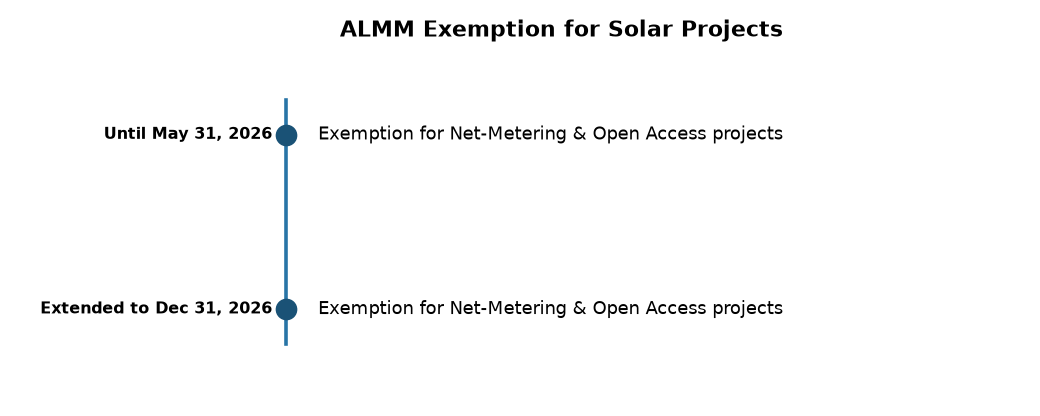
The Ministry of New and Renewable Energy (MNRE) recently announced that there would be no comprehensive change to the Approved List of Models and Manufacturers (ALMM) policy for solar PV cells. However, a limited exemption from ALMM List-II for net-metering and open access renewable energy projects has been extended until December 31, 2026. This decision, following extensive stakeholder consultations, aims to facilitate a smoother transition for these specific project categories while reinforcing the government’s commitment to indigenous solar manufacturing and self-reliance.
Background
- India has set ambitious targets for renewable energy capacity addition, aiming for 500 GW of non-fossil fuel energy capacity by 2030, with solar energy being a cornerstone of this strategy.
- The Approved List of Models and Manufacturers (ALMM) was introduced by MNRE to ensure the quality and reliability of solar PV modules and cells used in government-supported projects and projects under various schemes.
- ALMM List-II specifically pertains to solar PV cells, aiming to promote domestic manufacturing of these critical components and reduce reliance on imports.
- Initially, the ALMM mandate for solar PV modules (List-I) and cells (List-II) was implemented to bolster the ‘Atmanirbhar Bharat’ initiative and enhance India’s energy security.
- Previous exemptions and deferrals were provided for certain project categories, acknowledging the nascent stage of domestic manufacturing capacity for solar PV cells.
- The current extension for net-metering and open access projects, previously set to expire on May 31, 2026, provides additional time for the industry to adapt to the ALMM List-II requirements for solar cells.
What is the Approved List of Models and Manufacturers (ALMM)?
- The Approved List of Models and Manufacturers (ALMM) is a list published by the Ministry of New and Renewable Energy (MNRE) under the Solar (Registration of Solar PV Modules and Inverters) Order, 2019.
- Its primary objective is to ensure the quality, reliability, and performance of solar photovoltaic (PV) modules and cells deployed in India, particularly in government-supported projects or those requiring government financial assistance.
- The ALMM comprises two lists: List-I for solar PV modules and List-II for solar PV cells. Only models and manufacturers included in these lists are eligible for use in specified projects.
- Inclusion in the ALMM requires manufacturers to meet stringent criteria related to manufacturing facilities, testing capabilities, and product specifications, ensuring adherence to Indian and international standards.
- The policy aims to promote domestic manufacturing of solar equipment, reduce import dependence, enhance India’s energy security, and create a robust indigenous solar ecosystem.
- The ALMM acts as a non-tariff barrier, effectively mandating the use of domestically produced or ALMM-approved components, thereby fostering local production and value addition.
- Regular updates and revisions to the ALMM are undertaken by MNRE based on industry feedback, capacity growth, and technological advancements to ensure its continued relevance and effectiveness.
Key Features
| Feature | Significance |
|---|---|
| No Comprehensive ALMM Policy Change | Reaffirms government’s long-term commitment to indigenous manufacturing and quality control in the solar sector. |
| Extension of ALMM List-II Exemption (Solar PV Cells) | Provides relief to specific project categories (net-metering, open access) by allowing them to source solar cells from non-ALMM listed manufacturers until Dec 2026. |
| Targeted Relief for Net-Metering Projects | Supports rooftop solar installations and consumer-end renewable energy adoption, crucial for distributed generation and grid stability. |
| Support for Open Access Renewable Energy Projects | Facilitates industrial and commercial consumers in procuring green energy directly, promoting corporate sustainability and decarbonization. |
| Assistance to Independent Solar PV Module Manufacturers | Helps protect their inventory investments and provides time to transition to sourcing ALMM-listed solar cells, ensuring business continuity. |
| Smooth Transition to ALMM List-II | Acknowledges the evolving domestic solar cell manufacturing capacity and allows for gradual integration without disrupting ongoing projects. |
Why it Matters
Promoting Self-Reliance and ‘Atmanirbhar Bharat’
- The ALMM policy, reinforced by this decision, is a cornerstone of India’s ‘Atmanirbhar Bharat’ initiative in the renewable energy sector, aiming to reduce reliance on imported solar components.
- By fostering domestic manufacturing of solar PV cells and modules, India strengthens its energy security and reduces vulnerability to global supply chain disruptions and geopolitical tensions.
Boosting Domestic Manufacturing Capacity
- The policy provides a protected market for Indian manufacturers, incentivizing investment in advanced solar cell and module production technologies.
- The extended relief period allows domestic solar cell manufacturers to scale up their capacities and improve technological capabilities to meet future demand effectively.
Ensuring Quality and Reliability
- ALMM mandates adherence to stringent quality standards, ensuring that solar projects in India use reliable and high-performance components, which is crucial for long-term energy generation and project viability.
- This quality assurance builds confidence among investors and consumers in India’s solar ecosystem.
Facilitating Energy Transition and Decarbonization
- By supporting net-metering and open access projects, the policy indirectly promotes decentralized renewable energy generation and corporate adoption of green energy, contributing to India’s climate goals.
- A robust domestic manufacturing base is essential for achieving India’s ambitious renewable energy targets and transitioning to a low-carbon economy.
Economic Growth and Job Creation
- Increased domestic manufacturing leads to job creation across the value chain, from R&D and manufacturing to installation and maintenance.
- It also stimulates economic growth through increased investment, technology transfer, and the development of ancillary industries.
Challenges
1. Scaling Domestic Manufacturing Capacity
- Despite policy support, scaling up domestic solar cell manufacturing to meet the entire demand remains a significant challenge, requiring substantial capital investment and technological upgrades.
- The current domestic capacity for solar cells is still insufficient to cater to the rapidly expanding solar market in India.
UPSC Link: GS Paper III — Infrastructure: Energy
2. Technological Gap and R&D
- Indian manufacturers often lag behind global leaders in terms of advanced cell technologies (e.g., TOPCon, HJT) and manufacturing efficiency, necessitating greater investment in R&D.
- Bridging this technological gap is crucial for competing effectively in the global market and producing high-efficiency modules.
UPSC Link: GS Paper III — Science and Technology
3. Raw Material Sourcing
- India is heavily dependent on imports for key raw materials like polysilicon, wafers, and ingots, which are fundamental to solar cell manufacturing.
- Establishing an integrated domestic supply chain for these upstream components is vital but challenging.
UPSC Link: GS Paper III — Economy (Supply Chain Management)
4. Cost Competitiveness
- Domestic solar cells and modules can sometimes be more expensive than imported alternatives, primarily due to economies of scale, technology differences, and higher input costs.
- This cost differential can impact the overall project viability for developers.
UPSC Link: GS Paper III — Economy (Industrial Policy)
5. Policy Uncertainty and Implementation
- Frequent changes or extensions in policy deadlines can create uncertainty for investors and project developers, affecting long-term planning and investment decisions.
- Effective and consistent implementation of policies like ALMM is crucial for their success.
UPSC Link: GS Paper II — Government Policies
Challenges — UPSC Perspective
| Issue | Concern |
|---|---|
| Limited Domestic Cell Capacity | Risk of supply shortages for projects, potentially delaying commissioning and increasing costs. |
| Reliance on Imported Raw Materials | Vulnerability to global price fluctuations and geopolitical supply chain disruptions for polysilicon, wafers, etc. |
| Technology Adoption Lag | Indian manufacturers may struggle to produce high-efficiency cells, impacting overall project performance and competitiveness. |
| Higher Manufacturing Costs | Can make domestically produced solar components less attractive compared to cheaper imports, despite ALMM. |
| Impact on Project Developers | Balancing ALMM compliance with project timelines and cost-effectiveness, especially for smaller projects. |
| Quality Control and Certification | Ensuring all ALMM-listed manufacturers consistently meet stringent quality and performance standards. |
Government Initiatives — Must-Memorise for Prelims
- National Solar Mission (NSM)
- Production Linked Incentive (PLI) Scheme for High-Efficiency Solar PV Modules
- PM-KUSUM (Pradhan Mantri Kisan Urja Suraksha evam Utthaan Mahabhiyan)
- Rooftop Solar Programme Phase-II
- Green Energy Corridor (GEC) Project
- Solar Parks Scheme
- Strategic Interventions for Green Hydrogen Transition (SIGHT) Programme
Way Forward
- **Enhance PLI Scheme Effectiveness:** Continuously review and refine the PLI scheme to incentivize greater investment in integrated solar manufacturing, particularly for upstream components like polysilicon and wafers.
- **Boost R&D and Innovation:** Invest significantly in R&D for advanced solar cell technologies (e.g., TOPCon, HJT, Perovskites) to bridge the technological gap and foster indigenous innovation.
- **Develop Integrated Supply Chain:** Formulate policies to attract investment in the entire solar manufacturing value chain, from polysilicon to modules, to reduce import dependence on raw materials.
- **Skill Development and Capacity Building:** Implement robust programs for skilling and reskilling the workforce to support advanced solar manufacturing and deployment.
- **Streamline Certification and Testing:** Further strengthen domestic testing and certification infrastructure to ensure quality and facilitate faster ALMM approvals for manufacturers.
- **Promote Green Financing:** Encourage financial institutions to offer competitive financing options for solar manufacturing units and projects, including those utilizing domestic components.
- **International Collaborations:** Explore strategic international collaborations for technology transfer and joint ventures to accelerate the adoption of cutting-edge manufacturing processes.
- **Consistent Policy Framework:** Maintain a stable and predictable policy environment to instill confidence among investors and ensure long-term growth of the domestic solar industry.
UPSC Value Addition
Keywords for Mains Answer-Writing
Approved List of Models and Manufacturers (ALMM) · Solar PV Manufacturing · Atmanirbhar Bharat · Energy Security · Renewable Energy Transition · Domestic Value Addition · Production Linked Incentive (PLI) · Supply Chain Resilience · Technological Self-Reliance · Net-metering · Open Access Renewable Energy · Green Economy
Constitutional & Policy Linkages
- **Article 246 (Seventh Schedule, List I, Entry 53):** Union’s power to legislate on oilfields and mineral oil resources, and regulation of mines and mineral development to the extent to which such regulation and development under the control of the Union is declared by Parliament by law to be expedient in the public interest. (Indirectly relevant to energy policy and resource management).
- **Article 253:** Parliament’s power to make any law for implementing any treaty, agreement or convention with any other country or any decision made at any international conference, association or other body. (Relevant for international climate commitments and renewable energy targets).
- **Electricity Act, 2003:** Comprehensive legal framework for the power sector, including promotion of renewable energy, open access, and grid connectivity.
- **National Electricity Policy, 2005:** Outlines the policy framework for the power sector, emphasizing renewable energy development.
- **National Action Plan on Climate Change (NAPCC):** Launched in 2008, it outlines India’s strategy to address climate change, with the National Solar Mission being a key component.
Concept Flow
Government aims for Energy Security & Self-Reliance → ALMM Policy (List-II for Solar Cells) introduced to promote domestic manufacturing → Initial challenges in domestic cell capacity & supply chain → Limited exemption for Net-metering & Open Access projects extended → Provides time for domestic manufacturers to scale up & for projects to transition → Aims to ensure smooth energy transition while fostering ‘Atmanirbhar Bharat’ in solar → Contributes to India’s renewable energy targets and climate goals
Prelims Practice Questions
Q1. Consider the following statements regarding the Approved List of Models and Manufacturers (ALMM) for solar PV components in India:
1. The ALMM policy is implemented by the Ministry of Power.
2. ALMM List-II specifically pertains to solar PV cells.
3. Net-metering projects are currently fully exempt from ALMM List-II requirements without any time limit.
Which of the statements given above is/are correct?
- A. 1 only
- B. 2 only
- C. 1 and 3 only
- D. 2 and 3 only
Answer: B. 2 only — Statement 1 is incorrect: The ALMM policy is implemented by the Ministry of New and Renewable Energy (MNRE). Statement 2 is correct: ALMM List-II is specifically for solar PV cells, while List-I is for solar PV modules. Statement 3 is incorrect: Net-metering projects have been granted a limited exemption from ALMM List-II, which has been extended until December 31, 2026, not a full exemption without a time limit.
Q2. The recent extension of ALMM List-II exemption for certain solar projects in India is primarily aimed at:
1. Reducing the overall cost of solar power generation.
2. Providing a smoother transition period for the industry to adapt to domestic sourcing of solar cells.
3. Encouraging greater import of solar PV cells to meet immediate demand.
4. Completely dismantling the ALMM policy due to industry pressure.
Which of the reasons given above is/are correct?
- A. 1 and 3 only
- B. 2 only
- C. 1, 2 and 4 only
- D. 2 and 3 only
Answer: B. 2 only — Option B is the most accurate. The extension is specifically to facilitate a smooth transition for net-metering and open access projects, allowing independent module manufacturers to adjust their sourcing strategies as domestic solar cell capacity grows. It is not primarily aimed at reducing overall costs (though it might have an indirect effect) or encouraging imports, nor is it about dismantling the policy.
Mains Practice Question
✍ The Approved List of Models and Manufacturers (ALMM) policy is a critical instrument in India’s pursuit of ‘Atmanirbhar Bharat’ in the solar energy sector. Critically examine the objectives and implications of the ALMM policy, particularly in light of recent exemptions for specific project categories. What challenges persist in achieving complete self-reliance in solar PV manufacturing, and suggest a comprehensive way forward?
Approach: Begin by introducing the ALMM policy as a strategic initiative for domestic solar manufacturing and energy security. Detail its objectives, including quality assurance and promoting local production. Discuss the implications of the recent extension of ALMM List-II exemption for net-metering and open access projects, highlighting its role in facilitating a smooth transition while balancing industry needs. Subsequently, delve into the persistent challenges such as limited domestic capacity, technological gaps, raw material dependence, and cost competitiveness. Conclude by suggesting a multi-pronged way forward involving policy refinements, R&D investment, supply chain integration, and skill development to achieve sustainable self-reliance in solar PV manufacturing.
Source: PIB (Press Information Bureau)
Generated by AanyaAi for educational purpose.

- Harivansh Leads India at 153rd IPU Assembly in Tanzania - October 3, 2026
- अमेरिका में व्यापार मिशन: भारत की बड़ी योजना, जानिए क्या है सरकार की रणनीति - October 3, 2026
- Nasha Mukt Bharat: Youth Role in Polity & Governance for UPSC & PCS - October 3, 2026

No Comments