


20 Jul E-Shram Portal: Social Security for Unorganized Workers in UPSC Mains
Subject Relevance — Where This Topic Fits
- GS Paper II — Governance, Transparency and Accountability | GS Paper III — Labour, Employment, Social Security and Welfare | GS Paper III — Digital Infrastructure and e-Governance
- Prelims: E-Shram Portal, Universal Account Number (UAN), Unorganised Workers, Gig and Platform Workers, PM-SYM, PMSBY, PMJJBY, PM-KISAN, One Nation One Ration Card, Ayushman Bharat
- Essay: Digital Public Infrastructure for Inclusive Growth: The Case of E-Shram Portal, Bridging the Social Security Divide: Policy Interventions for India’s Unorganised Workforce
Quick Revision: E-Shram portal provides UAN to unorganised workers and integrates 15 central schemes for unified social security delivery, with state micro-sites enhancing localised implementation.
Why is this in the news?
The E-Shram portal, launched by the Ministry of Labour and Employment on 26 August 2021, has achieved a milestone of over 31.78 crore registrations of unorganised workers as of 14 July 2026. The portal has been transformed into a ‘One-Stop-Solution’ for accessing multiple social security schemes, integrating 15 central government welfare schemes and facilitating convergence with state-specific micro-sites to enhance last-mile delivery. This development underscores the government’s commitment to formalising the informal sector and ensuring comprehensive social protection for vulnerable workers.
Background
- The unorganised sector constitutes over 80% of India’s workforce, contributing significantly to GDP but lacking formal employment benefits such as provident fund, gratuity, and health insurance.
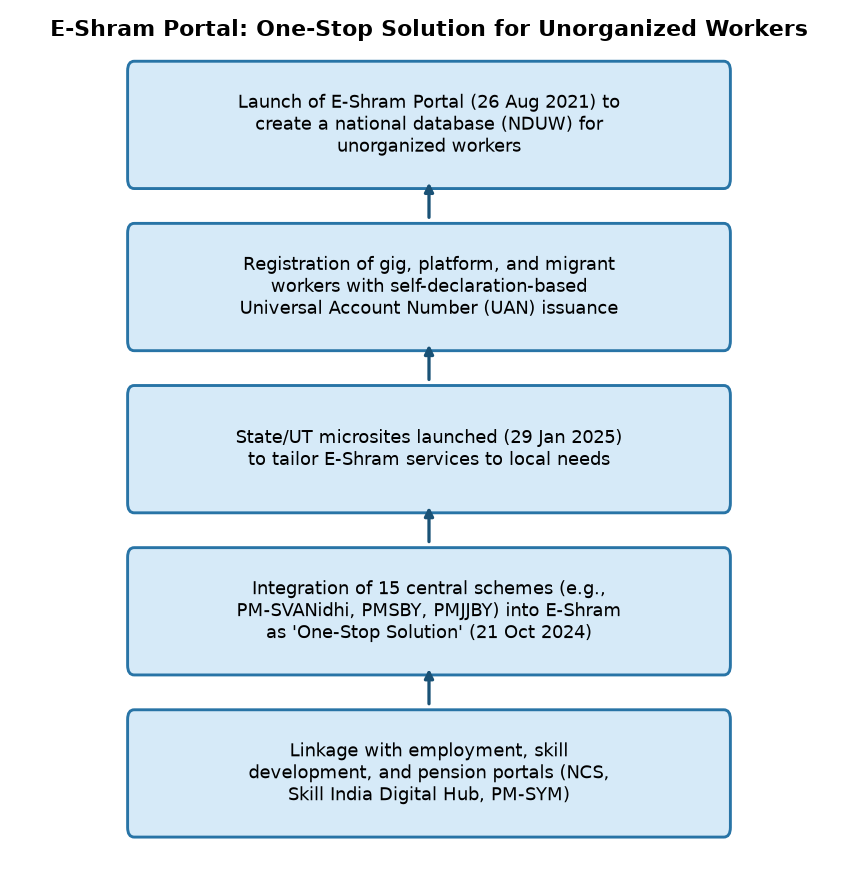
- The E-Shram portal was launched to create a National Database of Unorganised Workers (NDUW) for targeted welfare delivery.
- The portal addresses the challenges of informality by providing a unique Universal Account Number (UAN) to registered workers, enabling portability of benefits across schemes.
- State-specific micro-sites were launched on 29 January 2025 to tailor services to local needs, ensuring effective implementation and reducing data asymmetry.
- The Union Budget 2024-25 emphasised the integration of social security schemes under a unified digital platform to enhance accessibility and reduce fragmentation.
What is the E-Shram Portal?
- A digital platform launched by the Ministry of Labour and Employment to register unorganised workers, including gig and platform workers, street vendors, and migrant labourers.
- Provides a Universal Account Number (UAN) to registered workers based on self-declaration, ensuring a unique identifier for accessing welfare benefits.
- Functions as a ‘One-Stop-Solution’ by integrating 15 central government social security schemes, including PM-KISAN, PMJJBY, PMSBY, PM-SYM, and Ayushman Bharat, on a single portal.
- Enables workers to view their benefits, update personal details, and access employment opportunities through linkages with the National Career Service (NCS) and Skill India Digital Hub (SIDH).
- State governments can create micro-sites to customise services, streamline registration, data verification, and state-specific analysis for better policy implementation.
- The portal serves as a convergence point for multiple welfare schemes, reducing duplication and improving last-mile delivery for vulnerable workers.
- As of 14 July 2026, over 31.78 crore unorganised workers have registered on the portal, with Uttar Pradesh and Bihar leading in registrations.
- The portal is aligned with the vision of ‘Digital India’ and ‘Minimum Government, Maximum Governance’ to enhance transparency and efficiency in welfare delivery.
Key Features
| Feature | Significance |
|---|---|
| Universal Account Number (UAN) issuance | Provides a unique, portable identifier for unorganised workers, enabling seamless access to social security benefits across states and schemes. |
| State-specific microsites integration | Enables localisation of e-Shram services, allowing states to address regional labour market challenges and tailor welfare delivery. |
| One-Stop-Solution portal | Integrates 15 central social security schemes on a single platform, reducing fragmentation and improving ease of access for workers. |
| Real-time data updation | Facilitates dynamic inclusion of workers, ensuring updated records for targeted welfare delivery and policy formulation. |
| Convergence with employment and skill portals | Links e-Shram with NCS, Skill India Digital Hub, and PM-SYM for comprehensive labour market integration. |
Why it Matters
Labour Market Formalisation
- Reduces informality by providing formal recognition to unorganised workers through UAN issuance.
- Enhances data-driven policymaking by creating a national database of unorganised workers for targeted interventions.
- Supports the transition of gig and platform workers into formal social security frameworks.
Social Security Expansion
- Bridges the coverage gap for 31.78 crore workers, a critical step towards achieving Sustainable Development Goal 1.3.
- Integrates multiple schemes (e.g., PMSBY, PMJJBY, AB-PMJAY) under a unified portal, reducing administrative friction.
- Enables portability of benefits, ensuring continuity of welfare even during migration or job changes.
Digital Governance Innovation
- Demonstrates India’s ability to leverage digital public infrastructure for inclusive welfare delivery.
- Sets a precedent for inter-ministerial data convergence, reducing silos in governance.
- Enhances transparency and reduces leakages by linking Aadhaar and direct benefit transfers.
Regional Equity and Inclusion
- State-specific microsites address regional disparities in labour market access and welfare delivery.
- Data from states like Uttar Pradesh (8.45 crore registrations) and Bihar (3.24 crore) highlights the need for targeted interventions in high-density labour markets.
- Supports migrant workers by providing a unified platform for welfare access across states.
Challenges
1. Data Accuracy and Verification
- Self-declaration-based registration may lead to inaccuracies in worker profiles and eligibility for schemes.
- Lack of robust verification mechanisms for occupation, income, and eligibility criteria.
- Risk of duplicate registrations due to absence of Aadhaar-based biometric authentication in all cases.
UPSC Link: GS3: Labour Reforms
2. Digital Divide and Accessibility
- Limited digital literacy among unorganised workers, particularly in rural and tribal regions.
- Dependence on mobile/internet connectivity may exclude marginalised workers in remote areas.
- Language barriers in portal navigation for workers with limited proficiency in Hindi/English.
UPSC Link: GS2: Digital Divide
3. Scheme Integration Bottlenecks
- Inter-ministerial coordination challenges in integrating schemes due to differing eligibility criteria and administrative processes.
- Lag in updating state-specific microsites with real-time data from central schemes.
- Complexity in harmonising benefits across schemes (e.g., PM-KISAN vs. PM-SYM).
UPSC Link: GS2: Centre-State Relations
4. Worker Awareness and Outreach
- Low awareness among workers about the portal’s benefits and registration processes.
- Dependence on informal networks (e.g., labour contractors) for information dissemination, which may lead to misinformation.
- Limited engagement with women workers, who constitute a significant portion of the unorganised sector.
UPSC Link: GS1: Social Empowerment
5. Sustainability and Funding
- Long-term funding requirements for maintaining the portal, updating databases, and scaling up services.
- Risk of underutilisation of portal infrastructure due to low adoption rates in certain states.
- Dependence on central funding may strain state budgets for welfare delivery.
UPSC Link: GS3: Public Finance
6. Privacy and Data Security
- Risk of data breaches or misuse of sensitive worker information (e.g., Aadhaar-linked data).
- Lack of clear data governance frameworks for handling worker data across ministries.
- Potential for exclusion of workers due to stringent data protection measures.
UPSC Link: GS2: Fundamental Rights
Challenges — UPSC Perspective
| Issue | Concern |
|---|---|
| Self-declaration dependency | Accuracy of worker profiles and eligibility for schemes may be compromised. |
| Digital infrastructure gaps | Exclusion of workers in areas with poor internet/mobile connectivity. |
| Inter-ministerial coordination | Delays in scheme integration and real-time data updates. |
| Worker awareness deficit | Low registration and utilisation rates among unorganised workers. |
| Funding sustainability | Long-term viability of portal maintenance and service delivery. |
| Data privacy risks | Potential misuse of Aadhaar-linked worker data. |
Government Initiatives — Must-Memorise for Prelims
- Pradhan Mantri Street Vendors AtmaNirbhar Nidhi (PM SVANidhi)
- Pradhan Mantri Suraksha Bima Yojana (PMSBY)
- Pradhan Mantri Jeevan Jyoti Bima Yojana (PMJJBY)
- Ayushman Bharat – Pradhan Mantri Jan Arogya Yojana (AB-PMJAY)
- Pradhan Mantri Kisan Samman Nidhi (PM-KISAN)
- One Nation One Ration Card (ONORC)
- Pradhan Mantri Matru Vandana Yojana (PMMVY)
- Pradhan Mantri Awas Yojana – Gramin (PMAY-G)
- Pradhan Mantri Awas Yojana – Urban (PMAY-U)
- Pradhan Mantri Shram Yogi Maan-dhan (PM-SYM)
- National Career Service (NCS)
- Skill India Digital Hub (SIDH)
Way Forward
- Strengthen Aadhaar-based biometric authentication to reduce duplicate registrations and improve data accuracy.
- Expand digital literacy programs for unorganised workers, with a focus on rural and tribal regions.
- Enhance state-level coordination through regular reviews of microsite performance and data integration.
- Launch targeted awareness campaigns in regional languages, leveraging local influencers and community leaders.
- Develop a grievance redressal mechanism for workers facing issues with registration or benefit access.
- Integrate additional schemes (e.g., PM Garib Kalyan Anna Yojana) to expand social security coverage.
- Establish a dedicated fund for portal maintenance and scaling, with contributions from central and state governments.
- Conduct periodic audits of worker data to ensure accuracy and update eligibility criteria dynamically.
UPSC Value Addition
Keywords for Mains Answer-Writing
Unorganised Sector Workers · E-Shram Portal · Universal Account Number (UAN) · Social Security Schemes · Gig and Platform Workers · National Database of Unorganised Workers (NDUW) · Pradhan Mantri Street Vendors AtmaNirbhar Nidhi (PM SVANidhi) · Pradhan Mantri Shram Yogi Maan-dhan (PM-SYM) · Ayushman Bharat – Pradhan Mantri Jan Arogya Yojana (AB-PMJAY) · One Nation One Ration Card (ONORC) · National Career Service (NCS) · Skill India Digital Hub (SIDH) · Migrant Labourers · State-wise Micro-sites under E-Shram
Constitutional & Policy Linkages
- Article 21: Right to Life and Personal Liberty (includes right to livelihood and dignity).
- Article 41: Directive Principle of State Policy (right to work, education, and public assistance in cases of unemployment, old age, sickness, and disablement).
- Article 42: Provision for just and humane conditions of work and maternity relief.
Concept Flow
Unorganised Labour Market → Informality and lack of social security → Launch of e-Shram Portal (2021) → Registration of 31.78 crore workers → Issuance of UAN → Integration of 15+ social security schemes → One-Stop-Solution Portal → Enhanced access to welfare benefits → Data-driven policymaking → Formalisation of labour market → Achievement of SDG 1.3 (Social Protection Systems)
Prelims Practice Questions
Q1. Which of the following is NOT a feature of the E-Shram Portal launched by the Ministry of Labour and Employment?
- A. Creation of a national database of unorganised workers
- B. Issuance of Universal Account Number (UAN) to registered workers
- C. Integration with the Pradhan Mantri Kisan Samman Nidhi (PM-KISAN) for direct benefit transfer
- D. Provision of a micro-site for each state/UT to address local needs
Answer: C. Integration with the Pradhan Mantri Kisan Samman Nidhi (PM-KISAN) for direct benefit transfer — The E-Shram Portal integrates with PM-KISAN, but the issuance of UAN, creation of a national database, and provision of state micro-sites are core features. Option C is incorrect as PM-KISAN is a separate scheme, though its data may be linked for convergence.
Q2. As of 14 July 2026, which state has the highest number of registered unorganised workers on the E-Shram Portal?
- A. Maharashtra
- B. Uttar Pradesh
- C. Bihar
- D. Tamil Nadu
Answer: B. Uttar Pradesh — Uttar Pradesh has the highest registration with 8,45,90,721 workers, followed by Bihar and Maharashtra. This data is based on Annexure-I of the PIB release.
Q3. Which of the following social security schemes has been integrated with the E-Shram Portal to provide benefits to unorganised workers?
- A. Pradhan Mantri Fasal Bima Yojana (PMFBY)
- B. Pradhan Mantri Shram Yogi Maan-dhan (PM-SYM)
- C. Pradhan Mantri Garib Kalyan Anna Yojana (PM-GKAY)
- D. Swachh Bharat Mission (SBM)
Answer: B. Pradhan Mantri Shram Yogi Maan-dhan (PM-SYM) — PM-SYM, a pension scheme for unorganised workers, has been integrated with the E-Shram Portal. PMFBY and PM-GKAY are unrelated to E-Shram, while SBM is a sanitation mission.
Q4. The E-Shram Portal serves as a ‘One-Stop-Solution’ for unorganised workers primarily by:
- A. Providing direct cash transfers to all registered workers
- B. Integrating multiple social security schemes and employment services on a single platform
- C. Replacing the need for Aadhaar for welfare scheme identification
- D. Offering free health insurance to all gig workers
Answer: B. Integrating multiple social security schemes and employment services on a single platform — The portal acts as a convergence platform for multiple social security schemes (e.g., PM-SYM, AB-PMJAY) and employment services (e.g., NCS, SIDH), enabling seamless access to benefits.
Mains Practice Question
✍ Critically examine the role of the E-Shram Portal in addressing the challenges faced by unorganised sector workers in India. How does its design facilitate social security coverage, and what limitations persist in achieving universal inclusion? (250 words)
Approach: Begin by defining the unorganised sector and its vulnerabilities (e.g., lack of formal contracts, low wages, absence of social security). Explain the E-Shram Portal’s objectives, including the creation of a national database (NDUW), issuance of UAN, and integration with 15+ social security schemes (e.g., PM-SYM, AB-PMJAY, PM SVANidhi). Highlight its strengths: digitisation, state micro-sites for localised implementation, and convergence with employment/skill platforms (NCS, SIDH). Critique limitations: exclusion errors (e.g., workers unaware of registration), data privacy concerns, reliance on self-declaration for UAN, and gaps in gig/platform worker coverage. Conclude with suggestions: mandatory Aadhaar linkage for verification, awareness campaigns, and expanding the portal’s scope to include informal sector enterprises.
Source: PIB (Press Information Bureau)
Generated by AanyaAi for educational purpose.

- J&K’s Drug-Free Model & Welfare Schemes: A Blueprint for UPSC Exam - October 24, 2026
- ग्रामीण विकास विभाग ने विशेष अभियान 6 के तहत 76% फाइलों की समीक्षा पूरी की - October 24, 2026
- 2030 तक 250 बिलियन डॉलर इंजीनियरिंग निर्यात: नीति निर्माताओं की रणनीति - October 24, 2026

No Comments