


20 Jul WTO’s 8th Trade Policy Review of India: Key Dates, Significance & UPSC Focus
Subject Relevance — Where This Topic Fits
- GS Paper II — International Relations: Global Institutions (WTO), India’s Foreign Trade Policy | GS Paper III — Economy: Trade Reforms, Export Promotion, Digital Economy, GST, MSMEs
- Prelims: WTO, Trade Policy Review (TPR), GST Council, UPI, MSMEs, Self-Reliant India (Atmanirbhar Bharat), Foreign Trade Policy 2023, Trade facilitation, Digital Public Infrastructure (DPI), Export Preparedness Index, WTO dispute settlement mechanism
- Essay: The role of multilateral institutions in shaping national economic sovereignty, Digital transformation as a catalyst for India’s global trade integration
Quick Revision: The Trade Policy Review (TPR) at the WTO is a transparency mechanism that evaluates a member’s trade policies every five years (for India) to ensure compliance with multilateral rules and foster global trade predictability.
Why is this in the news?
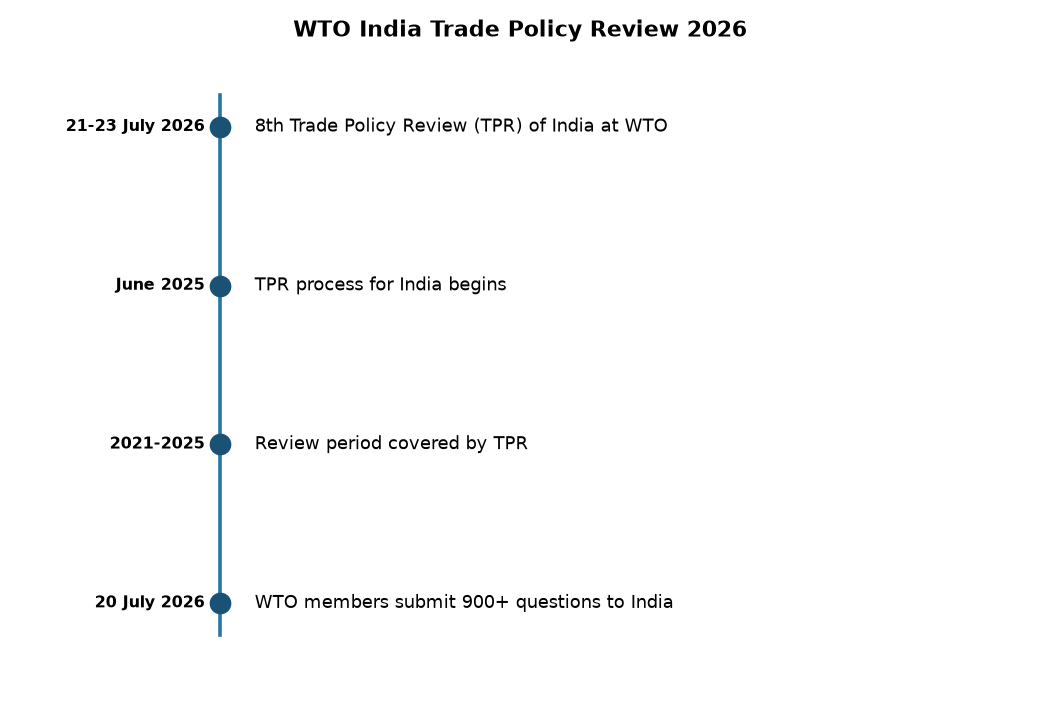
India’s Eighth Trade Policy Review (TPR) at the World Trade Organization (WTO) is scheduled for 21–23 July 2026, marking a critical juncture where the country’s trade and economic policies from 2021 to 2025 will undergo multilateral scrutiny. This review, led by the Commerce Secretary, assumes heightened significance amid India’s robust post-pandemic economic recovery, record-high exports, and ambitious reforms such as GST rationalisation and digital public infrastructure (DPI) integration. The exercise is expected to address over 900 questions from WTO members, reflecting global interest in India’s trade trajectory and policy coherence.
Background
- The WTO’s Trade Policy Review Mechanism (TPRM) was established under the Marrakesh Agreement (1995) to enhance transparency in global trade policies through periodic peer reviews of member states’ trade regimes.
- India is reviewed by the WTO every five years, with the Eighth TPR covering the period from 1 January 2021 to 31 December 2025, aligning with the assessment cycle of major economies.
- The review process involves two key documents: (a) India’s official policy statement (government report) and (b) a report prepared by the WTO Secretariat, which synthesises inputs from all members and assesses compliance with WTO agreements.
- India’s trade policy over the review period was shaped by the COVID-19 pandemic, global supply chain disruptions, and the implementation of structural reforms such as the Goods and Services Tax (GST).
- The review period also coincided with India’s participation in various free trade agreements.
- The WTO’s TPR process is distinct from dispute settlement mechanisms; it is a transparency tool designed to foster predictability and mutual understanding among members.
What is the Trade Policy Review (TPR) Mechanism at the WTO?
- The TPR is a transparency mechanism under the WTO’s Marrakesh Agreement (1995), aimed at enhancing the predictability and understanding of members’ trade policies through periodic peer reviews.
- Reviews are conducted by the Trade Policy Review Body (TPRB), comprising all WTO members, and are based on two primary documents: (a) the member’s own policy report and (b) a report prepared by the WTO Secretariat synthesising inputs from all members.
- WTO members are reviewed at regular intervals, and this interval is determined based on their share in world trade. India’s policy review (TPR) is done once every five years.
- The TPR process includes a comprehensive review of member countries’ trade policies, including many border and within-border measures, to enhance transparency, predictability, and understanding in the WTO.
- The review culminates in a meeting where the member presents its trade policy and responds to questions from other WTO members, followed by a collective assessment and recommendations.
- The TPR is not a punitive mechanism but a peer-review process designed to promote transparency, identify best practices, and address trade-related concerns through dialogue.
- India’s Eighth TPR (2021–2025) will focus on key reforms such as GST rationalisation, digital public infrastructure (e.g., UPI), and trade facilitation measures.
Key Features
| Feature | Significance |
|---|---|
| Frequency of India’s TPR | Conducted biennially under WTO rules, ensuring periodic scrutiny of India’s trade policies and compliance with multilateral commitments. |
| Scope of Review Period | Covers 1 January 2021 to 31 December 2025, capturing India’s post-pandemic recovery and trade resilience. |
| Two Core Documents | India’s Policy Statement (government report) and WTO Secretariat’s report; both form the basis for member queries and discussions. |
| Leadership of Delegation | Commercial Secretary Rajesh Agrawal leads the Indian delegation, reflecting bureaucratic ownership of trade policy articulation. |
| Digital Trade Initiatives | Inclusion of UPI, GST rationalisation, and digital tools underlines India’s integration of technology in trade facilitation. |
Why it Matters
Multilateral Trade Governance
- TPR is a transparency mechanism under WTO, enhancing predictability and trust among member states through structured peer review of trade policies.
- India’s participation reinforces its role as a key stakeholder in global trade governance, particularly amid rising protectionist tendencies.
- The process allows India to showcase reforms and address member concerns proactively, preventing potential trade disputes.
Economic Diplomacy and Trade Performance
- India’s trade performance during 2021–25 demonstrates resilience, with exports reaching $863.1 billion in 2025–26, underscoring its integration into global value chains.
- The review period highlights India’s strategic use of Free Trade Agreements (FTAs) to diversify trade partners and reduce dependency on traditional markets.
- Digital trade reforms (GST, UPI) and MSME support reflect India’s alignment with contemporary trade facilitation norms.
Domestic Policy Reforms and Global Benchmarking
- GST rationalisation and digital public infrastructure (DPI) adoption serve as case studies for other developing economies seeking trade competitiveness.
- The review process acts as an external audit, validating domestic reforms against global standards and identifying gaps for further policy refinement.
- India’s proactive engagement in TPR mitigates risks of unilateral trade measures by major economies, safeguarding its export interests.
Challenges
1. Non-Tariff Barriers (NTBs) in Key Markets
- Persistent NTBs in agriculture, pharmaceuticals, and services sectors may be highlighted by WTO members, necessitating robust technical justifications and dispute resolution readiness.
- India must prepare evidence-based responses to address concerns regarding sanitary and phytosanitary (SPS) measures and technical barriers to trade (TBT).
UPSC Link: WTO Agreements on SPS/TBT
2. Digital Trade Governance and Data Localisation
- Questions may arise on India’s stance on cross-border data flows, given its data localisation policies under the Digital Personal Data Protection Act, 2023.
- Balancing domestic data sovereignty with WTO’s e-commerce moratorium obligations poses a diplomatic and regulatory challenge.
UPSC Link: WTO Moratorium on Customs Duties on E-Commerce
3. Subsidies and Trade Distortions
- WTO members may scrutinise India’s production-linked incentive (PLI) schemes for potential trade-distorting effects under the Agreement on Subsidies and Countervailing Measures (ASCM).
- Ensuring compliance with WTO’s Agreement on Agriculture (AoA) while supporting farmers and MSMEs remains a delicate policy equilibrium.
UPSC Link: WTO Agreement on Subsidies and Countervailing Measures
4. Environmental and Labour Standards
- Increasing linkage of trade policies with environmental sustainability and labour rights may lead to queries on India’s compliance with international frameworks like the Paris Agreement.
- India must articulate its position on carbon border adjustment mechanisms (CBAM) and their potential impact on exports.
UPSC Link: WTO and Sustainable Development Goals
5. Geopolitical Trade Fragmentation
- Rising geopolitical tensions (e.g., US-China trade war, Russia-Ukraine conflict) may influence WTO members’ trade policies, indirectly affecting India’s export competitiveness.
- India’s strategic autonomy in trade alliances (e.g., IPEF, BRICS) may face scrutiny regarding its alignment with multilateral trade norms.
UPSC Link: WTO Dispute Settlement Understanding
Challenges — UPSC Perspective
| Issue | Concern |
|---|---|
| Non-Tariff Barriers (NTBs) | Risk of trade restrictions in agriculture, pharma, and services sectors due to SPS/TBT measures. |
| Data Localisation Policies | Potential conflict with WTO’s e-commerce moratorium and cross-border data flow norms. |
| Production-Linked Incentives (PLI) | Scrutiny under WTO’s ASCM for alleged trade-distorting subsidies. |
| Carbon Border Adjustment Mechanism (CBAM) | Impact on India’s exports to EU markets under climate-linked trade policies. |
| Geopolitical Trade Fragmentation | Exposure to trade diversion effects from US-China decoupling and regional trade blocs. |
Government Initiatives — Must-Memorise for Prelims
- Production-Linked Incentive (PLI) Scheme for 14 Sectors
Way Forward
- Finalise and submit a comprehensive Policy Statement to the WTO Secretariat by Q1 2026, incorporating inputs from 100+ ministries and stakeholders.
- Conduct pre-review bilateral engagements with key WTO members (e.g., EU, USA, China) to pre-emptively address potential concerns and align narratives.
- Strengthen domestic capacity for WTO dispute settlement by enhancing the Trade Remedies Wing of the Directorate General of Trade Remedies (DGTR).
- Develop a data-driven dashboard to monitor and respond to member queries in real-time during the TPR sessions (21–23 July 2026).
- Initiate targeted outreach programmes for MSMEs and exporters to ensure their preparedness for potential WTO-related trade policy adjustments.
- Align domestic reforms (e.g., GST, data protection laws) with evolving WTO norms to minimise compliance risks and maximise trade benefits.
- Establish a dedicated WTO Cell within the Ministry of Commerce to institutionalise periodic reviews and policy updates post-TPR.
- Leverage India’s G20 and BRICS presidencies to advocate for multilateral trade reforms that address contemporary challenges (e.g., digital trade, sustainability).
UPSC Value Addition
Keywords for Mains Answer-Writing
World Trade Organization (WTO) · Trade Policy Review (TPR) · India’s trade policy · WTO transparency mechanism · Foreign Trade Policy · Goods and Services Tax (GST) · Digital Public Infrastructure (DPI) · UPI (Unified Payments Interface) · MSMEs and trade · Self-reliance (Atmanirbhar Bharat) · Export performance of India · WTO dispute settlement mechanism · Trade facilitation and reforms · Global supply chains
Concept Flow
Global Trade Governance → WTO Membership → Periodic Trade Policy Review (TPR) → Transparency Mechanism → Peer Review by Members → India’s Policy Statement & WTO Secretariat Report → Member Queries & Statements → India’s Response & Future Vision → Domestic Policy Reforms → Export Competitiveness → Multilateral Trade Governance
Prelims Practice Questions
Q1. Consider the following statements regarding India’s 8th Trade Policy Review (TPR) at the WTO:
1. The review is conducted every five years for all WTO members.
2. The review period for India’s 8th TPR is from 1 January 2021 to 31 December 2025.
3. The review is led by the Union Minister of Commerce and Industry.
Which of the statements given above is/are correct?
- 1 only
- 1 and 2 only
- 2 and 3 only
- 1, 2 and 3
Answer: 1 and 2 only — Statement 1 is correct as WTO members undergo TPR at regular intervals based on their share in world trade. Statement 2 is correct as the review period for India’s 8th TPR is indeed 2021-2025. Statement 3 is incorrect as the review is led by the Commerce Secretary, not the Union Minister.
Q2. Which of the following is NOT a key document considered during India’s Trade Policy Review (TPR) at the WTO?
- India’s policy statement submitted to the WTO
- Report prepared by the WTO Secretariat
- Bilateral trade agreements signed by India
- Tariff and non-tariff measures data
Answer: Bilateral trade agreements signed by India — The WTO Secretariat prepares a report, but bilateral trade agreements are not considered as part of the TPR documents. The TPR focuses on a member’s trade policies and practices, not individual agreements.
Q3. The Trade Policy Review (TPR) mechanism of the WTO aims to:
1. Enhance transparency in members’ trade policies.
2. Provide a platform for dispute resolution between members.
3. Facilitate predictable trade environments.
Select the correct answer using the code below:
- 1 only
- 1 and 3 only
- 2 and 3 only
- 1, 2 and 3
Answer: 1 and 3 only — The TPR mechanism primarily aims to enhance transparency and predictability in trade policies (Statements 1 and 3). It does not serve as a dispute resolution platform, which is handled separately by the Dispute Settlement Body.
Mains Practice Question
✍ Examine the significance of India’s 8th Trade Policy Review (TPR) at the WTO in the context of its evolving trade policies, digital public infrastructure, and export performance. How does this review contribute to India’s engagement with the multilateral trading system?
Approach: Begin by defining the TPR mechanism and its objectives within the WTO framework. Analyze India’s trade policy evolution, highlighting reforms such as GST simplification, digital initiatives like UPI, and the impact of FTAs. Discuss export performance trends (2021-2025) and their implications for global supply chains. Conclude by assessing how the TPR process strengthens India’s role in shaping multilateral trade rules and addresses concerns of WTO members regarding trade facilitation and non-tariff barriers.
Source: PIB (Press Information Bureau)
Generated by AanyaAi for educational purpose.


No Comments