


21 Jul YSRCP Challenges EC Over Cross-State Voter Duplication in Andhra Pradesh
Subject Relevance — Where This Topic Fits
- GS Paper II — Functions and Responsibilities of the Union and the States, Issues and Challenges Pertaining to the Federal Structure | GS Paper II — Constitutional and Statutory Bodies (Election Commission of India) | GS Paper III — Challenges to Internal Security Through Communication Networks
- Prelims: Electoral Roll, Voter Duplication, Booth Rationalisation, Special Intensive Revision (SIR), Election Commission of India, EPIC, ERONET, Section 25 of the Representation of the People Act, 1951, Model Code of Conduct
- Essay: Electoral Integrity and Democratic Governance: Balancing Administrative Efficiency and Voter Rights, Federalism and Electoral Reforms: Addressing Cross-Border Anomalies in India’s Democratic Framework
Quick Revision: The Election Commission of India must ensure that the Special Intensive Revision (SIR) of electoral rolls is conducted without political interference, with robust inter-state verification mechanisms to prevent voter duplication and uphold electoral integrity.
Why is this in the news?
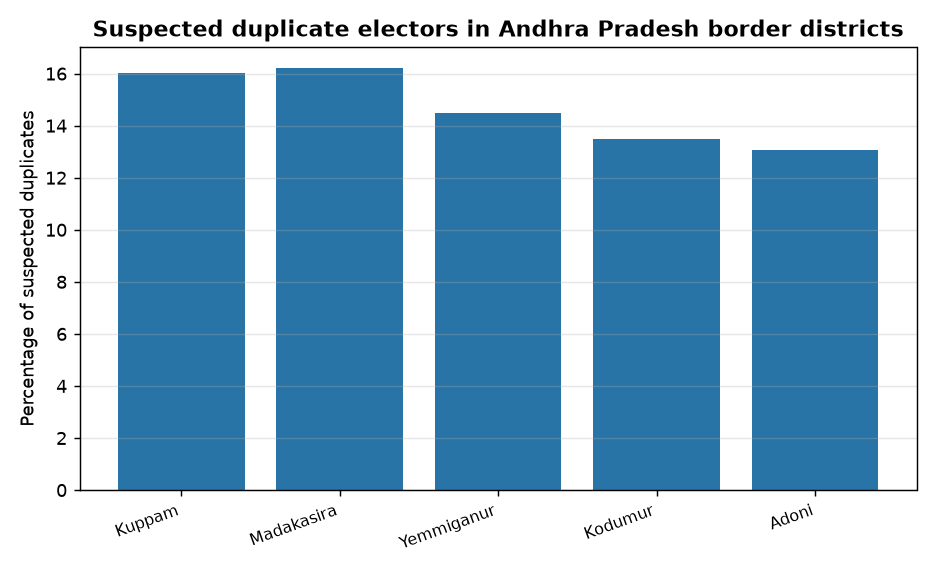
The YSR Congress Party (YSRCP) has petitioned the Election Commission of India (ECI) and the Chief Electoral Officer of Andhra Pradesh, alleging significant cross-state voter duplication and administrative irregularities during the ongoing Special Intensive Revision (SIR) of electoral rolls. The party has raised concerns over the simultaneous conduct of booth rationalisation and house-to-house enumeration, which it argues could lead to confusion and potential disenfranchisement of genuine electors. The petition highlights specific constituencies with alarmingly high rates of suspected duplicate electors, underscoring systemic issues in voter roll maintenance and inter-state verification mechanisms.
Background
- The Representation of the People Act, 1951, mandates the periodic revision of electoral rolls to ensure accuracy and inclusivity, with the Special Intensive Revision (SIR) being a critical phase in this process.
- Booth rationalisation is a process undertaken to optimise polling station locations and boundaries to enhance administrative efficiency and voter accessibility, often conducted alongside electoral roll revisions.
- The Election Commission of India (ECI) is constitutionally mandated under Article 324 to superintend, direct, and control the preparation of electoral rolls and the conduct of elections, ensuring fairness and transparency.
- Cross-state voter duplication arises due to migration, lack of inter-state coordination, and inadequate verification mechanisms, leading to potential electoral fraud and disenfranchisement.
- The ECI has previously addressed issues of voter duplication through initiatives like the Electors’ Photo Identity Cards (EPIC) and the ERONET portal, which facilitates inter-state verification of electors.
- Border districts, particularly in Andhra Pradesh, face heightened challenges due to shared boundaries with multiple states, necessitating robust coordination and verification mechanisms.
What is Voter Duplication and Electoral Roll Integrity?
- Voter duplication refers to the presence of a single elector’s name in multiple electoral rolls across different states or constituencies, which undermines the integrity of the electoral process by enabling potential fraud or disenfranchisement.
- Electoral roll integrity is the accuracy, completeness, and uniqueness of voter entries in the electoral rolls, ensuring that every eligible citizen is registered only once and that no ineligible persons are included.
- The Special Intensive Revision (SIR) is a statutory process under Section 25 of the Representation of the People Act, 1951, conducted periodically to update and cleanse electoral rolls through house-to-house enumeration and verification.
- Booth rationalisation is the process of reorganising polling station boundaries and locations to improve administrative efficiency, reduce voter inconvenience, and ensure equitable access to polling stations.
- The Election Commission of India (ECI) utilises technological tools such as the Electors’ Photo Identity Cards (EPIC) and the ERONET portal to verify electors’ identities and detect duplication across states.
- Inter-state coordination is critical to address voter duplication, as electoral rolls are maintained by state authorities, and lack of synchronised data sharing can lead to systemic errors.
- Transparency in the electoral roll revision process, including sharing of draft rolls and opportunities for public scrutiny, is essential to maintain public trust and prevent arbitrary deletions or inclusions.
Key Features
| Feature | Significance |
|---|---|
| Special Intensive Revision (SIR) of electoral rolls | A statutory process under the Representation of the People Act, 1951, aimed at updating and cleansing electoral rolls to ensure accuracy and inclusivity in voter registration. |
| Booth Level Officers (BLOs) | Frontline functionaries responsible for door-to-door enumeration and verification of electors, acting as the primary interface between the Election Commission and citizens. |
| Electoral Roll of India (ERONET) | A centralised digital platform used by the Election Commission for real-time monitoring and verification of voter data across States to detect duplication or errors. |
| EPIC-wise matching | A verification technique where the Electoral Photo Identity Card (EPIC) number is cross-referenced with demographic details to identify and eliminate duplicate or fraudulent entries in electoral rolls. |
| Draft and final electoral roll publication | A mandatory two-stage process under electoral law where draft rolls are published for public scrutiny before finalisation, allowing stakeholders to raise objections or corrections. |
Why it Matters
Electoral Integrity and Democratic Processes
- Ensures the foundational principle of ‘One Elector, One Vote’ by preventing cross-State or intra-State duplication, which could distort electoral outcomes and erode public trust in electoral processes.
- Maintains the sanctity of the electoral roll as a living document, updated through transparent and participatory mechanisms to reflect the actual electorate.
- Facilitates fair political competition by ensuring that political parties and candidates operate within a level playing field, free from distortions caused by erroneous voter registrations.
Administrative Efficiency and Transparency
- Highlights the operational challenges in concurrent processes such as booth rationalisation and electoral roll revision, which may lead to administrative confusion and inefficiencies if not sequenced properly.
- Emphasises the need for robust inter-State data sharing mechanisms to detect and resolve duplication, particularly in border districts where migratory patterns may complicate voter registration.
- Underscores the role of technology (ERONET, EPIC-wise matching) in streamlining verification processes and reducing human errors or malpractices in electoral administration.
Legal and Procedural Compliance
- Reinforces the statutory framework governing electoral rolls, including the Representation of the People Act, 1951, and the Conduct of Elections Rules, 1961, which mandate periodic revision and public scrutiny.
- Illustrates the importance of adherence to due process in electoral administration, where deviations (e.g., arbitrary deletions or misclassifications) can invite legal challenges and undermine credibility.
Challenges
1. Cross-State Voter Duplication
- High incidence of suspected duplicate electors in border districts (e.g., Kuppam at 16.03%, Madakasira at 16.20%), indicating systemic gaps in inter-State verification and data sharing.
- Instances of electors maintaining active registrations in multiple States (e.g., Andhra Pradesh and Telangana) or across multiple constituencies within the same State, violating the principle of ‘One Elector, One Vote’.
- Potential for electoral fraud or manipulation if duplication is not addressed proactively, leading to inflated voter rolls and distorted electoral outcomes.
UPSC Link: Part XV (Articles 324-329) of the Constitution
2. Concurrent Administrative Processes
- Risk of administrative confusion and inefficiency when booth rationalisation (reorganisation of polling stations) is undertaken simultaneously with electoral roll revision, particularly if field verifications are incomplete or rushed.
- Pressure on Booth Level Officers (BLOs) to misclassify electors without verified field checks, which could lead to erroneous deletions or inclusions in the electoral roll.
- Need for synchronised timelines and clear demarcation of responsibilities between the Election Commission, State electoral authorities, and political stakeholders to avoid overlapping and conflicting actions.
UPSC Link: Article 324(1) of the Constitution
3. Technological and Data Gaps
- Limited interoperability between State-level electoral databases and centralised platforms like ERONET, hindering real-time detection and resolution of duplication across jurisdictions.
- Inadequate utilisation of EPIC-wise matching for cross-verification, which could streamline the detection of duplicate or fraudulent entries but is often underutilised due to capacity constraints or procedural inertia.
- Dependence on manual verification processes in certain areas, which are prone to errors and delays, particularly in regions with high migratory populations or complex demographic profiles.
UPSC Link: Section 15 of the Representation of the People Act, 1951
4. Political and Social Implications
- Risk of political interference in electoral administration, where ruling parties may exert pressure on BLOs to manipulate voter rolls to favour their electoral prospects, undermining the neutrality of the Election Commission.
- Potential for social unrest or loss of public confidence in electoral processes if allegations of duplication or arbitrary deletions are perceived as partisan or discriminatory.
- Need for transparent and participatory mechanisms for political parties and civil society to engage in the electoral roll revision process, ensuring accountability and reducing perceptions of bias.
UPSC Link: Article 325 of the Constitution
5. Border District Complexities
- Geographical and administrative challenges in border districts, where migratory patterns, linguistic similarities, and administrative boundaries may complicate voter registration and verification.
- Lack of standardised protocols for inter-State coordination in electoral roll management, leading to inconsistencies in verification and potential duplication.
- Need for bilateral or multilateral agreements between States to facilitate data sharing and joint verification exercises, particularly in regions with high cross-border mobility.
UPSC Link: Article 324(4) of the Constitution
Challenges — UPSC Perspective
| Issue | Concern |
|---|---|
| Cross-State duplication | Violation of ‘One Elector, One Vote’ principle; potential for electoral fraud and distorted outcomes. |
| Concurrent processes (booth rationalisation + SIR) | Administrative confusion, rushed verifications, and risk of errors or malpractices. |
| Technological gaps (ERONET, EPIC-wise matching) | Limited interoperability and underutilisation of tools for real-time verification. |
| Political interference | Pressure on BLOs to manipulate rolls; erosion of public trust in electoral integrity. |
| Border district complexities | Migratory patterns, administrative boundaries, and lack of inter-State coordination complicate verification. |
| Public scrutiny and transparency | Inadequate sharing of mapped duplicate details with political parties; risk of arbitrary deletions. |
Way Forward
- Constitute a multi-Stakeholder Task Force comprising State electoral authorities, the Election Commission, and representatives of political parties to oversee the electoral roll revision process and address duplication issues.
- Mandate the use of ERONET and EPIC-wise matching for inter-State and intra-State verification, with real-time dashboards to monitor progress and flag discrepancies.
- Institute a phased approach to booth rationalisation, ensuring it is completed prior to the finalisation of the electoral roll to avoid administrative overlaps.
- Strengthen inter-State data sharing protocols, including bilateral agreements with neighbouring States (Telangana, Karnataka, Tamil Nadu, Odisha, Chhattisgarh) to verify and resolve duplication cases.
- Enhance the capacity of Booth Level Officers through training on verification protocols, ethical conduct, and the use of digital tools to reduce manual errors and malpractices.
- Publish mapped duplicate details on the Election Commission’s official portal and share them with recognised political parties ahead of the draft roll publication to enable transparent scrutiny.
- Establish a grievance redressal mechanism with a dedicated helpline and online portal for electors to report discrepancies or seek clarifications during the revision process.
- Conduct periodic audits of electoral rolls in border districts using demographic and migratory data to proactively identify and resolve duplication issues.
UPSC Value Addition
Keywords for Mains Answer-Writing
Electoral Reforms in India · Voter Registration and De-duplication · Special Intensive Revision (SIR) of Electoral Rolls · Election Commission of India (ECI) Powers and Functions · Cross-State Voter Duplication · Booth Level Officers (BLOs) and Electoral Integrity · Electronic Electoral Roll of India (ERONET) · Electoral Roll Management System (ERMS) · Political Parties and Electoral Transparency · Model Code of Conduct and Administrative Neutrality
Constitutional & Policy Linkages
- {‘Article 324(1)’: ‘Superintendence, direction, and control of elections vested in the Election Commission.’}
- {‘Article 325’: ‘Prohibition of discrimination in electoral rolls on grounds of religion, race, caste, or sex.’}
- {‘Article 326’: ‘Elections to the House of the People and Legislative Assemblies to be on the basis of adult suffrage.’}
- {‘Article 327’: ‘Power of Parliament to make provision with respect to elections.’}
- {‘Article 328’: ‘Power of State Legislatures to make provision with respect to elections.’}
Concept Flow
Cross-State migratory patterns and administrative gaps → Suspected duplication in electoral rolls (e.g., Kuppam at 16.03%) → YSRCP alleges malpractices and seeks EC intervention. → Concurrent processes (booth rationalisation + SIR) → Risk of rushed verifications and errors → YSRCP demands deferment of booth rationalisation until final roll publication. → Limited inter-State data sharing and underutilisation of ERONET/EPIC-wise matching → Inability to detect duplication in real time → Need for standardised inter-State protocols. → Political pressure on BLOs → Potential for arbitrary deletions or misclassifications → Erosion of public trust in electoral integrity. → Publication of draft electoral roll without transparency → Lack of stakeholder engagement → Risk of unaddressed grievances and legal challenges. → Finalisation of electoral roll with unresolved duplication → Distorted electoral outcomes → Compromised democratic legitimacy. → Implementation of way-forward measures → Strengthened inter-State coordination, technological adoption, and transparent processes → Restoration of electoral integrity.
Prelims Practice Questions
Q1. Which of the following is NOT a function of the Election Commission of India (ECI) as per the Constitution?
- Conducting elections to the Parliament and State Legislatures
- Preparing electoral rolls and revising them periodically
- Determining the delimitation of constituencies
- Appointing the Chief Election Commissioner and Election Commissioners
Answer: Determining the delimitation of constituencies — The delimitation of constituencies is carried out by the Delimitation Commission, a separate constitutional body, not by the ECI. The ECI’s functions include conducting elections, preparing electoral rolls, and appointing election commissioners.
Q2. Under which Article of the Constitution does the Election Commission of India derive its authority to superintend, direct, and control the entire process of elections?
- Article 324
- Article 325
- Article 326
- Article 327
Answer: Article 324 — Article 324 of the Indian Constitution vests the Election Commission with the power to superintend, direct, and control the entire process of elections to Parliament and State Legislatures, including the preparation of electoral rolls.
Q3. The Special Intensive Revision (SIR) of electoral rolls is conducted primarily to:
- Increase the number of voters in a constituency
- Ensure the accuracy and purity of the electoral rolls
- Replace electronic voting machines with ballot papers
- Conduct simultaneous elections in multiple States
Answer: Ensure the accuracy and purity of the electoral rolls — The Special Intensive Revision (SIR) is a periodic exercise conducted by the Election Commission to ensure the accuracy, purity, and up-to-date nature of electoral rolls by verifying and updating voter details.
Mains Practice Question
✍ Examine the challenges posed by cross-State voter duplication in India’s electoral system. How can the Election Commission of India address these issues while ensuring transparency and fairness in the electoral process?
Approach: The answer should highlight the constitutional and statutory provisions governing electoral rolls (Article 324, Representation of the People Act, 1950), the role of the ECI in managing voter duplication, and the mechanisms like ERONET and EPIC-wise matching for inter-State verification. Discuss the procedural safeguards required to prevent arbitrary deletions and ensure political neutrality, citing the Model Code of Conduct and judicial precedents on electoral reforms.
Source: The Hindu
Generated by AanyaAi for educational purpose.

- किशाऊ बहुउद्देशीय परियोजना: 6 राज्यों के बीच ऐतिहासिक समझौता, जानें पूरा विवरण - September 15, 2026
- 6 राज्यों ने किया किशाऊ परियोजना समझौते पर हस्ताक्षर, जानें पूरा विवरण - September 15, 2026
- पीएलएफएस अगस्त 2026: श्रम भागीदारी दर में वृद्धि, बेरोजगारी में गिरावट - September 15, 2026

No Comments