


22 Jul Mission Mausam: Key Steps for Weather-Ready & Climate-Smart India
Subject Relevance — Where This Topic Fits
- GS Paper III — Science and Technology (Applications in Weather Forecasting and Disaster Management) | GS Paper III — Environment and Disaster Management
- Prelims: Mission Mausam, Doppler Weather Radar (DWR), Numerical Weather Prediction (NWP), High-Performance Computing (HPC), Artificial Intelligence in Meteorology, IMD’s Global Forecast System (GFS), Mithun Modelling System, Petaflop Computing, Nowcasting Tools, Disaster Early Warning Systems
- Essay: The Role of Science and Technology in Disaster Mitigation: A Case Study of Mission Mausam, Climate Resilience and Technological Sovereignty: India’s Strategic Initiatives
Quick Revision: Mission Mausam aims to transform India into a ‘weather-ready and climate-conscious’ nation by integrating 28-petaflop HPC systems, and AI/ML-based forecasting tools to deliver high-resolution, seamless weather and climate services.
Why is this in the news?
The implementation status of Mission Mausam was recently reviewed in Parliament, underscoring its strategic importance in enhancing India’s weather and climate services. The mission, launched in January 2025, aims to integrate advanced observational networks, high-resolution modelling, and early warning systems to mitigate meteorological and hydrological risks, aligning with India’s broader climate resilience and disaster preparedness goals.
Background
- Mission Mausam was inaugurated by the Prime Minister on 14 January 2025, with the overarching objective of transforming India into a ‘weather-ready and climate-conscious’ nation.
- The mission is aligned with the National Disaster Management Plan (NDMP) and the Sendai Framework for Disaster Risk Reduction, emphasising proactive risk mitigation.
- India’s vulnerability to extreme weather events—cyclones, floods, heatwaves, and droughts—necessitates a robust, technology-driven meteorological infrastructure.
- The India Meteorological Department (IMD), under the Ministry of Earth Sciences (MoES), has historically been the nodal agency for weather forecasting but requires modernisation to meet contemporary challenges.
- The mission builds on previous initiatives such as the Monsoon Mission and the High-Performance Computing (HPC) upgrades, which have significantly improved forecast accuracy.
- Global best practices in meteorology, including AI/ML integration and high-resolution modelling, are being adopted to bridge gaps in spatial and temporal resolution of weather data.
What is Mission Mausam?
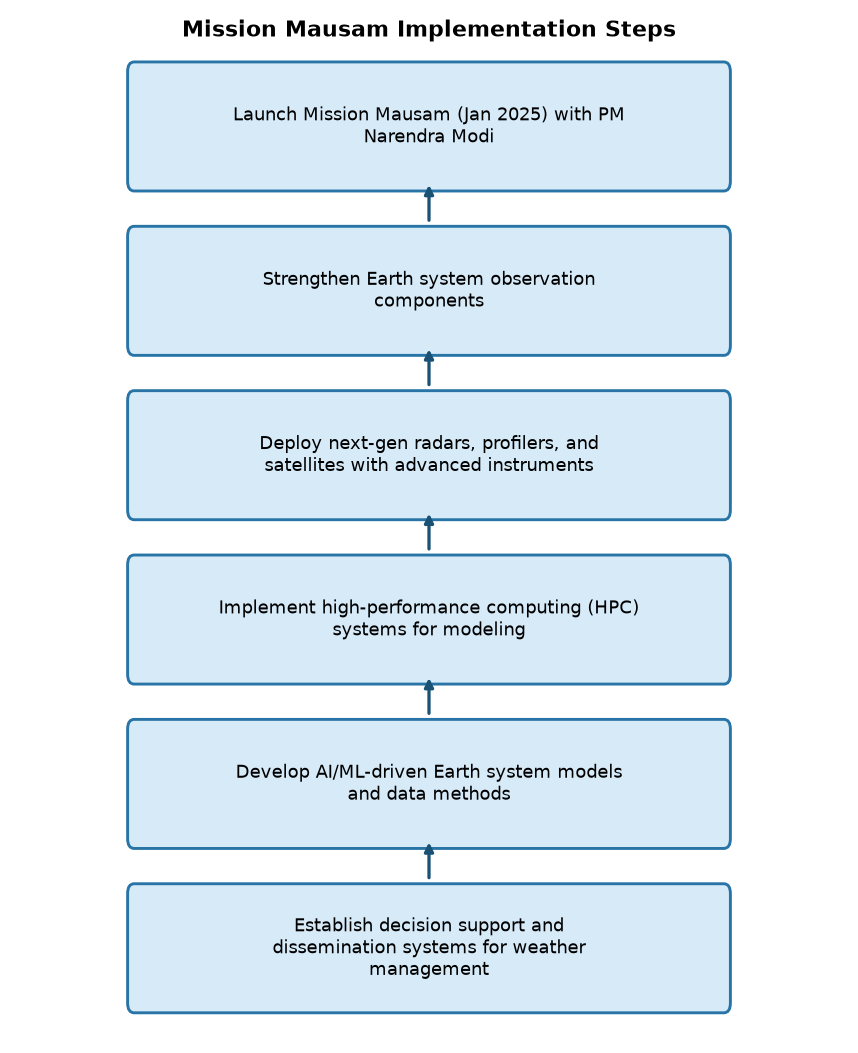
- Mission Mausam is a multi-institutional, technology-driven initiative under the Ministry of Earth Sciences, aimed at revolutionising India’s weather and climate services through advanced observational networks, high-resolution modelling, and early warning systems.
- The mission seeks to achieve seamless, accurate, and timely weather and climate services for all stakeholders, including government agencies, disaster managers, and the public, by leveraging cutting-edge technologies such as Doppler Weather Radars (DWR), wind profilers, and next-generation satellites.
- High-Performance Computing (HPC) infrastructure has been upgraded to 28 petaflops (from 6.8 petaflops in 2014), enabling the operation of global, regional, and mesoscale Numerical Weather Prediction (NWP) models at resolutions as fine as 6 km.
- The mission integrates Artificial Intelligence (AI) and Machine Learning (ML) into weather forecasting, with indigenous tools such as ‘Nowcasting’ systems and urban-scale downscaled forecasts developed by MoES scientists.
- Disaster early warning systems are being strengthened through the deployment of decision support systems (DSS) like ‘Atmanirbhar Bharat’-aligned solutions, which provide actionable insights for disaster managers and local authorities.
- The mission emphasises capacity building and research collaboration, fostering partnerships with international agencies (e.g., WMO) and academic institutions to enhance meteorological expertise.
- A critical component is the establishment of a seamless early warning system for all weather and climate hazards, including cyclones, heavy rainfall, heatwaves, and fog, to enable timely public advisories and disaster preparedness.
Key Features
| Feature | Significance |
|---|---|
| Deployment of 29 C-band, 45 X-band, and 12 S-band Doppler Weather Radars (DWR) | Enhances spatial resolution of weather monitoring, enabling precise tracking of severe weather events such as cyclones and thunderstorms. |
| Implementation of high-performance computing (HPC) systems (28 PetaFLOPS capacity) | Facilitates high-resolution numerical weather prediction models (e.g., IndiaFS at 6 km resolution) and real-time data assimilation for accurate forecasts. |
| Development of indigenous AI/ML-based forecasting tools (e.g., Nowcasting, Urban Forecasting) | Improves short-range and urban-scale weather predictions, reducing response time for disaster management. |
| Expansion of decision support systems (DSS) like ‘आत्मनिर्भर भारत’-aligned IMD tools | Enables block and panchayat-level weather advisories, enhancing localised disaster preparedness and mitigation. |
| Integration of advanced satellite and wind profiler networks | Provides comprehensive atmospheric observations, improving the accuracy of medium and long-range forecasts. |
Why it Matters
Disaster Risk Reduction
- Strengthens early warning systems for cyclones, floods, and heatwaves, reducing human and economic losses.
- Enhances real-time monitoring of extreme weather events, enabling timely evacuation and resource allocation.
- Supports the Sendai Framework for Disaster Risk Reduction by improving predictive accuracy and response coordination.
Agricultural Productivity
- Provides high-resolution weather forecasts for farmers, aiding in crop planning and pest management.
- Reduces crop losses due to unseasonal rainfall or droughts through precise advisories.
- Supports climate-smart agriculture by integrating long-term climate projections.
Public Health
- Improves air quality and heatwave forecasting, reducing heat-related mortality and respiratory illnesses.
- Enables proactive measures against vector-borne diseases by predicting conducive environmental conditions.
- Supports urban planning with data-driven climate resilience strategies.
Strategic and Economic Security
- Bolsters national security by enhancing weather intelligence for defence operations and infrastructure resilience.
- Reduces economic disruptions in sectors like aviation, shipping, and energy through accurate forecasts.
- Supports India’s climate diplomacy by providing reliable weather and climate data for international collaborations.
Scientific and Technological Advancement
- Accelerates indigenous development of weather prediction technologies, reducing dependence on foreign models.
- Fosters interdisciplinary research in Earth system science, including AI/ML applications.
- Positions India as a global leader in weather and climate services, with potential for technology exports.
Challenges
1. Data Integration and Interoperability
- Heterogeneous data sources (satellites, radars, surface stations) require seamless integration for unified forecasting.
- Standardisation of data formats and protocols across institutions (IMD, ISRO, NCMRWF) remains a challenge.
UPSC Link: GS3: Science & Tech
2. Computational and Infrastructure Bottlenecks
- High-resolution models demand massive computational power, straining existing HPC facilities.
- Upgrading and maintaining 120+ Doppler radars nationwide requires significant logistical and financial resources.
UPSC Link: GS3: Infrastructure
3. Human Resource and Capacity Gaps
- Shortage of skilled meteorologists and data scientists to operate advanced forecasting systems.
- Training and upskilling of personnel in AI/ML and high-performance computing is resource-intensive.
UPSC Link: GS2: Governance
4. Climate Change Adaptation
- Increasing frequency and intensity of extreme weather events challenge existing forecasting models.
- Long-term climate projections require continuous updating of Earth system models.
UPSC Link: GS3: Environment
5. Public Awareness and Trust
- Ensuring community trust in forecast accuracy to drive behavioural changes in disaster preparedness.
- Addressing misinformation and scepticism about weather predictions, especially in rural areas.
UPSC Link: GS4: Ethics
Challenges — UPSC Perspective
| Issue | Concern |
|---|---|
| Limited real-time data sharing between states | Delays in disseminating critical weather alerts to local authorities. |
| Dependence on imported sensors and components | Vulnerability to supply chain disruptions and geopolitical risks. |
| Inadequate rural weather monitoring infrastructure | Poor coverage in remote and hilly regions, leading to forecast inaccuracies. |
| Lack of standardised AI/ML training datasets | Reduces the reliability of machine learning-based forecasting tools. |
| Insufficient funding for long-term maintenance | Risk of system obsolescence due to underinvestment in infrastructure upgrades. |
| Regulatory hurdles in cross-border data exchange | Restricts access to global weather models and satellite data. |
Government Initiatives — Must-Memorise for Prelims
- Mission Mausam (2025)
- Prithvi Vigyan Yojana (Earth Science initiatives)
- National Monsoon Mission Phase-II
Way Forward
- Accelerate the deployment of next-generation radars and satellite networks to achieve pan-India coverage.
- Enhance HPC infrastructure to support ultra-high-resolution models (sub-kilometre scale) for urban forecasting.
- Develop a national framework for AI/ML integration in weather prediction, ensuring data standardisation and interoperability.
- Strengthen state-level disaster management agencies with real-time DSS tools and training programs.
- Establish a dedicated research consortium for climate change adaptation, focusing on model refinement and scenario analysis.
- Promote public-private partnerships for indigenous sensor development and maintenance of observation networks.
- Launch mass awareness campaigns to improve community trust and utilisation of weather advisories.
- Integrate Mission Mausam outputs with national climate action plans (e.g., National Action Plan on Climate Change).
UPSC Value Addition
Keywords for Mains Answer-Writing
Mission Mausam · Earth System Observation · Doppler Weather Radar (DWR) · High-Performance Computing (HPC) · Numerical Weather Prediction (NWP) · Artificial Intelligence in Meteorology · Early Warning Systems · Disaster Management · Atmanirbhar Bharat in Weather Services · Petaflops Computing Capacity · Mesoscale Modelling · Block-Level Weather Forecasting · IMD’s Global Forecast System (GFS) · Mithun Modelling System · Indigenous Weather Technologies
Concept Flow
Climate change intensifies extreme weather events (e.g., cyclones, heatwaves) → Mission Mausam launched to enhance weather prediction capabilities → Deployment of advanced radars, satellites, and HPC systems → Development of AI/ML-based forecasting tools → Real-time data assimilation and high-resolution modelling → Accurate early warnings and advisories → Proactive disaster preparedness and mitigation → Reduced human and economic losses → Sustainable development and climate resilience.
Prelims Practice Questions
Q1. Which of the following is NOT a component of Mission Mausam’s objectives?
- A. Deployment of next-generation radars with advanced instruments
- B. Establishment of high-resolution atmospheric observation systems
- C. Development of indigenous nuclear propulsion systems for weather satellites
- D. Strengthening capacity building and research collaboration in meteorology
Answer: C. Development of indigenous nuclear propulsion systems for weather satellites — Mission Mausam focuses on meteorological and climate services, not nuclear propulsion. Indigenous nuclear propulsion is unrelated to the mission’s stated goals.
Q2. What is the current computing capacity of the Ministry of Earth Sciences for weather modelling as of 2025?
- A. 6.8 Petaflops
- B. 12 Petaflops
- C. 28 Petaflops
- D. 45 Petaflops
Answer: C. 28 Petaflops — The Ministry of Earth Sciences upgraded its computing capacity to 28 Petaflops in 2025, significantly higher than the 6.8 Petaflops available in 2014.
Q3. Which of the following is a key feature of the India Forecast System (IndiaFS) under Mission Mausam?
- A. It operates at a horizontal resolution of 12 km for global forecasts
- B. It provides block-level and panchayat-level weather forecasts at 6 km resolution
- C. It is exclusively used for long-term climate projections
- D. It relies solely on manual observational data from IMD stations
Answer: B. It provides block-level and panchayat-level weather forecasts at 6 km resolution — IndiaFS operates at a high resolution of 6 km, enabling detailed forecasts down to the block and panchayat levels, unlike the 12 km resolution systems.
Mains Practice Question
✍ Analyse the significance of Mission Mausam in transforming India’s weather and climate services. How does it integrate advanced technologies like High-Performance Computing (HPC), Artificial Intelligence (AI), and indigenous radar systems to enhance disaster preparedness and early warning mechanisms? Discuss with reference to the mission’s objectives and its alignment with the ‘Atmanirbhar Bharat’ initiative.
Approach: Begin by outlining Mission Mausam’s objectives, emphasizing its focus on Earth System Observation, high-resolution modelling, and indigenous technology development. Discuss the role of HPC (e.g., Arunika and Arka systems with 28 Petaflops capacity) in enabling high-resolution NWP models like IndiaFS (6 km resolution) and global systems (GFS and Mithun at 12 km). Highlight the integration of AI/ML in tools such as nowcasting systems and urban forecasts. Explain how these advancements strengthen disaster management through early warning systems, including the deployment of Doppler Weather Radars (DWRs) and decision support systems (DSS). Conclude by linking the mission’s self-reliance goals (Atmanirbhar Bharat) to reduced dependence on foreign technologies and enhanced indigenous innovation in meteorological services.
Source: PIB (Press Information Bureau)
Generated by AanyaAi for educational purpose.

- तमिलनाडु: राज्यपाल अरलेकर ने निजी विश्वविद्यालय संशोधन विधेयक पर मांगी स्पष्टीकरण - September 18, 2026
- सुप्रीम कोर्ट ने एनटीए के अपग्रेडेड नीट परीक्षा सिस्टम का निरीक्षण करने पर विचार किया - September 18, 2026
- Supreme Court to Inspect NTA’s Upgraded NEET Exam System for Leak Prevention - September 18, 2026

No Comments