


23 Jul Axiom-4 Mission: India’s Key Experiments & Return Schedule Explained
Subject Relevance — Where This Topic Fits
- GS Paper III — Science and Technology — Developments and their Applications and Effects in Everyday Life | GS Paper III — Space Technology — Indian Space Research Organisation (ISRO) and its Contributions
- Prelims: Axiom Space Inc., Gaganyaan Mission, Bhartiya Antariksha Station, Crew Dragon spacecraft, Microgravity experiments, Tardigrades, Myogenesis, ISRO Flight Surgeons
- Essay: The Role of International Collaboration in Advancing Human Spaceflight, India’s Ascent in Space Exploration: From Chandrayaan to Gaganyaan
Quick Revision: The Axiom-4 mission exemplifies India’s strategic investments in microgravity research, with experiments in astrobiology, human physiology, and life support systems directly contributing to the Gaganyaan programme and the future Bhartiya Antariksha Station.
Why is this in the news?
The Axiom-4 mission, featuring Indian astronaut Shubhanshu Shukla as part of the Gaganyatri cohort, has reached a critical phase with four of seven microgravity experiments completed and three nearing finalization. The mission’s progress, including the tentative schedule for undocking from the International Space Station (ISS) and return to Earth, underscores India’s growing engagement in commercial human spaceflight and its strategic investments in space science and technology. This mission serves as a precursor to India’s ambitious Gaganyaan programme and the proposed Bhartiya Antariksha Station, while also contributing to global research in life support systems and human physiology in microgravity environments.
Background
- The Axiom-4 mission is a privately funded commercial spaceflight mission operated by Axiom Space Inc., USA, in collaboration with NASA and international partners, marking a significant step in the commercialization of low Earth orbit (LEO).
- India’s participation in Axiom-4, through the Gaganyatri Shubhanshu Shukla, aligns with the country’s broader strategy to enhance its capabilities in human spaceflight, as outlined in ISRO’s Gaganyaan programme and the proposed Bhartiya Antariksha Station.
- Microgravity experiments conducted during such missions provide critical insights into the effects of space environments on biological systems, materials, and life support technologies, which are essential for long-duration human space missions.
- The successful completion of four experiments and the near-finalization of three others reflect India’s growing expertise in space science, particularly in areas such as astrobiology, human physiology, and plant biology in microgravity.
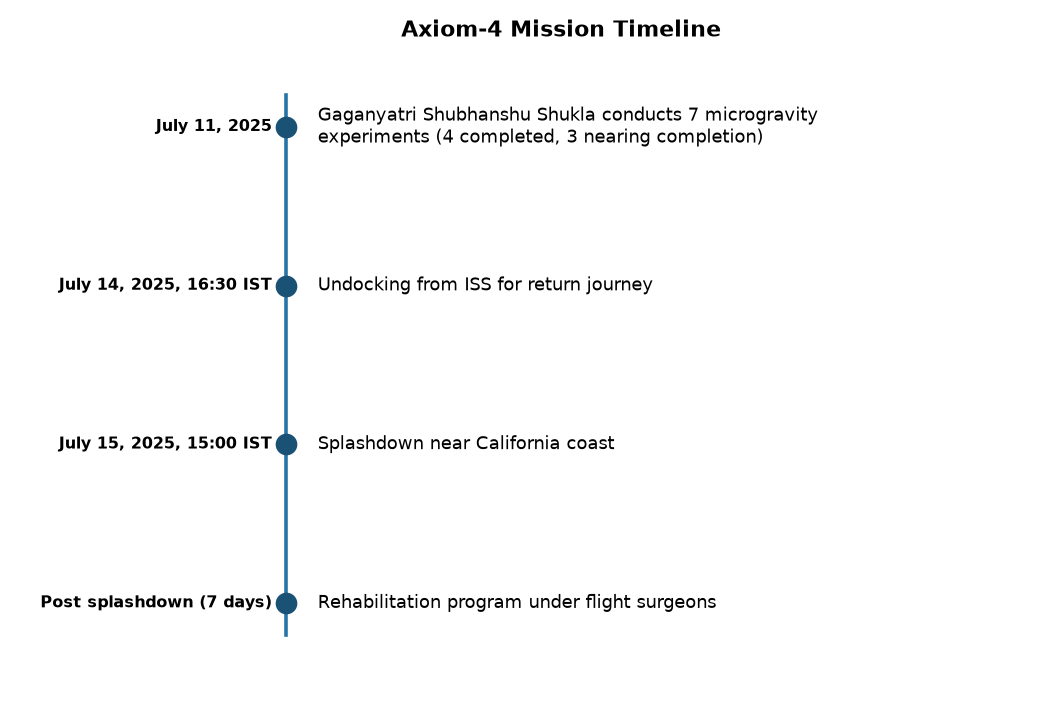
- The return journey, scheduled for July 14–15, 2025, involves undocking from the ISS, orbital maneuvers, and a splashdown near California, followed by a rehabilitation period to reacclimatize the crew to Earth’s gravity.
- ISRO’s flight surgeons play a pivotal role in monitoring the health and psychological well-being of the Gaganyatri, ensuring mission safety and contributing to India’s human spaceflight safety protocols.
What is the Axiom-4 Mission?
- The Axiom-4 mission is a commercial human spaceflight mission organized by Axiom Space Inc., USA, in partnership with NASA, involving a Crew Dragon spacecraft bound for the International Space Station (ISS).
- The mission includes a diverse international crew, with Indian astronaut Shubhanshu Shukla representing India as part of the Gaganyatri cohort, tasked with conducting a suite of microgravity experiments.
- The mission serves as a precursor to India’s Gaganyaan programme, which aims to send Indian astronauts to space aboard an indigenous spacecraft, and the proposed Bhartiya Antariksha Station, India’s future space station.
- Microgravity experiments aboard Axiom-4 focus on critical areas such as astrobiology (e.g., Tardigrades), human physiology (e.g., Myogenesis), plant biology (e.g., sprouting of methi and moong seeds), and life support systems (e.g., cyanobacteria growth).
- The experiments are designed to study the effects of microgravity on biological and physical systems, providing data that will inform the development of life support systems, crew health protocols, and agricultural techniques for long-duration space missions.
- The mission also highlights the growing role of private entities in space exploration, with Axiom Space Inc. facilitating commercial access to LEO and fostering international collaboration in space science.
- The return journey involves undocking from the ISS, orbital maneuvers, and a controlled splashdown in the Pacific Ocean near California, followed by a rehabilitation period to reacclimatize the crew to Earth’s gravity.
- ISRO’s involvement in the mission underscores India’s commitment to advancing its capabilities in human spaceflight, aligning with its long-term vision for space exploration and technological self-reliance.
Key Features
| Feature | Significance |
|---|---|
| Tardigrade Experiment (Indian strain) | Assesses extremophile survival, revival, and reproductive mechanisms in microgravity, providing insights into panspermia theory and potential for life-support systems in space habitats. |
| Myogenesis Experiment | Investigates muscle cell degradation in microgravity to inform countermeasures for astronaut muscle atrophy, critical for long-duration missions like Gaganyaan and Bhartiya Antariksha Station. |
| Seed Sprouting (Methi & Moong) | Evaluates nutritional viability of crop seeds in space, supporting closed-loop food systems for future crewed missions and planetary bases. |
| Cyanobacteria Experiment | Studies growth patterns of cyanobacteria to assess their role in oxygen generation and carbon dioxide recycling for life-support systems in extraterrestrial environments. |
| Microalgae Experiment | Examines microalgal growth kinetics for biofuel and nutritional applications, aligning with sustainable space resource utilization goals. |
| Crop Seeds Experiment | Analyzes genetic and physiological changes in seeds exposed to microgravity, informing agricultural strategies for space farming. |
| Voyager Display Experiment | Tests human-machine interface technologies for real-time data visualization and control in space missions, enhancing operational efficiency. |
Why it Matters
Scientific Advancement
- Demonstrates India’s capability to conduct indigenous microgravity research aboard international platforms, strengthening collaboration with NASA and Axiom Space.
- Provides empirical data on biological and botanical responses to microgravity, filling critical knowledge gaps for India’s Gaganyaan and Bhartiya Antariksha Station programs.
- Enhances understanding of extremophiles (Tardigrades) and cyanobacteria, offering potential applications in astrobiology and closed-loop life-support systems.
- Contributes to the development of countermeasures for human physiological degradation in space, directly supporting crew safety and mission success.
Technological Progression
- Validates India’s participation in commercial space missions, paving the way for future private-public partnerships in space exploration.
- Showcases advancements in space agriculture and bioengineering, aligning with India’s goals for sustainable extraterrestrial habitats.
- Demonstrates integration of Indian-led experiments with international space infrastructure, reinforcing India’s role in global space governance.
- Supports the development of indigenous technologies for life-support systems, reducing dependency on foreign systems for future missions.
Strategic Autonomy
- Reduces reliance on foreign space agencies for critical research data, enhancing India’s self-sufficiency in space science and technology.
- Strengthens India’s position in international space collaborations, particularly with NASA’s Commercial Crew Program and Axiom Space.
- Lays groundwork for India’s future contributions to lunar and Martian missions through validated microgravity research methodologies.
Human Capital Development
- Provides hands-on experience to Indian astronauts (Gaganyatris) in space research, fostering a skilled workforce for India’s space program.
- Enhances collaboration between ISRO, academic institutions, and private sector entities, promoting interdisciplinary innovation.
- Serves as a model for training future astronauts in conducting complex scientific experiments in microgravity environments.
Challenges
1. Microgravity Experiment Logistics
- Ensuring precise execution of experiments within the constrained environment of the ISS, including real-time adjustments for optimal data collection.
- Managing the transfer of biological samples (e.g., tardigrades, cyanobacteria) to and from Earth while maintaining viability and sterility.
- Coordinating with international partners (Axiom Space, NASA) for seamless integration of experiments into the mission timeline.
UPSC Link: GS Paper 3: Science & Technology – Space Technology
2. Human Physiological Adaptation
- Monitoring and mitigating the effects of microgravity on the Gaganyatri’s health, including muscle atrophy, bone density loss, and psychological stress.
- Ensuring a smooth transition back to Earth’s gravity post-mission, including rehabilitation protocols to prevent orthostatic intolerance and other post-flight complications.
- Maintaining continuous medical and psychological support during the mission, including private conferences with flight surgeons.
UPSC Link: GS Paper 3: Science & Technology – Human Spaceflight
3. Data Analysis and Interpretation
- Processing and analyzing biological and botanical data collected in microgravity, which requires advanced computational tools and expertise.
- Ensuring the accuracy and reproducibility of experimental results to derive actionable insights for future missions.
- Collaborating with international researchers to validate findings and integrate them into broader scientific discourse.
UPSC Link: GS Paper 3: Science & Technology – Research & Development
4. Mission Timelines and Coordination
- Adhering to the strict undocking and splashdown schedules set by Axiom Space and NASA, which requires precise orbital maneuvers and contingency planning.
- Coordinating with multiple stakeholders (ISRO, Axiom Space, NASA, recovery teams) to ensure a safe and timely return of the Gaganyatri and experiments.
- Managing potential delays or technical issues that may arise during the return journey, including weather conditions at the splashdown site.
UPSC Link: GS Paper 3: Science & Technology – Space Missions
5. Ethical and Safety Considerations
- Ensuring the ethical treatment of biological samples, particularly extremophiles and human cells, in compliance with international space research guidelines.
- Mitigating risks associated with the introduction of Earth-based organisms (e.g., cyanobacteria, seeds) into the ISS environment, including potential contamination.
- Addressing concerns related to the use of human subjects in space research, including informed consent and long-term health monitoring.
UPSC Link: GS Paper 4: Ethics – Space Research Ethics
Challenges — UPSC Perspective
| Issue | Concern |
|---|---|
| Biological Sample Viability | Maintaining the integrity of tardigrades, cyanobacteria, and human cells during transit to and from Earth. |
| Real-Time Experiment Adjustments | Limited ability to modify experimental parameters once in microgravity, requiring pre-mission planning and contingency protocols. |
| International Collaboration Constraints | Navigating differing regulatory and operational standards between ISRO, Axiom Space, and NASA. |
| Post-Mission Rehabilitation | Ensuring the Gaganyatri’s safe re-adaptation to Earth’s gravity, including medical and psychological support. |
| Data Security and Sharing | Protecting proprietary research data while facilitating international collaboration and peer review. |
| Contingency Planning for Splashdown | Managing potential delays or adverse weather conditions affecting the return timeline. |
Way Forward
- Enhance indigenous capabilities in microgravity experiment design and execution to reduce reliance on foreign platforms for critical research.
- Develop standardized protocols for biological sample handling and transportation in space missions to ensure data reliability.
- Strengthen collaboration with international space agencies (NASA, ESA, JAXA) to expand access to ISS and other microgravity platforms.
- Invest in advanced computational tools and AI-driven data analysis to process and interpret experimental results efficiently.
- Establish dedicated rehabilitation facilities and protocols for astronauts returning from long-duration missions to mitigate health risks.
- Promote interdisciplinary research by fostering partnerships between ISRO, academic institutions, and private sector entities in space science.
- Integrate findings from Axiom-4 experiments into the design of life-support systems for India’s Gaganyaan and Bhartiya Antariksha Station.
- Develop contingency plans for mission delays or technical failures, including alternative splashdown sites and recovery strategies.
UPSC Value Addition
Keywords for Mains Answer-Writing
Axiom-4 mission · Gaganyatri Shubhanshu Shukla · microgravity experiments · Tardigrades in space · myogenesis in space · crop seed germination in microgravity · cyanobacteria for life support · Gaganyaan mission · Bhartiya Antariksha Station · space biology and biotechnology · private spaceflight · International Space Station (ISS) · space habitat research · orbital re-entry and splashdown · space medicine and rehabilitation
Concept Flow
India’s participation in Axiom-4 mission → Conduct of microgravity experiments by Gaganyatri Shubhanshu Shukla → Completion of four experiments and near-completion of three others → Preparation for return journey to Earth. → Microgravity experiments (Tardigrades, Myogenesis, Seed Sprouting, Cyanobacteria) → Data collection on biological and botanical responses → Analysis of results for life-support applications → Integration into Gaganyaan and Bhartiya Antariksha Station programs. → Undocking from ISS (July 14, 2025) → Orbital maneuvers and return trajectory → Splashdown near California (July 15, 2025) → Post-splashdown rehabilitation (7 days) → Re-adaptation to Earth’s gravity. → ISRO’s flight surgeons monitor Gaganyatri’s health → Private medical/psychological conferences → Ensuring crew safety and mission success → Data from experiments analyzed post-return. → Completion of Axiom-4 mission → Validation of India’s space research capabilities → Strengthening of international collaborations → Paving the way for future planetary missions.
Prelims Practice Questions
Q1. Which of the following microgravity experiments was NOT part of the four successfully completed experiments aboard the Axiom-4 mission?
- Study of Indian strain of Tardigrades involving survival and reproduction
- Myogenesis: impact of space environment on human muscle cells
- Sprouting of methi and moong seeds for crew nutrition
- Cyanobacteria growth study for potential life support systems
Answer: Myogenesis: impact of space environment on human muscle cells — Myogenesis is listed among the three experiments nearing completion, not among the four already completed.
Q2. The Axiom-4 mission’s return journey to Earth is scheduled to involve which of the following sequences?
- Undocking from ISS on July 14, 2025 → Orbital maneuvers → Splashdown near California on July 15, 2025 → Rehabilitation
- Undocking on July 15, 2025 → Orbital maneuvers → Splashdown on July 14, 2025 → Rehabilitation
- Splashdown on July 14, 2025 → Orbital maneuvers → Undocking on July 15, 2025 → Rehabilitation
- Undocking on July 14, 2025 → Splashdown on July 15, 2025 → Orbital maneuvers → Rehabilitation
Answer: Undocking from ISS on July 14, 2025 → Orbital maneuvers → Splashdown near California on July 15, 2025 → Rehabilitation — The sequence is undocking on July 14, 2025, followed by orbital maneuvers, splashdown near California on July 15, 2025, and then rehabilitation.
Q3. Which of the following best describes the primary objective of studying cyanobacteria in the Axiom-4 mission experiments?
- To analyze the growth patterns of cyanobacteria for potential use in life support systems
- To assess the impact of microgravity on the photosynthetic efficiency of cyanobacteria
- To evaluate the survival of cyanobacteria in extreme radiation environments
- To study the genetic mutations in cyanobacteria due to space radiation
Answer: To analyze the growth patterns of cyanobacteria for potential use in life support systems — The cyanobacteria experiment focuses on growth patterns relevant to life support systems, such as oxygen production and nutrient cycling.
Mains Practice Question
✍ Analyze the significance of India’s participation in the Axiom-4 mission for the Gaganyaan programme and the proposed Bhartiya Antariksha Station. How do the microgravity experiments conducted by Gaganyatri Shubhanshu Shukla contribute to advancing India’s capabilities in space biology, life support systems, and human spaceflight?
Approach: Begin by contextualizing the Axiom-4 mission as a precursor to India’s Gaganyaan programme and the Bhartiya Antariksha Station. Discuss the completed and ongoing microgravity experiments—such as Tardigrade survival, myogenesis, seed germination, and cyanobacteria growth—and their relevance to space biology, life support systems, and human adaptation to microgravity. Highlight how these experiments provide critical data for designing life support systems, understanding human physiology in space, and developing sustainable habitats. Conclude by emphasizing the strategic importance of private-public partnerships in space exploration for India’s future in human spaceflight.
Source: ISRO
Generated by AanyaAi for educational purpose.


No Comments