


28 Jul PM Surya Ghar Yojana: Free Electricity & Low-Interest Loans for Rooftop Solar
Subject Relevance — Where This Topic Fits
- GS Paper III — Environment, Ecology, Bio-diversity and Climate Change | GS Paper III — Infrastructure: Energy | GS Paper III — Government Budgeting and Financial Inclusion
- Prelims: Rooftop Solar Scheme (RTS), PM-KUSUM, Renewable Purchase Obligation (RPO), Repo Rate Linked Loans, Energy Transition, Net Metering, Renewable Energy Certificates (REC), DISCOMs, Distributed Solar Generation, Subsidy on Solar Panels
- Essay: Energy Security and Self-Reliance: India’s Path to Sustainable Development, Balancing Economic Growth and Environmental Sustainability: The Role of Renewable Energy
Quick Revision: PM Surya Ghar: Muft Bijli Yojana provides more central financial assistance for the first 2 kW of rooftop solar capacity, with loans at 5.75% interest for 10 years, aiming to install 10 million RTS systems by 2027 to enhance energy access and affordability.
Why is this in the news?
The Union Ministry of New and Renewable Energy (MNRE) has expanded the PM Surya Ghar: Muft Bijli Yojana (PMSG-MBY) to enhance accessibility of rooftop solar systems (RTS) for middle-income and economically weaker sections by providing increased central financial assistance and concessional loans at 5.75% interest rate for the first 2 kW capacity. As of 22 July 2026, over 39.72 lakh RTS systems have been installed across 48.02 lakh households, significantly reducing electricity bills and even resulting in zero bills for some beneficiaries, underscoring the scheme’s impact on energy affordability and financial inclusion.
Background
- The Government of India launched the PM Surya Ghar: Muft Bijli Yojana in February 2024 as a comprehensive initiative to promote rooftop solar adoption across residential sectors, aiming to achieve 10 million households with RTS by 2027.
- The scheme is aligned with India’s commitment under the Paris Agreement and the updated Nationally Determined Contributions (NDCs) to achieve 50% cumulative electric power installed capacity from non-fossil fuel-based energy resources by 2030.
- Prior to PMSG-MBY, the PM-KUSUM scheme (2019) focused on decentralized solar power plants for farmers, while the Grid Connected Rooftop Solar Programme (Phase II) provided subsidies for RTS installation in residential, institutional, and social sectors.
- The scheme integrates financial instruments such as subsidies, concessional loans, and aggregation models (RESCO and Utility-Led Aggregation) to address capital constraints and market barriers in solar adoption.
- The scheme is implemented through DISCOMs, state nodal agencies, and nationalized banks, ensuring last-mile delivery and financial intermediation.
What is PM Surya Ghar: Muft Bijli Yojana?
- A centrally sponsored scheme launched in February 2024 under the Ministry of New and Renewable Energy (MNRE) to accelerate the adoption of rooftop solar systems (RTS) in residential households across India.
- The scheme aims to install RTS systems in 10 million households by 2027, reducing dependence on grid electricity and promoting energy self-sufficiency.
- Financial assistance is provided for RTS systems, with enhanced central subsidy for the first 2 kW segment to incentivize early adoption among middle-income and economically weaker sections.
- Concessional loans are available at 5.75% annual interest rate (repo rate + 50 basis points) for 10 years without collateral, facilitating access to finance for solar system installation.
- The scheme promotes two deployment models: (a) RESCO (Renewable Energy Service Company) model, where the service provider installs, owns, and maintains the system, and consumers pay for the energy consumed; and (b) Utility-Led Aggregation (ULA) model, where DISCOMs aggregate demand and facilitate bulk procurement and installation.
- Subsidies are disbursed directly to beneficiaries’ bank accounts through the National Portal for Rooftop Solar (https://pmsuryaghar.gov.in), ensuring transparency and reducing leakages.
- The scheme mandates net metering or gross metering arrangements, allowing surplus energy to be fed back into the grid and credited to the consumer’s account, thereby reducing electricity bills.
- Monitoring and evaluation are conducted through real-time dashboards, beneficiary feedback mechanisms, and third-party audits to ensure scheme effectiveness and accountability.
Key Features
| Feature | Significance |
|---|---|
| Central Financial Assistance (CFA) for first 2 kWp capacity | Enhances affordability for middle-income and economically weaker sections by reducing upfront capital burden. |
| Repo-rate linked loans at 5.75% for 10 years (no collateral) | Provides low-cost financing to households, reducing the cost of capital for rooftop solar adoption. |
| RESCO and Utility-Led Aggregation (ULA) models | Facilitates third-party ownership and aggregation of demand, reducing barriers for consumers with limited rooftop space or capital. |
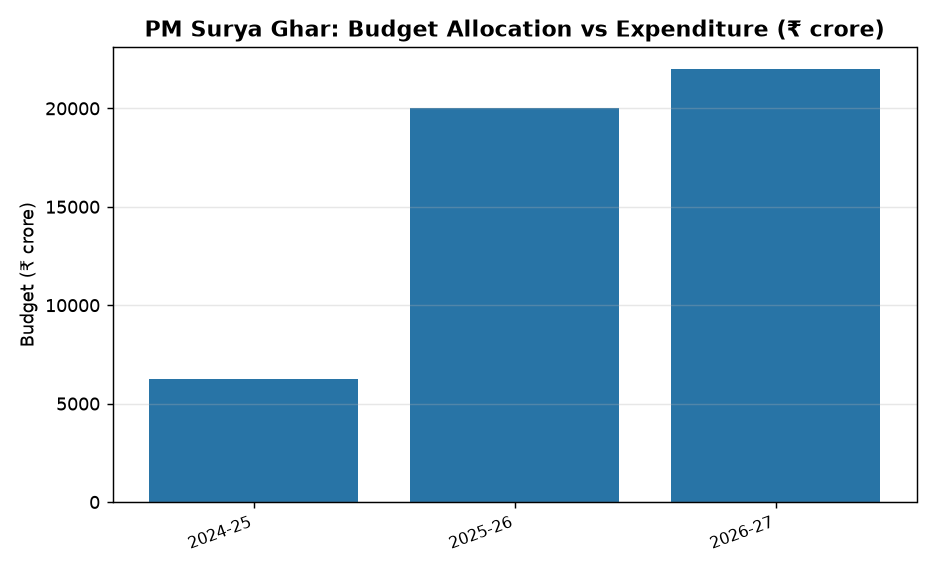
| Budgetary allocation and expenditure trends (FY 2024-25 to 2026-27) | Demonstrates government commitment and scalability of the scheme, with increasing allocations reflecting policy prioritisation. |
| Zero electricity bills for certain months for 18.93 lakh beneficiaries | Highlights immediate economic relief and incentivisation of solar adoption through net metering benefits. |
Why it Matters
Economic
- Reduces household electricity expenditure by up to 30-50%, enhancing disposable income for low- and middle-income groups.
- Stimulates local manufacturing and service industries through demand for solar panels, inverters, and installation services, creating employment in the green energy sector.
- Lowers aggregate technical and commercial losses for DISCOMs by reducing grid dependency and peak load demand.
- Encourages private investment in distributed renewable energy, reducing the fiscal burden on the central exchequer for energy subsidies.
Environmental
- Accelerates India’s renewable energy capacity addition, contributing to the target of 500 GW non-fossil fuel capacity by 2030.
- Reduces carbon emissions by an estimated 15-20 million tonnes annually, aligning with India’s Nationally Determined Contributions (NDCs).
- Promotes sustainable urban energy systems by integrating decentralised solar power into residential rooftops.
Social
- Enhances energy access and equity by prioritising economically weaker and middle-income households, reducing energy poverty.
- Empowers consumers through energy independence, reducing vulnerability to volatile fossil fuel prices.
- Promotes gender-inclusive energy solutions by enabling women-led households to benefit from reduced electricity costs.
Governance
- Demonstrates effective implementation of a centrally sponsored scheme with transparent budgetary disbursements and real-time monitoring.
- Leverages public-private partnerships (PPPs) through RESCO and ULA models, enhancing operational efficiency.
- Facilitates data-driven policymaking through real-time tracking of installations and beneficiary feedback.
Challenges
1. Grid Integration and Net Metering Policy Gaps
- Inconsistent net metering policies across states lead to disputes over surplus energy injection and billing mechanisms.
- Limited grid capacity in certain urban and rural areas may hinder seamless integration of distributed solar power.
- Lack of standardised interconnection guidelines increases transaction costs and delays for consumers.
UPSC Link: GS3: Energy Infrastructure
2. Financial Viability and Disbursement Bottlenecks
- Delays in disbursement of central financial assistance (CFA) due to procedural bottlenecks in state nodal agencies.
- High initial capital expenditure despite subsidies, deterring adoption among low-income households.
- Limited awareness among beneficiaries about loan schemes and eligibility criteria for low-interest financing.
UPSC Link: GS3: Financial Inclusion
3. Technical and Skilled Manpower Constraints
- Shortage of certified solar installers and technicians, leading to suboptimal system performance and safety risks.
- Inadequate quality control mechanisms for solar equipment, resulting in underperformance or premature system failures.
- Limited availability of after-sales service networks in rural and semi-urban areas.
UPSC Link: GS3: Skill Development
4. Land and Rooftop Availability
- Urban density and multi-storeyed buildings limit rooftop space availability for solar installations.
- Legal ambiguities over rooftop ownership in rented or cooperative housing societies complicate project execution.
- Aesthetic and structural concerns deter adoption in heritage or densely populated areas.
UPSC Link: GS3: Urbanisation
5. Monitoring and Evaluation Framework
- Lack of real-time data on system performance and energy generation leads to underutilisation of installed capacity.
- Inadequate grievance redressal mechanisms for beneficiaries facing delays or disputes with installers.
- Limited post-installation support for maintenance and troubleshooting.
UPSC Link: GS3: Governance
Challenges — UPSC Perspective
| Issue | Concern |
|---|---|
| State-wise variation in net metering policies | Creates regulatory uncertainty and discourages investment in distributed solar. |
| Delays in CFA disbursement | Increases financial burden on beneficiaries and reduces scheme credibility. |
| Shortage of skilled solar technicians | Leads to poor installation quality and higher maintenance costs. |
| Urban rooftop space constraints | Limits scalability of the scheme in high-density residential areas. |
| Limited awareness among target beneficiaries | Reduces uptake despite financial incentives and subsidies. |
| Grid stability concerns in high solar penetration areas | May require upgrades to distribution infrastructure, increasing costs. |
Government Initiatives — Must-Memorise for Prelims
- Pradhan Mantri Kisan Urja Suraksha evam Utthaan Mahabhiyaan (PM-KUSUM)
- KUSUM Component-A (Grid-connected solar pumps for farmers)
- National Solar Mission (NSM)
- Atal Jyoti Yojana (AJY)
- DDUGJY (Deen Dayal Upadhyaya Gram Jyoti Yojana)
Way Forward
- Strengthen inter-state coordination to harmonise net metering policies and standardise interconnection guidelines.
- Enhance disbursement mechanisms for CFA through digital platforms and direct benefit transfer (DBT) to reduce delays.
- Expand skill development programs for solar technicians under the PM-KUSUM and PM-Surya Ghar schemes.
- Promote innovative financing models such as green bonds and viability gap funding for RESCO operators.
- Establish a national-level grievance redressal portal for beneficiaries to track installation progress and resolve disputes.
- Incentivise urban local bodies (ULBs) to allocate dedicated rooftop space for solar installations in public buildings.
- Conduct periodic impact assessments to evaluate energy savings, carbon reduction, and socio-economic benefits.
- Develop a national rooftop solar atlas to map potential capacity and streamline project approvals.
UPSC Value Addition
Keywords for Mains Answer-Writing
Rooftop Solar Programme Phase-II · PM Surya Ghar Muft Bijli Yojana · Renewable Energy Targets 2030 · Central Financial Assistance for Solar Rooftops · Subsidised Interest Rates for Solar Loans · RESCO Model for Solar Energy · Utility-Led Aggregation (ULA) Model · Net Metering and Energy Credits · Energy Transition in India · Solar Energy Adoption in Urban and Rural Areas · National Renewable Energy Mission · Atmanirbhar Bharat in Solar Manufacturing
Constitutional & Policy Linkages
- Article 21 (Right to Life) – Right to clean and affordable energy.
- Article 39(b) (Directive Principles) – Promotion of public welfare through equitable distribution of resources.
Concept Flow
Rooftop solar adoption → Reduced electricity bills for households → Increased disposable income → Higher savings and consumption → Economic growth → Reduced fossil fuel dependency → Lower carbon emissions → Climate change mitigation → Achievement of NDCs → Sustainable development.
Prelims Practice Questions
Q1. Consider the following statements regarding the PM Surya Ghar Muft Bijli Yojana: 1) It provides financial assistance for rooftop solar systems up to 2 kW capacity. 2) Loans are offered at repo rate plus 50 basis points for a tenure of 10 years without collateral. 3) The scheme is applicable only for economically weaker sections and excludes middle-income groups. Which of the above statements is/are correct?
- 1 and 2 only
- 2 and 3 only
- 1 and 3 only
- 1, 2 and 3
Answer: 1 and 2 only — Statement 1 is correct as the scheme provides enhanced central financial assistance for the first 2 kW of rooftop solar capacity. Statement 2 is correct as loans are offered at repo rate plus 50 basis points (currently 5.75%) for 10 years without collateral. Statement 3 is incorrect as the scheme targets both middle-income and economically weaker sections.
Q2. Which of the following models is NOT a part of the PM Surya Ghar Muft Bijli Yojana for rooftop solar adoption?
- RESCO Model
- Utility-Led Aggregation (ULA) Model
- Grid-Connected Solar Model
- Net Metering Model
Answer: Net Metering Model — The PM Surya Ghar Muft Bijli Yojana includes the RESCO Model and Utility-Led Aggregation (ULA) Model for rooftop solar adoption. The Grid-Connected Solar Model is a general term and not a specific model under this scheme. Net Metering is a mechanism, not a model.
Q3. What is the primary objective of the PM Surya Ghar Muft Bijli Yojana?
- To provide free electricity to all households in India
- To make rooftop solar systems accessible to middle-income and economically weaker sections with financial and interest rate support
- To replace all conventional power plants with solar energy within five years
- To subsidise electric vehicles for urban commuters
Answer: To make rooftop solar systems accessible to middle-income and economically weaker sections with financial and interest rate support — The primary objective of the PM Surya Ghar Muft Bijli Yojana is to make rooftop solar systems accessible to middle-income and economically weaker sections by providing financial assistance and subsidised interest rates.
Mains Practice Question
✍ Critically analyse the role of the PM Surya Ghar Muft Bijli Yojana in accelerating India’s transition to renewable energy. How does the scheme address financial and technological barriers to rooftop solar adoption? Discuss its potential impact on energy security and climate goals.
Approach: Begin by outlining the scheme’s key provisions, including financial assistance, subsidised loans, and models like RESCO and ULA. Examine how these provisions address financial and technological barriers such as high upfront costs and lack of awareness. Analyse the scheme’s contribution to India’s renewable energy targets, energy security, and climate goals, while also discussing challenges like grid integration and scalability. Conclude with a balanced assessment of its effectiveness and areas for improvement.
Source: PIB (Press Information Bureau)
Generated by AanyaAi for educational purpose.

- तमिलनाडु के लिए क्या है ‘एल नीनो’ और उत्तर-पूर्वी मानसून का खतरा? - September 23, 2026
- El Nino & Northeast Monsoon: Impact on Tamil Nadu for UPSC 2026 - September 23, 2026
- हिमाचल में डिजिटल भुगतान क्रांति: बिलासपुर अव्वल, महिलाओं की भागीदारी 93% तक पहुंची - September 23, 2026

No Comments