


29 Jul Treasury Bills Auction Results: RBI’s July 2026 Data Explained for UPSC
Subject Relevance — Where This Topic Fits
- GS Paper III — Indian Economy: Money and Banking, Government Budgeting and Fiscal Policy, Monetary Policy
- Prelims: Treasury Bills (T-Bills), Yield to Maturity (YTM), Weighted Average Yield (WAY), Non-competitive Bidding, Partial Allotment, RBI’s Open Market Operations (OMOs), Liquidity Adjustment Facility (LAF), Statutory Liquidity Ratio (SLR), Cash Management Bills (CMBs)
- Essay: The role of Treasury Bills in India’s fiscal-monetary interface: balancing liquidity, cost of borrowing, and macroeconomic stability, Debt financing in India: the interplay between fiscal deficit, market borrowing, and monetary policy transmission
Quick Revision: Treasury Bills are zero-coupon, short-term government securities issued at a discount to face value, with yields determined by auction cut-off prices and weighted average yields, reflecting market liquidity and interest rate expectations.
Why is this in the news?
The Reserve Bank of India (RBI) conducted a full auction of 91-day, 182-day, and 364-day Treasury Bills on 29 July 2026, with notable oversubscription and differential cut-off yields across tenors. The auction results reflect evolving market expectations of interest rates, liquidity conditions, and the RBI’s debt management strategy amid evolving macroeconomic dynamics, including inflation trajectories and fiscal consolidation efforts.
Background
- Treasury Bills (T-Bills) are short-term government securities issued by the RBI on behalf of the Government of India to meet its short-term borrowing requirements.
- T-Bills are issued at a discount to face value and redeemed at par, with the difference representing the interest earned by investors.
- The RBI conducts T-Bill auctions weekly under the Multiple Price Auction (MPA) system, where successful bidders pay their respective bid prices.
- Non-competitive bidding allows small investors to participate without specifying yield or price, with allotment on a pro-rata basis.
- The auction results are critical indicators of market liquidity, interest rate expectations, and the RBI’s monetary policy stance.
- India’s fiscal deficit management relies heavily on market borrowings through instruments like T-Bills, especially during periods of revenue shortfalls or elevated expenditure.
What are Treasury Bills (T-Bills)?
- T-Bills are zero-coupon securities issued by the Government of India, maturing in less than one year (typically 91, 182, or 364 days).
- They are issued at a discount to their face value and redeemed at par, with the discount representing the implicit interest.
- T-Bills are considered risk-free assets due to their sovereign guarantee and are used by the RBI for liquidity management and monetary operations.
- The auction process for T-Bills follows a Multiple Price Auction (MPA) system, where successful bidders pay their respective bid prices, ensuring price discovery.
- Non-competitive bidding is permitted to encourage retail participation, with allotment on a pro-rata basis and settlement at the weighted average yield.
- T-Bills serve as benchmarks for short-term interest rates in the economy and are actively traded in the secondary market.
- They are an integral part of the RBI’s Open Market Operations (OMOs) and Cash Management Bills (CMBs) issuance framework.
- The yield on T-Bills is influenced by factors such as the repo rate, inflation expectations, liquidity conditions, and global interest rate trends.
Key Features
| Feature | Significance |
|---|---|
| Notified Amount | Represents the government’s planned borrowing through Treasury Bills (T-Bills) for liquidity management and fiscal deficit financing. |
| Competitive Bids Received | Indicates market demand for short-term government securities, reflecting investor confidence and liquidity conditions. |
| Cut-off Price/Yield | Determines the cost of borrowing for the government and the return for investors; higher yields signal rising interest rate expectations. |
| Competitive Bids Accepted | Shows the proportion of bids that met the government’s borrowing requirements, ensuring efficient allocation of funds. |
| Non-Competitive Bids Accepted | Provides retail investors (e.g., individuals) access to T-Bills without competitive bidding, promoting financial inclusion. |
| Weighted Average Yield | Reflects the true cost of borrowing for the government across all accepted bids, aiding in benchmarking for other debt instruments. |
Why it Matters
Fiscal Policy and Government Borrowing
- T-Bills are a key instrument for managing the fiscal deficit, as they are short-term debt instruments issued by the government to meet immediate funding needs.
- The auction results indicate the government’s ability to raise funds at sustainable yields, balancing fiscal prudence with market conditions.
- Higher yields in longer-tenor T-Bills (364-Day) suggest rising inflation expectations or tighter liquidity conditions in the economy.
Monetary Policy and Liquidity Management
- The yield curve derived from T-Bill auctions provides insights into the Reserve Bank of India’s (RBI) monetary policy stance, particularly regarding interest rate expectations.
- Non-competitive bids, predominantly from retail investors, indicate the attractiveness of government securities as a safe investment avenue, reducing pressure on commercial banks for liquidity.
Market Sentiment and Investor Confidence
- The oversubscription of bids (e.g., 182-Day T-Bills received ₹22,590 crore against a notified ₹8,000 crore) reflects strong investor appetite for high-quality sovereign debt.
- Partial allotment percentages (e.g., 96.42% for 364-Day T-Bills) suggest efficient price discovery and allocation mechanisms in the primary market.
Benchmarking for Financial Markets
- T-Bill yields serve as a benchmark for pricing other debt instruments, including corporate bonds and commercial paper, influencing borrowing costs across the economy.
- The weighted average yield provides a reference rate for the RBI to assess the transmission of monetary policy to the broader financial system.
Retail Participation and Financial Inclusion
- Non-competitive bids, particularly in the 91-Day T-Bills (₹20,826 crore), highlight the growing participation of retail investors in government securities, aligning with RBI’s initiatives for financial inclusion.
Challenges
1. Rising Borrowing Costs
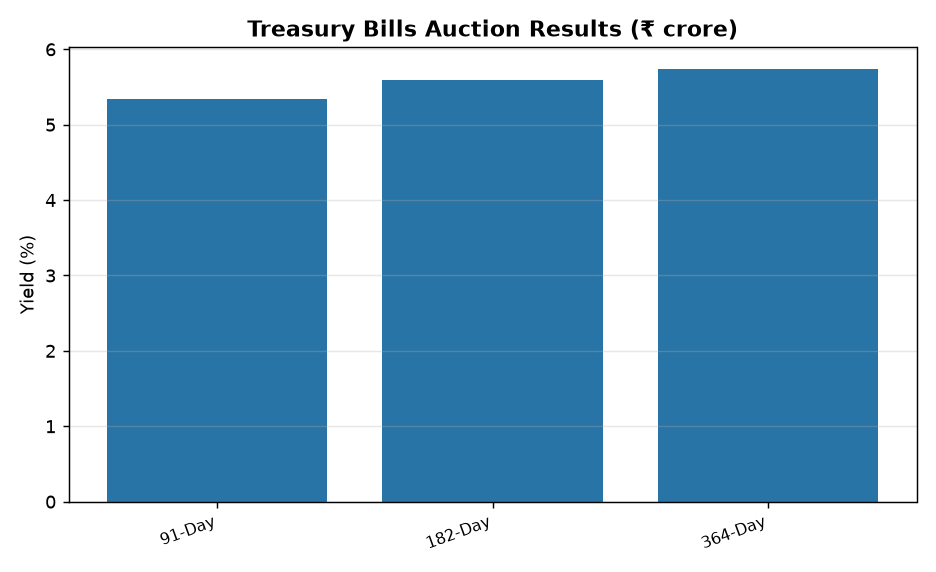
- The increasing yields across T-Bill tenors (5.34% to 5.74%) indicate rising borrowing costs for the government, which could exacerbate fiscal pressures if sustained.
- Higher yields may crowd out private sector borrowing, leading to reduced investment and economic growth.
UPSC Link: GS3: Fiscal Policy
2. Liquidity Constraints in the Banking System
- Oversubscription in T-Bill auctions may reflect tight liquidity conditions, where banks and financial institutions prefer parking funds in risk-free government securities over lending to the private sector.
- This could constrain credit growth, particularly for MSMEs and other priority sectors.
UPSC Link: GS3: Banking Sector Reforms
3. Inflation Expectations and Monetary Policy Dilemma
- Higher T-Bill yields may signal rising inflation expectations, complicating the RBI’s monetary policy stance between controlling inflation and supporting growth.
- The RBI may face challenges in calibrating interest rates to balance inflation control with liquidity infusion.
UPSC Link: GS3: Inflation Dynamics
4. Retail Investor Participation Challenges
- While non-competitive bids indicate retail interest, the small absolute amounts (e.g., ₹9.79 crore for 364-Day T-Bills) suggest limited awareness or accessibility barriers for retail investors.
- Digital infrastructure and financial literacy initiatives are critical to enhance participation.
UPSC Link: GS3: Financial Inclusion
5. Market Volatility and Yield Fluctuations
- Sudden shifts in investor sentiment or global financial conditions can lead to volatility in T-Bill yields, affecting the government’s borrowing costs and market stability.
- This necessitates robust risk management frameworks in financial institutions.
UPSC Link: GS3: Financial Markets
Challenges — UPSC Perspective
| Issue | Concern |
|---|---|
| Fiscal Deficit Management | Sustained high borrowing costs may widen the fiscal deficit, necessitating a rebalancing of revenue and expenditure. |
| Credit Market Impact | Higher T-Bill yields could lead to higher lending rates, reducing credit availability for the private sector. |
| Inflation Persistence | Rising yields may reflect inflationary pressures, requiring tighter monetary policy which could dampen economic growth. |
| Investor Diversification | Over-reliance on T-Bills for liquidity management may reduce diversification in investor portfolios, increasing systemic risks. |
| Regulatory Oversight | Ensuring fair price discovery and preventing market manipulation in T-Bill auctions requires robust regulatory oversight. |
| Digital Divide in Investments | Limited digital infrastructure and financial literacy may hinder retail investor participation in government securities. |
Way Forward
- Monitor T-Bill yields closely to assess inflation expectations and adjust fiscal and monetary policies accordingly.
- Enhance retail investor participation through digital platforms (e.g., RBI Retail Direct Scheme) and financial literacy campaigns.
- Strengthen liquidity management in the banking system to ensure credit flow to productive sectors of the economy.
- Diversify the investor base for government securities to reduce reliance on a narrow set of institutional investors.
- Conduct regular reviews of the T-Bill auction mechanism to improve price discovery and allocation efficiency.
- Collaborate with the RBI to align T-Bill issuance with broader monetary policy objectives, particularly in managing inflation and growth trade-offs.
- Promote the development of secondary markets for T-Bills to enhance liquidity and price transparency.
UPSC Value Addition
Keywords for Mains Answer-Writing
Treasury Bills · Money Market Instruments · Yield to Maturity (YTM) · Reserve Bank of India (RBI) · Public Debt Management · Short-term Government Securities · Cut-off Yield · Weighted Average Yield · Competitive and Non-Competitive Bidding · Monetary Policy Transmission · Fiscal Deficit Financing · Liquidity Management · Capital Market Instruments · Government Securities Act, 2006 · Open Market Operations
Concept Flow
Government announces notified amount for T-Bill auctions → Market participants (banks, FIs, retail investors) submit competitive and non-competitive bids → RBI conducts auction to determine cut-off yields → Accepted bids are allotted, and funds are raised → Government uses funds to meet fiscal deficit or liquidity needs → Market yields influence broader interest rates and inflation expectations → Investor confidence and liquidity conditions are assessed for future auctions.
Prelims Practice Questions
Q1. Consider the following statements regarding Treasury Bills (T-Bills) in India:
1. Treasury Bills are issued by the Government of India to meet short-term financial needs.
2. T-Bills are issued for maturities of 91 days, 182 days, and 364 days.
3. The yield on T-Bills is determined through a competitive bidding process conducted by the Reserve Bank of India.
4. Non-competitive bids are not allowed in the auction of T-Bills.
How many of the above statements are correct?
- Only one
- Only two
- Only three
- All four
Answer: Only three — Statements 1, 2, and 3 are correct. Statement 4 is incorrect as non-competitive bids are permitted in T-Bill auctions.
Q2. Assertion (A): The yield to maturity (YTM) on a Treasury Bill is inversely related to its price.
Reason (R): Treasury Bills are zero-coupon securities, and their price is determined by market demand and supply.
Options:
A. Both A and R are true, and R is the correct explanation of A.
B. Both A and R are true, but R is not the correct explanation of A.
C. A is true, but R is false.
D. A is false, but R is true.
- A
- B
- C
- D
Answer: A — Both A and R are true, and R correctly explains A. The inverse relationship between price and yield is a fundamental principle of zero-coupon securities like T-Bills.
Q3. Match the following columns related to Treasury Bills:
Column I (Maturity Period) | Column II (Yield to Maturity Range)
—————————|——————————-
A. 91-Day T-Bill | 1. 5.3% – 5.5%
B. 182-Day T-Bill | 2. 5.5% – 5.7%
C. 364-Day T-Bill | 3. 5.7% – 5.9%
Options:
1. A-1, B-2, C-3
2. A-2, B-1, C-3
3. A-3, B-2, C-1
4. A-1, B-3, C-2
- 1
- 2
- 3
- 4
Answer: 1 — The 91-Day T-Bill has a YTM of 5.34%, the 182-Day T-Bill has a YTM of 5.59%, and the 364-Day T-Bill has a YTM of 5.73%, matching Column I to Column II as 1, 2, and 3 respectively.
Mains Practice Question
✍ The yield on Treasury Bills (T-Bills) serves as a critical benchmark for short-term interest rates in the Indian economy. In this context, critically examine the role of T-Bills in India’s public debt management and monetary policy transmission. Also, analyse how the auction results of T-Bills reflect the interplay between fiscal deficit financing and liquidity conditions in the economy. (15 Marks)
Approach: MODEL-ANSWER SKELETON:
1. **Introduction**: Define Treasury Bills and their significance as short-term government securities.
2. **Role in Public Debt Management**:
– Explain how T-Bills are used to finance the fiscal deficit.
– Discuss the Government Securities Act, 2006, and RBI’s role in managing public debt.
– Highlight the advantages of T-Bills (e.g., zero credit risk, liquidity).
3. **Monetary Policy Transmission**:
– Explain how T-Bill yields influence broader interest rates (e.g., repo rate, bank lending rates).
– Discuss the concept of ‘term premium’ and its impact on yields.
– Reference the RBI’s Open Market Operations (OMOs) and liquidity management.
4. **Auction Results Analysis**:
– Interpret the given auction data (cut-off yields, weighted average yields, competitive vs. non-competitive bids).
– Explain how higher bids reflect stronger demand and tighter liquidity conditions.
– Discuss the significance of partial allotment percentages.
5. **Interplay with Fiscal Deficit and Liquidity**:
– Analyse how fiscal deficit financing through T-Bills affects liquidity in the banking system.
– Discuss the role of non-competitive bids in ensuring broad-based participation.
6. **Challenges and Criticisms**:
– Highlight issues like crowding out of private investment or over-reliance on short-term debt.
– Discuss the impact of global financial conditions on domestic T-Bill yields.
7. **Conclusion**: Summarise the findings and provide a balanced view on the efficacy of T-Bills in India’s macroeconomic framework.
Source: RBI
Generated by AanyaAi for educational purpose.

- मध्य प्रदेश में स्वास्थ्य सेवाओं का विस्तार: पीपीपी मॉडल और एमबीबीएस सीटों में वृद्धि - September 19, 2026
- MP’s Health Sector Progress Reviewed by Union Health Minister JP Nadda - September 19, 2026
- ओडिशा में 870 एकड़ में बनेगा ‘सिलिकॉन वैली’, जानिए क्या होगा फायदा - September 19, 2026

No Comments