


31 Jul UPSC Exam: ‘Poshan Tracker’ App Launched Under Mission Poshan 2.0 for Nutrition Tracking
✎ The Ministry of Women and Child Development has launched the digital application 'Poshan Tracker' under Mission Poshan 2.0 as an ICT-based governance tool to monitor and track all services provided to beneficiaries registered at…
Subject Relevance — Where This Topic Fits
- GS Paper II — Governance, Transparency and Accountability | GS Paper II — Issues Relating to Development and Management of Social Sector/Services relating to Health, Education, Human Resources | GS Paper III — Technology Missions and Digital Governance for Public Welfare
- Prelims: Poshan Tracker, Mission Poshan 2.0, Anganwadi Services, Take-Home Ration (THR), Hot Cooked Meal (HCM), Growth Monitoring Devices (GMD), POSHAN Abhiyaan, Severe Acute Malnutrition (SAM), Nutrition Month (Poshan Maah), Nutrition Fortnight (Poshan Pakhwada), Nutrition Gardens (Poshan Vatika), National Food Security Act 2013, Integrated Child Development Services (ICDS), Community Mobilisation, District Nutrition Committees
- Essay: Digital Public Infrastructure for Social Welfare: The Case of Poshan Tracker, Nutrition as a Cornerstone of Human Capital Development: Policy and Technological Interventions
Why is this in the news?
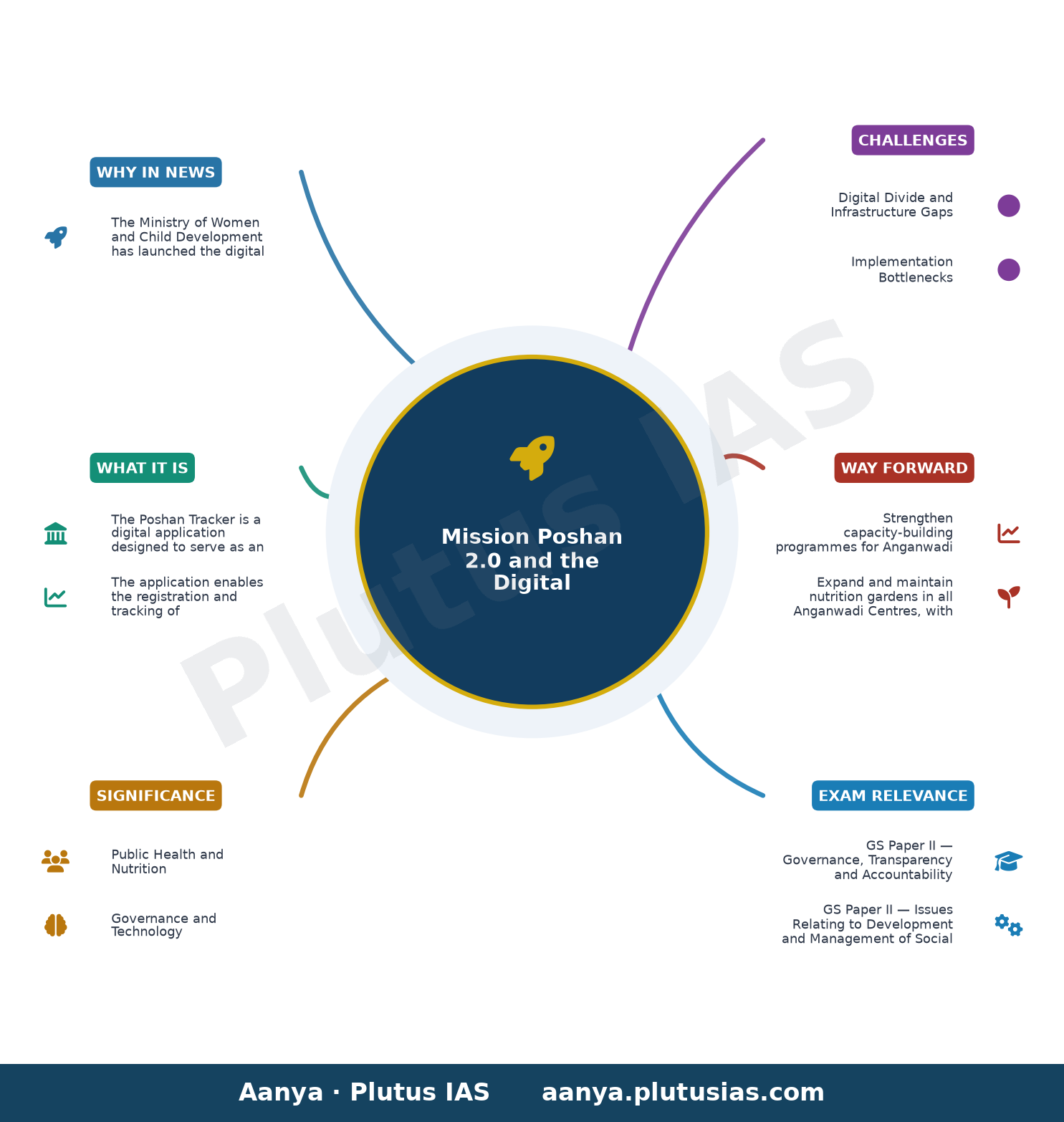
The Ministry of Women and Child Development has launched the digital application ‘Poshan Tracker’ under Mission Poshan 2.0 as an ICT-based governance tool to monitor and track all services provided to beneficiaries registered at Anganwadi Centres (AWCs). This initiative aims to enhance the efficiency, transparency, and accountability of nutritional governance by leveraging real-time data analytics and digital dashboards, thereby addressing the persistent challenge of malnutrition in India through data-driven interventions.
Background
- The Government of India launched the Poshan Abhiyaan (National Nutrition Mission) in 2018 to address malnutrition among children, pregnant women, lactating mothers, and adolescent girls through a multi-sectoral convergence approach.
- The National Food Security Act (NFSA), 2013, mandates the provision of supplementary nutrition to children aged 6 months to 6 years, pregnant women, lactating mothers, and adolescent girls through the Integrated Child Development Services (ICDS) scheme, including Hot Cooked Meal (HCM) and Take-Home Ration (THR).
- Malnutrition remains a critical public health challenge in India, with high prevalence of stunting (35.5%), wasting (19.3%), and underweight (32.1%) among children under five, as per the National Family Health Survey-5 (NFHS-5, 2019-21).
- The use of digital tools in public health governance has gained prominence post-COVID-19, with a focus on real-time monitoring, data-driven decision-making, and reducing administrative bottlenecks.
What is Mission Poshan 2.0 and the Poshan Tracker Application?
- The Poshan Tracker is a digital application designed to serve as an ICT-based governance tool for real-time monitoring, tracking, and evaluation of nutritional services provided at Anganwadi Centres (AWCs) across India, ensuring transparency and accountability in service delivery.
- The application enables the registration and tracking of beneficiaries, including children aged 0-6 years, pregnant women, lactating mothers, and adolescent girls, with demographic and anthropometric data captured at the point of service delivery.
- Poshan Tracker facilitates the dynamic identification of malnutrition prevalence, including stunting, wasting, and underweight among children, through automated data analytics and reporting mechanisms, aiding in targeted interventions.
- The application supports the digitization of growth monitoring through the provision of Growth Monitoring Devices (GMDs) such as infantometers, stadiometers, and weighing scales at AWCs, enabling accurate and timely tracking of child growth metrics.
- Frontline workers, including Anganwadi workers and supervisors, are equipped with smartphones and data recharge facilities to ensure seamless data entry and real-time updates on beneficiary progress, enhancing their operational efficiency.
- Poshan Tracker integrates with the Poshan Tracker Dashboard (https://www.poshantracker.in/statistics), which provides state-wise and district-wise statistics on the number of AWCs, beneficiaries, and services delivered, fostering data-driven governance and public accountability.
- The application also supports the implementation of community mobilization campaigns such as Poshan Maah (Nutrition Month) and Poshan Pakhwada (Nutrition Fortnight), which aim to raise awareness about nutrition, dietary diversity, and behavioral change among communities.
Key Features
| Feature | Significance |
|---|---|
| Digital Application ‘Poshan Tracker’ | Enables real-time monitoring and tracking of nutritional services provided to beneficiaries at Anganwadi Centres (AWCs) across all states and Union Territories, ensuring transparency and accountability in service delivery. |
| Development Monitoring Devices (GMDs) | Includes infantometers, stadiometers, neonatal weighing machines, and mother-child weighing machines to regularly assess growth parameters of children and mothers, facilitating early detection of malnutrition. |
| Hot Cooked Meal (HCM) and Take-Home Ration (THR) | Provides supplementary nutrition to children aged 6 months to 6 years, pregnant women, lactating mothers, and adolescent girls as per prescribed nutritional norms under the National Food Security Act, 2013. |
| Nutrition Gardens (Poshan Vatika) | Promotes dietary diversity by encouraging the consumption of local and seasonal fruits and vegetables, thereby enhancing micronutrient intake at the grassroots level. |
| Community Mobilisation and Awareness Campaigns | Conducted as ‘Poshan Maah’ (September) and ‘Poshan Pakhwada’ (March-April) to educate communities on nutrition, fostering behavioral change for sustainable dietary habits. |
Why it Matters
Public Health and Nutrition
- Facilitates early identification and intervention for children suffering from Severe Acute Malnutrition (SAM) through systematic growth monitoring and data-driven tracking.
- Enhances the efficiency of supplementary nutrition programmes by ensuring targeted delivery of services to high-risk groups such as pregnant women, lactating mothers, and children under six.
- Promotes dietary diversity and micronutrient sufficiency through the establishment of nutrition gardens, addressing hidden hunger in vulnerable populations.
Governance and Technology
- Leverages ICT-based governance tools to improve transparency, reduce leakages, and enable evidence-based policymaking in nutrition programmes.
- Strengthens inter-departmental coordination by integrating data from Anganwadi workers, health workers, and district administration through digital platforms.
- Empowers frontline workers (Anganwadi Sevika) with smartphones and data connectivity, enhancing their capacity to deliver timely and accurate nutritional counselling.
Socio-Economic Impact
- Contributes to the reduction of stunting, wasting, and underweight prevalence among children, thereby improving human capital development and long-term economic productivity.
- Supports maternal and child health outcomes, reducing maternal and infant mortality rates by ensuring adequate nutrition during critical life stages.
- Fosters community ownership and participation in nutrition programmes through awareness campaigns, leading to sustainable behavioral change.
Data-Driven Policy
- Provides real-time data on nutritional status, service delivery gaps, and programme performance, enabling targeted interventions and resource allocation.
- Enables periodic review of programme progress at district, state, and national levels through structured committees, ensuring accountability and course correction.
Challenges
1. Digital Divide and Infrastructure Gaps
- Inadequate digital literacy among frontline workers may hinder effective utilisation of the ‘Poshan Tracker’ application.
- Uneven availability of smartphones and internet connectivity in remote and tribal areas may limit the reach of digital monitoring tools.
UPSC Link: GS2: E-governance
2. Implementation Bottlenecks
- Delays in the procurement and distribution of Take-Home Ration (THR) and Hot Cooked Meal (HCM) due to logistical and administrative challenges.
- Inconsistent quality of supplementary nutrition provided under ICDS, leading to suboptimal nutritional outcomes.
UPSC Link: GS2: Welfare schemes
3. Behavioral and Cultural Barriers
- Deep-rooted dietary practices and food taboos may resist the adoption of recommended nutritional practices, particularly in tribal and rural communities.
- Low awareness and participation in community mobilisation activities, especially among marginalised groups.
UPSC Link: GS1: Social empowerment
4. Monitoring and Evaluation Gaps
- Inadequate training of Anganwadi workers in growth monitoring and data entry may lead to inaccuracies in the ‘Poshan Tracker’ database.
- Limited capacity of district and state-level committees to conduct rigorous, evidence-based reviews of programme performance.
UPSC Link: GS2: Governance
5. Resource Constraints
- Insufficient budgetary allocation for the expansion and maintenance of nutrition gardens and supplementary nutrition programmes.
- Shortage of certified nutrition specialists in district and state-level committees, affecting the quality of technical oversight.
UPSC Link: GS3: Resource mobilisation
Challenges — UPSC Perspective
| Issue | Concern |
|---|---|
| Digital Literacy Gaps | Frontline workers may lack the skills to effectively use the ‘Poshan Tracker’ application, leading to data inaccuracies. |
| Supply Chain Disruptions | Delays in the delivery of Take-Home Ration (THR) and Hot Cooked Meal (HCM) undermine the programme’s impact. |
| Cultural Resistance to Dietary Change | Traditional food practices may hinder the adoption of nutrition gardens and recommended dietary habits. |
| Inadequate Training in Growth Monitoring | Anganwadi workers may lack the expertise to accurately measure and record growth parameters. |
| Limited Community Participation | Low awareness and engagement in ‘Poshan Maah’ and ‘Poshan Pakhwada’ reduce the programme’s reach. |
| Data Privacy and Security Risks | Digital tracking of beneficiary data raises concerns about confidentiality and misuse of sensitive information. |
Government Initiatives — Must-Memorise for Prelims
- Integrated Child Development Services (ICDS)
- National Food Security Act, 2013 (Schedule-II)
Way Forward
- Strengthen capacity-building programmes for Anganwadi workers on digital tools, growth monitoring, and nutritional counselling to enhance service delivery.
- Expand and maintain nutrition gardens in all Anganwadi Centres, with a focus on indigenous and climate-resilient crops to ensure year-round availability.
- Improve the supply chain for Take-Home Ration (THR) and Hot Cooked Meal (HCM) through robust monitoring and decentralised procurement mechanisms.
- Enhance community mobilisation efforts by leveraging local influencers, self-help groups, and digital platforms to drive behavioral change.
- Establish a robust grievance redressal mechanism for beneficiaries to report delays, quality issues, or non-delivery of supplementary nutrition.
- Promote inter-ministerial convergence between the Ministry of Women and Child Development and the Ministry of Health and Family Welfare to align nutrition and health interventions.
- Conduct periodic independent evaluations of the ‘Poshan Tracker’ to assess its impact on nutritional outcomes and programme efficiency.
- Ensure equitable access to digital tools by providing smartphones and internet connectivity to Anganwadi workers in remote and tribal areas.
UPSC Value Addition
Keywords for Mains Answer-Writing
Mission Saksham Anganwadi and POSHAN 2.0 · Poshan Tracker digital application · ICT-based governance tools · Anganwadi Services Monitoring · Nutrition Tracking System · Severe Acute Malnutrition (SAM) · Take-Home Ration (THR) · Hot Cooked Meal (HCM) · Nutrition Month and Poshan Pakhwada · Nutrition Gardens (Poshan Vatika) · ICDS Scheme · Women and Child Development Ministry
Constitutional & Policy Linkages
- [‘Article 47 (DPSP)’, “State’s duty to raise nutrition levels”]
- [‘Article 21 (Right to Life)’, ‘Implied right to nutrition for survival and dignity’]
Concept Flow
Inadequate nutrition among pregnant women, lactating mothers, and children under six → High prevalence of stunting, wasting, and underweight → Implementation of ICDS and Mission Poshan 2.0 → Mission Poshan 2.0 introduces ‘Poshan Tracker’ and Development Monitoring Devices (GMDs) → Real-time data on nutritional status and service delivery gaps → Digital tracking and growth monitoring enable early identification of Severe Acute Malnutrition (SAM) → Targeted interventions for high-risk groups → Supplementary nutrition (HCM and THR) provided as per NFSA norms → Improved dietary intake and micronutrient sufficiency → Nutrition gardens established to promote dietary diversity → Enhanced consumption of local and seasonal produce → Community mobilisation through ‘Poshan Maah’ and ‘Poshan Pakhwada’ → Behavioral change and sustained adoption of nutritional practices → Periodic reviews by district and state-level committees → Evidence-based policymaking and course correction
Prelims Practice Questions
Q1. Consider the following statements regarding the Poshan Tracker application launched under Mission Saksham Anganwadi and POSHAN 2.0:
1. It is an ICT-based governance tool for monitoring and tracking services provided to beneficiaries at Anganwadi Centres.
2. It is designed to identify the prevalence of stunting, underweight, and wasting among children dynamically.
3. The application is mandatory for all states and Union Territories to adopt under the National Food Security Act, 2013.
How many of the above statements are correct?
- Only one
- Only two
- All three
- None
Answer: Only two — Statement 1 is correct as Poshan Tracker is an ICT-based governance tool for monitoring services at Anganwadi Centres. Statement 2 is correct as it is used for dynamic identification of malnutrition indicators. Statement 3 is incorrect as adoption is not mandatory under NFSA 2013 but under Mission POSHAN 2.0.
Q2. Assertion (A): The Poshan Tracker application is designed to replace the manual monitoring of nutrition outcomes in Anganwadi Centres.
Reason (R): The application provides real-time data on the nutritional status of children and mothers, enabling timely interventions.
In the context of the above two statements, which one of the following is correct?
- Both A and R are true, and R is the correct explanation of A.
- Both A and R are true, but R is not the correct explanation of A.
- A is true, but R is false.
- A is false, but R is true.
Answer: Both A and R are true, and R is the correct explanation of A. — Both the assertion and reason are true. The Poshan Tracker does replace manual monitoring to some extent by providing real-time data, and the reason correctly explains the assertion.
Q3. Match the following initiatives under Mission POSHAN 2.0 with their respective objectives:
Column I (Initiative) | Column II (Objective)
— | —
A. Poshan Tracker | 1. To provide real-time monitoring of nutritional services at Anganwadi Centres
B. Take-Home Ration (THR) | 2. To deliver supplementary nutrition to severely malnourished children
C. Nutrition Gardens (Poshan Vatika) | 3. To promote dietary diversity through locally grown fruits and vegetables
D. Poshan Pakhwada | 4. To create awareness about nutrition through community mobilization campaigns
Select the correct match:
- A-1, B-2, C-3, D-4
- A-2, B-1, C-4, D-3
- A-3, B-4, C-1, D-2
- A-4, B-3, C-2, D-1
Answer: A-1, B-2, C-3, D-4 — The correct matches are: A-1 (Poshan Tracker for real-time monitoring), B-2 (THR for severely malnourished children), C-3 (Nutrition Gardens for dietary diversity), and D-4 (Poshan Pakhwada for awareness campaigns).
Mains Practice Question
✍ Critically examine the role of the Poshan Tracker application in addressing malnutrition under Mission POSHAN 2.0. How far has the integration of ICT tools in nutrition governance improved outcomes for children and mothers? (15 Marks)
Approach: MODEL-ANSWER SKELETON:
1. **Introduction (2 marks)**
– Briefly define Mission POSHAN 2.0 and its objectives under the ICDS scheme.
– Introduce Poshan Tracker as an ICT-based governance tool launched to monitor nutritional services at Anganwadi Centres.
2. **Role of Poshan Tracker (5 marks)**
– **Real-time monitoring**: Explain how the application enables dynamic tracking of nutritional status (stunting, wasting, underweight) and services (HCM, THR) for children (6 months–6 years), pregnant/lactating mothers, and adolescents.
– **Data-driven interventions**: Discuss how the dashboard (https://www.poshantracker.in/statistics) provides state-wise and district-wise data for targeted policy responses.
– **Empowerment of frontline workers**: Highlight the provision of smartphones and data recharge to Anganwadi workers for seamless data entry and service delivery.
– **Integration with existing frameworks**: Link to the National Food Security Act, 2013 (Schedule-II nutrition norms) and the National Nutrition Mission (NNM) targets.
3. **Impact on Outcomes (5 marks)**
– **Quantitative improvements**: Cite any available data (if any in the source) on reductions in malnutrition prevalence post-implementation.
– **Behavioral change**: Discuss how Poshan Tracker supports the Poshan Pakhwada and Poshan Maah campaigns in raising community awareness.
– **Challenges**: Acknowledge limitations such as digital divide, data accuracy, and the need for capacity-building among workers.
4. **Critical Evaluation (3 marks)**
– **Strengths**: Emphasize the transparency, accountability, and evidence-based policymaking enabled by ICT tools.
– **Weaknesses**: Highlight gaps in ground-level implementation, such as underreporting or lack of inter-departmental coordination.
– **Way forward**: Suggest measures like strengthening backend infrastructure, training, and community participation to enhance effectiveness.
Source: PIB (Press Information Bureau)
Generated by AanyaAi for educational purpose.

- तमिलनाडु के लिए क्या है ‘एल नीनो’ और उत्तर-पूर्वी मानसून का खतरा? - September 23, 2026
- El Nino & Northeast Monsoon: Impact on Tamil Nadu for UPSC 2026 - September 23, 2026
- हिमाचल में डिजिटल भुगतान क्रांति: बिलासपुर अव्वल, महिलाओं की भागीदारी 93% तक पहुंची - September 23, 2026

No Comments