


02 Aug UN Warns: Record El Niño Could Trigger Global Climate Disasters in 2026-27
✎ El Niño, a natural climate phenomenon, is currently intensifying in 2026 with record-breaking early-stage ocean warming, amplifying extreme weather events globally due to its interaction with anthropogenic climate change, thereby…
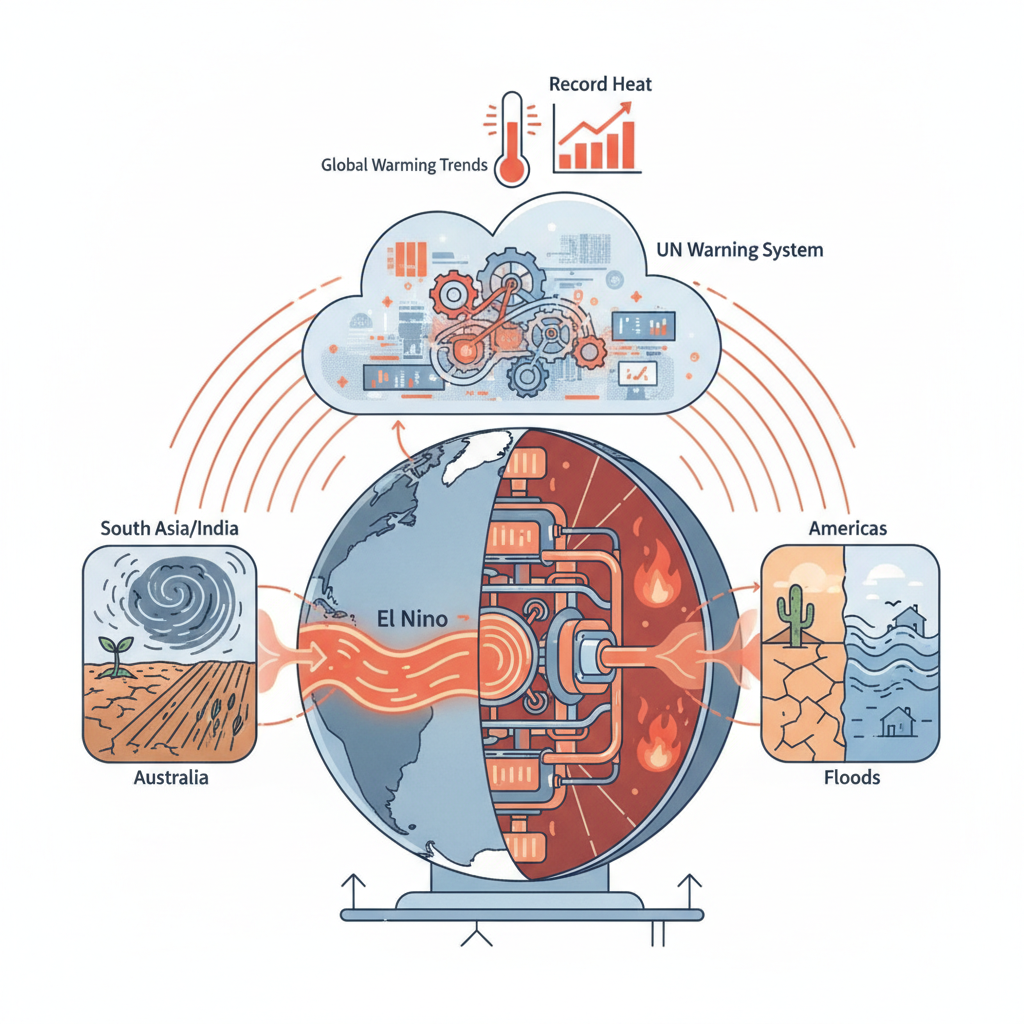 El Niño eventOcean warmingGlobal warming trendsExtreme weather eventsAgricultural productivity
Subject Relevance — Where This Topic Fits
- GS Paper I — Geography (Climate and Weather Systems) | GS Paper III — Environment and Disaster Management
- Prelims: El Niño-Southern Oscillation (ENSO), Walker Circulation, Pacific Decadal Oscillation, La Niña, Madden-Julian Oscillation, Ocean Heat Content, Global Warming, Monsoon variability, Droughts in India, Wildfires in Australia, Floods in South America, Heatwaves in Europe
- Essay: Climate Change as a Threat Multiplier: The Intersection of Natural Variability and Anthropogenic Forcing, Global Governance in the Anthropocene: Balancing Sovereignty and Collective Action in Climate Crisis
Quick Revision: El Niño, a natural climate phenomenon, is currently intensifying in 2026 with record-breaking early-stage ocean warming, amplifying extreme weather events globally due to its interaction with anthropogenic climate change, thereby posing significant risks to agriculture, water security, and disaster resilience.
Why is this in the news?
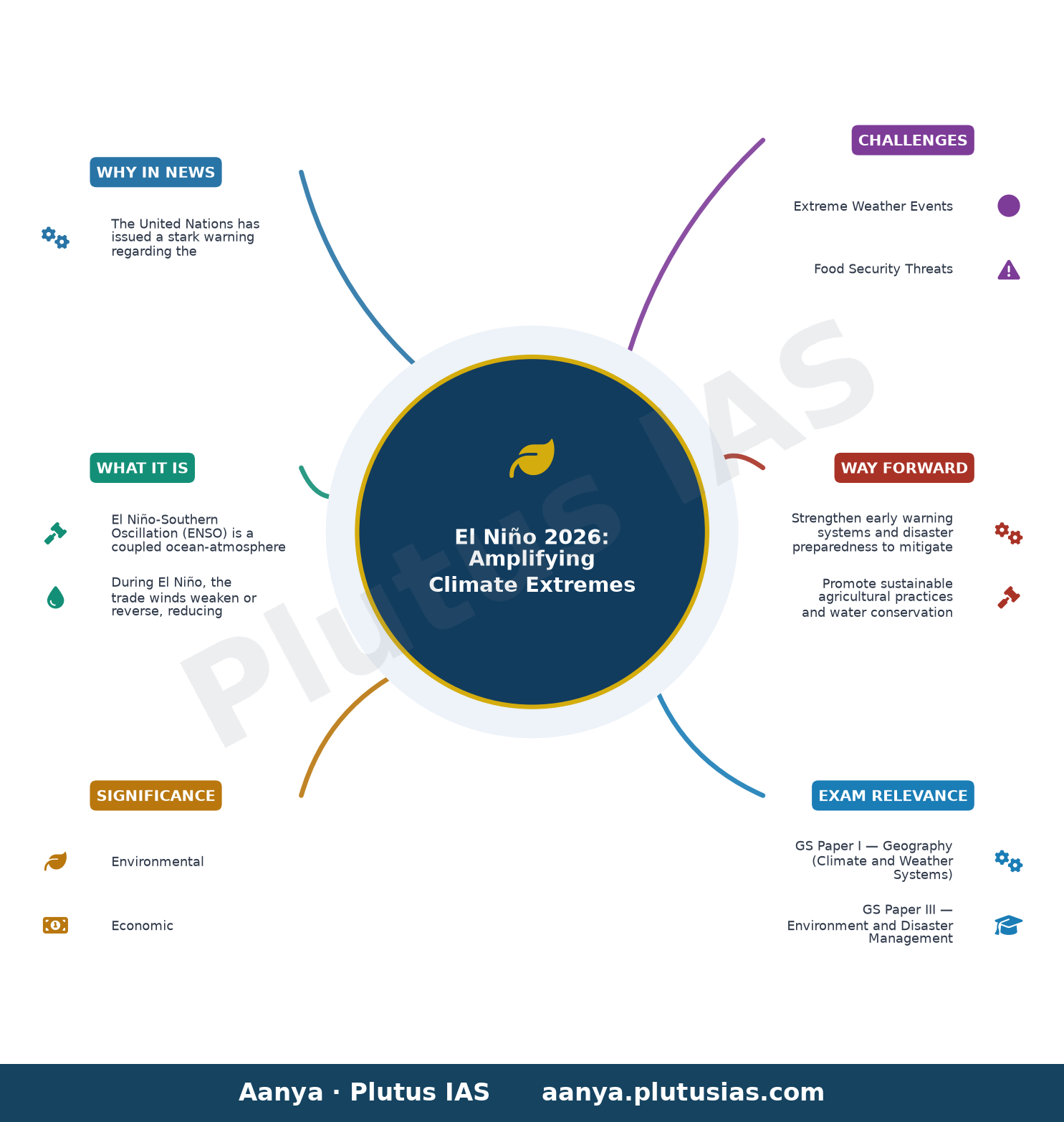
The United Nations has issued a stark warning regarding the intensifying El Niño event of 2026, describing it as an unprecedented climate phenomenon that, when combined with existing global warming trends, is poised to exacerbate extreme weather events worldwide. The UN Secretary-General’s characterization of the situation as entering ‘uncharted territory’ underscores the severity of potential impacts, including record-breaking heatwaves, prolonged droughts, devastating wildfires, and catastrophic flooding, particularly in vulnerable regions such as South Asia, Australia, and parts of the Americas. This development is critical for UPSC aspirants due to its direct relevance to India’s monsoon dynamics, agricultural productivity, and disaster preparedness, as well as broader themes of climate governance and sustainable development.
Background
- El Niño-Southern Oscillation (ENSO) is a naturally occurring climate phenomenon characterized by periodic warming (El Niño) and cooling (La Niña) of sea surface temperatures in the central and eastern equatorial Pacific Ocean, with global climatic repercussions.
- Scientific consensus indicates that while El Niño itself is a natural variability, its interaction with anthropogenic climate change amplifies the frequency and severity of extreme weather events, including heatwaves, droughts, and floods.
- The World Meteorological Organization (WMO) has projected that the 2026 El Niño will persist through spring 2027, with peak intensity likely occurring in late 2026, aligning with the seasonal cycle of ENSO.
- Historical precedents, such as the 1997-98 and 2015-16 El Niño events, demonstrate the potential for widespread socio-economic disruption, including crop failures, infrastructure damage, and humanitarian crises.
- India’s monsoon system is highly sensitive to ENSO variability, with El Niño phases historically correlating with below-normal monsoon rainfall, thereby impacting agricultural output, water resources, and rural livelihoods.
What is El Niño?
- El Niño-Southern Oscillation (ENSO) is a coupled ocean-atmosphere phenomenon driven by interactions between the tropical Pacific Ocean and the overlying atmosphere, primarily the Walker Circulation.
- During El Niño, the trade winds weaken or reverse, reducing upwelling of cold, nutrient-rich waters in the eastern Pacific and causing a significant rise in sea surface temperatures (SSTs) across the central and eastern equatorial Pacific.
- The Southern Oscillation Index (SOI), which measures the air pressure difference between Tahiti and Darwin, typically becomes negative during El Niño, reflecting the atmospheric response to oceanic warming.
- El Niño events recur irregularly, typically every 2 to 7 years, and persist for 9 to 12 months, though their intensity and duration vary significantly between events.
- The phenomenon disrupts global weather patterns by altering atmospheric circulation, leading to teleconnections such as weakened Indian monsoons, increased rainfall in the southern United States, and droughts in Australia and Southeast Asia.
- El Niño is distinct from La Niña, its counterpart, which is characterized by anomalously cool SSTs in the equatorial Pacific and typically brings opposite climatic effects, including enhanced monsoons in India and wetter conditions in Australia.
- The magnitude of El Niño is classified using indices such as the Niño 3.4 region (5°N–5°S, 120°W–170°W), where SST anomalies of +0.5°C or more for five consecutive months define an El Niño event.
- While El Niño is a natural climate variability, its impacts are exacerbated by anthropogenic global warming, which increases the frequency of extreme weather events and intensifies their severity.
Key Features
| Feature | Significance |
|---|---|
| Intensity of El Niño | The current El Niño event has broken records for early-stage ocean warming, indicating a potentially severe phase that could exacerbate global extreme weather events. |
| Global Ocean Temperatures | Record-breaking ocean temperatures, driven by greenhouse gas emissions, compound the effects of El Niño, amplifying heatwaves and altering weather patterns worldwide. |
| Temporal Persistence | The El Niño event is expected to persist through spring 2027, prolonging its impact on global climate systems and extreme weather events. |
| Regional Weather Disruptions | El Niño disrupts regional weather patterns, leading to droughts in India, Southeast Asia, and southern Africa, while increasing rainfall and flooding risks in the United States, southern Europe, and other regions. |
| Amplification of Climate Change | El Niño releases stored ocean heat into the atmosphere, accelerating global warming and intensifying the frequency and severity of extreme weather events. |
Why it Matters
Environmental
- El Niño exacerbates global warming by releasing stored ocean heat, contributing to record-breaking temperatures and extreme weather events.
- Increased frequency of heatwaves, droughts, wildfires, and floods poses severe threats to ecosystems, biodiversity, and natural habitats.
- Prolonged droughts and wildfires in regions like Southeast Asia and South America can lead to deforestation and loss of biodiversity, disrupting ecological balance.
Economic
- Agricultural sectors in drought-prone regions face significant losses due to reduced rainfall, threatening food security and livelihoods of millions.
- Increased flooding and infrastructure damage in high-rainfall regions can disrupt supply chains, transportation, and economic activities, leading to financial losses.
- Rising global temperatures and extreme weather events increase operational costs for industries reliant on stable environmental conditions, such as agriculture, energy, and tourism.
Social
- Extreme weather events disproportionately affect vulnerable populations, exacerbating poverty, displacement, and social inequalities.
- Increased risk of heatwaves and wildfires poses direct threats to human health, particularly for the elderly, children, and those with pre-existing medical conditions.
- Disruptions in agricultural productivity and food supply chains can lead to malnutrition and food insecurity, particularly in developing nations.
Geopolitical
- Regions experiencing severe droughts or floods may face water scarcity and food shortages, potentially leading to conflicts over resources and migration pressures.
- Extreme weather events can destabilize political and economic systems, particularly in countries heavily reliant on agriculture, increasing geopolitical tensions.
- International cooperation is essential to mitigate the impacts of El Niño and climate change, requiring coordinated global responses and resource-sharing mechanisms.
Challenges
1. Extreme Weather Events
- Increased frequency and intensity of heatwaves, droughts, wildfires, and floods threaten human settlements, infrastructure, and ecosystems.
- Regions like India, Southeast Asia, and southern Africa face heightened risks of droughts and wildfires, while the United States and southern Europe may experience severe flooding.
- The compounded effects of El Niño and climate change create unprecedented challenges for disaster preparedness and response systems.
UPSC Link: GS3: Disaster Management
2. Food Security Threats
- Droughts and reduced rainfall in agricultural regions like India, Southeast Asia, and South America threaten crop yields and food production.
- Increased temperatures and erratic weather patterns disrupt planting and harvesting cycles, exacerbating food shortages and price volatility.
- Vulnerable populations, particularly in developing nations, face heightened risks of malnutrition and famine due to disrupted food supply chains.
UPSC Link: GS3: Food Security
3. Economic Disruptions
- Agricultural losses and infrastructure damage from extreme weather events lead to significant economic losses, particularly in regions reliant on agriculture.
- Supply chain disruptions and increased operational costs for industries like energy and tourism can slow economic growth and increase unemployment.
- Governments and businesses face financial burdens in responding to and recovering from extreme weather events, diverting resources from other developmental priorities.
UPSC Link: GS3: Economic Development
4. Health Risks
- Heatwaves and wildfires pose direct threats to public health, increasing the risk of heatstroke, respiratory illnesses, and other heat-related conditions.
- Disruptions in healthcare services and infrastructure during extreme weather events can exacerbate health crises, particularly in vulnerable populations.
- Increased vector-borne diseases, such as malaria and dengue, may emerge due to altered weather patterns and ecological disruptions.
UPSC Link: GS2: Health
5. Geopolitical Instability
- Resource scarcity, particularly water and food, can lead to conflicts and migration pressures, destabilizing regional and global geopolitical dynamics.
- Extreme weather events may exacerbate existing socio-economic inequalities, increasing tensions within and between nations.
- International cooperation and resource-sharing mechanisms are essential to mitigate the geopolitical impacts of El Niño and climate change.
UPSC Link: GS2: International Relations
Challenges — UPSC Perspective
| Issue | Concern |
|---|---|
| Heatwaves | Increased frequency and intensity of heatwaves threaten human health, agricultural productivity, and energy demand. |
| Droughts | Prolonged droughts in regions like India and Southeast Asia reduce water availability, agricultural output, and increase wildfire risks. |
| Floods | Increased rainfall and flooding in regions like the United States and southern Europe disrupt infrastructure, supply chains, and economic activities. |
| Wildfires | Heightened wildfire risks in drought-prone regions like Australia and South America threaten ecosystems, human settlements, and air quality. |
| Food Security | Disruptions in agricultural productivity due to extreme weather events exacerbate food shortages and price volatility. |
| Water Scarcity | Reduced rainfall and increased temperatures lead to water scarcity, threatening both human consumption and agricultural irrigation. |
Way Forward
- Strengthen early warning systems and disaster preparedness to mitigate the impacts of extreme weather events linked to El Niño and climate change.
- Promote sustainable agricultural practices and water conservation measures to enhance resilience against droughts and erratic rainfall patterns.
- Invest in climate-resilient infrastructure to reduce vulnerabilities in high-risk regions, including flood-prone areas and drought-affected zones.
- Enhance international cooperation and resource-sharing mechanisms to address the transboundary impacts of El Niño and climate change.
- Integrate climate adaptation strategies into national policies, particularly in sectors like agriculture, energy, and healthcare.
- Support research and innovation in climate science to improve the accuracy of El Niño forecasts and their regional impacts.
- Raise public awareness and community engagement to foster adaptive behaviors and resilience-building at the grassroots level.
- Develop policies to address the socio-economic impacts of extreme weather events, including food security, health risks, and migration pressures.
UPSC Value Addition
Keywords for Mains Answer-Writing
El Niño-Southern Oscillation (ENSO) · climate change and extreme weather events · global ocean warming · World Meteorological Organization (WMO) · UN Secretary-General warnings on climate · El Niño impacts on India and Southeast Asia · droughts and wildfires during El Niño · atmospheric circulation and ocean-atmosphere interactions · greenhouse gas emissions and ocean heat absorption · IPCC projections on climate extremes
Concept Flow
Greenhouse gas emissions → Ocean warming → El Niño formation → Release of stored ocean heat → Amplification of global warming → Increased frequency and intensity of extreme weather events → Regional disruptions in weather patterns → Impacts on agriculture, health, and infrastructure → Socio-economic and geopolitical consequences
Prelims Practice Questions
Q1. Consider the following statements regarding El Niño-Southern Oscillation (ENSO):
1. El Niño is characterized by unusually warm sea surface temperatures in the central and eastern equatorial Pacific Ocean.
2. El Niño events typically occur every two to seven years and last between nine months and a year.
3. El Niño is solely responsible for global climate change and extreme weather events.
4. The World Meteorological Organization (WMO) expects the current El Niño event to persist through spring 2027.
How many of the above statements are correct?
- Only one
- Only two
- Only three
- All
Answer: All — Statements 1, 2, and 4 are correct. Statement 3 is incorrect because El Niño is a naturally occurring phenomenon and not solely responsible for climate change; it amplifies the effects of climate change.
Q2. Assertion (A): The current El Niño event is unprecedented due to record ocean warming in the Pacific region.
Reason (R): El Niño events are primarily driven by human-induced greenhouse gas emissions.
Options:
A. Both A and R are true, and R is the correct explanation of A.
B. Both A and R are true, but R is not the correct explanation of A.
C. A is true, but R is false.
D. A is false, but R is true.
Answer: ? — Assertion (A) is true as the current El Niño is marked by record ocean warming. Reason (R) is true but incorrect as a driver; El Niño is a natural phenomenon, though climate change may intensify its impacts.
Q3. Match the following climate phenomena with their respective impacts:
Column I
1. El Niño
2. La Niña
3. Indian Ocean Dipole (IOD)
4. Atlantic Multidecadal Oscillation (AMO)
Column II
A. Increased rainfall in Australia and Southeast Asia
B. Drought in India and Indonesia
C. Enhanced monsoon rainfall in India
D. Cooling of the tropical North Atlantic
Options:
1. 1-B, 2-A, 3-C, 4-D
2. 1-A, 2-B, 3-C, 4-D
3. 1-B, 2-A, 3-D, 4-C
4. 1-C, 2-B, 3-A, 4-D
Answer: ? — Correct matches: El Niño (1-B: Drought in India and Indonesia), La Niña (2-A: Increased rainfall in Australia and Southeast Asia), IOD (3-C: Enhanced monsoon rainfall in India), AMO (4-D: Cooling of the tropical North Atlantic).
Mains Practice Question
✍ Critically analyse the assertion that ‘El Niño, while a natural climate phenomenon, has become a catalyst for exacerbating the adverse impacts of climate change.’ Substantiate your response with reference to the current El Niño event and its projected global impacts. (15 Marks)
Approach: MODEL-ANSWER SKELETON:
1. **Introduction (2 marks)**
– Define El Niño-Southern Oscillation (ENSO) as a naturally occurring climate phenomenon.
– State its recurrence cycle (every 2–7 years) and duration (9 months–1 year).
– Highlight the current El Niño event as unprecedented due to record ocean warming in the Pacific.
2. **El Niño as a Natural Phenomenon (3 marks)**
– Explain the mechanism: warm sea surface temperatures in the central/eastern equatorial Pacific altering atmospheric circulation.
– Discuss its global weather impacts: droughts (India, Indonesia), floods (USA, southern Europe), wildfires (Australia, South America).
– Reference the WMO’s forecast of the event persisting through spring 2027.
3. **Interaction with Climate Change (4 marks)**
– Explain how oceans absorb excess heat from greenhouse gas emissions, releasing it during El Niño.
– Discuss the amplification effect: El Niño intensifies heatwaves, droughts, and extreme rainfall events.
– Cite UN Secretary-General’s warning on El Niño ‘turning up the heat’ on a planet already affected by climate change.
– Reference Columbia University’s observation of the Pacific region reaching record warmth for the 15th consecutive week.
4. **Projected Global Impacts (3 marks)**
– Enumerate specific impacts: increased wildfire risk (Australia, South America), flooding (USA, southern Europe), droughts (southern Africa, South America).
– Highlight the ‘uncharted territory’ narrative by the UN, emphasizing the severity of combined El Niño and climate change effects.
5. **Critical Analysis and Way Forward (3 marks)**
– Critique the assertion: While El Niño is natural, its interaction with climate change makes impacts more severe.
– Discuss the role of mitigation: reducing greenhouse gas emissions to limit El Niño’s amplifying effects.
– Emphasise the need for global cooperation and adaptation strategies (e.g., drought-resistant agriculture, early warning systems).
**Key Terms/Frameworks:**
– ENSO, WMO, IPCC projections, greenhouse gas emissions, ocean heat absorption, atmospheric circulation.
Source: Mint
Generated by AanyaAi for educational purpose.

- तमिलनाडु: राज्यपाल अरलेकर ने निजी विश्वविद्यालय संशोधन विधेयक पर मांगी स्पष्टीकरण - September 18, 2026
- सुप्रीम कोर्ट ने एनटीए के अपग्रेडेड नीट परीक्षा सिस्टम का निरीक्षण करने पर विचार किया - September 18, 2026
- Supreme Court to Inspect NTA’s Upgraded NEET Exam System for Leak Prevention - September 18, 2026

No Comments