


03 Aug Philosophy Graduates Can Excel in AI Careers: UPSC Exam Insights
✎ Philosophy provides the conceptual and ethical scaffolding for AI, from Aristotle’s logic to Pāṇini’s grammar, while modern AI’s opacity necessitates explainable AI (XAI) frameworks to align with regulatory and ethical demands.
 AI ethics frameworksRegulatory compliance systemsPhilosophical logic modelsSemantic reasoning engines
Subject Relevance — Where This Topic Fits
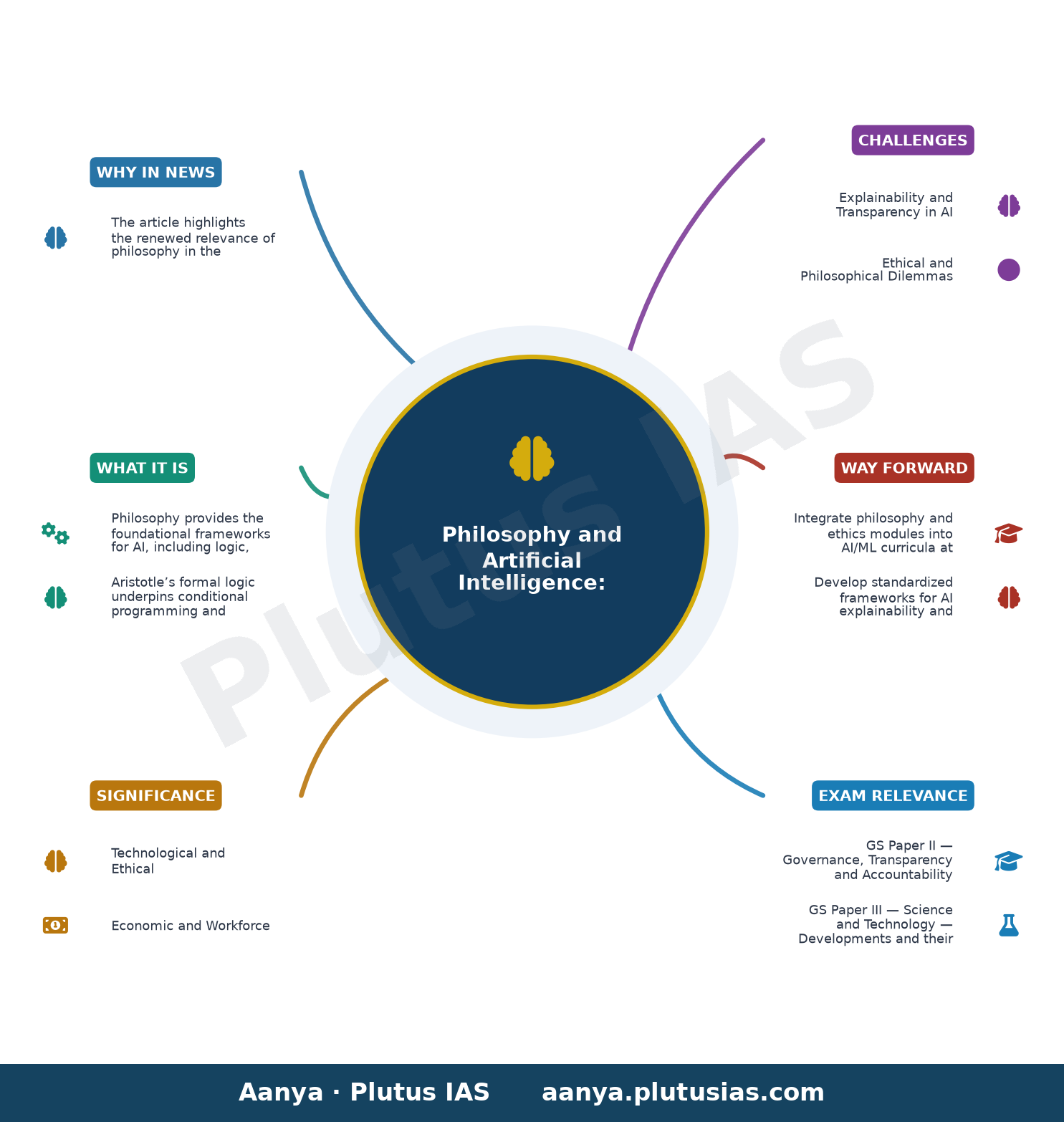
- GS Paper II — Governance, Transparency and Accountability | GS Paper III — Science and Technology — Developments and their Applications and Effects in Everyday Life | GS Paper IV — Ethics and Human Interface — Ethical Concerns and Dilemmas
- Prelims: Artificial Intelligence (AI), Explainable AI (XAI), EU AI Act, MeitY India AI Governance Guidelines, Pāṇini’s Aṣṭādhyāyī, Logic Theorist, Turing Test, Black Box AI, Generative AI, RBI FREE-AI Report
- Essay: The Intersection of Philosophy and Technology: Can Machines Truly Think?, Ethical Governance in the Age of AI: Balancing Innovation with Accountability
Quick Revision: Philosophy provides the conceptual and ethical scaffolding for AI, from Aristotle’s logic to Pāṇini’s grammar, while modern AI’s opacity necessitates explainable AI (XAI) frameworks to align with regulatory and ethical demands.
Why is this in the news?
The article highlights the renewed relevance of philosophy in the development and governance of artificial intelligence, particularly as AI systems increasingly operate as ‘black boxes’ and face regulatory demands for transparency and explainability. It underscores how philosophical inquiry—ranging from logic and semantics to ethics—continues to shape AI’s theoretical foundations and practical applications, while also addressing the challenges posed by modern AI systems to traditional notions of reasoning and accountability.
Background
- Philosophy has historically underpinned the formal and conceptual frameworks of computing and artificial intelligence, with contributions from Aristotle, Descartes, Leibniz, and Indian logicians like Pāṇini.
- The early development of AI in the mid-20th century, such as the Logic Theorist (1956), drew directly from philosophical and mathematical logic, demonstrating the discipline’s foundational role in AI.
- Modern AI systems, particularly large language models (LLMs), function as ‘black boxes,’ generating outputs without transparent reasoning, raising concerns about accountability and regulatory compliance.
What is the relationship between Philosophy and Artificial Intelligence?
- Philosophy provides the foundational frameworks for AI, including logic, semantics, and epistemology, which are essential for designing systems that reason and infer.
- Aristotle’s formal logic underpins conditional programming and rule-based AI systems, forming the basis for inference engines and expert systems.
- Descartes’ distinction between mechanistic bodies and rational minds posed early challenges to the idea of machine intelligence, influencing debates on consciousness and AI capabilities.
- Leibniz’s development of binary arithmetic enabled digital computing, demonstrating how abstract philosophical ideas can translate into technological innovation.
- Pāṇini’s Aṣṭādhyāyī (4th century BCE) is a generative grammar system with metarules, predating modern formal grammars and inspiring computational linguistics and AI language models.
- The Logic Theorist (1956), an early AI program, used symbolic logic to prove mathematical theorems, directly applying philosophical principles to machine reasoning.
- Modern AI systems, particularly LLMs, rely on statistical and probabilistic reasoning derived from philosophical theories of knowledge and inference, though their ‘black box’ nature limits interpretability.
- The demand for explainable AI (XAI) reflects a philosophical concern with transparency, accountability, and the ethical implications of delegating reasoning to machines, as seen in global AI governance frameworks.
Key Features
| Feature | Significance |
|---|---|
| Philosophical foundations of AI | Provides the logical and epistemological frameworks (e.g., Aristotelian logic, binary systems) that underpin AI algorithms and computational reasoning. |
| Regulatory transparency demands | Mandates explainability and traceability in AI systems (e.g., EU AI Act Article 50, India’s AI Governance Guidelines) to address black-box concerns. |
| Generative AI limitations | Highlights the inability of current large language models to justify outputs in human-understandable terms, necessitating philosophical and ethical scrutiny. |
| Interdisciplinary skill integration | Demonstrates how philosophy graduates contribute through critical thinking, problem decomposition, and assumption analysis—skills directly applicable to AI governance and ethics. |
| Historical continuity in AI development | Traces the lineage of AI formalisms from ancient logic (Pāṇini’s grammar) to modern computational systems, underscoring the enduring role of philosophy. |
Why it Matters
Technological and Ethical
- Philosophy provides the conceptual bedrock for AI’s logical and mathematical formalisms, ensuring that AI systems operate within defined ethical and logical boundaries.
- The rise of black-box AI models necessitates philosophical inquiry into explainability, accountability, and the nature of machine reasoning.
- Regulatory frameworks (e.g., EU AI Act, India’s AI Governance Guidelines) require AI systems to be transparent and auditable, a domain where philosophical training is invaluable.
- The intersection of AI and philosophy challenges traditional notions of intelligence, cognition, and human-machine parity, prompting deeper epistemological debates.
Economic and Workforce
- Philosophy graduates possess transferable skills (critical analysis, problem-solving, ethical reasoning) that are increasingly sought in AI governance, ethics, and policy roles.
- The demand for interdisciplinary talent in AI underscores the need for curricula that integrate philosophy, ethics, and technical training to bridge the skills gap.
- AI-driven automation of repetitive tasks accentuates the value of human-centric disciplines like philosophy, which emphasize creativity, contextual reasoning, and ethical judgment.
Policy and Governance
- Regulatory frameworks (e.g., EU AI Act, India’s AI Governance Guidelines) mandate explainability and fairness, creating a demand for professionals trained in philosophical and ethical reasoning.
- The
Challenges
1. Explainability and Transparency in AI
- Current large language models (LLMs) operate as black boxes, generating outputs without reliable justification, complicating regulatory compliance and ethical oversight.
- Regulatory mandates (e.g., EU AI Act Article 50, India’s AI Governance Guidelines) require AI systems to be auditable and explainable, a challenge for existing model architectures.
- The lack of interpretable AI hinders trust among stakeholders, including policymakers, industry, and the public, necessitating philosophical and technical solutions.
UPSC Link: GS Paper 3: Science & Tech, Ethics
2. Ethical and Philosophical Dilemmas
- AI systems increasingly replicate aspects of human cognition, raising questions about the nature of intelligence, agency, and moral responsibility (e.g., Krishnamurti’s critique of machine-like intelligence).
- The deployment of AI in sensitive domains (e.g., healthcare, criminal justice) requires philosophical frameworks to address fairness, bias, and unintended consequences.
- The tension between efficiency-driven automation and human-centric values (e.g., autonomy, dignity) demands interdisciplinary approaches combining philosophy and technology.
UPSC Link: GS Paper 4: Ethics, Integrity & Aptitude
3. Workforce Skill Mismatch
- The AI industry faces a shortage of professionals with interdisciplinary training in philosophy, ethics, and technical domains, limiting the development of responsible AI systems.
- Philosophy graduates often lack exposure to technical tools (e.g., programming, data science), while technical graduates may lack ethical and philosophical grounding, creating a skills gap.
- Educational institutions must redesign curricula to integrate philosophy, ethics, and AI/ML training to produce a workforce capable of addressing AI’s challenges.
UPSC Link: GS Paper 2: Governance, Social Justice
4. Regulatory Fragmentation
- Divergent regulatory approaches (e.g., EU’s prescriptive AI Act vs. India’s sectoral guidelines) create compliance challenges for global AI developers and policymakers.
- The absence of standardized frameworks for AI governance (e.g., explainability, fairness) hinders cross-border collaboration and innovation.
- Regulatory uncertainty discourages investment in AI ethics and governance, stalling progress in addressing AI’s societal impacts.
UPSC Link: GS Paper 2: Governance, International Relations
5. Cultural and Epistemological Bias
- AI systems trained on Western-centric datasets may embed cultural biases, necessitating philosophical frameworks to ensure inclusivity and contextual relevance (e.g., Pāṇini’s grammar as a non-Western formal system).
- The dominance of Western philosophical traditions in AI development risks marginalizing alternative epistemologies, limiting the field’s global applicability.
- Addressing bias requires philosophical inquiry into the nature of knowledge, representation, and power dynamics in AI systems.
UPSC Link: GS Paper 1: Indian Heritage, GS Paper 4: Ethics
Challenges — UPSC Perspective
| Issue | Concern |
|---|---|
| Black-box AI models | Lack of explainability and traceability, complicating regulatory compliance and ethical oversight. |
| Regulatory fragmentation | Divergent global frameworks (e.g., EU AI Act vs. India’s guidelines) create compliance challenges for AI developers. |
| Workforce skill mismatch | Shortage of interdisciplinary talent combining philosophy, ethics, and technical AI skills. |
| Cultural bias in AI | Western-centric datasets and philosophies risk embedding biases, limiting global applicability. |
| Ethical dilemmas in AI deployment | Questions about agency, responsibility, and human-machine parity in sensitive domains. |
| Educational curriculum gaps | Lack of integrated training in philosophy, ethics, and AI/ML in higher education institutions. |
Way Forward
- Integrate philosophy and ethics modules into AI/ML curricula at undergraduate and postgraduate levels to bridge the skills gap.
- Develop standardized frameworks for AI explainability and auditing, drawing on philosophical and technical expertise.
- Encourage interdisciplinary research collaborations between philosophers, ethicists, and AI engineers to address regulatory and ethical challenges.
- Promote global dialogue on AI governance to harmonize regulatory approaches and reduce fragmentation.
- Invest in public awareness campaigns to highlight the role of philosophy in AI development and its societal implications.
- Establish industry-academia partnerships to create internships and fellowships for philosophy graduates in AI ethics and governance roles.
- Support the development of open-source tools for interpretable AI, enabling broader adoption of explainable systems.
- Encourage philosophical inquiry into non-Western epistemologies to ensure cultural inclusivity in AI systems.
UPSC Value Addition
Keywords for Mains Answer-Writing
Artificial Intelligence Governance · Philosophy and AI · EU AI Act 2026 · India AI Governance Guidelines 2025 · MeitY’s AI Principles · Transparency in AI Systems · Logic and Formal Systems in AI · Pāṇini’s Aṣṭādhyāyī and AI · Ethical AI Frameworks · Regulatory Compliance in AI
Concept Flow
Philosophical inquiry into the nature of intelligence and logic → Development of formal systems (e.g., Aristotelian logic, binary arithmetic) → Emergence of AI as a discipline → Rise of black-box AI models → Regulatory demand for transparency and explainability → Need for interdisciplinary talent combining philosophy and AI → Redesign of educational curricula to address skills gaps.
Prelims Practice Questions
Q1. Consider the following statements regarding the India AI Governance Guidelines released by MeitY in 2025:
1. The guidelines are based on seven sutras including accountability and fairness.
2. The principle of ‘Understandable by Design’ is explicitly mentioned.
3. The guidelines are sector-neutral and do not require domain-specific regulations.
How many of the above statements are correct?
- Only one
- Only two
- All
- None
Answer: Only two — Statement 1 and 2 are correct as per the guidelines. Statement 3 is incorrect because the guidelines are deliberately sectoral, leaving individual regulators to frame rules for their domains.
Q2. Assertion (A): Aristotle’s formalisation of logic is foundational to the development of artificial intelligence.
Reason (R): Aristotle’s work on valid inference provided the logical framework behind conditional programming in AI systems.
Options:
A. Both A and R are true, and R is the correct explanation of A.
B. Both A and R are true, but R is not the correct explanation of A.
C. A is true, but R is false.
D. A is false, but R is true.
Answer: ? — Both the assertion and reason are true. Aristotle’s formal logic underpins the logical structures used in AI programming, making R the correct explanation of A.
Q3. Match the following AI governance frameworks with their respective jurisdictions:
Column I (Framework) | Column II (Jurisdiction)
1. EU AI Act | A. India
2. India AI Governance Guidelines | B. European Union
3. RBI’s FREE-AI Report | C. United States
- 1-B, 2-A, 3-C; 1-A, 2-B, 3-C; 1-C, 2-A, 3-B; 1-B, 2-C, 3-A
Answer: 1-B, 2-A, 3-C; 1-A, 2-B, 3-C; 1-C, 2-A, 3-B; 1-B, 2-C, 3-A — The EU AI Act applies to the European Union, the India AI Governance Guidelines apply to India, and the RBI’s FREE-AI Report is specific to India’s financial sector.
Mains Practice Question
✍ The integration of philosophy into artificial intelligence is often cited as a foundational element in the development of AI systems. Critically examine the role of philosophical inquiry in shaping AI governance frameworks, with particular reference to the principles of transparency and accountability. (15 Marks)
Approach: MODEL-ANSWER SKELETON:
1. Introduction: Define the philosophical roots of AI (Aristotle’s logic, Pāṇini’s generative grammar, Descartes’ challenge to mechanised thought).
2. Philosophical Contributions to AI:
– Logic and formal systems (Aristotle, Leibniz, Russell & Whitehead) as the basis for AI algorithms.
– Pāṇini’s Aṣṭādhyāyī and its influence on modern grammar formalisms in AI.
3. AI Governance Frameworks:
– EU AI Act 2026 (Article 50: transparency obligations).
– India AI Governance Guidelines 2025 (seven sutras: accountability, fairness, transparency, ‘Understandable by Design’).
– RBI’s FREE-AI Report 2025: sectoral approach to AI governance.
4. Role of Philosophy in Governance:
– Transparency: Philosophical emphasis on clarity in reasoning and justification in AI outputs.
– Accountability: Philosophical frameworks (e.g., Kantian ethics) underpinning regulatory demands for auditable AI systems.
5. Challenges and Critiques:
– Black-box nature of modern LLMs and the difficulty in aligning them with philosophical ideals of explainability.
– Tension between regulatory demands and the computational opacity of AI models.
6. Conclusion: Philosophical inquiry provides the ethical and logical scaffolding for AI governance, but practical implementation remains fraught with challenges. Balance of views: Philosophers and technologists must collaborate to bridge the gap between theory and practice.
Source: The Hindu
Generated by AanyaAi for educational purpose.

- Gurugram’s groundwater extraction exceeds limit by 212%; HC seeks ban - October 4, 2026
- स्वतंत्रता सेनानी श्यामजी कृष्ण वर्मा की जन्म जयंती पर पीएम का श्रद्धांजलि - October 4, 2026
- KWML’s Feasibility Reports for Water Metro in 18 Cities: UPSC & PCS Insights - October 3, 2026

No Comments