


03 Aug Indian Statistical Institute Bill 2026: Key Provisions & UPSC Relevance Explained
✎ The Indian Statistical Institute Bill, 2026, if enacted, may transform ISI into a statutory body corporate, potentially altering its governance and academic autonomy, while the Bankers’ Books Evidence Bill, 2026, aims to…
Subject Relevance — Where This Topic Fits
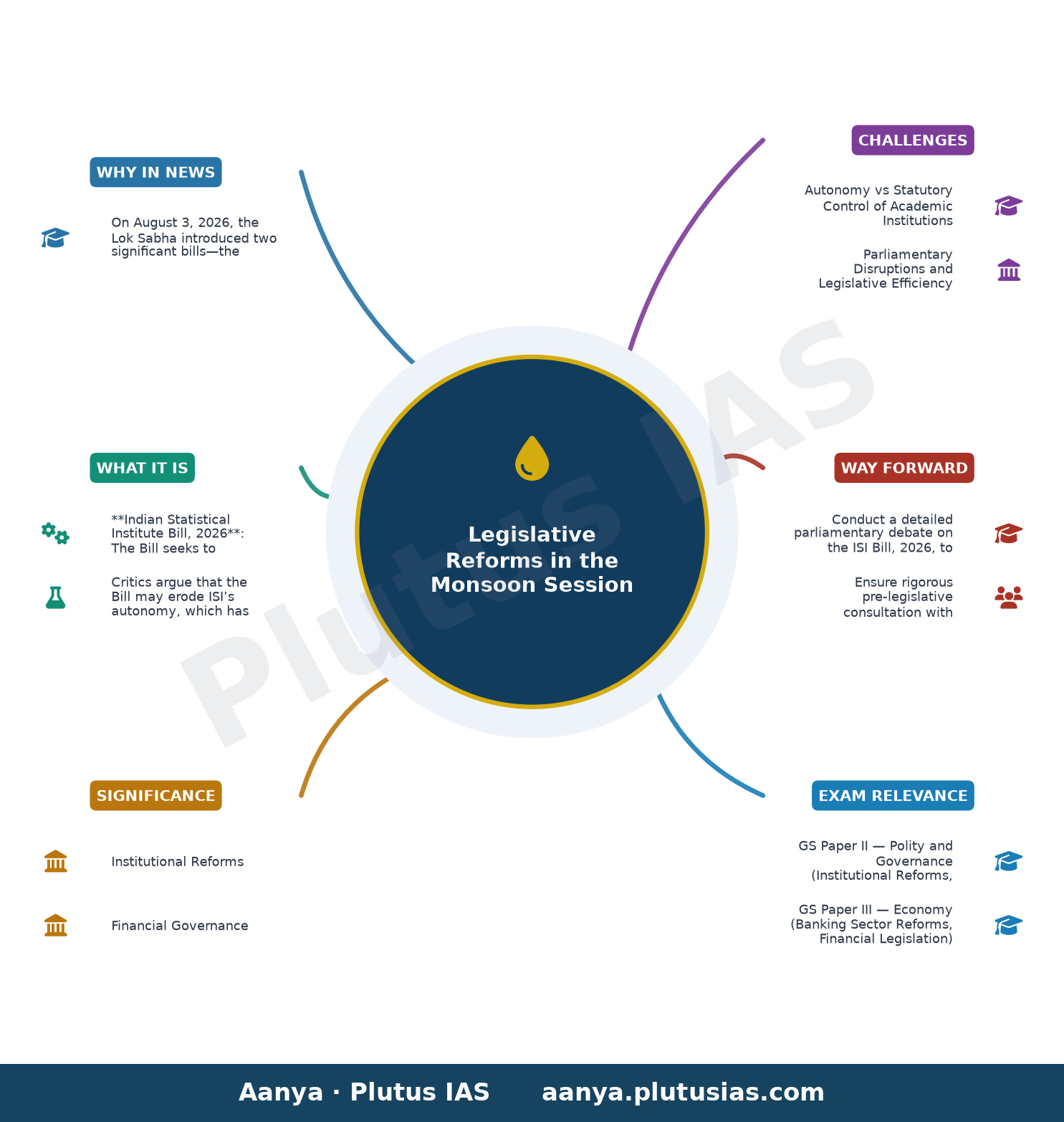
- GS Paper II — Polity and Governance (Institutional Reforms, Statutory Bodies) | GS Paper III — Economy (Banking Sector Reforms, Financial Legislation)
- Prelims: Indian Statistical Institute (ISI), Statutory Body Corporate, Bankers’ Books Evidence Act, 1891, Demands for Excess Grants, NEET-UG paper leak, Jantar Mantar protests
- Essay: The evolving role of statutory bodies in India’s educational and financial governance, Balancing autonomy and accountability in institutions of national importance
Quick Revision: The Indian Statistical Institute Bill, 2026, if enacted, may transform ISI into a statutory body corporate, potentially altering its governance and academic autonomy, while the Bankers’ Books Evidence Bill, 2026, aims to modernise financial evidence laws to align with digital banking and contemporary financial crimes.
Why is this in the news?
On August 3, 2026, the Lok Sabha introduced two significant bills—the Indian Statistical Institute Bill, 2026, and the Bankers’ Books Evidence Bill, 2026—during the eleventh day of the Monsoon Session of Parliament. These legislative proposals have sparked debates among academicians, students, and policymakers, particularly regarding the potential dilution of the Indian Statistical Institute’s (ISI) academic autonomy and the modernisation of financial evidence laws. The introduction of these bills coincides with broader parliamentary disruptions over issues such as the NEET-UG paper leak and alleged police action against student protesters, underscoring the contentious nature of legislative agendas in the current session.
Background
- The Indian Statistical Institute (ISI), established in 1931 by Professor P.C. Mahalanobis, is an autonomous institute of national importance, recognised for its contributions to statistical research, economics, and data science. It operates under the aegis of the Ministry of Statistics and Programme Implementation (MoSPI) but functions as a registered society, granting it significant academic and administrative autonomy.
- The Bankers’ Books Evidence Act, 1891, governs the admissibility of bank records as evidence in legal proceedings. The Act has remained largely unchanged since its inception, despite significant advancements in banking technology, digital transactions, and financial crimes such as fraud and money laundering.
- The Monsoon Session of Parliament, which began on July 20, 2026, and is scheduled to conclude on August 13, 2026, has been marked by frequent adjournments due to Opposition protests over the NEET-UG paper leak and alleged police excesses during student demonstrations at Jantar Mantar.
- The introduction of these bills reflects the government’s legislative agenda to modernise institutional frameworks and financial governance, aligning with broader reforms in education and banking sectors.
- Academicians and students of ISI have expressed concerns that the proposed Bill may undermine the institute’s autonomy by converting it into a statutory body corporate, potentially centralising control under the government.
Key Provisions and Implications of the Bills
- **Indian Statistical Institute Bill, 2026**: The Bill seeks to convert the Indian Statistical Institute (ISI) from a registered society into a statutory body corporate. This transformation would bring ISI under the direct regulatory and administrative purview of the Ministry of Statistics and Programme Implementation (MoSPI), potentially altering its governance structure, funding mechanisms, and academic freedom.
- Critics argue that the Bill may erode ISI’s autonomy, which has historically fostered interdisciplinary research and policy-relevant statistical innovations. The institute’s status as a deemed university and its role in shaping India’s statistical infrastructure could be affected by increased bureaucratic oversight.
- Proponents of the Bill contend that statutory status would enhance ISI’s financial stability, streamline its operations, and align it with other institutions of national importance, such as the Indian Institutes of Technology (IITs) and Indian Institutes of Management (IIMs).
- The Bill also proposes to empower the central government to frame rules for the institute’s functioning, including appointment of directors, academic governance, and utilisation of funds, raising concerns about potential government interference in academic matters.
- **Bankers’ Books Evidence Bill, 2026**: The Bill aims to amend the Bankers’ Books Evidence Act, 1891, to modernise the legal framework governing the admissibility of bank records as evidence in courts. Key provisions include recognising digital and electronic records as valid evidence, streamlining the process for obtaining certified copies of bank documents, and enhancing the efficiency of financial investigations.
- The Bill addresses gaps in the existing Act, which was framed in an era dominated by paper-based banking. With the proliferation of digital transactions, fintech innovations, and cyber frauds, the outdated Act has become inadequate for addressing contemporary financial crimes.
- The proposed amendments would facilitate quicker resolution of banking disputes, reduce litigation delays, and strengthen the legal framework for prosecuting financial offences, including money laundering and fraud.
- The Bill also seeks to balance the interests of banks and customers by ensuring transparency in the certification and submission of bank records while preventing misuse of financial data.
Key Features
| Feature | Significance |
|---|---|
| Indian Statistical Institute (ISI) Bill, 2026 | Proposes to convert ISI from a ‘registered society’ to a ‘statutory body corporate’, raising concerns over academic autonomy and institutional independence. |
| Bankers’ Books Evidence Bill, 2026 | Aims to amend the legal framework governing the admissibility of bank records as evidence in courts, enhancing financial probity and judicial efficiency. |
| Demands for Excess Grants for 2022-23 | Parliamentary procedure to approve supplementary expenditure beyond original budget allocations, reflecting fiscal accountability. |
| Opposition protests in Parliament | Highlights legislative disruptions due to unaddressed grievances on student police action and NEET-UG paper leak, underscoring democratic accountability. |
| Monsoon Session 2026 agenda | Legislative agenda prioritises financial and institutional reforms amid procedural challenges, reflecting parliamentary governance dynamics. |
Why it Matters
Institutional Reforms
- The ISI Bill, 2026, if enacted, will alter the governance structure of a premier academic institution, potentially affecting its research autonomy and academic freedom.
- The Bankers’ Books Evidence Bill, 2026, seeks to modernise legal provisions for financial evidence, aligning with contemporary banking practices and judicial requirements.
- Statutory conversion of ISI may set a precedent for other autonomous institutions, raising debates on centralisation versus institutional independence.
Financial Governance
- The Demands for Excess Grants highlight the need for transparent supplementary budgetary allocations, ensuring fiscal discipline and parliamentary oversight.
- The Bankers’ Books Evidence Bill enhances the evidentiary value of bank records, reinforcing financial accountability in legal proceedings.
- Parliamentary scrutiny of excess grants reflects the constitutional mandate for legislative control over public expenditure under Article 113.
Parliamentary Functioning
- Frequent adjournments and protests during the Monsoon Session 2026 underscore the challenges of legislative efficiency amid political polarisation.
- Opposition demands for Home Minister’s presence reflect the constitutional principle of ministerial accountability to Parliament under Article 75(3).
- Procedural disruptions highlight the tension between legislative agenda and democratic representation in a parliamentary democracy.
Judicial and Legal Implications
- The Bankers’ Books Evidence Bill may streamline financial litigation by clarifying the admissibility of bank records, reducing judicial delays.
- Statutory conversion of ISI could lead to legal challenges on grounds of violation of academic freedom, invoking Article 21 (Right to Education) and Article 19(1)(g).
Challenges
1. Autonomy vs Statutory Control of Academic Institutions
- Conversion of ISI from a society to a statutory body may dilute its academic autonomy, impacting research independence and institutional governance.
- Risk of bureaucratic interference in academic decision-making, potentially compromising the institute’s global reputation.
- Legal ambiguity over the balance between regulatory oversight and institutional freedom under the Constitution.
UPSC Link: GS-2: Statutory bodies and constitutional provisions
2. Parliamentary Disruptions and Legislative Efficiency
- Frequent adjournments disrupt the legislative agenda, delaying critical reforms and undermining parliamentary productivity.
- Opposition protests reflect systemic issues in parliamentary functioning, including lack of timely responses to public grievances.
- Risk of erosion of decorum in legislative proceedings, affecting the dignity of Parliament as envisaged in Article 108.
UPSC Link: GS-2: Parliament and its functioning
3. Financial Transparency and Supplementary Grants
- Excess grants for 2022-23 may indicate fiscal mismanagement or unforeseen expenditures, raising concerns over budgetary discipline.
- Lack of pre-emptive parliamentary scrutiny of supplementary demands may lead to unchecked expenditure, violating fiscal federalism.
- Potential for misuse of supplementary funds if not subjected to rigorous post-facto audit under CAG.
UPSC Link: GS-3: Public finance and budgetary process
4. Judicial Backlog and Financial Evidence
- Ambiguity in the admissibility of bank records as evidence may contribute to judicial delays in financial litigation.
- Inadequate legal framework for digital banking records may pose challenges in modern financial disputes.
- Risk of inconsistent judicial interpretations if the Bill is not comprehensive in its scope.
UPSC Link: GS-2: Judiciary and legal reforms
5. Public Trust and Institutional Accountability
- Protests over police action against students and NEET-UG paper leak reflect eroding public trust in institutions of governance.
- Perceived lack of accountability in financial embezzlement cases (e.g., Ram temple donations) exacerbates societal disillusionment.
- Need for transparent mechanisms to address grievances and restore faith in democratic institutions.
UPSC Link: GS-4: Ethics and public service
Challenges — UPSC Perspective
| Issue | Concern |
|---|---|
| Academic autonomy of ISI | Potential erosion of research freedom and institutional independence due to statutory conversion. |
| Parliamentary disruptions | Frequent adjournments undermine legislative productivity and delay critical reforms. |
| Supplementary budgetary demands | Lack of pre-emptive scrutiny may lead to fiscal indiscipline and unchecked expenditure. |
| Admissibility of bank records as evidence | Ambiguity in legal provisions may cause judicial delays and inconsistent rulings. |
| Public trust in institutions | Perceived lack of accountability in governance erodes societal faith in democratic processes. |
Way Forward
- Conduct a detailed parliamentary debate on the ISI Bill, 2026, to address concerns over academic autonomy and institutional independence.
- Ensure rigorous pre-legislative consultation with stakeholders, including ISI faculty, students, and alumni, to refine the Bill.
- Strengthen parliamentary procedures to minimise disruptions, such as enforcing time-bound discussions and structured opposition participation.
- Introduce a mechanism for real-time grievance redressal to address public concerns and reduce protest-driven adjournments.
- Enhance fiscal transparency by mandating prior parliamentary approval for supplementary demands, with detailed justifications.
- Amend the Bankers’ Books Evidence Bill to include provisions for digital banking records, ensuring alignment with modern financial practices.
- Establish an independent oversight body to monitor the implementation of financial reforms and ensure accountability.
- Promote public awareness campaigns to rebuild trust in institutions, highlighting measures taken to address grievances.
UPSC Value Addition
Keywords for Mains Answer-Writing
Indian Statistical Institute Bill, 2026 · Bankers’ Books Evidence Bill, 2026 · academic autonomy · statutory body corporate · Parliamentary legislative process · Ministry of Statistics and Programme Implementation · judicial review of legislative amendments · institutional autonomy · evidentiary standards in banking · Parliamentary accountability
Constitutional & Policy Linkages
- Article 75(3) – Collective responsibility of the Council of Ministers to the Lok Sabha
- Article 108 – Joint sitting of Parliament and its powers
- Article 113 – Procedure for supplementary, additional, or excess grants
Concept Flow
Opposition to ISI Bill → Concerns over academic autonomy → Debate on institutional independence vs statutory control → Potential legal challenges under Article 19(1)(g) and Article 21 → Introduction of Bankers’ Books Evidence Bill → Need for financial probity → Modernisation of legal framework → Alignment with judicial and banking practices → Demands for Excess Grants → Supplementary expenditure beyond original budget → Parliamentary scrutiny under Article 113 → Fiscal accountability and transparency → Parliamentary protests → Disruptions in legislative proceedings → Adjournments and delays → Erosion of parliamentary decorum under Article 108 → Public grievances (NEET-UG, police action) → Lack of accountability → Erosion of public trust → Need for institutional reforms and transparency
Prelims Practice Questions
Q1. Consider the following statements regarding the Indian Statistical Institute (ISI):
1. The ISI is currently governed as a registered society under the Societies Registration Act, 1860.
2. The Indian Statistical Institute Bill, 2026 seeks to convert ISI into a statutory body corporate.
3. The Bill grants the Union Government full control over the academic and administrative autonomy of ISI.
How many of the above statements are correct?
- Only one
- Only two
- All three
- None
Answer: Only two — Statement 1 is correct as ISI operates under the Societies Registration Act. Statement 2 is correct as the Bill proposes conversion to a statutory body corporate. Statement 3 is incorrect as the Bill does not grant full control but raises concerns about autonomy.
Q2. Assertion (A): The Bankers’ Books Evidence Bill, 2026 aims to enhance the evidentiary value of digital records in banking disputes.
Reason (R): The Bill seeks to amend the Indian Evidence Act, 1872 to include electronic records as primary evidence in courts.
Select the correct option from the following:
- Both (A) and (R) are true, and (R) is the correct explanation of (A)
- Both (A) and (R) are true, but (R) is not the correct explanation of (A)
- (A) is true, but (R) is false
- (A) is false, but (R) is true
Answer: Both (A) and (R) are true, but (R) is not the correct explanation of (A) — Assertion (A) is true as the Bill intends to strengthen digital evidence in banking disputes. Reason (R) is also true and correctly explains (A) as the Bill amends the Indian Evidence Act to include electronic records.
Q3. Which of the following best describes the primary objective of the Indian Statistical Institute Bill, 2026 as introduced in the Lok Sabha?
- To privatise the Indian Statistical Institute and reduce government funding
- To convert the ISI from a registered society into a statutory body corporate
- To merge the ISI with the Indian Institute of Technology system
- To grant full autonomy to state governments over ISI operations
Answer: To convert the ISI from a registered society into a statutory body corporate — The Bill aims to convert the ISI from a registered society under the Societies Registration Act, 1860, into a statutory body corporate, thereby altering its governance structure.
Mains Practice Question
✍ The Indian Statistical Institute Bill, 2026 seeks to transform the ISI from a registered society into a statutory body corporate, raising concerns about the erosion of its academic autonomy. Critically examine the implications of this legislative move for institutional autonomy in higher education in India. (15 Marks)
Approach: MODEL-ANSWER SKELETON:
1. **Context and Provisions**:
– Briefly outline the current status of ISI as a registered society under the Societies Registration Act, 1860.
– Summarise the key provisions of the Indian Statistical Institute Bill, 2026, including the shift to a statutory body corporate.
– Mention the role of the Ministry of Statistics and Programme Implementation in the proposed governance structure.
2. **Academic Autonomy and Institutional Governance**:
– Discuss the importance of academic autonomy in premier institutions like ISI, citing constitutional provisions (Art. 29 and 30) and judicial precedents (e.g., T.M.A. Pai Foundation v. State of Karnataka, 2002).
– Analyse how statutory conversion may impact decision-making, curriculum design, and faculty governance.
– Reference concerns raised by academicians and students regarding potential government interference.
3. **Comparative Perspective**:
– Compare the ISI model with other statutory institutions in India (e.g., IITs, IIMs) to highlight differences in governance and autonomy.
– Discuss the role of regulatory bodies like UGC and their interplay with statutory institutions.
4. **Judicial and Policy Implications**:
– Examine the potential for judicial review of the Bill under the doctrine of constitutional morality and the right to education (Art. 21A).
– Evaluate the government’s rationale for the Bill, including claims of improved accountability and resource utilisation.
5. **Conclusion and Balanced View**:
– Present a reasoned conclusion weighing the trade-offs between autonomy and accountability.
– Suggest safeguards (e.g., independent governing bodies, transparent appointment processes) to preserve academic freedom while ensuring public accountability.
Source: The Hindu
Generated by AanyaAi for educational purpose.

- यूपी हाईकोर्ट ने स्कूल बस सुरक्षा पर दिया सख्त आदेश, डीएम को 1 माह में रिपोर्ट देने का निर्देश - September 22, 2026
- UP High Court Directs DM & Chief Secretary on School Vehicle Safety: Key Facts for UPSC/PCS - September 22, 2026
- पेरियार टाइगर रिजर्व में 6 नई प्रजातियाँ खोजी गईं, जानिए क्या हैं विशेषताएँ - September 22, 2026

No Comments