


03 Aug PESA Act Review 2026: Key Recommendations for Scheduled Areas Governance
✎ The Gram Sabha, as the foundational institution under PESA, must be empowered through mandatory orientation programmes, local-language awareness campaigns, and digitisation of its resolutions to ensure effective implementation of…
Subject Relevance — Where This Topic Fits
- GS Paper II — Constitutional and Non-Constitutional Bodies (Role of Gram Sabha in Scheduled Areas) | GS Paper II — Governance, Transparency and Accountability (Implementation of PESA in Tribal Areas) | GS Paper III — Environment and Forest Conservation (Minor Forest Produce and Tribal Livelihoods) | GS Paper III — Land Reforms and Issues Relating to Tribal Land Alienation
- Prelims: Fifth Schedule, Sixth Schedule, Panchayats (Extension to the Scheduled Areas) Act, 1996 (PESA), Gram Sabha, Tribal Sub-Plan, Forest Rights Act, 2006, Land Acquisition, Rehabilitation and Resettlement Act, 2013, Scheduled Tribes and Other Traditional Forest Dwellers (Recognition of Forest Rights) Act, 2006
- Essay: Tribal Self-Governance: The Imperative of Empowering Gram Sabhas in Scheduled Areas, Balancing Development and Tribal Rights: The Challenge of Land Acquisition in India’s Scheduled Areas
Quick Revision: The Gram Sabha, as the foundational institution under PESA, must be empowered through mandatory orientation programmes, local-language awareness campaigns, and digitisation of its resolutions to ensure effective implementation of tribal self-governance.
Why is this in the news?
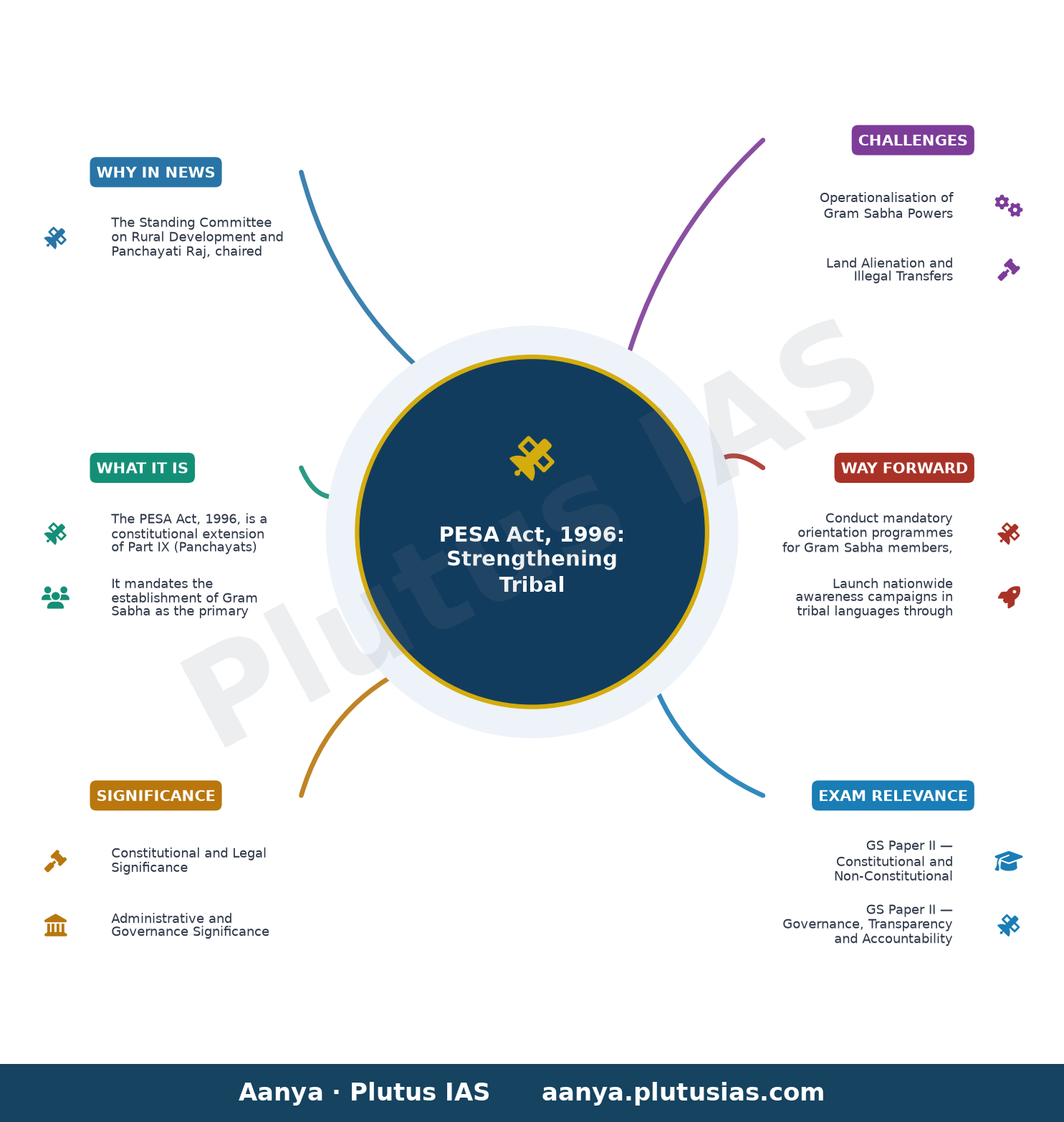
The Standing Committee on Rural Development and Panchayati Raj, chaired by Mr. Saptagiri Sankar Ulaka, submitted its report on July 31, 2026, reviewing the implementation of the Panchayats Extension to the Scheduled Areas (PESA) Act, 1996. The report highlights critical gaps in the operationalisation of Gram Sabha powers, illegal land transfers, and inadequate village-centric planning, underscoring the need for systemic reforms to strengthen tribal self-governance and protect land rights in scheduled areas.
Background
- The Panchayats Extension to the Scheduled Areas (PESA) Act, 1996, extends Part IX of the Constitution to the Fifth Schedule areas with modifications to accommodate tribal autonomy.
- Scheduled Areas are notified by the President under the Fifth Schedule, characterised by a preponderance of tribal population and socio-economic backwardness.
- The Act grants Gram Sabha extensive powers over community resources, customary dispute resolution, minor forest produce, land acquisition, and village development planning.
- Despite constitutional provisions, the operationalisation of PESA has been uneven, with Gram Sabha powers often remaining on paper due to administrative and institutional constraints.
- The Forest Rights Act, 2006, and the Land Acquisition, Rehabilitation and Resettlement Act, 2013, intersect with PESA, creating overlapping jurisdictions and implementation challenges.
What is the Panchayats Extension to the Scheduled Areas (PESA) Act, 1996?
- The PESA Act, 1996, is a constitutional extension of Part IX (Panchayats) to the Fifth Schedule areas, enacted to recognise and protect the traditional rights and governance structures of tribal communities.
- It mandates the establishment of Gram Sabha as the primary institution of local self-government in scheduled areas, with decision-making authority over land, forests, water, and other community resources.
- The Act provides for the protection of customary rights, including rights over minor forest produce, and empowers Gram Sabha to regulate and manage these resources.
- PESA requires mandatory consultation with Gram Sabha before any land acquisition or development project in scheduled areas, ensuring tribal consent and preventing alienation of tribal lands.
- The Act also recognises the role of traditional tribal institutions and customary dispute resolution mechanisms, subject to constitutional safeguards.
- PESA aims to integrate tribal development with sustainable natural resource management, aligning with constitutional principles of tribal autonomy and social justice.
Key Features
| Feature | Significance |
|---|---|
| Gram Sabha as foundational institution | Empowers tribal communities to manage local resources, resolve disputes, and plan development, ensuring autonomy under PESA. |
| Village-centric planning via GPDP | Ensures bottom-up planning aligned with tribal livelihoods, natural resource management, and cultural priorities. |
| Mandatory Gram Sabha consent for land acquisition | Prevents alienation of tribal land by requiring prior consultation, safeguarding livelihoods. |
| Digitisation of land records | Enhances transparency, reduces fraudulent land transfers, and facilitates monitoring of tribal land transactions. |
| Awareness campaigns in tribal languages | Bridges communication gaps, ensures inclusive participation, and operationalises PESA provisions effectively. |
Why it Matters
Constitutional and Legal Significance
- Implements the Fifth Schedule provisions, ensuring tribal self-governance and protection of customary rights in scheduled areas.
- Upholds the constitutional mandate of decentralisation by strengthening local institutions like Gram Sabha as per Article 243M(4).
- Reinforces the principle of ‘tribal autonomy’ enshrined in the Fifth Schedule, balancing development with community rights.
Administrative and Governance Significance
- Promotes participatory governance by mandating Gram Sabha-led planning and decision-making in tribal areas.
- Enhances accountability through digitisation of land records and national monitoring of Gram Sabha resolutions.
- Reduces administrative delays and conflicts by integrating tribal customary practices with formal governance systems.
Economic Significance
- Protects tribal livelihoods by preventing illegal land transfers and ensuring fair compensation for land acquisition.
- Supports sustainable development through village-centric planning that aligns with tribal economic priorities, such as minor forest produce management.
- Facilitates equitable resource distribution by empowering Gram Sabha to regulate community resources.
Social and Cultural Significance
- Preserves tribal cultural identity by integrating customary practices into development planning and dispute resolution.
- Strengthens social cohesion by ensuring inclusive participation of tribal communities in governance processes.
- Reduces marginalisation of tribal populations by addressing language barriers and enhancing outreach through local media.
Challenges
1. Operationalisation of Gram Sabha Powers
- Inadequate awareness among Gram Sabha members regarding their powers and responsibilities under PESA.
- Weak institutional support and lack of training for Gram Sabha functionaries, leading to poor implementation of provisions.
- Dependence on English-based administrative systems, which alienates tribal communities and limits outreach.
UPSC Link: Fifth Schedule and PESA implementation
2. Land Alienation and Illegal Transfers
- Fraudulent land transfers, including misuse of tribal identity for acquisition, threaten tribal land ownership.
- Loopholes in existing protective laws, such as the Scheduled Tribes and Other Traditional Forest Dwellers (Recognition of Forest Rights) Act, 2006, exacerbate the issue.
- Lack of digitisation and weak monitoring systems enable illegal transactions to go unchecked.
UPSC Link: Land reforms and tribal rights
3. Implementation of Consent Safeguards
- Improper implementation of mandatory Gram Sabha consent for land acquisition leads to alienation of tribal land and livelihoods.
- Absence of comprehensive operational guidelines for state governments to enforce these safeguards effectively.
- Delays in rehabilitation and compensation processes further marginalise affected tribal communities.
UPSC Link: Land acquisition and tribal consent
4. Integration with Development Goals
- Lack of alignment between Gram Panchayat Development Plans (GPDP) and tribal development schemes, such as the Tribal Sub-Plan.
- Insufficient incorporation of tribal livelihood protection and natural resource management in village-centric planning.
- Limited integration of PESA priorities with national sustainable development goals, leading to fragmented policy execution.
UPSC Link: Tribal development and sustainable planning
5. Language and Communication Barriers
- Exclusive reliance on English-based administrative systems excludes non-English-speaking tribal populations.
- Inadequate translation of training modules and awareness campaigns into major tribal languages limits outreach.
- Dependence on formal communication channels reduces participation of marginalised tribal groups.
UPSC Link: Tribal languages and administrative outreach
Challenges — UPSC Perspective
| Issue | Concern |
|---|---|
| Awareness among Gram Sabha members | Limited understanding of PESA provisions and powers, leading to underutilisation of institutional mechanisms. |
| Land alienation and illegal transfers | Fraudulent acquisition of tribal land through loopholes in protective laws and weak monitoring. |
| Implementation of consent safeguards | Failure to enforce mandatory Gram Sabha consent, resulting in land alienation and livelihood loss. |
| Digitisation of land records | Lack of digital records in many PESA states, enabling fraudulent transactions and weak monitoring. |
| Integration with tribal development schemes | Fragmented policy execution due to poor alignment between GPDP and tribal welfare programmes. |
| Language and communication barriers | Exclusion of non-English-speaking tribal populations from governance processes due to formal administrative systems. |
Way Forward
- Conduct mandatory orientation programmes for Gram Sabha members, focusing on PESA provisions, dispute resolution, and resource management.
- Launch nationwide awareness campaigns in tribal languages through community radio, local media, and cultural platforms to enhance outreach.
- Digitise land records in all PESA states and establish a dedicated national PESA platform to monitor Gram Sabha resolutions and land transactions.
- Develop comprehensive operational guidelines for state governments to enforce mandatory Gram Sabha consent for land acquisition and rehabilitation.
- Integrate tribal livelihood protection, natural resource management, and customary practices into Gram Panchayat Development Plans (GPDP).
- Translate all training modules and administrative documents into major tribal languages to ensure inclusivity.
- Strengthen monitoring systems across all PESA states to detect and prevent illegal land transfers and fraudulent transactions.
- Conduct a detailed study on illegal tribal land transfers and identify loopholes in existing protective laws for targeted reforms.
UPSC Value Addition
Keywords for Mains Answer-Writing
Panchayats Extension to the Scheduled Areas Act (PESA), 1996 · Fifth Schedule of the Constitution · Gram Sabha · tribal land rights · Scheduled Areas · Gram Panchayat Development Plans (GPDP) · tribal livelihood protection · illegal land transfers · tribal customary practices · PESA implementation challenges · tribal development schemes · sustainable development goals (SDGs)
Constitutional & Policy Linkages
- Fifth Schedule to the Constitution — Tribal self-governance and administration of scheduled areas.
Concept Flow
Fifth Schedule notification → Establishment of scheduled areas → Implementation of PESA → Empowerment of Gram Sabha → Village-centric planning (GPDP) → Protection of tribal land and resources → Prevention of land alienation → Sustainable development and tribal autonomy.
Prelims Practice Questions
Q1. Consider the following statements regarding the Panchayats Extension to the Scheduled Areas Act (PESA), 1996:
1. PESA extends constitutional provisions on Panchayati Raj to the Fifth Schedule areas with modifications.
2. The Gram Sabha is the foundational institution under PESA with powers over community resources and customary dispute resolution.
3. PESA mandates mandatory consultation with Gram Sabha before land acquisition in scheduled areas.
4. PESA is applicable to all states in India, including those without notified scheduled areas.
How many of the above statements are correct?
- Only one
- Only two
- Only three
- All four
Answer: Only three — Statements 1, 2, and 3 are correct. Statement 4 is incorrect as PESA applies only to states with notified scheduled areas under the Fifth Schedule.
Q2. Assertion (A): The Panchayats Extension to the Scheduled Areas Act (PESA), 1996, empowers Gram Sabhas to regulate minor forest produce in scheduled areas.
Reason (R): PESA grants Gram Sabhas extensive powers over community resources, including minor forest produce, to protect tribal livelihoods and customary practices.
Options:
A. Both A and R are true, and R is the correct explanation of A.
B. Both A and R are true, but R is not the correct explanation of A.
C. A is true, but R is false.
D. A is false, but R is true.
Answer: ? — Both Assertion (A) and Reason (R) are true, and Reason (R) correctly explains Assertion (A). PESA explicitly empowers Gram Sabhas to regulate minor forest produce as part of their authority over community resources.
Q3. Match the following provisions of the Panchayats Extension to the Scheduled Areas Act (PESA), 1996 with their corresponding powers:
Column I (Provision)
A. Mandatory consultation with Gram Sabha before land acquisition
B. Regulation of minor forest produce
C. Protection of tribal customary practices
D. Village development planning
Column II (Power)
1. Empowering Gram Sabhas to manage natural resources
2. Ensuring tribal livelihood security
3. Mandating Gram Sabha approval for developmental projects
4. Integrating tribal cultural priorities into planning
Options:
A – 3, B – 1, C – 4, D – 2
A – 2, B – 1, C – 4, D – 3
A – 3, B – 1, C – 2, D – 4
A – 1, B – 2, C – 3, D – 4
Answer: ? — The correct match is: A – 3 (Mandatory consultation with Gram Sabha before land acquisition), B – 1 (Regulation of minor forest produce), C – 4 (Protection of tribal customary practices), D – 2 (Village development planning).
Mains Practice Question
✍ The Standing Committee on Rural Development and Panchayati Raj (2026) has highlighted significant implementation gaps in the Panchayats Extension to the Scheduled Areas Act (PESA), 1996, despite its constitutional intent to empower tribal communities. Critically examine the structural and institutional challenges in operationalising PESA, with particular reference to the role of Gram Sabhas, land rights, and tribal livelihood protection. (15 Marks)
Approach: MODEL-ANSWER SKELETON:
1. **Constitutional and Legal Framework**:
– Brief explanation of PESA, 1996: Extension of Part IX of the Constitution to Fifth Schedule Areas with modifications (Article 243M(4)).
– Key provisions: Empowerment of Gram Sabhas (Article 243B), control over minor forest produce (Article 243G), mandatory consultation for land acquisition (Article 243ZD).
– Cite the Fifth Schedule and its role in protecting tribal rights.
2. **Structural Challenges in Implementation**:
– **Gram Sabha as a Foundational Institution**:
– Weak institutional capacity: Lack of awareness among Gram Sabha members, inadequate training, and dependence on English-based administrative systems.
– Recommendations from the Standing Committee: Mandatory orientation programmes, awareness campaigns in tribal languages, digitisation of Gram Sabha resolutions, and translation of training modules.
– **Land Rights and Illegal Transfers**:
– Persistent issues: Fraudulent land transfers, misuse of tribal identity for land acquisition, and inadequate monitoring.
– Committee’s recommendations: Digitisation of land records, mandatory Gram Sabha verification for tribal land transactions, and strengthening of protective laws.
3. **Tribal Livelihood Protection and Customary Practices**:
– **Gram Panchayat Development Plans (GPDP)**:
– Data: 96% of Gram Panchayats in PESA states prepared GPDPs in 2025-26, but origin must mandatorily be from Gram Sabha level.
– Integration of tribal livelihood protection, natural resource management, and cultural priorities into GPDPs.
– **Sustainable Development Goals (SDGs)**:
– Linking PESA priorities with SDGs (e.g., SDG 15 on life on land, SDG 2 on zero hunger).
4. **Balancing Views and Way Forward**:
– **State vs. Community Autonomy**:
– Critique of excessive state interference vs. need for structured oversight to prevent misuse.
– Role of the Ministry of Panchayati Raj in monitoring and capacity-building.
– **Judicial and Policy Interventions**:
– Reference to Supreme Court judgments on tribal land rights (e.g., Samatha v. State of Andhra Pradesh, 1997).
– Need for a dedicated national PESA platform for monitoring Gram Sabha resolutions.
5. **Conclusion**:
– PESA’s intent to empower Gram Sabhas remains underrealised due to structural and institutional gaps.
– Recommendations: Strengthening Gram Sabha capacity, digitisation, legal reforms, and integrating tribal priorities into development planning.
– Reiterate the need for a rights-based approach to tribal development in scheduled areas.
Source: PRS Legislative Research
Generated by AanyaAi for educational purpose.

- नासा-इसरो सहयोग: अंतरिक्ष अनुसंधान में नया मोड़, जानिए क्या है अगला कदम? - September 20, 2026
- NASA highlights ISRO partnership for future space missions in UPSC focus - September 20, 2026
- सीजी सरकार की श्रीरामलला दर्शन योजना: धमतरी के 2,176 श्रद्धालुओं को मिला अयोध्या दर्शन का अवसर - September 20, 2026

No Comments