


04 Aug Supreme Court Judge Strength Increased to 38: Key Reasons for UPSC Exam
✎ The Supreme Court (Number of Judges) Amendment Bill, 2026, increases the court’s sanctioned strength from 34 to 38 judges to address judicial pendency, but structural reforms in case management and appointment mechanisms remain…
Subject Relevance — Where This Topic Fits
- GS Paper II — Polity and Governance | GS Paper III — Judiciary and Legal Reforms
- Prelims: Judicial pendency, Supreme Court (Number of Judges) Act, 1956, Constitution Benches, Article 124 of the Constitution, Collegium System, judicial vacancies
- Essay: Judicial Reforms: Balancing Efficiency and Constitutional Integrity, The Role of Institutions in Ensuring Access to Justice
Quick Revision: The Supreme Court (Number of Judges) Amendment Bill, 2026, increases the court’s sanctioned strength from 34 to 38 judges to address judicial pendency, but structural reforms in case management and appointment mechanisms remain critical for sustainable impact.
Why is this in the news?
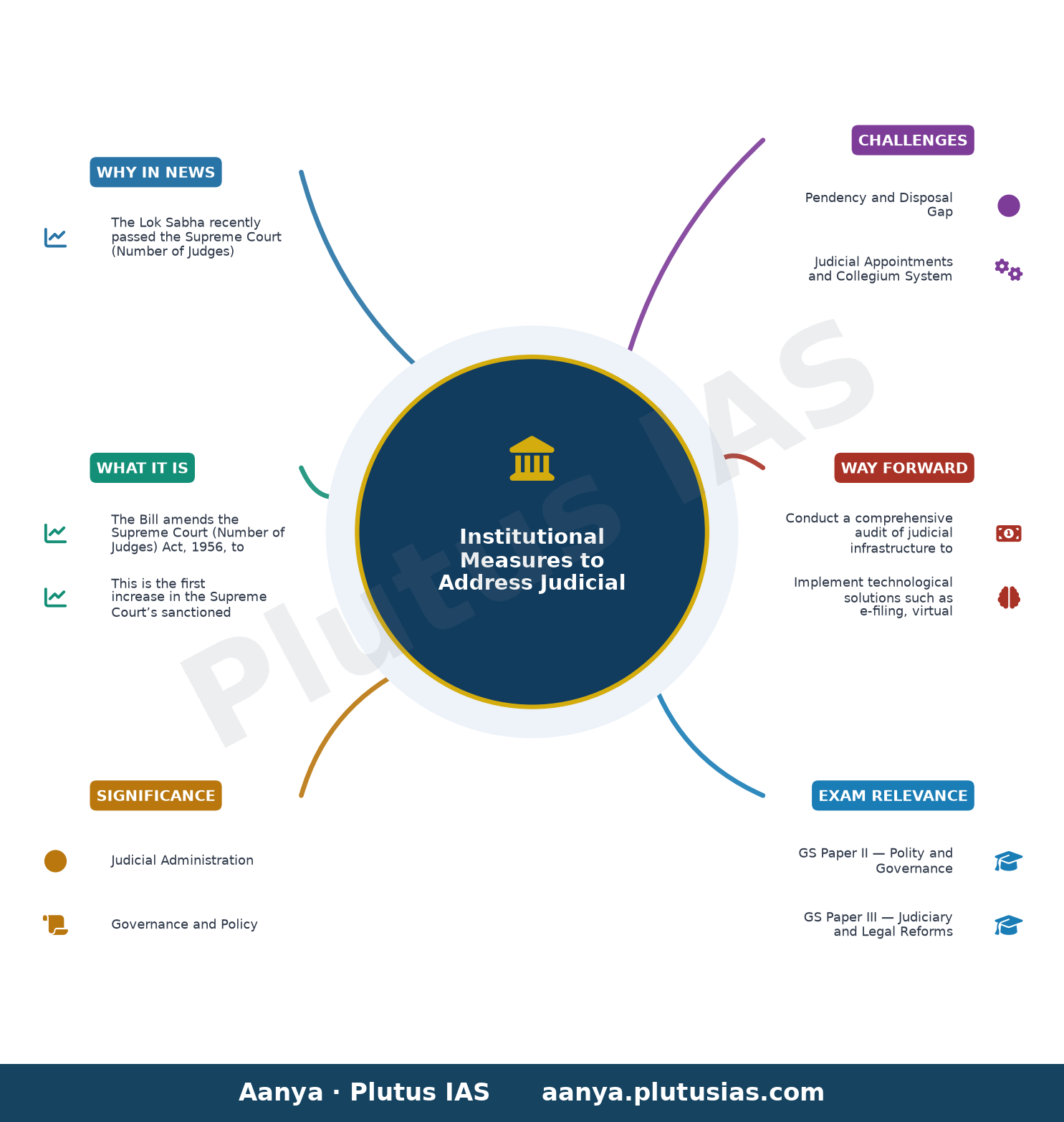
The Lok Sabha recently passed the Supreme Court (Number of Judges) Amendment Bill, 2026, which increases the sanctioned strength of the Supreme Court from 34 to 38 judges, including the Chief Justice of India (CJI). This legislative intervention, the first since 2019, is framed as a response to the persistent backlog of 92,101 cases as of January 2026, with a widening gap between case institution (75,410 in 2025) and disposal (65,615 in 2025). The Bill, introduced via an ordinance and passed without debate, reflects the executive’s emphasis on institutional capacity-building to expedite justice delivery, particularly in constitutional adjudication.
Background
- The Supreme Court of India, established under Article 124 of the Constitution, operates under a sanctioned strength of judges determined by Parliament via the Supreme Court (Number of Judges) Act, 1956.
- The last increase in sanctioned strength occurred in 2019, when Parliament raised the number from 31 to 34 judges, including the CJI.
- Judicial pendency in the Supreme Court has been a long-standing concern, exacerbated by factors such as the complexity of constitutional cases, limited judicial time, and systemic inefficiencies in case management.
- The Collegium System, while ensuring judicial independence, has faced criticism for delays in judicial appointments, contributing to vacancies and workload imbalances.
- The Constitution mandates the formation of Constitution Benches (comprising at least five judges) for cases involving substantial questions of constitutional law, but their frequent constitution is constrained by the court’s existing strength.
- The executive’s proposal aligns with the broader discourse on judicial reforms, including the need for structural adjustments to enhance the judiciary’s functional efficiency.
What is the Supreme Court (Number of Judges) Amendment Bill, 2026?
- The Bill amends the Supreme Court (Number of Judges) Act, 1956, to increase the sanctioned strength of puisne judges from 33 to 37, raising the total strength (including the CJI) from 34 to 38 judges.
- This is the first increase in the Supreme Court’s sanctioned strength since the 2019 amendment, which raised it from 31 to 34 judges.
- The Bill was introduced in the Lok Sabha on August 3, 2026, and passed without debate, following the promulgation of an ordinance to the same effect.
- The government’s rationale for the amendment is to address the growing backlog of cases, which stood at 92,101 as of January 1, 2026, with a disposal deficit of 9,795 cases in 2025.
- The amendment aims to enable the CJI to constitute Constitution Benches more frequently, thereby expediting the resolution of cases involving constitutional interpretation.
- The Bill is part of a broader institutional strategy to enhance the judiciary’s capacity to handle its workload, though it is acknowledged as a partial solution to the problem of judicial pendency.
- The amendment does not alter the constitutional framework governing the Supreme Court’s composition or functioning, as the number of judges remains subject to parliamentary approval under Article 124(1).
- The Bill awaits consideration in the Rajya Sabha, where its passage would formalize the increase in sanctioned strength.
Key Features
| Feature | Significance |
|---|---|
| Increase in sanctioned strength from 34 to 38 judges (including CJI) | Enhances the apex court’s capacity to handle a higher volume of cases, addressing the persistent issue of pendency. |
| Amendment to the Supreme Court (Number of Judges) Act, 1956 | Provides a legal framework for the structural expansion of the judiciary, ensuring institutional legitimacy and continuity. |
| Constitution of Constitution Benches with five or more judges | Facilitates the resolution of complex constitutional questions without disrupting the hearing of regular matters, ensuring doctrinal consistency. |
| Simultaneous hearing of cases through additional judges | Improves the disposal rate by enabling parallel processing of matters, reducing the backlog incrementally. |
| Voice vote passage in Lok Sabha without debate | Reflects procedural efficiency but also underscores the absence of substantive parliamentary scrutiny on judicial reforms. |
Why it Matters
Judicial Administration
- The increase in judicial strength is a direct response to the alarming backlog of 92,101 cases as of January 1, 2026, which undermines the constitutional guarantee of timely justice under Article 21.
- It reinforces the principle of judicial efficiency, ensuring that the Supreme Court can function within its constitutional mandate without being overwhelmed by procedural delays.
- The move aligns with the doctrine of separation of powers, as Parliament exercises its legislative authority to augment judicial capacity, thereby upholding the rule of law.
- By enabling the CJI to constitute Constitution Benches more frequently, the reform strengthens the Supreme Court’s role as the guardian of the Constitution.
Governance and Policy
- The amendment demonstrates the government’s commitment to judicial reform, a critical component of good governance and public trust in institutions.
- It signals a proactive approach to addressing systemic inefficiencies in the judiciary, which is essential for maintaining India’s democratic fabric.
- The reform underscores the need for a holistic judicial policy, integrating structural changes with technological and administrative improvements.
Legal Profession and Stakeholders
- The expansion provides greater opportunities for senior advocates to be elevated to the Supreme Court, enhancing the quality of judicial appointments.
- It may reduce the burden on existing judges, allowing for more focused deliberation on complex cases and reducing burnout among judicial officers.
- The move could also incentivize legal professionals to engage more actively with constitutional litigation, given the increased capacity for Constitution Bench hearings.
Challenges
1. Pendency and Disposal Gap
- Despite the increase in sanctioned strength, the gap between case institution (75,410 in 2025) and disposal (65,615 in 2025) remains a critical challenge, indicating that structural reforms alone may not suffice.
- The backlog of 92,101 cases as of January 2026 reflects systemic inefficiencies that require concurrent administrative and technological interventions.
- The judiciary’s reliance on ad-hoc judges and additional benches to manage workload highlights the need for a more sustainable solution.
UPSC Link: Judicial Pendency (Article 21, Right to Speedy Trial)
2. Judicial Appointments and Collegium System
- The reform does not address the underlying issues in the collegium system, which has been criticized for opacity and delays in judicial appointments.
- The increased strength may exacerbate the challenge of maintaining a high standard of judicial appointments, given the limited pool of eligible candidates.
- The lack of parliamentary debate on the bill raises concerns about the accountability and transparency of judicial reforms.
UPSC Link: Collegium System (Third Judges Case)
3. Resource Allocation and Infrastructure
- The expansion requires commensurate investment in judicial infrastructure, including courtrooms, staff, and digital resources, to fully leverage the increased judicial strength.
- The existing infrastructure may not be equipped to handle the additional workload, leading to potential bottlenecks in case management.
- The judiciary’s dependence on government funding for infrastructure projects may introduce delays or constraints in implementation.
UPSC Link: Judicial Infrastructure (Article 50, Separation of Judiciary)
4. Constitutional Bench Accessibility
- While the increase in judges facilitates Constitution Bench hearings, the sheer volume of pending constitutional matters may still overwhelm the reformed strength.
- The CJI’s discretion in constituting Constitution Benches could lead to prioritization disputes, particularly in politically sensitive cases.
- The reform does not guarantee equitable access to constitutional justice across regions or socio-economic groups.
UPSC Link: Constitution Bench (Article 145(3))
5. Parliamentary Scrutiny and Democratic Accountability
- The passage of the bill without debate in the Lok Sabha raises concerns about the lack of democratic scrutiny in judicial reforms.
- The absence of substantive discussion on the bill undermines the principle of parliamentary oversight in matters of constitutional importance.
- The reform process highlights the need for greater transparency and public consultation in judicial administration.
UPSC Link: Parliamentary Scrutiny (Article 105, Parliamentary Privileges)
Challenges — UPSC Perspective
| Issue | Concern |
|---|---|
| Case Backlog | Persistent gap between case institution and disposal, indicating systemic inefficiencies. |
| Judicial Appointments | Opacity and delays in the collegium system may undermine the quality of judicial appointments. |
| Infrastructure Gaps | Inadequate courtrooms, staff, and digital resources may limit the impact of increased judicial strength. |
| Constitution Bench Access | Volume of pending constitutional matters may still overwhelm the reformed strength. |
| Parliamentary Scrutiny | Lack of debate on the bill raises concerns about democratic accountability in judicial reforms. |
| Resource Allocation | Government funding constraints may delay the implementation of necessary infrastructure projects. |
Way Forward
- Conduct a comprehensive audit of judicial infrastructure to identify gaps and prioritize investments in courtrooms, staff, and digital resources.
- Implement technological solutions such as e-filing, virtual hearings, and AI-assisted case management to enhance judicial efficiency.
- Strengthen the collegium system by introducing transparency measures, such as public disclosure of criteria for judicial appointments and consultations.
- Establish a dedicated task force to monitor the impact of the increased judicial strength on pendency and disposal rates, with quarterly reports to Parliament.
- Introduce mandatory time-bound disposal targets for the Supreme Court to ensure accountability and reduce backlog.
- Enhance the capacity of the Supreme Court Registry through recruitment of additional staff and training in case management.
- Promote alternative dispute resolution mechanisms, such as mediation and arbitration, to divert cases from the overburdened judiciary.
- Encourage public-private partnerships to fund and develop judicial infrastructure, particularly in underserved regions.
UPSC Value Addition
Keywords for Mains Answer-Writing
Supreme Court (Number of Judges) Act, 1956 · sanctioned judicial strength · Constitution Benches · judicial pendency · Article 124 of the Constitution · Chief Justice of India · judicial appointments · judicial reforms · backlog of cases · judicial workload · constitutional interpretation · judicial efficiency
Constitutional & Policy Linkages
- Article 124(1) – Appointment of Supreme Court judges
- Article 145(3) – Constitution Benches for constitutional matters
- Article 21 – Right to speedy trial and judicial pendency
- Article 50 – Separation of judiciary from executive
- Article 105 – Parliamentary privileges and judicial reforms
Concept Flow
Growing backlog of cases in the Supreme Court (92,101 as of January 2026) → Inadequate disposal rate (65,615 cases in 2025) despite functioning at full sanctioned strength → Parliament introduces Supreme Court (Number of Judges) Amendment Bill, 2026 → Increase in sanctioned strength from 34 to 38 judges (including CJI) → Amendment to the Supreme Court (Number of Judges) Act, 1956 → Enhanced capacity for simultaneous case hearings and Constitution Bench hearings → Potential reduction in pendency and improvement in disposal rates → Need for concurrent administrative and technological reforms to sustain impact
Prelims Practice Questions
Q1. Consider the following statements regarding the Supreme Court of India:
1. The sanctioned strength of the Supreme Court judges is determined by the Supreme Court (Number of Judges) Act, 1956.
2. The Chief Justice of India is included in the sanctioned strength of the Supreme Court judges.
3. The Supreme Court can constitute Constitution Benches only when the sanctioned strength is fully utilised.
4. The sanctioned strength of the Supreme Court judges was last increased in 2019.
How many of the above statements are correct?
- Only one
- Only two
- Only three
- All
Answer: All — Statements 1, 2, and 4 are correct. Statement 3 is incorrect as Constitution Benches can be constituted irrespective of the utilisation of the sanctioned strength, though utilisation facilitates their formation.
Q2. Assertion (A): The Supreme Court (Number of Judges) Amendment Bill, 2026 aims to address the backlog of cases by increasing the sanctioned strength of judges.
Reason (R): The increasing pendency of cases in the Supreme Court has necessitated the expansion of judicial capacity to ensure timely justice.
- Both A and R are true, and R is the correct explanation of A.
- Both A and R are true, but R is not the correct explanation of A.
- A is true, but R is false.
- A is false, but R is true.
Answer: Both A and R are true, and R is the correct explanation of A. — Both the assertion and reason are true, and the reason correctly explains the assertion as the primary objective of the Bill is to mitigate case pendency.
Q3. Match the following columns regarding the Supreme Court of India:
Column I | Column II
— | —
A. Article 124 | 1. Provides for the appointment of the Chief Justice of India
B. Constitution Bench | 2. Hears cases involving substantial questions of constitutional law
C. Supreme Court (Number of Judges) Act, 1956 | 3. Determines the sanctioned strength of judges
D. Chief Justice of India | 4. Head of the Supreme Court and included in the sanctioned strength
- A-3, B-2, C-1, D-4
- A-4, B-2, C-3, D-1
- A-1, B-2, C-3, D-4
- A-3, B-1, C-2, D-4
Answer: A-4, B-2, C-3, D-1 — A matches Article 124 (constitutional provision for the Supreme Court), B matches Constitution Benches (hearing constitutional questions), C matches the Supreme Court (Number of Judges) Act, 1956 (sanctioned strength), and D matches the Chief Justice of India (head of the Supreme Court).
Mains Practice Question
✍ The Parliament has recently increased the sanctioned strength of the Supreme Court judges from 34 to 38. Critically examine the necessity of this amendment in the context of judicial pendency and constitutional adjudication. Also, analyse whether increasing the number of judges alone can resolve the issue of case backlog. (15 Marks)
Approach: MODEL-ANSWER SKELETON:
1. **Context and Background**: State the provisions of the Supreme Court (Number of Judges) Act, 1956 and the recent amendment (Supreme Court (Number of Judges) Amendment Bill, 2026). Highlight the sanctioned strength increase from 34 to 38 judges, including the CJI.
2. **Necessity of the Amendment**:
– **Judicial Pendency**: Cite data on pending cases (92,101 as of January 1, 2026) and the gap between institution and disposal of cases (75,410 fresh cases vs. 65,615 disposed in 2025).
– **Constitution Benches**: Explain the role of Constitution Benches (Art. 145(3)) in interpreting constitutional provisions and the difficulty in constituting them due to workload constraints.
– **Judicial Efficiency**: Argue that additional judges can enable parallel hearings and reduce pendency.
3. **Constitutional and Legal Framework**:
– Reference Article 124 of the Constitution, which empowers Parliament to determine the number of judges.
– Discuss the principle of judicial independence and the need for adequate judicial capacity to uphold constitutional governance.
4. **Critique and Limitations**:
– **Not a Panacea**: Explain that increasing the number of judges is a necessary but insufficient step. Other reforms such as better case management, alternative dispute resolution (ADR), and digital infrastructure are equally critical.
– **Appointment Bottlenecks**: Highlight the delays in judicial appointments due to collegium system constraints, which may offset the benefits of increased strength.
– **Quality vs. Quantity**: Discuss the potential dilution of judicial quality if appointments are expedited without rigorous selection processes.
5. **Comparative Perspective**:
– Compare with judicial reforms in other jurisdictions (e.g., UK’s Senior Courts Act, 1981) where similar measures were adopted to address pendency.
6. **Conclusion**:
– Summarise that while the amendment is a positive step, it must be complemented with systemic reforms to achieve meaningful reduction in pendency and ensure constitutional adjudication remains robust and timely.
Source: The Hindu
Generated by AanyaAi for educational purpose.

- यूपी हाईकोर्ट ने स्कूल बस सुरक्षा पर दिया सख्त आदेश, डीएम को 1 माह में रिपोर्ट देने का निर्देश - September 22, 2026
- UP High Court Directs DM & Chief Secretary on School Vehicle Safety: Key Facts for UPSC/PCS - September 22, 2026
- पेरियार टाइगर रिजर्व में 6 नई प्रजातियाँ खोजी गईं, जानिए क्या हैं विशेषताएँ - September 22, 2026

No Comments