


04 Aug Congress Demands Anti-Defection Law in Lok Sabha; Sitharaman’s Tax Bill Introduced
✎ The anti-defection law, enshrined in the Tenth Schedule, aims to curb political opportunism but has often been criticised for stifling intra-party democracy; reform proposals include reducing the Presiding Officer’s discretion…
Subject Relevance — Where This Topic Fits
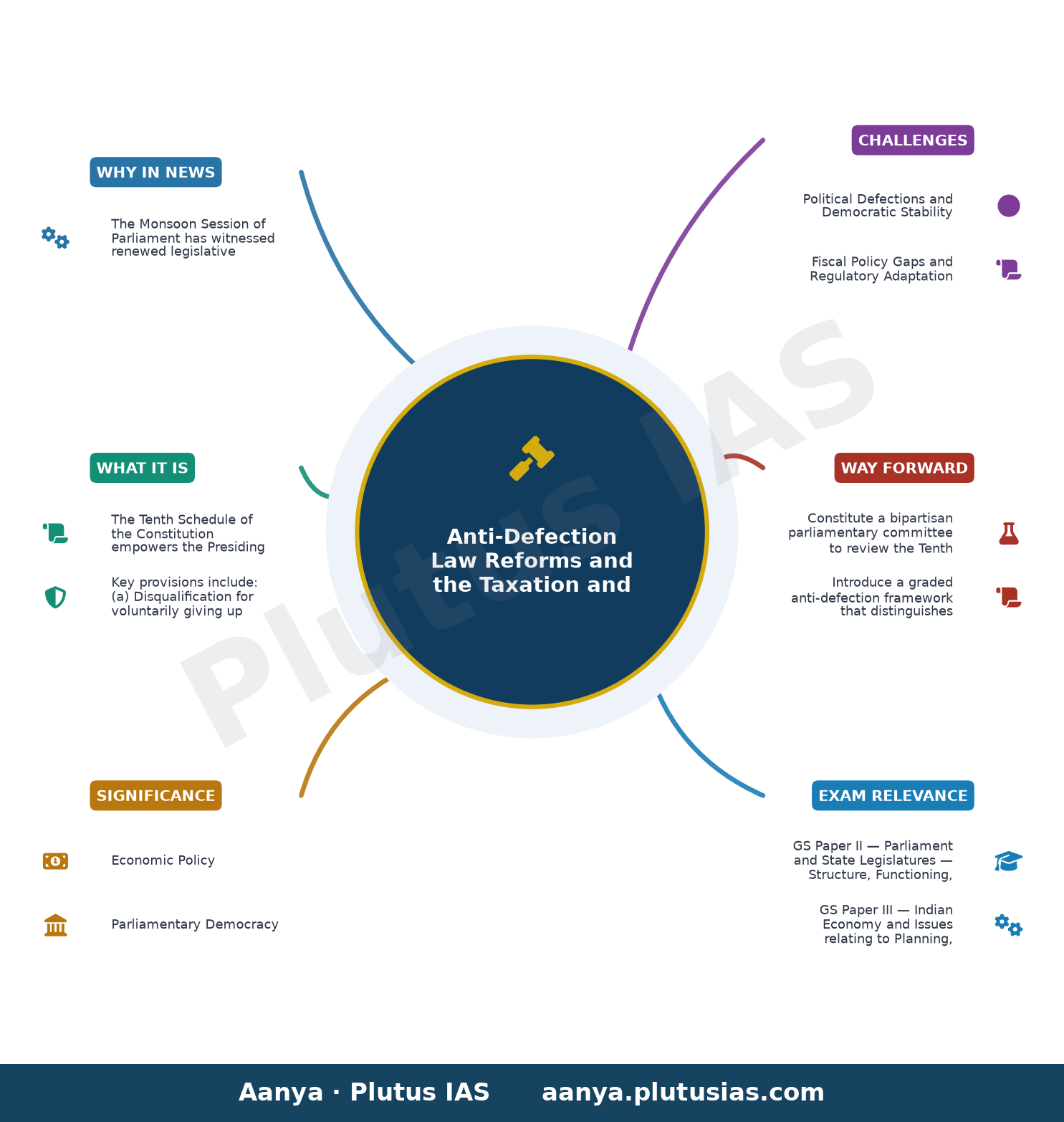
- GS Paper II — Parliament and State Legislatures — Structure, Functioning, Conduct of Business, Powers & Privileges and Issues Arising out of these | GS Paper III — Indian Economy and Issues relating to Planning, Mobilisation of Resources, Growth, Development and Employment
- Prelims: Anti-Defection Law (Tenth Schedule), Whip, Defection, Presiding Officer, Floor Test, Taxation and Other Laws (Amendment) Bill, Payment and Settlement Systems Act, 2007, Income-tax Act, 2025, Finance Act, 2026
- Essay: The integrity of democratic institutions: Balancing party discipline and individual conscience, Taxation as a tool of economic governance: Equity, efficiency, and accountability
Quick Revision: The anti-defection law, enshrined in the Tenth Schedule, aims to curb political opportunism but has often been criticised for stifling intra-party democracy; reform proposals include reducing the Presiding Officer’s discretion and introducing a ‘conscience clause’ for dissent.
Why is this in the news?
The Monsoon Session of Parliament has witnessed renewed legislative activity with the introduction of the Taxation and Other Laws (Amendment) Bill, 2026, aimed at amending fiscal statutes, alongside a demand by the Congress for urgent discussion on reforming the anti-defection law to address concerns over opportunistic mass defections. These developments are significant as they intersect constitutional provisions on parliamentary conduct, fiscal policy, and the evolving challenges to party discipline in India’s multi-party democracy.
Background
- The anti-defection law, enshrined in the Tenth Schedule of the Constitution (added by the 52nd Amendment Act, 1985), was introduced to curb the menace of political defections that destabilised governments in the 1960s and 1970s.
- The law provides for the disqualification of legislators who voluntarily give up membership of their party or vote against the party whip, except when the party allows a ‘split’ or ‘merger’ under specific conditions.
- Critics argue that the current law has been misused to stifle dissent within parties and has contributed to the erosion of intra-party democracy, as evidenced by frequent mass defections driven by political opportunism rather than ideological differences.
- The Bill’s introduction follows the promulgation of the Income-tax (Amendment) Ordinance, 2026, suggesting urgency in addressing taxation-related issues, possibly linked to economic stabilization or compliance simplification.
- Parliamentary proceedings during the Monsoon Session often witness debates on both fiscal policies and procedural reforms, reflecting the dual role of Parliament in lawmaking and oversight.
Anti-Defection Law: Constitutional Provisions, Challenges, and Reform Proposals
- The Tenth Schedule of the Constitution empowers the Presiding Officer of a House to decide on disqualification petitions related to defection, subject to judicial review under Article 32 and Article 226 of the Constitution.
- Key provisions include: (a) Disqualification for voluntarily giving up party membership; (b) Voting against the party whip; (c) Exceptions for splits or mergers approved by the party; and (d) Protection for legislators who resign or are expelled.
- The law has been criticised for its rigidity, which often suppresses dissent and reduces intra-party democracy, as parties enforce whips strictly to maintain cohesion.
- The Dinesh Goswami Committee (1990) and the Law Commission of India (1999) recommended reforms such as reducing the role of the Presiding Officer in disqualification decisions and introducing a ‘conscience clause’ to allow dissent under exceptional circumstances.
- Recent instances of mass defections, such as those in Karnataka (2019) and Madhya Pradesh (2020), have reignited debates on the need for stricter or more nuanced anti-defection norms.
- The Congress’s demand for a new anti-defection law reflects broader concerns about the erosion of ideological commitment and the rise of transactional politics, where legislators switch parties for personal gain rather than policy alignment.
- Reform proposals include: (i) Mandating a supermajority within the party for disqualification; (ii) Allowing dissent on matters of conscience with safeguards; and (iii) Strengthening the role of the Election Commission in overseeing defections.
- The Supreme Court, in the case of Keisham Meghachandra Singh v. Hon’ble Speaker, Manipur Legislative Assembly (2020), upheld the Speaker’s discretion in disqualification matters but emphasised the need for timely decisions to avoid political paralysis.
Key Features
| Feature | Significance |
|---|---|
| Taxation and Other Laws (Amendment) Bill, 2026 | Introduces amendments to the Payment and Settlement Systems Act, 2007, Income-tax Act, 2025, and Finance Act, 2026, aimed at addressing contemporary fiscal and regulatory challenges. |
| Adjournment Motion on Anti-Defection Law | Seeks urgent discussion on mass political defections driven by opportunism, highlighting the need for legislative safeguards against unprincipled shifts in party affiliation. |
| Explanatory Statement for Ordinance | Lays out the rationale for immediate legislative action through the Income-tax (Amendment) Ordinance, 2026, ensuring transparency in the government’s fiscal policy interventions. |
| Suspension of Parliamentary Business | Proposal to suspend Question Hour and Zero Hour to prioritize discussion on anti-defection reforms, underscoring the Opposition’s emphasis on democratic accountability. |
| Financial Legislation Process | Demonstrates the procedural steps in introducing and passing financial bills, including leave to introduce, laying of explanatory statements, and subsequent legislative scrutiny. |
Why it Matters
Economic Policy
- The Taxation and Other Laws (Amendment) Bill, 2026, reflects the government’s proactive approach to adapting fiscal policies to evolving economic conditions, particularly in digital payment systems and tax administration.
- The introduction of the Bill alongside an ordinance suggests urgency in addressing gaps in the Income-tax Act, 2025, which may include anti-avoidance measures or compliance reforms.
- Amendments to the Payment and Settlement Systems Act, 2007, could enhance regulatory oversight of fintech and digital payment ecosystems, aligning with India’s push for a cashless economy.
Parliamentary Democracy
- The adjournment motion on anti-defection law underscores the tension between political opportunism and democratic principles, particularly the need to balance party discipline with individual conscience.
- The suspension of parliamentary business for a specific debate highlights the Opposition’s strategy to prioritize legislative discussions that address perceived democratic deficits.
- The episode reflects broader concerns about the erosion of ideological commitment in Indian politics, a trend that has implications for policy consistency and electoral integrity.
Institutional Integrity
- The demand for a robust anti-defection law aims to curb the destabilizing effects of mass defections, which can undermine the stability of governments and legislative bodies.
- Strengthening the anti-defection framework could reinforce the credibility of Parliament and state legislatures, particularly in an era of coalition politics and shifting alliances.
- The episode also raises questions about the role of the Speaker in adjudicating defection cases, a topic often debated in the context of the Tenth Schedule of the Constitution.
Regulatory Governance
- Amendments to the Payment and Settlement Systems Act, 2007, may include provisions to address risks in digital payment infrastructure, such as fraud, cybersecurity, and consumer protection.
- The Income-tax Act, 2025, amendments could target tax evasion, base erosion, and profit shifting, aligning with global standards like the OECD’s BEPS framework.
- The legislative process, including the use of ordinances, reflects the government’s reliance on expedited measures to address critical gaps in fiscal policy.
Challenges
1. Political Defections and Democratic Stability
- Mass defections driven by opportunism erode the mandate of voters and destabilize elected governments, leading to governance disruptions.
- The current anti-defection law, enshrined in the Tenth Schedule of the Constitution, has been criticized for its rigidity, which may stifle dissent and reduce accountability.
- Opportunistic defections often undermine the ideological coherence of political parties, complicating policy formulation and implementation.
- The lack of a clear mechanism to distinguish between principled dissent and opportunistic shifts complicates enforcement of anti-defection norms.
UPSC Link: Constitution: Tenth Schedule
2. Fiscal Policy Gaps and Regulatory Adaptation
- The Income-tax Act, 2025, may have gaps in addressing tax evasion in digital economies, necessitating urgent amendments to prevent revenue loss.
- The Payment and Settlement Systems Act, 2007, requires updates to keep pace with the rapid growth of fintech and digital payment systems, including cryptocurrencies and cross-border transactions.
- The use of ordinances for fiscal amendments raises concerns about bypassing parliamentary scrutiny, potentially undermining democratic accountability.
- Balancing the need for regulatory flexibility with the protection of taxpayer rights remains a persistent challenge.
UPSC Link: Finance: Taxation Reforms
3. Parliamentary Functioning and Legislative Priorities
- The suspension of parliamentary business for a specific debate risks disrupting the legislative agenda and delaying other critical bills.
- The Opposition’s strategy to prioritize anti-defection reforms over routine business may reflect a broader trend of using parliamentary time for political messaging.
- The lack of consensus on the urgency of anti-defection reforms could lead to prolonged debates, delaying fiscal and regulatory amendments.
- Ensuring that parliamentary time is used productively, without undue politicization, is a persistent institutional challenge.
UPSC Link: Parliament: Legislative Procedures
Challenges — UPSC Perspective
| Issue | Concern |
|---|---|
| Opportunistic Defections | Undermines voter mandate and destabilizes governments, leading to governance disruptions and policy inconsistencies. |
| Rigidity in Anti-Defection Law | May stifle principled dissent and reduce accountability, complicating enforcement and reducing public trust in institutions. |
| Gaps in Fiscal Policy | Income-tax Act, 2025, may lack provisions to address tax evasion in digital economies, necessitating urgent amendments. |
| Regulatory Lag in Digital Payments | Payment and Settlement Systems Act, 2007, requires updates to address risks in fintech, cybersecurity, and cross-border transactions. |
| Use of Ordinances for Fiscal Amendments | Raises concerns about bypassing parliamentary scrutiny, potentially undermining democratic accountability and transparency. |
| Parliamentary Time Management | Suspension of business for specific debates risks disrupting legislative agendas and delaying critical bills. |
Way Forward
- Constitute a bipartisan parliamentary committee to review the Tenth Schedule and propose amendments that balance party discipline with the protection of individual conscience.
- Introduce a graded anti-defection framework that distinguishes between genuine dissent and opportunistic shifts, with clear criteria for enforcement.
- Amend the Income-tax Act, 2025, to incorporate anti-avoidance measures, digital tax compliance frameworks, and provisions for taxing cryptocurrencies and cross-border transactions.
- Update the Payment and Settlement Systems Act, 2007, to include robust cybersecurity norms, consumer protection guidelines, and regulatory oversight for fintech innovations.
- Ensure that ordinances are used sparingly for fiscal amendments, with mandatory post-facto parliamentary ratification within a stipulated timeframe.
- Enhance parliamentary oversight of fiscal policy by mandating detailed explanatory statements for all financial bills and ordinances, ensuring transparency and accountability.
- Promote institutional capacity-building in Parliament to manage legislative priorities effectively, avoiding disruptions to routine business.
- Encourage political parties to adopt internal mechanisms for addressing dissent and defections, reducing reliance on legal frameworks alone.
UPSC Value Addition
Keywords for Mains Answer-Writing
Anti-Defection Law · Tenth Schedule of the Constitution · Constitutional morality · Parliamentary accountability · Speaker’s discretion in defection cases · Supreme Court judgments on defection · Political ethics and opportunism · Taxation and Other Laws (Amendment) Bill, 2026 · Payment and Settlement Systems Act, 2007 · Income-tax Act, 2025 · Finance Act, 2026 · Legislative process in Parliament · Constitutional amendments and ordinances · Parliamentary procedures and adjournment motions
Constitutional & Policy Linkages
- Article 102(2): Disqualification for defection under the Tenth Schedule.
- Article 191(2): Grounds for disqualification of members of state legislatures.
- Article 324: Role of the Election Commission in ensuring free and fair elections, indirectly linked to anti-defection concerns.
Concept Flow
Political opportunism and mass defections → Erosion of voter mandate and governance instability → Demand for anti-defection law reform → Adjournment motion in Lok Sabha → Legislative scrutiny and potential amendments to Tenth Schedule → Rapid digitization of payments → Gaps in Payment and Settlement Systems Act, 2007 → Need for regulatory updates → Introduction of Taxation and Other Laws (Amendment) Bill, 2026 → Amendments to enhance oversight and consumer protection → Income-tax Act, 2025, gaps in addressing digital tax evasion → Revenue loss and compliance challenges → Use of ordinance for immediate amendments → Explanatory statement in Parliament → Parliamentary ratification and scrutiny → Parliamentary disruption due to adjournment motions → Delay in legislative agenda → Risk to fiscal and regulatory reforms → Need for institutional reforms in time management → Lack of consensus on anti-defection reforms → Prolonged debates → Delay in fiscal amendments → Potential erosion of public trust in institutions
Prelims Practice Questions
Q1. Consider the following statements regarding the Tenth Schedule of the Constitution of India, also known as the Anti-Defection Law:
1. It was inserted by the 52nd Amendment Act, 1985.
2. It provides for the disqualification of members of Parliament and state legislatures on grounds of defection.
3. The decision of the Speaker regarding disqualification is final and cannot be challenged in any court of law.
4. The law allows for splits and mergers of political parties without attracting disqualification.
How many of the above statements are correct?
- Only one
- Only two
- Only three
- All
Answer: Only three — Statements 1, 2, and 4 are correct. Statement 3 is incorrect as the Supreme Court, in Kihoto Hollohan v. Zachillhu (1992), held that the Speaker’s decision is subject to judicial review.
Q2. Assertion (A): The Taxation and Other Laws (Amendment) Bill, 2026, seeks to amend the Payment and Settlement Systems Act, 2007.
Reason (R): The amendment aims to introduce stricter regulations on digital payment systems to curb tax evasion.
In the context of the above two statements, which one of the following is correct?
- Both A and R are true, and R is the correct explanation of A.
- Both A and R are true, but R is not the correct explanation of A.
- A is true, but R is false.
- A is false, but R is true.
Answer: A is true, but R is false. — Assertion (A) is true as the Bill does seek to amend the Payment and Settlement Systems Act, 2007. However, Reason (R) is not the correct explanation because the Bill’s stated purpose is broader and includes amendments to the Income-tax Act, 2025, and the Finance Act, 2026, not solely to regulate digital payments.
Q3. Match the following provisions of the Constitution of India with their respective schedules:
Column I (Provision) | Column II (Schedule)
1. Allocation of seats in the Rajya Sabha | A. Tenth Schedule
2. Provisions as to disqualification on grounds of defection | B. Fourth Schedule
3. Languages recognized by the Constitution | C. Eighth Schedule
4. Provisions relating to the administration and control of scheduled areas and scheduled tribes | D. Fifth Schedule
Select the correct match:
- 1-B, 2-A, 3-C, 4-D
- 1-A, 2-B, 3-C, 4-D
- 1-C, 2-A, 3-B, 4-D
- 1-B, 2-C, 3-A, 4-D
Answer: 1-B, 2-A, 3-C, 4-D — The correct matches are: 1-B (Allocation of seats in the Rajya Sabha is governed by the Fourth Schedule), 2-A (Provisions as to disqualification on grounds of defection are in the Tenth Schedule), 3-C (Languages recognized by the Constitution are listed in the Eighth Schedule), and 4-D (Provisions relating to the administration and control of scheduled areas and scheduled tribes are in the Fifth Schedule).
Mains Practice Question
✍ Critically examine the efficacy of the Anti-Defection Law (Tenth Schedule) in curbing political opportunism in India. Also, discuss the role of the Speaker in enforcing this law and the judicial interventions that have shaped its implementation. (15 Marks)
Approach: MODEL-ANSWER SKELETON:
1. **Introduction (2 marks)**
– Brief background: Insertion of the Tenth Schedule via the 52nd Amendment Act, 1985, to address the menace of political defections.
– Core objective: To ensure stability in governance by preventing legislators from switching parties for personal or political gains.
2. **Efficacy of the Anti-Defection Law (5 marks)**
– **Strengths**:
– Reduced instances of ‘horse-trading’ and mass defections (cite examples like the 1980s and 1990s).
– Enhanced party discipline and reduced fragmentation in legislatures.
– Provision for splits and mergers (Explanation 4 of the Tenth Schedule) allows for legitimate political realignments.
– **Weaknesses**:
– **Opportunistic defections**: The law has not eliminated defections driven by power or profit (e.g., recent mass defections in states like Karnataka, Madhya Pradesh).
– **Misuse of the law**: Parties use it to stifle dissent and punish rebels (e.g., disqualification of MLAs for voting against party whip).
– **Lack of deterrence**: The penalty of disqualification is often seen as a temporary setback rather than a long-term deterrent.
– **Exclusion of independent MLAs**: The law does not apply to independent legislators, creating a loophole.
3. **Role of the Speaker (4 marks)**
– **Constitutional authority**: The Speaker is the adjudicating authority under the Tenth Schedule (Articles 191(2) and 194(2)).
– **Discretion and bias**: Speakers, often from the ruling party, have been accused of partisan decisions (e.g., disqualification of MLAs in Arunachal Pradesh 2016, Karnataka 2019).
– **Judicial scrutiny**: The Supreme Court, in *Kihoto Hollohan v. Zachillhu* (1992), held that the Speaker’s decision is subject to judicial review, but this has not fully addressed concerns of bias.
– **Reforms suggested**: Calls for an independent tribunal or the Election Commission to decide defection cases.
4. **Judicial Interventions (3 marks)**
– *Kihoto Hollohan v. Zachillhu* (1992): Established that the Speaker’s decision is subject to judicial review under Article 226/32 of the Constitution.
– *Rajendra Singh Rana v. Swami Prasad Maurya* (2007): Clarified that the law applies even to pre-poll alliances.
– *Keisham Meghachandra Singh v. Hon’ble Speaker, Manipur Legislative Assembly* (2020): Emphasized the need for timely disposal of defection cases.
– **Recent trends**: The Supreme Court has increasingly intervened to prevent misuse of the law (e.g., in the case of rebel MLAs in Maharashtra 2022).
5. **Conclusion (1 mark)**
– The Anti-Defection Law has been partially successful in curbing opportunistic defections but remains flawed due to the Speaker’s discretion and lack of deterrence. Judicial interventions have provided some safeguards, but structural reforms (e.g., independent adjudication) are needed to align the law with constitutional morality and democratic principles.
Source: Hindustan Times
Generated by AanyaAi for educational purpose.

- तमिलनाडु में महिला निःशुल्क बस सेवा ‘वेट्री पयणम’ का विस्तार, जानिए पूरी योजना - September 21, 2026
- यूपी नीट यूजी काउंसलिंग राउंड-2: मेरिट लिस्ट हुई जारी, 22 सितंबर से रिपोर्टिंग शुरू - September 21, 2026
- UP NEET UG Counselling 2026 Round 2: Merit List Out, Key Dates & Reporting Process - September 21, 2026

No Comments