


04 Aug Supreme Court to Hear NEET-UG OMR Discrepancy Plea Before Counseling
✎ The Supreme Court's intervention in NEET-UG OMR discrepancies underscores the need for transparent, accountable, and legally compliant examination processes to uphold meritocracy in competitive assessments.
Subject Relevance — Where This Topic Fits
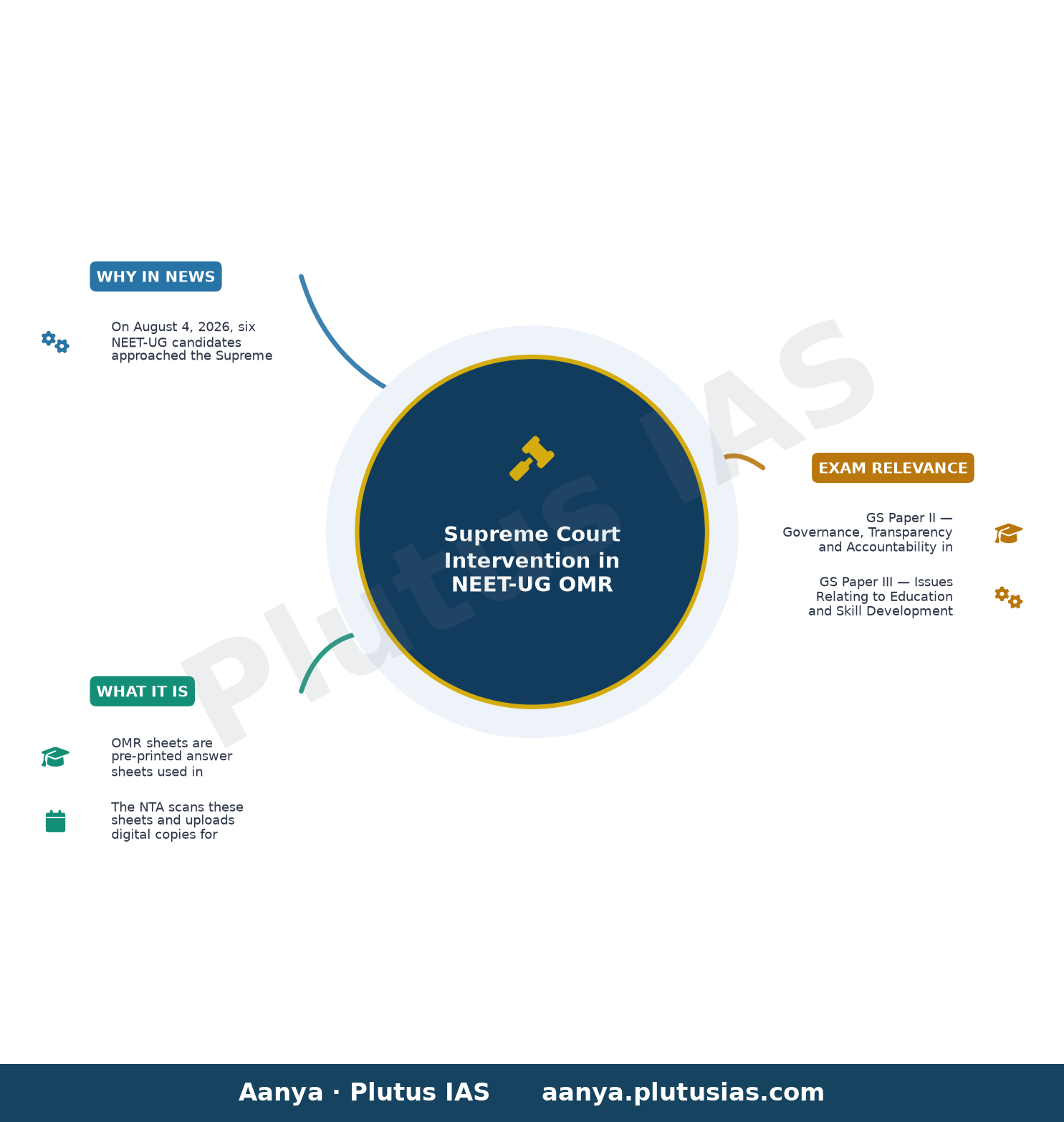
- GS Paper II — Governance, Transparency and Accountability in Examinations | GS Paper III — Issues Relating to Education and Skill Development
- Prelims: NEET-UG, OMR sheets, NTA, Supreme Court, examination malpractice, paper leak, re-examination, counselling process, transparency in evaluations
- Essay: The Role of Technology in Ensuring Transparency and Accountability in Public Examinations, Ethical Governance: Balancing Accountability and Efficiency in Public Institutions
Quick Revision: The Supreme Court’s intervention in NEET-UG OMR discrepancies underscores the need for transparent, accountable, and legally compliant examination processes to uphold meritocracy in competitive assessments.
Why is this in the news?
On August 4, 2026, six NEET-UG candidates approached the Supreme Court alleging discrepancies between their actual OMR sheet responses and the copies provided by the National Testing Agency (NTA). The plea seeks early judicial intervention to resolve the issue before the counselling process commences, highlighting concerns over transparency, accountability, and the integrity of the examination system. This development assumes significance in the context of the NEET-UG 2026 exam, which was cancelled due to a paper leak and subsequently re-conducted on June 21, 2026.
Background
- The NEET-UG 2026 examination, originally scheduled for May 3, 2026, was cancelled following allegations of a paper leak, necessitating a re-examination on June 21, 2026.
- The National Testing Agency (NTA) is the statutory body responsible for conducting NEET-UG, a high-stakes entrance examination for admission to undergraduate medical courses in India.
- OMR (Optical Mark Recognition) sheets are used for recording answers in NEET-UG, and discrepancies between marked responses and uploaded copies can undermine the credibility of the examination.
- The Supreme Court has been approached to ensure timely resolution of grievances to prevent delays in the counselling and admission process for medical aspirants.
- The petitioners claim that despite multiple attempts to seek redressal from the NTA—including emails and physical visits—they received no response, indicating systemic inefficiencies.
- This case reflects broader concerns about the transparency and accountability of examination bodies, particularly in the aftermath of high-profile irregularities in competitive examinations.
What are OMR Sheets and Their Role in NEET-UG?
- OMR sheets are pre-printed answer sheets used in examinations like NEET-UG, where candidates mark their responses by filling in bubbles corresponding to the correct options.
- The NTA scans these sheets and uploads digital copies for provisional result declarations, which candidates can access for verification.
- Discrepancies between the marked responses on the original OMR sheet and the uploaded copy can arise due to scanning errors, human oversight, or intentional manipulation.
- The integrity of OMR sheets is critical, as they form the basis for evaluating candidates’ performance and determining merit lists for admissions.
- The NTA has previously issued advisories warning against the submission of fake OMR sheets for scrutiny, emphasising the legal consequences of such actions.
- The Supreme Court’s intervention in such cases underscores the judiciary’s role in safeguarding the rights of candidates and ensuring procedural fairness.
- The issue also highlights the challenges in maintaining transparency in large-scale examinations, particularly when conducted under heightened scrutiny due to past irregularities.
- For UPSC aspirants, this case serves as a case study in the importance of accountability in public institutions and the role of judicial oversight in maintaining public trust.
UPSC Value Addition
Keywords for Mains Answer-Writing
NEET-UG examination · National Testing Agency (NTA) · OMR sheet discrepancies · Supreme Court of India · examination malpractice · re-examination of NEET-UG · paper leak in NEET-UG · counselling process in medical admissions · judicial review of administrative decisions · right to fair examination · transparency in examinations · administrative accountability · medical education reforms · examination reforms in India
Prelims Practice Questions
Q1. Consider the following statements regarding the NEET-UG examination conducted by the National Testing Agency (NTA):
1. The NEET-UG 2026 exam was originally scheduled for May 3, 2026, but was cancelled due to a paper leak.
2. The re-conducted NEET-UG 2026 was held on June 21, 2026.
3. The NTA is responsible for conducting the NEET-UG examination and is also the final authority on the authenticity of OMR sheets.
How many of the above statements are correct?
- Only one
- Only two
- All three
- None
Answer: All three — Statements 1 and 2 are correct as per the news report. Statement 3 is incorrect because the NTA’s role as the final authority on OMR sheets is currently under judicial scrutiny due to alleged discrepancies.
Q2. Assertion (A): The Supreme Court of India has the power to direct the National Testing Agency (NTA) to re-examine OMR sheets in cases of alleged discrepancies.
Reason (R): The Supreme Court can intervene in administrative decisions of statutory bodies when fundamental rights or fairness in examination processes are involved.
In the context of the above statements, which of the following is correct?
- Both A and R are true, and R is the correct explanation of A.
- Both A and R are true, but R is not the correct explanation of A.
- A is true, but R is false.
- A is false, but R is true.
Answer: Both A and R are true, but R is not the correct explanation of A. — The Supreme Court has the power to intervene in administrative decisions of bodies like the NTA when fundamental rights or fairness in examination processes are at stake. The assertion and reason are both correct, and the reason correctly explains the assertion.
Q3. Match the following columns with reference to the NEET-UG examination and its associated issues:
Column I (Issue) | Column II (Description)
—————–|———————–
A. OMR Sheet Discrepancies | 1. Conducted by NTA on June 21, 2026, after cancellation of the original exam
B. Paper Leak | 2. Alleged mismatches between answers marked by candidates and those uploaded by NTA
C. Re-examination | 3. Unauthorised access to examination content before the scheduled date
D. Counselling Process | 4. Process of seat allocation for medical admissions post-examination results
Select the correct match:
- A-2, B-3, C-1, D-4
- A-1, B-2, C-3, D-4
- A-3, B-1, C-2, D-4
- A-4, B-3, C-2, D-1
Answer: A-2, B-3, C-1, D-4 — The correct matches are: A-2 (OMR Sheet Discrepancies refer to mismatches between answers marked and uploaded), B-3 (Paper Leak refers to unauthorised access to examination content), C-1 (Re-examination was conducted on June 21, 2026), and D-4 (Counselling Process is for seat allocation).
Mains Practice Question
✍ The integrity of examination processes is a cornerstone of fair and equitable access to educational opportunities. In light of the recent Supreme Court intervention concerning alleged discrepancies in OMR sheets of NEET-UG candidates, critically examine the mechanisms for ensuring transparency and accountability in high-stakes examinations conducted by statutory bodies like the National Testing Agency (NTA). Also, analyse the role of judicial review in safeguarding the rights of candidates. (15 Marks)
Approach: MODEL-ANSWER SKELETON:
1. **Introduction (2 marks)**: Define the importance of examination integrity in the context of NEET-UG and its role in medical admissions. Highlight the recent Supreme Court intervention as a trigger for this discussion.
2. **Mechanisms for Transparency and Accountability (6 marks)**:
– **Pre-Examination**: Role of the NTA in designing question papers, conducting mock tests, and ensuring standardised procedures (e.g., CCTV surveillance, biometric verification).
– **During Examination**: OMR sheet handling protocols, use of tamper-evident seals, and real-time monitoring.
– **Post-Examination**: Transparent evaluation processes, provision for re-evaluation, and grievance redressal mechanisms (e.g., OMR sheet scrutiny requests).
– **Legal Safeguards**: Reference to the Right to Information (RTI) Act, 2005, and the need for statutory regulations governing examination conduct (e.g., proposed Examination Conduct Act).
3. **Role of Judicial Review (5 marks)**:
– **Judicial Activism**: Cite landmark cases such as *T.M.A. Pai Foundation v. State of Karnataka* (2002) and *P.A. Inamdar v. State of Maharashtra* (2005) to establish the judiciary’s role in ensuring fairness in admissions.
– **Recent Precedents**: Reference to the Supreme Court’s intervention in the NEET-UG 2024 paper leak case (*MCC v. NEET-UG Aspirants Welfare Association*, 2024) and its impact on re-examinations.
– **Balancing Act**: Discuss how the judiciary balances administrative autonomy of bodies like the NTA with the rights of candidates (e.g., *Rajasthan Public Service Commission v. Union of India*, 2021).
4. **Challenges and Reforms (2 marks)**:
– **Systemic Issues**: Highlight the lack of a dedicated statutory framework for examinations, delays in grievance redressal, and the need for digital transparency (e.g., OMR sheet scanning and cross-verification).
– **Proposed Reforms**: Suggest measures such as the establishment of an independent Examination Regulatory Authority, mandatory third-party audits, and the use of blockchain for tamper-proof records.
5. **Conclusion (1 mark)**: Summarise the need for a multi-stakeholder approach involving the executive, judiciary, and statutory bodies to restore public trust in examination processes.
Source: The Hindu
Generated by AanyaAi for educational purpose.


No Comments