


05 Aug Allahabad HC: Pending Case Can’t Deny Character Certificate | UPSC Polity Insight
✎ Pending criminal cases cannot be used as grounds to deny a character certificate; only a conviction by a competent court can justify such denial, in accordance with the constitutional presumption of innocence.
Subject Relevance — Where This Topic Fits
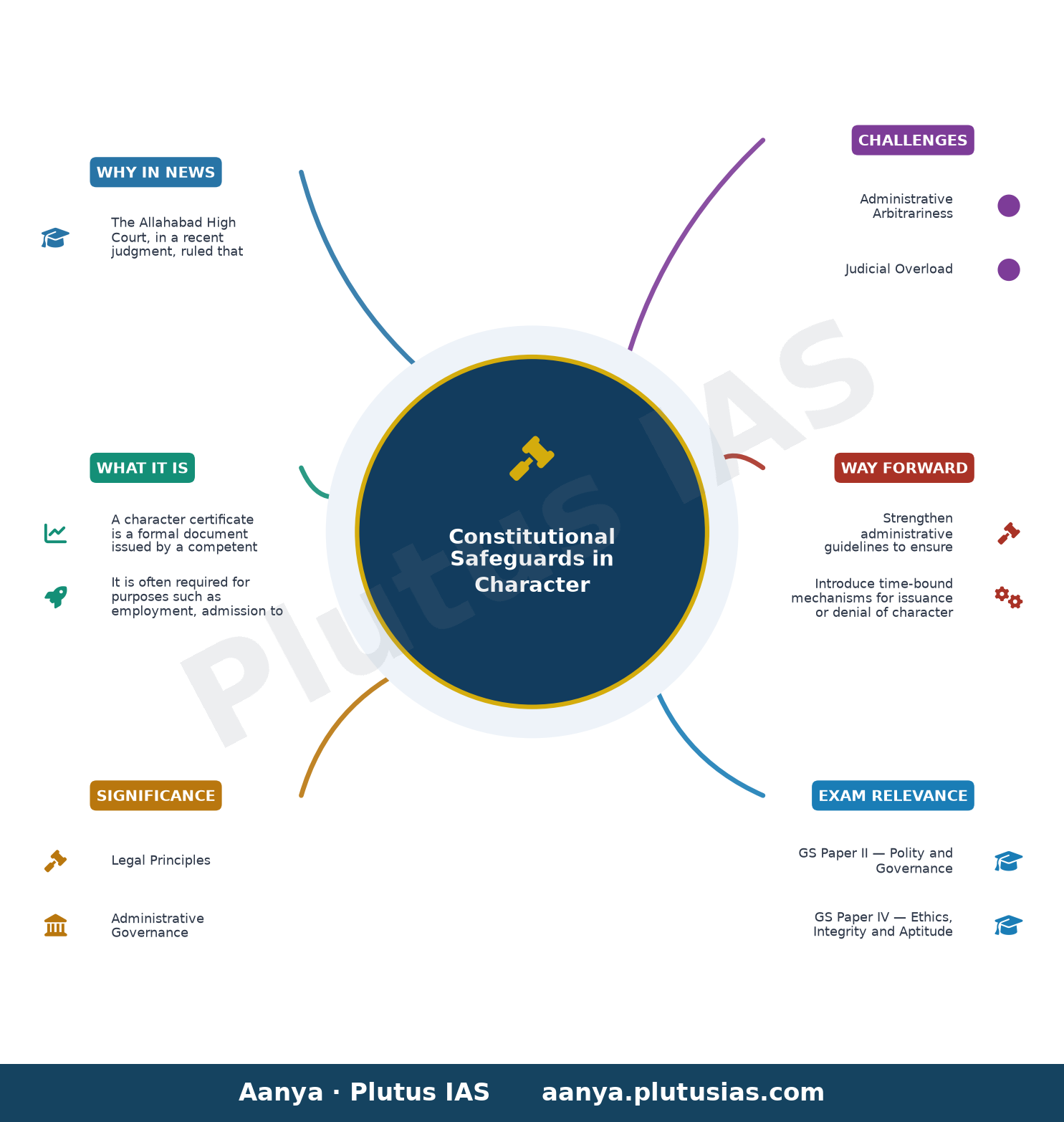
- GS Paper II — Polity and Governance | GS Paper IV — Ethics, Integrity and Aptitude
- Prelims: Character Certificate, Right to Fair Opportunity, Judicial Review, Article 21, Due Process of Law
- Essay: Judicial Activism and Protection of Fundamental Rights, Balance Between Individual Liberty and State Authority
Quick Revision: Pending criminal cases cannot be used as grounds to deny a character certificate; only a conviction by a competent court can justify such denial, in accordance with the constitutional presumption of innocence.
Why is this in the news?
The Allahabad High Court, in a recent judgment, ruled that refusal to issue a character certificate solely on the grounds of a pending criminal case is constitutionally impermissible. The court held that a pending case cannot be treated as prima facie evidence of an individual’s character unless a competent court of law declares them guilty. This decision reinforces the principle that the presumption of innocence remains intact until proven otherwise, and administrative authorities cannot impose collateral restrictions based on unadjudicated allegations.
Background
- Character certificates are official documents issued by competent authorities to attest to an individual’s conduct and behaviour, often required for employment, education, or other legal purposes.
- The issuance of character certificates is governed by administrative discretion, but such discretion must align with constitutional principles, including the presumption of innocence under Article 21 of the Constitution.
- Pending criminal cases are not equivalent to convictions; they merely represent allegations that require judicial adjudication.
- Administrative authorities, such as District Magistrates, often face challenges in balancing the need for due diligence with the constitutional rights of individuals.
- The Supreme Court of India, in *Avtar Singh v. Union of India* (2016), had previously held that pending criminal cases cannot automatically disqualify an individual unless the nature and gravity of the offence warrant such action.
- This judgment aligns with the broader jurisprudence on procedural fairness and the protection of individual liberties against arbitrary state action.
What is a Character Certificate and its Legal Framework?
- A character certificate is a formal document issued by a competent authority—typically the District Magistrate or a designated officer—that certifies an individual’s conduct, behaviour, and antecedents.
- It is often required for purposes such as employment, admission to educational institutions, visa applications, or participation in public services.
- The issuance of a character certificate is not an absolute right but is subject to administrative discretion, provided such discretion is exercised in accordance with constitutional and statutory provisions.
- The presumption of innocence, enshrined in Article 21 of the Constitution, ensures that no individual can be treated as guilty until proven so by a competent court of law.
- Administrative authorities must apply the principle of proportionality when evaluating pending criminal cases; mere pendency of a case does not justify denial of a character certificate unless the offence is of a grave nature or involves moral turpitude.
- The Allahabad High Court’s judgment reinforces the need for due process and judicial review in administrative decisions that impact fundamental rights.
- The court’s ruling is consistent with the Supreme Court’s observations in *Avtar Singh v. Union of India*, which emphasized that the nature and gravity of the offence must be considered before denying a character certificate.
- This judgment underscores the importance of separating adjudicatory processes from administrative functions to prevent arbitrary restrictions on individual liberties.
Key Features
| Feature | Significance |
|---|---|
| Character Certificate | A formal document issued by competent authorities certifying an individual’s moral and social conduct, often required for employment, education, or legal purposes. |
| Pending Criminal Case | A legal proceeding that has been initiated but not yet concluded by a competent court, implying no conclusive determination of guilt. |
| Judicial Review | The power of higher courts to examine and invalidate administrative or executive decisions that violate legal principles or fundamental rights. |
| Presumption of Innocence | A legal principle enshrined in Article 21 of the Constitution, which presumes an individual innocent until proven guilty by a competent court. |
| Administrative Discretion | The authority of executive bodies to make decisions within the bounds of law, subject to judicial oversight for arbitrariness or illegality. |
Why it Matters
Legal Principles
- Reaffirms the constitutional guarantee of presumption of innocence under Article 21, protecting individuals from arbitrary stigma.
- Establishes that administrative authorities cannot deny character certificates solely on the basis of pending criminal cases, ensuring procedural fairness.
- Highlights the supremacy of judicial determination over executive assumptions in matters of individual character.
Administrative Governance
- Delineates the boundaries of administrative discretion, mandating reasoned decisions based on factual and legal merits rather than speculative grounds.
- Emphasizes the need for transparency and accountability in public administration, particularly in issuance of official documents.
- Underscores the role of higher judiciary in correcting administrative overreach and protecting citizens’ rights.
Citizens’ Rights
- Protects individuals from collateral damage arising from unproven allegations, ensuring equitable access to opportunities.
- Promotes the rule of law by preventing executive actions from undermining judicial processes.
- Strengthens trust in public institutions by ensuring decisions are based on evidence rather than presumptions.
Challenges
1. Administrative Arbitrariness
- Risk of executive authorities acting on assumptions rather than legal evidence, leading to denial of legitimate rights.
- Potential for misuse of administrative power to deny benefits or opportunities based on unproven allegations.
UPSC Link: GS-II: Judiciary, Executive
2. Judicial Overload
- Pending criminal cases may delay issuance of character certificates, affecting individuals’ access to employment or education.
- Judicial scrutiny of administrative decisions adds to the burden on higher courts, necessitating systemic reforms.
UPSC Link: GS-II: Judiciary
3. Stigma and Social Bias
- Pending cases, even if ultimately dismissed, may lead to social ostracization or reputational harm.
- Administrative denial of certificates exacerbates societal biases against individuals facing legal proceedings.
UPSC Link: GS-II: Fundamental Rights
Challenges — UPSC Perspective
| Issue | Concern |
|---|---|
| Executive Overreach | Risk of administrative authorities acting beyond their legal mandate, denying rights without due process. |
| Judicial Delay | Pending criminal cases may lead to prolonged administrative inaction, affecting individuals’ access to opportunities. |
| Reputational Harm | Pending allegations, even if baseless, may cause irreversible social and professional damage. |
| Procedural Fairness | Need for transparent and reasoned decisions to ensure equity in administrative actions. |
| Resource Constraints | Judicial and administrative systems may struggle to handle the volume of such cases efficiently. |
Way Forward
- Strengthen administrative guidelines to ensure decisions on character certificates are based solely on conclusive judicial findings.
- Introduce time-bound mechanisms for issuance or denial of character certificates to prevent arbitrary delays.
- Enhance awareness among citizens regarding their rights and the legal recourse available against arbitrary denials.
- Promote digital integration of judicial records to enable seamless verification of pending cases and their status.
- Encourage executive training programs to sensitize authorities on the presumption of innocence and procedural fairness.
- Establish grievance redressal mechanisms within administrative bodies for swift resolution of disputes.
- Conduct periodic audits of administrative decisions to identify and rectify patterns of arbitrariness.
UPSC Value Addition
Keywords for Mains Answer-Writing
Character Certificate · Pending Criminal Cases · Right to Fair Procedure · Judicial Review · Article 21 · Natural Justice · Judicial Activism · Executive Discretion · Due Process of Law · Judicial Precedents
Constitutional & Policy Linkages
- Article 21: Right to life and personal liberty (Presumption of Innocence)
- Article 14: Right to equality before law (Procedural fairness)
- Article 19(1)(g): Freedom to practice any profession (Access to employment)
- Article 226: Writ jurisdiction of High Courts (Judicial review)
Concept Flow
Pending criminal case filed against individual → Executive authority denies character certificate based solely on pending case → Individual approaches High Court under Article 226 for judicial review → High Court examines administrative decision in light of constitutional principles (Article 21, 14) → Judicial scrutiny upholds presumption of innocence and procedural fairness → Administrative authority directed to issue certificate in prescribed format → Reaffirmation of judicial supremacy over executive discretion
Prelims Practice Questions
Q1. Consider the following statements regarding the issuance of a Character Certificate in India:
1. A pending criminal case alone can be a valid ground for refusing to issue a Character Certificate.
2. The Allahabad High Court has held that refusal to issue a Character Certificate solely on the basis of a pending criminal case is unconstitutional.
3. The Supreme Court of India has ruled that the competent authority must consider the nature and gravity of the case before denying a Character Certificate.
How many of the above statements are correct?
- Only one
- Only two
- All three
- None
Answer: All three — Statement 1 is incorrect because the Allahabad High Court has explicitly held that a pending criminal case alone cannot be a ground for refusal. Statements 2 and 3 are correct as they align with the judicial precedents cited by the High Court.
Q2. Assertion (A): The issuance of a Character Certificate is a matter of executive discretion and cannot be subject to judicial review.
Reason (R): The Allahabad High Court has directed the executive to issue a Character Certificate within three weeks, overriding the discretion of the District Magistrate.
In the context of the above statements, which of the following is correct?
- Both A and R are true, and R is the correct explanation of A
- Both A and R are true, but R is not the correct explanation of A
- A is true, but R is false
- A is false, but R is true
Answer: ? — Assertion (A) is false because the issuance of a Character Certificate is subject to judicial review, as evidenced by the Allahabad High Court’s intervention. Reason (R) is true as the Court directed the executive to issue the certificate, demonstrating judicial oversight over executive discretion.
Mains Practice Question
✍ The refusal to issue a Character Certificate solely on the grounds of a pending criminal case violates the principles of natural justice and due process of law. Critically examine this proposition with reference to recent judicial precedents and constitutional provisions. (15 Marks)
Approach: MODEL-ANSWER SKELETON:
1. **Introduction**: Define Character Certificate and its significance in governance and employment contexts.
2. **Constitutional and Legal Framework**:
– Article 21 (Right to Life and Personal Liberty) and its interpretation by the Supreme Court.
– Judicial review under Article 226 (High Court’s power to issue writs) and Article 32 (Supreme Court’s power).
– Reference to the Allahabad High Court’s judgment in the instant case (Justice Prakash Padia & Justice Vivek Saron, 2026).
3. **Judicial Precedents**:
– Supreme Court’s ruling in *Avtar Singh v. State of Punjab* (2016) on the irrelevance of pending cases for character assessment.
– Other relevant judgments on executive discretion and judicial review (e.g., *S.G. Jaisinghani v. Union of India*).
4. **Principles of Natural Justice**:
– Right to be heard (Audi Alteram Partem).
– Proportionality and non-arbitrariness in administrative action.
5. **Executive Discretion vs. Judicial Review**:
– Balance between administrative efficiency and individual rights.
– Role of the judiciary in safeguarding constitutional rights.
6. **Conclusion**: Reiterate the violation of due process and propose a balanced approach for executive authorities.
Source: amarujala.com
Generated by AanyaAi for educational purpose.

- यूपीएससी के लिए महत्वपूर्ण: 91, 182 और 364 दिन के टी-बिल नीलामी परिणाम - September 23, 2026
- RBI Auction Results: Key Cuts in 91/182/364-Day T-Bill Yields Explained for UPSC - September 23, 2026
- विकलांग सैन्य कैडेटों को पेंशन देने से रोक रही सरकार की नीति: केंद्र ने सुप्रीम कोर्ट में बताया - September 23, 2026

No Comments