


05 Aug Rajya Sabha Discusses SC Judges’ Bill Amid Opposition Protests in Monsoon Session
✎ The Supreme Court (Number of Judges) Amendment Bill, 2026 increases the sanctioned judicial strength of the Supreme Court from 34 to 38 judges, including the Chief Justice of India, to address case backlog and improve judicial…
Subject Relevance — Where This Topic Fits
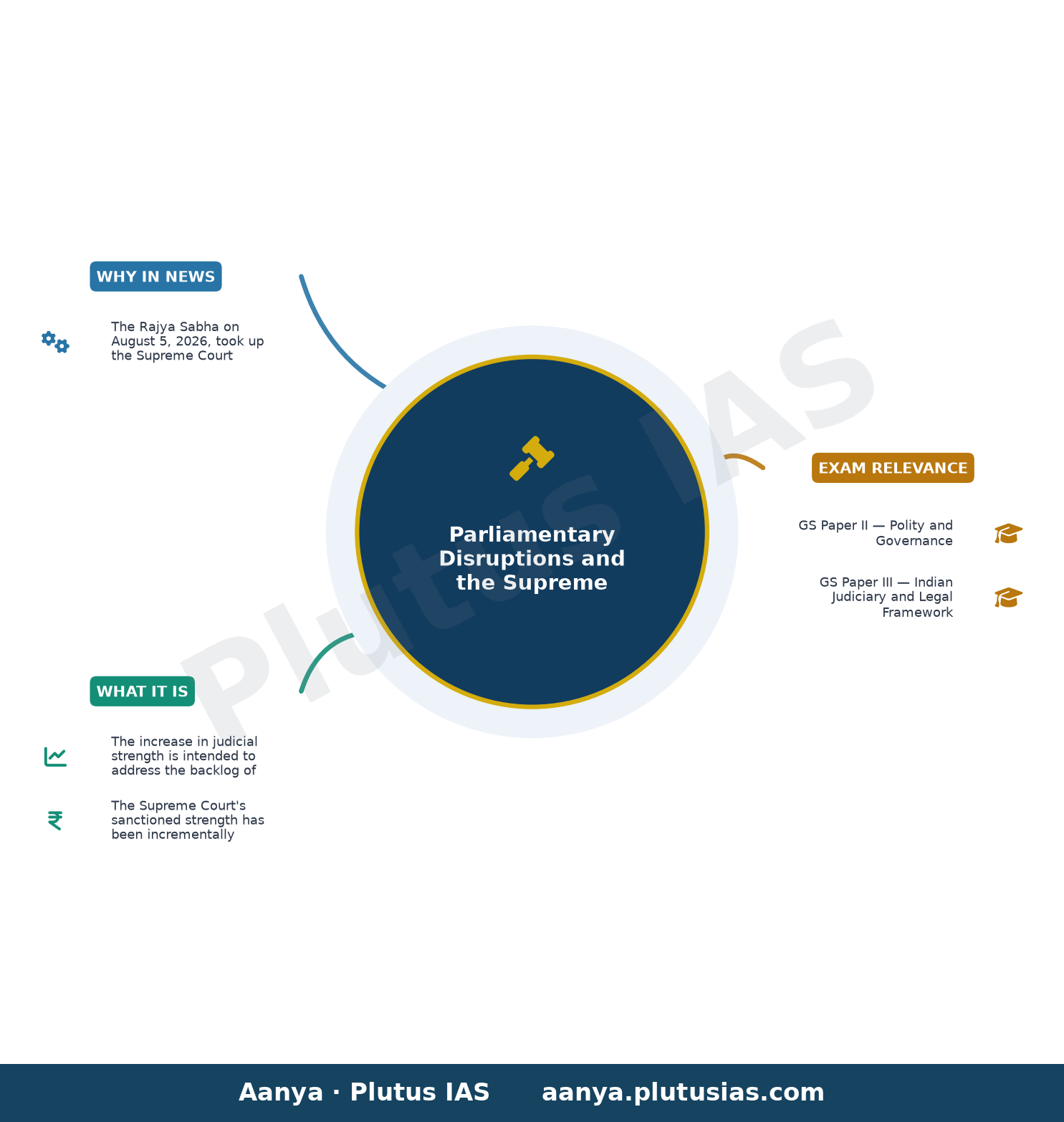
- GS Paper II — Polity and Governance | GS Paper III — Indian Judiciary and Legal Framework
- Prelims: Supreme Court (Number of Judges) Act, 1956, Parliamentary procedures, Judicial appointments, Constitutional amendments, Disruption in Parliament, Judicial strength, Bankers’ Books Evidence Bill
- Essay: Parliamentary democracy in India: Challenges and reforms, Judicial reforms and institutional capacity
Quick Revision: The Supreme Court (Number of Judges) Amendment Bill, 2026 increases the sanctioned judicial strength of the Supreme Court from 34 to 38 judges, including the Chief Justice of India, to address case backlog and improve judicial efficiency.
Why is this in the news?
The Rajya Sabha on August 5, 2026, took up the Supreme Court (Number of Judges) Amendment Bill, 2026 for discussion amid persistent disruptions by the Opposition, which has been demanding statements from the Union Home Minister on alleged police excesses, misappropriation of Ram temple donations, and statehood for Jammu and Kashmir. This development underscores the tension between legislative productivity and parliamentary decorum, while also highlighting the judiciary’s evolving institutional capacity.
Background
- The Constitution of India, under Article 124(1), empowers Parliament to determine the number of judges in the Supreme Court, including the Chief Justice of India.
- Parliamentary disruptions have become a recurring feature in recent sessions, often leading to adjournments and stalling of legislative business.
- The Opposition’s demands reflect broader political tensions, particularly regarding issues of federalism, minority rights, and governance accountability.
- The Bankers’ Books Evidence Bill, 2026, passed in the Lok Sabha, aims to modernize evidence laws in line with digital banking practices.
What is the Supreme Court (Number of Judges) Amendment Bill, 2026?
- The increase in judicial strength is intended to address the backlog of cases and improve judicial efficiency, particularly in light of the Supreme Court’s expanding docket and the constitutional mandate to ensure timely justice.
- The Supreme Court’s sanctioned strength has been incrementally increased over the decades, reflecting the growing complexity and volume of litigation in India, including constitutional, civil, and criminal matters.
- The Bill does not alter the constitutional provisions governing judicial appointments, which remain vested in the President after consultation with the Chief Justice of India, as outlined in Article 124(2) of the Constitution.
- The increase in judicial strength is a legislative measure distinct from the collegium system, which governs the appointment and transfer of judges, and does not directly impact judicial independence.
- The Bill is part of broader efforts to enhance the judiciary’s institutional capacity, which has been under scrutiny due to delays in case disposal and the pendency of over 70,000 cases in the Supreme Court as of recent data.
- The Bill’s passage in the Lok Sabha without debate, amid Opposition protests, highlights the challenges of legislative functioning in a polarized political environment.
UPSC Value Addition
Keywords for Mains Answer-Writing
Parliamentary functioning · Supreme Court judges’ strength · Supreme Court (Number of Judges) Act, 1956 · Parliamentary disruption · Opposition protests in Parliament · Judicial appointments and vacancies · Constitutional Amendment Bills · Parliamentary decorum · Separation of powers · Judicial reforms
Prelims Practice Questions
Q1. Consider the following statements regarding the Supreme Court (Number of Judges) Amendment Bill, 2026:
1. The Bill seeks to amend the Supreme Court (Number of Judges) Act, 1956.
2. It increases the number of puisne judges from 33 to 37.
3. The total sanctioned strength of the Supreme Court, including the Chief Justice of India, will rise to 38.
4. The Bill was passed by the Rajya Sabha without any debate.
How many of the above statements are correct?
- Only one
- Only two
- Only three
- All four
Answer: Only three — Statements 1, 2, and 3 are correct. Statement 4 is incorrect as the Bill was passed by the Lok Sabha on August 3, 2026, and taken up for discussion in the Rajya Sabha on August 5, 2026.
Q2. Assertion (A): The Supreme Court (Number of Judges) Act, 1956, originally fixed the maximum number of puisne judges at 10.
Reason (R): The Act was amended in 2009 to increase the sanctioned strength of the Supreme Court to 31 judges, including the Chief Justice of India.
In the context of the above statements, which of the following is correct?
- Both A and R are true, and R is the correct explanation of A.
- Both A and R are true, but R is not the correct explanation of A.
- A is true, but R is false.
- A is false, but R is true.
Answer: Both A and R are true, but R is not the correct explanation of A. — Assertion (A) is true as the original Act fixed the maximum number of puisne judges at 10. Reason (R) is also true and correctly explains that the Act was amended in 2009 to increase the sanctioned strength to 31 judges, including the Chief Justice of India.
Q3. Match the following parliamentary procedures with their descriptions:
Column I
A. Adjournment Motion
B. No-Confidence Motion
C. Calling Attention Notice
D. Zero Hour
Column II
1. A procedure to draw the attention of the House to a matter of urgent public importance.
2. A procedure to suspend the business of the House for a specified period.
3. A procedure to test the majority of the government in the House.
4. A period immediately before the regular business of the House begins, when members can raise matters without prior notice.
Select the correct match:
- A-2, B-3, C-1, D-4; A-1, B-2, C-3, D-4; A-3, B-1, C-4, D-2; A-4, B-3, C-2, D-1
- answer
Answer: A-2, B-3, C-1, D-4; A-1, B-2, C-3, D-4; A-3, B-1, C-4, D-2; A-4, B-3, C-2, D-1 —
Mains Practice Question
✍ The Parliament of India has witnessed repeated disruptions in recent times, with the Opposition demanding statements from the government on various issues. In this context, critically examine the role of parliamentary disruption in a parliamentary democracy like India. Also, analyse the constitutional and parliamentary provisions that govern the functioning of Parliament, and suggest measures to ensure smooth functioning of the House. (15 Marks)
Approach: MODEL-ANSWER SKELETON:
1. Introduction (2 marks): Define parliamentary disruption and its significance in a parliamentary democracy. Briefly mention recent instances of disruptions in Parliament.
2. Role of parliamentary disruption (4 marks):
– Arguments in favour: Highlighting public grievances, forcing government accountability, and ensuring debates on critical issues.
– Arguments against: Undermining democratic processes, wasting legislative time, and setting a negative precedent for future sessions.
3. Constitutional and parliamentary provisions (4 marks):
– Article 75(3) of the Constitution: Collective responsibility of the Council of Ministers.
– Rules of Procedure and Conduct of Business in Parliament: Rules 187-193 on disorderly conduct and Rules 194-200 on adjournment motions.
– Speaker/Rajya Sabha Chairman’s powers under Article 118 and Rule 374.
4. Measures to ensure smooth functioning (3 marks):
– Strengthening the role of the Chair in maintaining decorum.
– Encouraging structured discussions through select committees and joint sittings.
– Implementing time-bound debates and voting on critical issues.
5. Conclusion (2 marks): Balanced view on the need for disruption as a tool of democracy versus the necessity of smooth legislative functioning.
Source: The Hindu
Generated by AanyaAi for educational purpose.

- उत्तराखंड में असिस्टेंट प्रोफेसर भर्ती: यूकेपीएससी करेगा चयन, जानिए बदलाव - September 22, 2026
- UKPSC to Recruit Assistant Professors in Uttarakhand Aided Colleges: Draft Policy - September 22, 2026
- हिमाचल में नदियों से रेत-बजरी निकालने पर सरकार ने लगाई रोक, जानिए नए नियम - September 22, 2026

No Comments