


06 Aug Lok Sabha Passes Taxation Bill to Boost Domestic Electronics Manufacturing
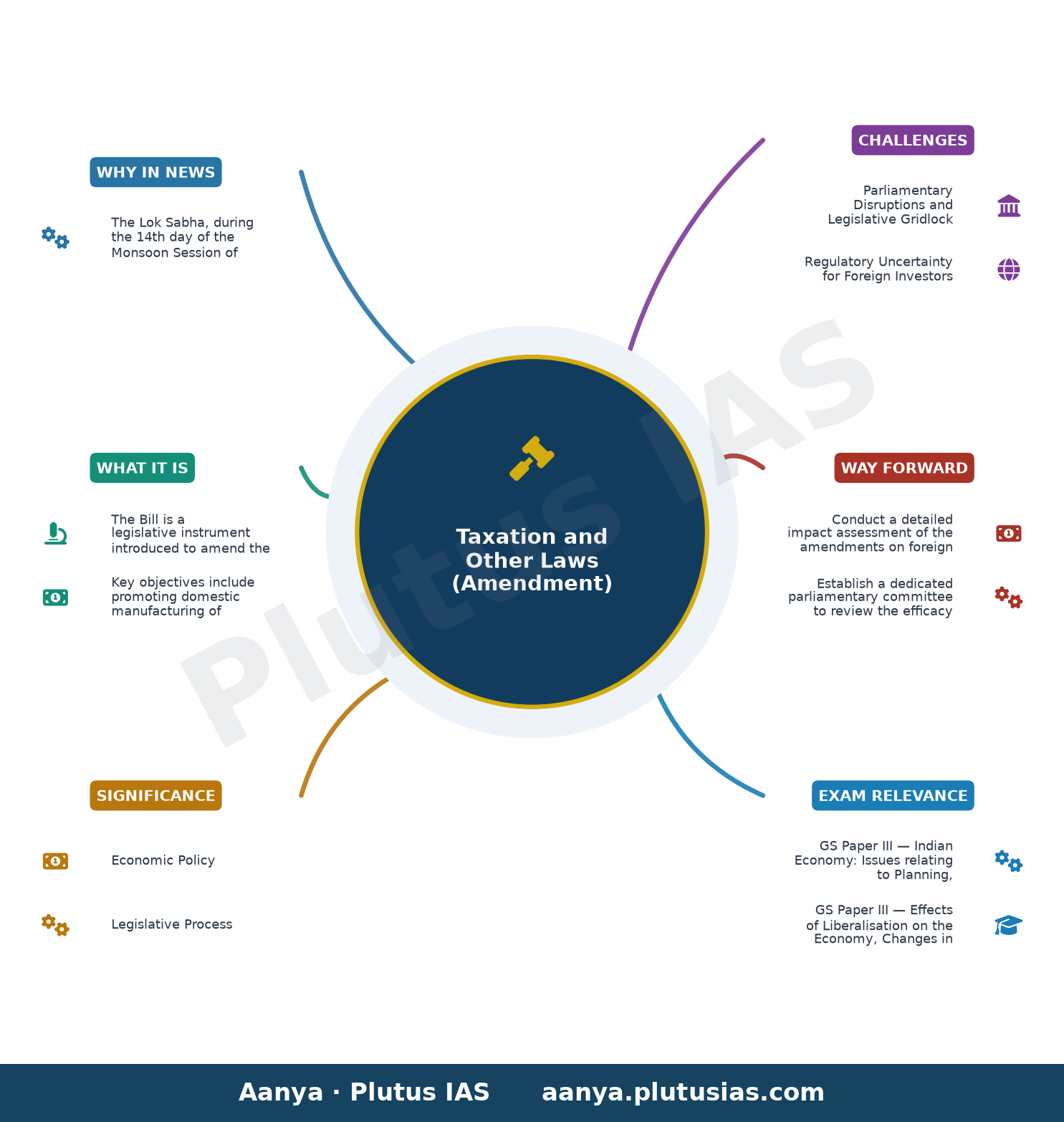
✎ The Taxation and Other Laws (Amendment) Bill, 2026, is a fiscal and regulatory measure aimed at boosting domestic electronics manufacturing, attracting FDI, and clarifying data localisation norms for foreign cloud providers…
Subject Relevance — Where This Topic Fits
- GS Paper III — Indian Economy: Issues relating to Planning, Mobilisation of Resources, Growth, Development and Employment | GS Paper III — Effects of Liberalisation on the Economy, Changes in Industrial Policy and their Effects on Industrial Growth | GS Paper III — Government Budgeting and Fiscal Policy | GS Paper II — Parliament and State Legislatures—Structure, Functioning, Conduct of Business, Powers & Privileges and Issues Arising out of these
- Prelims: Taxation and Other Laws (Amendment) Bill, 2026, Production-Linked Incentive (PLI) Scheme for Electronics, Payment and Settlement Systems Act, 2007, Foreign Direct Investment (FDI) in Electronics Manufacturing, Rule 235 of Rules of Procedure and Conduct of Business in the Rajya Sabha, Consolidated Fund of India, Excess Grant, Public Accounts Committee, Delimitation Commission, Women’s Reservation Bill (108th Constitutional Amendment Bill)
- Essay: The Role of Parliament in Balancing Economic Reforms and Democratic Accountability, Digital Sovereignty and Data Localisation: Implications for India’s Technological and Economic Future
Quick Revision: The Taxation and Other Laws (Amendment) Bill, 2026, is a fiscal and regulatory measure aimed at boosting domestic electronics manufacturing, attracting FDI, and clarifying data localisation norms for foreign cloud providers, while amending the Payment and Settlement Systems Act, 2007, to modernise India’s digital payments ecosystem.
Why is this in the news?
The Lok Sabha, during the 14th day of the Monsoon Session of Parliament (2026), passed the Taxation and Other Laws (Amendment) Bill, 2026 without debate due to persistent disruptions by the Opposition. The Bill introduces amendments to the Payment and Settlement Systems Act, 2007, aimed at promoting domestic electronic manufacturing, attracting foreign capital, and providing process certainty for foreign cloud companies utilising Indian data centres. The legislative development assumes significance against the backdrop of India’s broader strategy to enhance self-reliance in critical sectors and integrate with global digital supply chains.
Background
- The Government of India has identified electronics manufacturing as a key sector for achieving Atmanirbhar Bharat (self-reliant India) and reducing import dependence, particularly in components such as semiconductors, displays, and mobile phones.
- The Production-Linked Incentive (PLI) Scheme for Large Scale Electronics Manufacturing, launched in 2020, provides financial incentives to eligible companies to boost domestic production and exports.
- The Payment and Settlement Systems Act, 2007, regulates payment systems in India and has been amended periodically to accommodate innovations such as digital payments, prepaid instruments, and cross-border remittances.
- India’s data localisation policies, including the Personal Data Protection Bill (2023), aim to ensure the storage and processing of sensitive personal data within the country, while balancing the needs of global technology firms.
- The Bill’s passage coincides with ongoing deliberations on the Women’s Reservation Bill (108th Constitutional Amendment Bill), which seeks to reserve one-third of seats in the Lok Sabha and State Legislative Assemblies for women, and the Delimitation Bill, which proposes an increase in the Lok Sabha’s strength to 816 seats.
- Parliamentary proceedings during the Monsoon Session have been marked by disruptions, reflecting broader political tensions over governance, accountability, and legislative priorities.
What is the Taxation and Other Laws (Amendment) Bill, 2026?
- The Bill is a legislative instrument introduced to amend the Payment and Settlement Systems Act, 2007.
- Key objectives include promoting domestic manufacturing of electronic goods, attracting foreign direct investment (FDI) in the electronics sector, and facilitating the use of Indian data centres by foreign cloud service providers through enhanced regulatory clarity.
- Amendments to the Payment and Settlement Systems Act, 2007, aim to strengthen the regulatory framework for digital payment systems, ensure consumer protection, and promote innovation in fintech while maintaining financial stability.
- The Bill seeks to provide ‘process certainty’ for foreign cloud companies by clarifying data storage and processing requirements, thereby reducing regulatory ambiguity and encouraging investment in Indian data infrastructure.
- The legislative measure aligns with India’s broader ‘Digital India’ and ‘Make in India’ initiatives, which seek to position the country as a global hub for electronics manufacturing and digital services.
- The passage of the Bill without debate underscores the challenges of legislative deliberation in a polarised Parliament, raising questions about the efficacy of parliamentary scrutiny in economic policymaking.
Key Features
| Feature | Significance |
|---|---|
| Amendment to Payment and Settlement Systems Act, 2007 | Facilitates easier entry and operation of foreign cloud companies in India by providing procedural certainty and reducing regulatory ambiguity. |
| Taxation provisions for domestic electronic manufacturing | Incentivises foreign capital inflow into India’s electronics sector, aligning with ‘Atmanirbhar Bharat’ and ‘Make in India’ objectives. |
| Process certainty for foreign cloud companies | Ensures predictable regulatory environment, reducing compliance costs and encouraging data localisation within Indian data centres. |
| Amendment to Taxation and other Laws (Amendment) Bill | Aims to streamline tax compliance and remove bottlenecks for foreign investors in India’s electronics and digital infrastructure sectors. |
Why it Matters
Economic Policy
- Enhances India’s attractiveness as a global electronics manufacturing hub by reducing tax and regulatory burdens on foreign investors.
- Supports the government’s strategic push for self-reliance in critical sectors such as electronics and digital infrastructure.
- Aligns with global trends of data localisation and digital sovereignty, positioning India as a preferred destination for cloud service providers.
Legislative Process
- Demonstrates the government’s ability to legislate despite Opposition disruptions, highlighting the procedural robustness of parliamentary democracy.
- Raises questions about the efficacy of legislative debate in the presence of persistent disruptions, impacting democratic accountability.
- Underscores the challenges in passing contentious bills without consensus, particularly in a polarised political environment.
Strategic Autonomy
- Strengthens India’s digital sovereignty by encouraging the use of domestic data centres, reducing dependence on foreign cloud infrastructure.
- Promotes indigenous capabilities in high-technology sectors, reducing import dependency in critical electronics components.
Challenges
1. Parliamentary Disruptions and Legislative Gridlock
- Persistent sloganeering and disruptions obstruct meaningful debate, delaying critical legislative reforms.
- Undermines the quality of legislative scrutiny, potentially leading to poorly drafted or hastily passed amendments.
- Erodes public trust in parliamentary institutions, particularly when key economic reforms are passed without discussion.
UPSC Link: Parliamentary functioning and legislative process
2. Regulatory Uncertainty for Foreign Investors
- Frequent amendments to tax and regulatory frameworks may create uncertainty, deterring long-term foreign investment.
- Lack of clarity on data localisation norms and compliance requirements may discourage cloud service providers from establishing operations in India.
UPSC Link: Foreign Direct Investment (FDI) policy and regulatory framework
3. Balancing Economic Incentives with Domestic Industry Protection
- Over-reliance on tax incentives may distort market competition, disadvantaging domestic manufacturers who lack similar support.
- Ensuring that foreign capital inflow translates into tangible benefits for India’s electronics manufacturing ecosystem remains a challenge.
UPSC Link: Industrial policy and Make in India initiative
4. Data Sovereignty vs. Global Digital Integration
- Stringent data localisation requirements may conflict with global digital integration, potentially isolating India in the global digital economy.
- Balancing national security imperatives with the need for seamless cross-border data flows is a complex policy challenge.
UPSC Link: Data governance and cybersecurity policy
Challenges — UPSC Perspective
| Issue | Concern |
|---|---|
| Legislative disruptions | Delays in passing critical economic reforms, reducing policy predictability for investors. |
| Regulatory ambiguity | Foreign investors may hesitate due to unclear compliance requirements and frequent amendments. |
| Data localisation norms | Potential conflict with global digital integration, impacting India’s attractiveness as a cloud services hub. |
| Tax incentive distortions | Risk of market distortion if incentives are not calibrated to support domestic industry competitiveness. |
Way Forward
- Conduct a detailed impact assessment of the amendments on foreign investment flows in the electronics sector over the next 12-18 months.
- Establish a dedicated parliamentary committee to review the efficacy of legislative processes amid disruptions and propose reforms.
- Develop a clear and stable regulatory framework for data localisation to provide certainty to cloud service providers.
- Enhance stakeholder consultations with industry associations and foreign investors to refine tax and regulatory incentives.
- Strengthen domestic R&D and manufacturing capabilities in electronics to reduce reliance on foreign capital and technology.
- Monitor compliance and enforcement mechanisms to ensure that tax incentives translate into tangible industrial growth.
- Promote public-private partnerships in electronics manufacturing to bridge the gap between policy intent and ground-level implementation.
UPSC Value Addition
Keywords for Mains Answer-Writing
Taxation and other Laws (Amendment) Bill 2026 · domestic electronic manufacturing · Payment and Settlement Systems Act, 2007 · foreign capital attraction · Indian data centres · Parliamentary disruption · Rule 235 of Rajya Sabha · Women’s Reservation Bill · Delimitation Bill · Lok Sabha strength increase · Appropriation (No.3) Bill, 2026 · excess grant · Public Accounts Committee · Monsoon Session of Parliament 2026
Constitutional & Policy Linkages
- [‘Article 105’, ‘Parliamentary privileges and freedom of speech’]
- [‘Article 118’, ‘Rules of procedure in Parliament’]
- [‘Article 120’, ‘Language to be used in Parliament’]
Concept Flow
Persistent Opposition disruptions in Parliament → Government passes Taxation Bill without debate → Focus on economic reforms amid legislative gridlock → Amendment to Payment and Settlement Systems Act, 2007 → Provides procedural certainty for foreign cloud companies → Encourages data localisation in India → Taxation provisions for domestic electronics manufacturing → Incentivises foreign capital inflow → Aligns with Atmanirbhar Bharat and Make in India → Regulatory certainty for foreign investors → Reduces compliance costs and operational risks → Enhances India’s attractiveness as an electronics manufacturing hub → Balancing data sovereignty with global digital integration → Ensures national security while maintaining economic competitiveness → Critical for long-term digital strategy
Prelims Practice Questions
Q1. Consider the following statements regarding the Taxation and other Laws (Amendment) Bill, 2026, recently passed by the Lok Sabha:
1. The Bill amends the Payment and Settlement Systems Act, 2007.
2. It seeks to promote domestic electronic manufacturing.
3. The Bill provides ‘process certainty’ for foreign cloud companies using Indian data centres.
4. The Bill includes provisions for the 33% women’s reservation in legislatures.
How many of the above statements are correct?
- Only one
- Only two
- Only three
- All four
Answer: Only three — Statements 1, 2, and 3 are correct as per the Bill’s provisions. Statement 4 is incorrect as the women’s reservation is addressed in a separate Bill (Women’s Reservation Bill), not this Bill.
Q2. Assertion (A): The Appropriation (No.3) Bill, 2026, provides for the authorisation of appropriation of moneys out of the Consolidated Fund of India for expenditures incurred in the financial year 2022-23.
Reason (R): The Bill is introduced to meet the amounts spent in excess of the grants previously sanctioned by Parliament.
- Both A and R are true, and R is the correct explanation of A
- Both A and R are true, but R is not the correct explanation of A
- A is true, but R is false
- A is false, but R is true
Answer: ? — Assertion (A) is false as the Bill pertains to the financial year ended March 31, 2023. Reason (R) is true as the Bill authorises excess grants for expenditures beyond sanctioned amounts.
Q3. Match the following Bills with their respective objectives:
Column I (Bill) | Column II (Objective)
———————————————|———————————————
A. Taxation and other Laws (Amendment) Bill | 1. Authorisation of excess grants
B. Women’s Reservation Bill | 2. Promote domestic electronic manufacturing
C. Appropriation (No.3) Bill, 2026 | 3. 33% reservation for women in legislatures
D. Delimitation Bill | 4. Increase Lok Sabha strength to 816 seats
- A-2, B-3, C-1, D-4
- A-1, B-2, C-3, D-4
- A-3, B-4, C-1, D-2
- A-4, B-3, C-2, D-1
Answer: A-2, B-3, C-1, D-4 — A matches with 2 (promote domestic electronic manufacturing), B with 3 (33% reservation), C with 1 (excess grants), and D with 4 (increase Lok Sabha strength).
Mains Practice Question
✍ The Monsoon Session of Parliament, 2026, witnessed significant legislative activity alongside persistent disruptions. Critically examine the implications of the Taxation and other Laws (Amendment) Bill, 2026, for India’s economic policy and parliamentary democracy. Also assess the role of parliamentary disruption in a deliberative democracy. (15 Marks)
Approach: MODEL-ANSWER SKELETON:
1. **Introduction (2 marks)**: Contextualise the Bill within India’s push for ‘Atmanirbhar Bharat’ and the government’s economic policy. Define parliamentary disruption and its constitutional context.
2. **Key Provisions of the Bill (3 marks)**:
– Amendments to the Payment and Settlement Systems Act, 2007: Objectives and provisions.
– Measures to promote domestic electronic manufacturing: Tax incentives, FDI facilitation.
– ‘Process certainty’ for foreign cloud companies: Data localisation and sovereignty implications.
3. **Economic Policy Implications (4 marks)**:
– **Positive**: Attracting FDI, boosting domestic manufacturing, aligning with PLI schemes.
– **Critiques**: Potential revenue loss, over-reliance on tax sops, data sovereignty concerns.
– **Comparative**: Contrast with global models (e.g., China’s semiconductor policy, EU’s Digital Services Act).
4. **Parliamentary Democracy and Disruption (3 marks)**:
– **Constitutional Framework**: Article 75(3), Rules of Procedure and Conduct of Business in Parliament (Rule 235).
– **Arguments for Disruption**: Democratic right to protest, highlighting urgent issues (e.g., Ayodhya donation theft allegation).
– **Arguments against**: Erosion of deliberative function, violation of parliamentary decorum, Rule 235 provisions.
5. **Balancing Act (3 marks)**:
– Role of the Chair (Rajya Sabha Deputy Chairman Harivansh Narayan Singh citing Rule 235).
– Need for structured debates vs. ad-hoc disruptions.
– Examples from past sessions (e.g., 2012 Parliament disruption over FDI in retail).
6. **Conclusion (2 marks)**: Summarise the dual challenge of legislative efficiency and democratic expression. Suggest reforms (e.g., time-bound discussions, digital petitions) to mitigate disruptions.
Source: The Indian Express
Generated by AanyaAi for educational purpose.

- यूपी नीट यूजी काउंसलिंग राउंड-2: मेरिट लिस्ट हुई जारी, 22 सितंबर से रिपोर्टिंग शुरू - September 21, 2026
- UP NEET UG Counselling 2026 Round 2: Merit List Out, Key Dates & Reporting Process - September 21, 2026
- UPSC Civil Services (Main) Examination 2026 — Geology Optional Paper I: Question Paper | Plutus IAS - September 21, 2026

No Comments