


06 Aug Lok Sabha Passes Taxation Bill 2026: MDR on UPI Transactions Explained for UPSC
✎ The Taxation and Other Laws (Amendment) Bill, 2026, introduces MDR on high-value UPI transactions, extends tax exemptions for electronics manufacturing until 2040-41, and simplifies compliance for foreign investors and cloud…
Subject Relevance — Where This Topic Fits
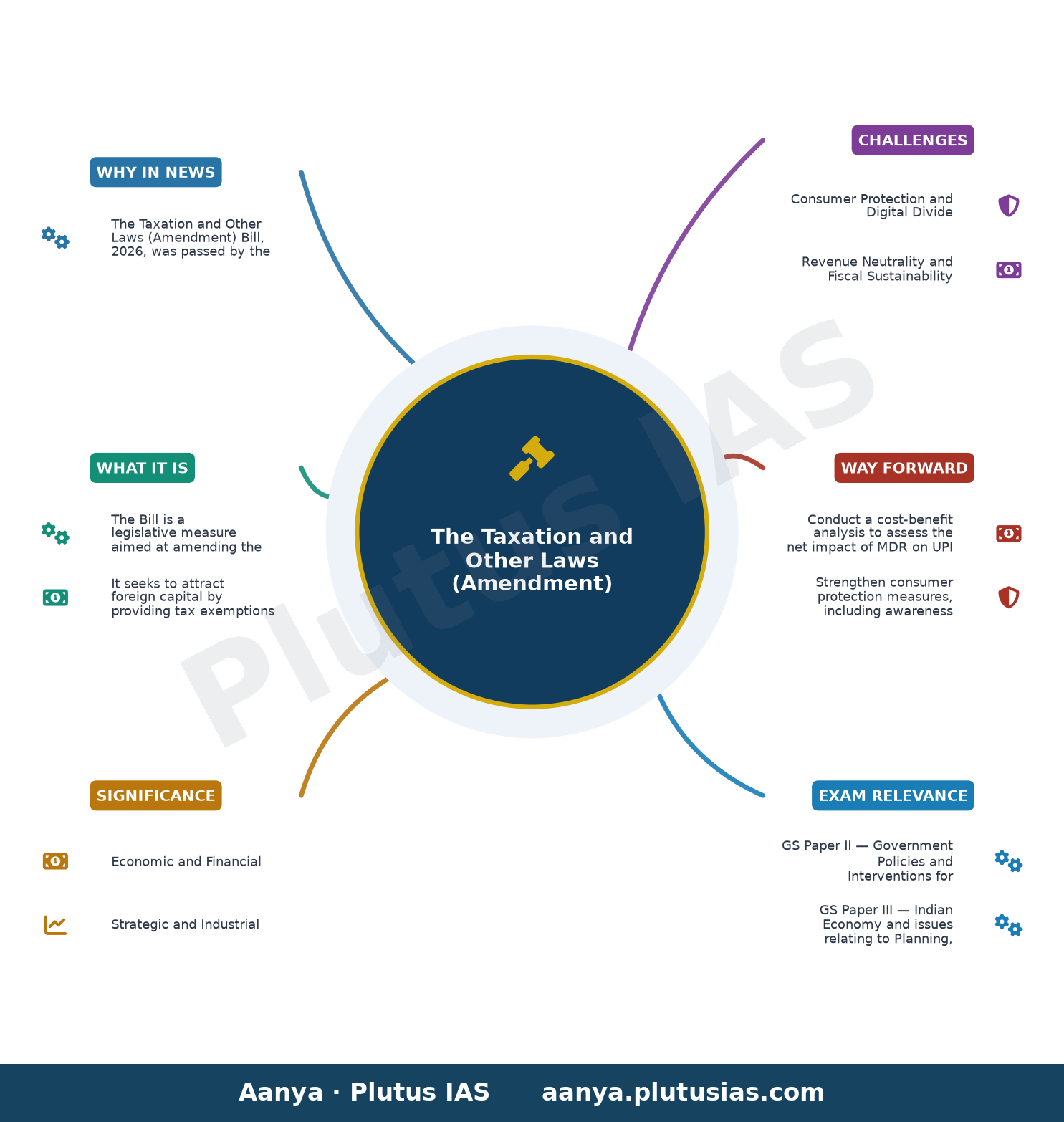
- GS Paper II — Government Policies and Interventions for Development in various sectors | GS Paper III — Indian Economy and issues relating to Planning, Mobilisation of Resources, Growth, Development and Employment | GS Paper III — Effects of Liberalisation on the Economy, Changes in Industrial Policy and their Effects on Industrial Growth
- Prelims: Payment and Settlement Systems Act, 2007, Merchant Discount Rate (MDR), UPI (Unified Payments Interface), RuPay cards, Foreign Portfolio Investors (FPIs), Customs-bonded warehouses, Data localisation, Income-tax exemption for electronics manufacturing, Contract manufacturing, Foreign direct investment (FDI) in electronics
- Essay: The role of technology in transforming India’s financial infrastructure: Opportunities and challenges, Balancing fiscal incentives for domestic manufacturing with global competitiveness
Quick Revision: The Taxation and Other Laws (Amendment) Bill, 2026, introduces MDR on high-value UPI transactions, extends tax exemptions for electronics manufacturing until 2040-41, and simplifies compliance for foreign investors and cloud providers.
Why is this in the news?
The Taxation and Other Laws (Amendment) Bill, 2026, was passed by the Lok Sabha on August 6, 2026, despite disruptions, to amend the Payment and Settlement Systems Act, 2007, and the Income Tax Act, 1961. The Bill introduces provisions for levying Merchant Discount Rate (MDR) on UPI transactions above a specified threshold, thereby altering the existing zero-MDR regime. Additionally, it extends tax exemptions for electronics manufacturing and simplifies regulatory frameworks for foreign cloud service providers and fund managers, aiming to attract foreign capital and bolster domestic production.
Background
- The zero-MDR policy was introduced to promote digital payments and financial inclusion, particularly in the wake of demonetisation in 2016.
- The Reserve Bank of India (RBI) and the government have periodically reviewed the MDR framework to address concerns of sustainability for payment aggregators and banks, particularly for high-value transactions.
- The Taxation and Other Laws (Amendment) Bill, 2026, replaces an ordinance issued on June 5, 2026, which granted income-tax exemptions to foreign portfolio investors (FPIs) on interest income and capital gains from investments in government securities.
- India’s electronics manufacturing sector has been prioritised under the Production-Linked Incentive (PLI) schemes, with a focus on reducing import dependence and enhancing domestic value addition.
- The Bill aligns with the government’s broader objective of making India a global hub for electronics manufacturing, particularly for mobile phones, laptops, and servers, by extending tax benefits until FY 2040-41.
What is the Taxation and Other Laws (Amendment) Bill, 2026?
- The Bill is a legislative measure aimed at amending the Income Tax Act, 1961, and the Payment and Settlement Systems Act, 2007, to introduce fiscal and regulatory reforms.
- It seeks to attract foreign capital by providing tax exemptions and simplifying compliance for foreign portfolio investors and fund managers.
- The Bill introduces a legal framework to allow the government to levy Merchant Discount Rate (MDR) on UPI transactions exceeding a specified threshold, thereby ending the zero-MDR regime for high-value transactions.
- It extends income-tax exemptions for foreign companies engaged in contract manufacturing of specified electronic goods (e.g., mobile phones, laptops, servers) until FY 2040-41.
- To strengthen the electronics manufacturing supply chain, the legislation proposes a 15-year income tax exemption, extending until FY2040-41.
- The bill provides ‘process certainty’ to make it easier for overseas cloud companies to use data centres located in the country.
- The Bill also aims to reduce the compliance burden on fund managers by relaxing conditions that could otherwise make their global income taxable in India.
- The legislation replaces an ordinance issued in June 2026, ensuring continuity and legal certainty for investors and businesses.
Key Features
| Feature | Significance |
|---|---|
| Delinking Payment and Settlement Systems Act from Income Tax Act | Facilitates independent regulation of digital payment systems without tax-related ambiguities. |
| Provision for MDR on UPI transactions | Enables government to levy merchant discount rates on UPI payments above specified thresholds, potentially reducing subsidy burden on banks. |
| Extension of income-tax exemption for foreign electronics manufacturers | Encourages contract manufacturing of specified electronic goods in India, aligning with ‘Make in India’ objectives. |
| 15-year tax exemption for storage of electronic components in bonded warehouses | Strengthens supply chain resilience by incentivising pre-processing of components within India. |
| Simplification of regulatory framework for foreign cloud service providers | Reduces compliance burden and accelerates adoption of Indian data centres, enhancing data localisation efforts. |
Why it Matters
Economic and Financial
- Enhances fiscal flexibility by introducing MDR on UPI, potentially generating revenue for the exchequer while balancing consumer convenience.
- Attracts foreign capital into India’s electronics manufacturing sector, reducing import dependency and boosting GDP growth.
- Provides policy certainty for foreign portfolio investors (FPIs) by replacing the ordinance on tax exemptions for investments in government securities.
- Supports the formalisation of digital payments by creating a sustainable revenue model for payment aggregators and banks.
Strategic and Industrial
- Aligns with the ‘Atmanirbhar Bharat’ initiative by incentivising domestic production of critical electronic goods such as mobile phones and servers.
- Strengthens India’s position as a global electronics manufacturing hub by extending tax benefits to contract manufacturers and bonded warehouse operators.
- Facilitates the relocation of fund managers to India, reducing tax-related barriers and enhancing the competitiveness of India’s financial services sector.
Technological and Regulatory
- Clarifies the regulatory landscape for digital payments by decoupling the Payment and Settlement Systems Act from the Income Tax Act.
- Encourages the use of Indian data centres by simplifying compliance for foreign cloud service providers, advancing data localisation goals.
- Promotes the adoption of RuPay and UPI ecosystems by allowing MDR, which may incentivise further innovation in digital payment technologies.
Challenges
1. Consumer Protection and Digital Divide
- Risk of MDR on UPI transactions disproportionately affecting small merchants and low-income users, potentially widening the digital divide.
- Possible erosion of the ‘zero-MDR’ regime’s consumer-friendly benefits, leading to reduced adoption of digital payments in rural and semi-urban areas.
UPSC Link: GS3: Digital Economy
2. Revenue Neutrality and Fiscal Sustainability
- Uncertainty over whether MDR revenue will offset the subsidy burden on banks, raising questions about long-term fiscal sustainability.
- Potential for tax arbitrage if MDR is not uniformly applied across all digital payment modes, leading to market distortions.
UPSC Link: GS3: Fiscal Policy
3. Data Localisation and Privacy Concerns
- Simplification of compliance for foreign cloud providers may dilute data localisation safeguards, raising concerns over cross-border data flows.
- Risk of inadequate protection for sensitive financial and personal data stored in Indian data centres due to relaxed regulatory oversight.
UPSC Link: GS3: Cyber Security
4. Supply Chain Disruptions in Electronics Manufacturing
- Over-reliance on contract manufacturing may lead to vulnerabilities in critical component supply chains, particularly for semiconductors.
- Extended tax exemptions may not address structural issues such as high logistics costs and import dependency for raw materials.
UPSC Link: GS3: Industrial Policy
Challenges — UPSC Perspective
| Issue | Concern |
|---|---|
| MDR on UPI transactions | Potential increase in transaction costs for small merchants, undermining financial inclusion. |
| Data localisation compliance | Risk of weakened data protection frameworks due to simplified regulatory processes for foreign cloud providers. |
| Fiscal impact of tax exemptions | Long-term revenue loss for the exchequer without guaranteed economic returns from electronics manufacturing. |
| Supply chain resilience | Dependence on contract manufacturing may not address critical gaps in indigenous production of high-tech components. |
| Digital payment adoption | Possible decline in UPI usage if MDR is perceived as a regressive measure by consumers. |
Way Forward
- Conduct a cost-benefit analysis to assess the net impact of MDR on UPI transactions, ensuring equitable burden-sharing between merchants and consumers.
- Strengthen consumer protection measures, including awareness campaigns to educate small merchants and users on MDR implications.
- Enhance data localisation safeguards by mandating strict compliance with the Digital Personal Data Protection Act, 2023, for foreign cloud providers.
- Expand the scope of the Production-Linked Incentive (PLI) scheme for electronics to include high-value components like semiconductors.
- Establish a monitoring mechanism to track the efficacy of tax exemptions in boosting domestic electronics manufacturing and reducing import dependency.
- Promote R&D in electronics manufacturing through public-private partnerships to address supply chain vulnerabilities.
- Ensure interoperability between UPI and other digital payment systems to maintain competitive neutrality and consumer choice.
UPSC Value Addition
Keywords for Mains Answer-Writing
Taxation and Other Laws (Amendment) Bill, 2026 · MDR on UPI transactions · Payment and Settlement Systems Act, 2007 · electronic manufacturing in India · foreign portfolio investors (FPIs) · data localisation for cloud services · income-tax exemption for contract manufacturers · customs-bonded warehouses for electronic components · RBI Governor on MDR proposal · foreign cloud service providers and Indian data centres
Concept Flow
Digital payment ecosystem (UPI, RuPay) → Government introduces MDR provision → Potential increase in transaction costs → Impact on small merchants and consumers → Risk of reduced digital payment adoption → Need for consumer protection measures. → Foreign investment in electronics manufacturing → Tax exemptions and incentives → Relocation of fund managers to India → Strengthening of domestic supply chains → Alignment with ‘Atmanirbhar Bharat’ goals. → Payment and Settlement Systems Act, 2007 → Delinked from Income Tax Act → Independent regulation of digital payments → Clarity in compliance requirements for banks and aggregators. → Foreign cloud providers → Simplified regulatory framework → Increased use of Indian data centres → Advancement of data localisation policies → Potential privacy and security concerns. → Contract manufacturing of electronics → Extended tax exemptions → Growth in domestic production → Reduction in import dependency → Enhanced GDP contribution.
Prelims Practice Questions
Q1. Consider the following statements regarding the Taxation and Other Laws (Amendment) Bill, 2026:
1. The Bill seeks to delink the Payment and Settlement Systems Act, 2007 from the Income Tax Act.
2. The Bill proposes to extend the income-tax exemption for foreign companies engaged in contract manufacturing of electronic goods in India until FY 2040-41.
3. The Bill mandates that all UPI transactions must remain free of charges indefinitely.
How many of the above statements are correct?
- Only one
- Only two
- All three
- None
Answer: Only two — Statement 1 is correct as the Bill delinks the Payment and Settlement Systems Act from the Income Tax Act. Statement 2 is correct as the Bill extends the exemption until FY 2040-41. Statement 3 is incorrect because the Bill empowers the government to specify which transactions must remain free of charges, implying potential changes.
Q2. Assertion (A): The Taxation and Other Laws (Amendment) Bill, 2026, seeks to promote domestic electronics manufacturing by providing income-tax exemptions.
Reason (R): The Bill extends the exemption for foreign companies storing electronic components in customs-bonded warehouses until FY 2040-41.
In the context of the above two statements, which one of the following is correct?
- Both A and R are true and R is the correct explanation of A.
- Both A and R are true but R is not the correct explanation of A.
- A is true but R is false.
- A is false but R is true.
Answer: Both A and R are true and R is the correct explanation of A. — Both the Assertion (A) and Reason (R) are true. The Bill indeed aims to promote domestic electronics manufacturing through income-tax exemptions. The Reason (R) correctly explains this by citing the specific provision for customs-bonded warehouses.
Q3. Match the following provisions of the Taxation and Other Laws (Amendment) Bill, 2026, with their intended objectives:
Column I
A. Delinking Payment and Settlement Systems Act from Income Tax Act
B. Extending income-tax exemption for contract manufacturers of electronic goods
C. Allowing MDR on UPI transactions above Rs. 2,000
D. Simplifying regulatory framework for foreign cloud service providers
Column II
1. Promoting domestic electronics manufacturing
2. Providing process certainty for overseas cloud companies
3. Facilitating relocation of fund managers to India
4. Enabling government to alter zero-MDR regime
Select the correct match:
- A-4, B-1, C-3, D-2
- A-2, B-1, C-4, D-3
- A-4, B-3, C-1, D-2
- A-3, B-2, C-4, D-1
Answer: A-4, B-1, C-3, D-2 — A matches with 4 (delinking enables the government to alter the MDR regime). B matches with 1 (exemption promotes domestic manufacturing). C matches with 4 (altering zero-MDR regime). D matches with 2 (simplifying framework aids cloud companies).
Mains Practice Question
✍ Critically examine the provisions of the Taxation and Other Laws (Amendment) Bill, 2026, in the context of its stated objectives of attracting foreign capital, promoting domestic electronics manufacturing, and ensuring process certainty for overseas cloud service providers. Also, analyse the implications of introducing MDR on UPI transactions above Rs. 2,000 on digital payment ecosystems and financial inclusion in India. (15 Marks)
Approach: MODEL-ANSWER SKELETON:
1. **Introduction (2 marks)**: Briefly state the objectives of the Bill — attracting foreign capital, promoting electronics manufacturing, and ensuring process certainty for cloud providers. Mention the key provisions: delinking Payment and Settlement Systems Act from Income Tax Act, extending tax exemptions, and empowering the government to introduce MDR on UPI transactions.
2. **Attracting Foreign Capital (3 marks)**:
– Discuss the income-tax exemption for foreign portfolio investors (FPIs) from investments in government securities.
– Explain the facilitation of relocation of fund managers by reducing conditions to prevent global income taxation.
– Highlight the role of income-tax exemption for foreign companies engaged in contract manufacturing of electronic goods until FY 2040-41.
– Cite the 15-year income-tax exemption for foreign companies storing electronic components in customs-bonded warehouses.
3. **Promoting Domestic Electronics Manufacturing (4 marks)**:
– Analyse the extension of income-tax exemption for contract manufacturers producing specified electronic products (mobile phones, laptops, servers, etc.).
– Discuss the significance of customs-bonded warehouses in strengthening the supply chain for electronic components.
– Evaluate the long-term impact on India’s ‘Make in India’ initiative and self-reliance in electronics manufacturing.
– Reference: National Policy on Electronics 2019 and Production Linked Incentive (PLI) schemes for electronics.
4. **Process Certainty for Overseas Cloud Providers (3 marks)**:
– Explain the simplification of the regulatory framework by removing approval and notification requirements for using Indian data centres.
– Discuss the implications for data localisation policies and the Digital India initiative.
– Reference: Justice BN Srikrishna Committee Report (2018) on data protection and localisation.
5. **MDR on UPI Transactions and Digital Payment Ecosystem (3 marks)**:
– Define MDR (Merchant Discount Rate) and its traditional role in incentivising digital payments.
– Analyse the implications of introducing MDR on UPI transactions above Rs. 2,000: potential impact on small merchants, financial inclusion, and the growth of UPI as a low-cost payment mechanism.
– Reference: RBI Governor’s statement on the need to balance costs and sustainability of digital payment infrastructure.
– Discuss the trade-off between revenue generation for payment service providers and affordability for users.
6. **Conclusion (2 marks)**: Summarise the potential benefits and challenges of the Bill. Highlight the need for a balanced approach to ensure that policy measures do not inadvertently hinder digital inclusion or deter foreign investment.
Source: Times of India
Generated by AanyaAi for educational purpose.

- UPSC Civil Services (Main) Examination 2026 — Sanskrit Literature Paper II: Question Paper | Plutus IAS - September 21, 2026
- चीनी राष्ट्रपति शी जिनपिंग अमेरिका दौरे पर, ट्रंप से मिलेंगे वार्ता हेतु - September 21, 2026
- Xi Jinping’s US Visit: Key Takeaways for UPSC & State PCS Aspirants - September 21, 2026

No Comments