


06 Aug Lok Sabha Passes Taxation Bill: MDR on UPI Transactions Explained for UPSC & PCS
✎ The Taxation and Other Laws (Amendment) Bill, 2026, enables the government to impose MDR on UPI transactions, while extending tax exemptions for electronics manufacturing and streamlining regulations for foreign cloud service…
Subject Relevance — Where This Topic Fits
- GS Paper III — Indian Economy: Issues relating to planning, mobilization of resources, growth, development and employment; Inclusive growth and issues arising from it; Government Budgeting; Major Crops — Cropping Patterns in various parts of the country; Transport and Marketing of Agricultural Produce and Issues and Constraints; E-technologies in the aid of farmers | GS Paper III — Effects of Liberalization on the Economy, Changes in Industrial Policy and their Effects on Industrial Growth | GS Paper II — Government Policies and Interventions for Development in various sectors and Issues arising out of their Design and Implementation
- Prelims: Payment and Settlement Systems Act, 2007, Zero-MDR regime for UPI and RuPay transactions, Foreign Portfolio Investors (FPIs), Customs-bonded warehouses, Data localisation and cloud service providers, Income-tax exemption for electronics manufacturing, Foreign Direct Investment (FDI) in electronics sector
- Essay: The role of fiscal policy in shaping India’s digital economy: Balancing innovation and revenue imperatives, Ethical considerations in tax policy: Incentivising manufacturing versus burdening consumers
Quick Revision: The Taxation and Other Laws (Amendment) Bill, 2026, enables the government to impose MDR on UPI transactions, while extending tax exemptions for electronics manufacturing and streamlining regulations for foreign cloud service providers and fund managers.
Why is this in the news?
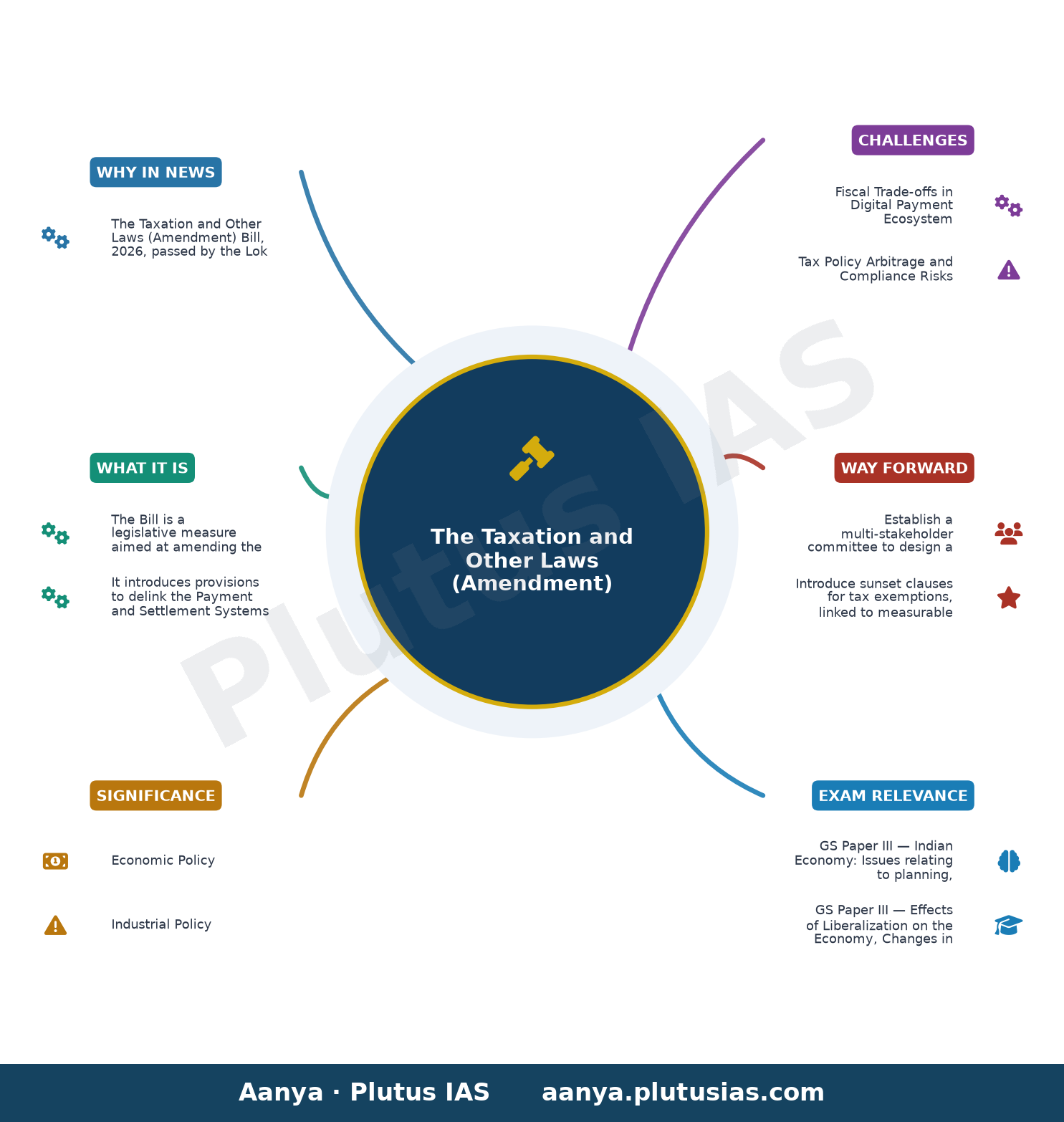
The Taxation and Other Laws (Amendment) Bill, 2026, passed by the Lok Sabha on August 6, 2026, introduces significant amendments to the Payment and Settlement Systems Act, 2007, and the Income Tax Act, 1961. The Bill seeks to enable the levying of Merchant Discount Rate (MDR) on UPI transactions, thereby altering the zero-MDR regime that has hitherto incentivised digital payments. Additionally, it extends tax exemptions for electronics manufacturing and streamlines regulatory frameworks for foreign cloud service providers and fund managers, reflecting the government’s dual objectives of attracting foreign capital and fostering domestic industrial growth.
Background
- The zero-MDR regime for UPI and RuPay transactions was introduced to promote digital payments and reduce the cost burden on consumers, aligning with the government’s ‘Digital India’ and ‘Make in India’ initiatives.
- The Payment and Settlement Systems Act, 2007, currently prohibits banks and payment system providers from levying charges on UPI and RuPay transactions, ensuring cost-free digital payments for users.
- The Reserve Bank of India (RBI) has, on multiple occasions, highlighted the unsustainability of the zero-MDR regime, citing the need for a calibrated approach to incentivise digital payment infrastructure providers while balancing consumer convenience.
- The Bill replaces an ordinance issued on June 5, 2026, which granted income-tax exemptions to foreign portfolio investors (FPIs) on interest income and capital gains from investments in government securities, aimed at attracting foreign capital.
- India’s electronics manufacturing sector has witnessed significant growth under the Production-Linked Incentive (PLI) scheme, with a focus on mobile phones, laptops, and other electronic goods.
- The Bill’s provisions for customs-bonded warehouses and extended tax exemptions for electronics manufacturing are aligned with the government’s broader strategy to integrate India into global supply chains.
What is the Taxation and Other Laws (Amendment) Bill, 2026?
- The Bill is a legislative measure aimed at amending the Income Tax Act, 1961, and the Payment and Settlement Systems Act, 2007, to facilitate foreign investment, promote electronics manufacturing, and provide regulatory clarity for digital payment systems and cloud service providers.
- It introduces provisions to delink the Payment and Settlement Systems Act from the Income Tax Act, enabling the government to impose MDR on UPI transactions, subject to notification, thereby altering the zero-MDR regime.
- The Bill extends income-tax exemptions for foreign companies engaged in electronics manufacturing in India until FY 2040-41, covering specified electronic products such as mobile phones, laptops, servers, and their components.
- It proposes a 15-year income-tax exemption to strengthen the electronics manufacturing supply chain.
- The legislation provides ‘process certainty’ to make it easier for overseas cloud companies to use data centres located in the country, facilitating data localisation while easing compliance burdens.
- The Bill also seeks to facilitate the relocation of fund managers to India by reducing the number of conditions that such funds must meet to prevent their global income from becoming taxable in the country, thereby enhancing India’s attractiveness as a financial services hub.
- Additionally, the Bill replaces an ordinance issued in June 2026, which provided income-tax exemptions to foreign portfolio investors (FPIs) on investments in government securities, aimed at attracting foreign capital.
- The amendments reflect the government’s broader strategy to balance fiscal incentives with market-driven growth, particularly in sectors critical to India’s digital and industrial transformation.
Key Features
| Feature | Significance |
|---|---|
| Discontinuation of zero-MDR regime for UPI/RuPay transactions | Enables levying of Merchant Discount Rate (MDR) on UPI transactions above ₹2,000, potentially reducing fiscal burden on exchequer while rationalising digital payment costs. |
| Income-tax exemption for FPIs in government securities | Extends tax relief to foreign portfolio investors, enhancing attractiveness of Indian debt markets and capital inflows. |
| Relocation incentives for fund managers | Reduces compliance conditions for fund managers relocating to India, preventing global income from becoming taxable in India and boosting financial services sector. |
| Extended tax exemption for electronics manufacturing (until 2040-41) | Supports domestic and contract manufacturing of specified electronic goods, aligning with ‘Make in India’ and supply chain resilience objectives. |
| 15-year tax exemption for bonded warehouses storing electronic components | Encourages storage of critical components in India, reducing import dependency and strengthening electronics supply chain integrity. |
| Simplified regulatory framework for foreign cloud service providers | Removes approval requirements for using Indian data centres, facilitating data localisation while promoting investment in digital infrastructure. |
Why it Matters
Economic Policy
- Enhances fiscal policy flexibility by introducing MDR on UPI transactions, balancing digital inclusion with revenue generation.
- Strengthens capital account convertibility by exempting FPI income from government securities, aiding rupee stability.
- Promotes financialisation of the economy through incentives for fund managers, deepening domestic capital markets.
Industrial Policy
- Extends fiscal support to electronics manufacturing, critical for reducing import dependence in strategic sectors like IT hardware.
- Encourages contract manufacturing and supply chain localisation, aligning with global geopolitical supply chain realignment.
- Provides long-term tax certainty (until 2040-41), aiding investment planning for multinational corporations.
Digital Economy
- Rationalises digital payment costs by allowing MDR, potentially improving merchant adoption of formal payment systems.
- Facilitates data localisation by easing regulatory burdens on foreign cloud providers, supporting India’s data sovereignty goals.
- Promotes investment in data centre infrastructure, a prerequisite for India’s digital public infrastructure expansion.
Challenges
1. Fiscal Trade-offs in Digital Payment Ecosystem
- Introduction of MDR may increase transaction costs for small merchants, risking exclusion of micro-enterprises from formal economy.
- Potential regressive impact on low-value UPI transactions, undermining financial inclusion gains of the JAM trinity.
- Revenue optimisation versus consumer welfare dilemma, requiring calibrated implementation to avoid adverse economic effects.
UPSC Link: GS3: Digital Economy & Fiscal Policy
2. Tax Policy Arbitrage and Compliance Risks
- Extended tax exemptions for electronics manufacturing may create tax arbitrage opportunities, necessitating robust anti-avoidance measures.
- Reduced conditions for fund managers could lead to base erosion if global income is not adequately taxed in source countries.
- Risk of revenue leakage due to prolonged exemptions, requiring sunset clauses and periodic reviews.
UPSC Link: GS3: Taxation & Fiscal Federalism
3. Data Localisation and Regulatory Coherence
- Removal of approval requirements for cloud providers may conflict with data localisation mandates under the DPDP Act, 2023.
- Potential conflict between ease of doing business and national security concerns in cross-border data flows.
- Need for harmonised regulatory framework to balance investment facilitation with data protection obligations.
UPSC Link: GS2: Government Policies & GS3: IT & Cyber Security
4. Supply Chain Vulnerabilities in Electronics Manufacturing
- Dependence on imported electronic components may persist despite tax incentives, exposing supply chains to geopolitical disruptions.
- Limited focus on R&D and innovation incentives in the Bill may hinder India’s transition from assembly to high-value manufacturing.
- Risk of over-reliance on contract manufacturing without commensurate development of ancillary industries.
UPSC Link: GS3: Industrial Policy & Supply Chain Resilience
Challenges — UPSC Perspective
| Issue | Concern |
|---|---|
| Revenue Neutrality in MDR Implementation | Ensuring that MDR does not disproportionately burden small merchants or low-income users. |
| Tax Exemption Sustainability | Balancing long-term revenue implications with industrial policy objectives. |
| Data Localisation vs. Ease of Business | Avoiding regulatory conflicts between investment facilitation and data sovereignty. |
| Supply Chain Depth | Ensuring tax incentives translate into end-to-end manufacturing capabilities. |
| Compliance Burden for Fund Managers | Preventing misuse of relaxed conditions for tax avoidance. |
Way Forward
- Establish a multi-stakeholder committee to design a phased implementation roadmap for MDR, with safeguards for small merchants.
- Introduce sunset clauses for tax exemptions, linked to measurable milestones in domestic value addition and R&D spending.
- Harmonise data localisation norms under the DPDP Act with incentives for cloud providers to ensure regulatory coherence.
- Expand PLI schemes for electronic components manufacturing to complement tax incentives and reduce import dependence.
- Enhance customs-bonded warehouse infrastructure to maximise utilisation of tax exemptions for component storage.
- Conduct periodic impact assessments of fund manager relocations to monitor tax base erosion risks.
- Integrate digital payment cost rationalisation with Jan Dhan Yojana and PM SVANidhi to sustain financial inclusion.
UPSC Value Addition
Keywords for Mains Answer-Writing
Taxation and Other Laws (Amendment) Bill 2026 · MDR on UPI transactions · Payment and Settlement Systems Act, 2007 · zero-MDR regime · electronic manufacturing incentives · foreign portfolio investors · data localisation · contract manufacturing in India · customs-bonded warehouses · foreign cloud service providers
Constitutional & Policy Linkages
- [‘Article 265: Taxation without legislative authority (MDR provisions).’]
- [‘Article 286: Restrictions on imposition of tax on inter-State sales (digital transactions).’]
Concept Flow
Government introduces Taxation and Other Laws (Amendment) Bill, 2026 in Lok Sabha → → Bill amends Payment and Settlement Systems Act, 2007 to allow MDR on UPI transactions → → Provision for tax exemptions to FPIs and fund managers to attract foreign capital → → Extended tax incentives for electronics manufacturing to boost domestic production → → Simplified regulatory framework for cloud providers to facilitate data localisation → → Potential fiscal trade-offs in digital payment ecosystem and tax policy arbitrage → → Implementation challenges require calibrated policy design and stakeholder consultations.
Prelims Practice Questions
Q1. Consider the following statements regarding the Taxation and Other Laws (Amendment) Bill, 2026:
1. The Bill seeks to delink the Payment and Settlement Systems Act from the Income Tax Act.
2. It proposes to extend the income-tax exemption for foreign companies engaged in contract manufacturing of electronic goods until 2040-41.
3. The Bill introduces a provision to levy Merchant Discount Rate (MDR) on all UPI transactions without exception.
How many of the above statements are correct?
- Only one
- Only two
- All
- None
Answer: Only two — Statements 1 and 2 are correct as per the Bill’s provisions. Statement 3 is incorrect because the Bill empowers the government to specify exemptions for certain transactions or payment modes from MDR.
Q2. Assertion (A): The Taxation and Other Laws (Amendment) Bill, 2026, aims to promote domestic electronic manufacturing by extending tax exemptions.
Reason (R): The Bill identifies specified electronic products such as mobile phones, laptops, and servers for the exemption.
Code:
- Both A and R are true, and R is the correct explanation of A.
- Both A and R are true, but R is not the correct explanation of A.
- A is true but R is false.
- A is false but R is true.
Answer: Both A and R are true, but R is not the correct explanation of A. — Both the assertion and reason are true. The Bill indeed aims to promote domestic electronic manufacturing through tax exemptions (A). The reason (R) correctly identifies the specific products covered under the exemption, but the extension of exemptions is not solely explained by the list of products.
Q3. Match the following provisions of the Taxation and Other Laws (Amendment) Bill, 2026, with their respective objectives:
Column I (Provision) | Column II (Objective)
1. Delinking Payment and Settlement Systems Act from Income Tax Act | A. Facilitate relocation of fund managers to India
2. Extension of tax exemption for foreign companies in contract manufacturing | B. Promote domestic electronic manufacturing
3. Simplification of regulatory framework for foreign cloud service providers | C. Provide process certainty for overseas cloud companies
4. Reduction of conditions for fund managers to avoid global taxability | D. Ensure regulatory clarity for data centre operations
Choose the correct match:
- 1-A, 2-B, 3-C, 4-D
- 1-C, 2-B, 3-D, 4-A
- 1-D, 2-A, 3-B, 4-C
- 1-B, 2-D, 3-A, 4-C
Answer: 1-C, 2-B, 3-D, 4-A — The correct matches are: 1-C (delinking Payment and Settlement Systems Act from Income Tax Act provides process certainty), 2-B (extension of tax exemption promotes domestic electronic manufacturing), 3-D (simplification of regulatory framework for foreign cloud providers ensures clarity for data centre operations), and 4-A (reduction of conditions for fund managers facilitates their relocation to India).
Mains Practice Question
✍ The Taxation and Other Laws (Amendment) Bill, 2026, represents a strategic shift in India’s policy framework to attract foreign investment and bolster domestic manufacturing. Critically examine the key provisions of the Bill and analyse their implications for India’s economic and regulatory landscape. (15 Marks)
Approach: MODEL-ANSWER SKELETON:
1. **Introduction (2 marks)**: Briefly contextualise the Bill within India’s broader economic policy objectives (e.g., ‘Make in India’, Atmanirbhar Bharat) and the need for foreign capital inflows. Mention the disruption caused by Opposition sloganeering in the Lok Sabha.
2. **Key Provisions (5 marks)**:
– **MDR on UPI Transactions**: Explain the zero-MDR regime under the Payment and Settlement Systems Act, 2007, and the proposed empowerment of the government to specify exemptions. Link to the RBI Governor’s statement on ‘Someone has to pay the cost’.
– **Tax Exemptions for Electronic Manufacturing**: Detail the extension of income-tax exemptions for foreign companies engaged in contract manufacturing of electronic goods (e.g., mobile phones, laptops) until 2040-41. Include the provision for 15-year exemptions for storing electronic components in customs-bonded warehouses.
– **Facilitation of Foreign Portfolio Investors (FPIs)**: Explain the income-tax exemption on interest income and capital gains for FPIs investing in government securities, and the reduction of conditions for fund managers to avoid global taxability.
– **Data Localisation and Cloud Services**: Analyse the simplification of the regulatory framework for foreign cloud service providers, including removal of approval/notification requirements for using Indian data centres.
3. **Implications (5 marks)**:
– **Economic Implications**: Discuss potential benefits such as increased FDI, job creation in electronics manufacturing, and reduced compliance burden for cloud service providers. Mention the trade-off between attracting investment and fiscal revenue loss.
– **Regulatory Implications**: Evaluate the shift from a blanket zero-MDR regime to selective exemptions, and the implications for digital payment ecosystems. Discuss data localisation benefits (e.g., sovereignty, cybersecurity) vs. costs (e.g., compliance burden for foreign firms).
– **Legal and Constitutional Implications**: Briefly touch upon the delinking of the Payment and Settlement Systems Act from the Income Tax Act and its implications for legal clarity and judicial review.
4. **Critical Analysis (3 marks)**:
– **Balancing Act**: Critically assess whether the Bill strikes a balance between attracting foreign investment and protecting domestic industries. Discuss potential conflicts with WTO rules on subsidies or digital trade.
– **Sustainability**: Evaluate the long-term sustainability of tax exemptions and whether they align with global trends in digital taxation (e.g., OECD’s Pillar 1 and 2).
– **Stakeholder Concerns**: Highlight concerns raised by payment system providers, banks, and consumer groups regarding MDR and its impact on UPI users.
Source: Times of India
Generated by AanyaAi for educational purpose.

- UPSC Civil Services (Main) Examination 2026 — Sanskrit Literature Paper II: Question Paper | Plutus IAS - September 21, 2026
- चीनी राष्ट्रपति शी जिनपिंग अमेरिका दौरे पर, ट्रंप से मिलेंगे वार्ता हेतु - September 21, 2026
- Xi Jinping’s US Visit: Key Takeaways for UPSC & State PCS Aspirants - September 21, 2026

No Comments