


06 Aug AI-Generated Deepfakes: Govt Strengthens Regulatory Framework for UPSC 2026
✎ AI-generated deepfakes pose multifaceted threats to cybersecurity, democracy, and individual rights; India’s regulatory framework under the IT Act, BNS 2023, and IT Rules 2021 mandates AI content labelling and stringent…
 AI-generated deepfakesRegulatory frameworkAI content labellingSynthetic media
Subject Relevance — Where This Topic Fits
- GS Paper III — Science and Technology — Developments and their Applications and Effects in Everyday Life | GS Paper III — Security — Challenges to Internal Security through Communication Networks | GS Paper II — Governance — Government Policies and Interventions for Development in various sectors and Issues arising out of their Design and Implementation
- Prelims: Deepfake, IT Rules 2021, Section 66D of IT Act, Section 353 of BNS 2023, Intermediary Liability, AI Content Labelling, Cybercrime, Section 79 of IT Act
- Essay: The Ethical Governance of Artificial Intelligence: Balancing Innovation and Public Trust, Digital Sovereignty and the Role of Regulation in a Hyperconnected World
Quick Revision: AI-generated deepfakes pose multifaceted threats to cybersecurity, democracy, and individual rights; India’s regulatory framework under the IT Act, BNS 2023, and IT Rules 2021 mandates AI content labelling and stringent intermediary obligations to mitigate these risks.
Why is this in the news?
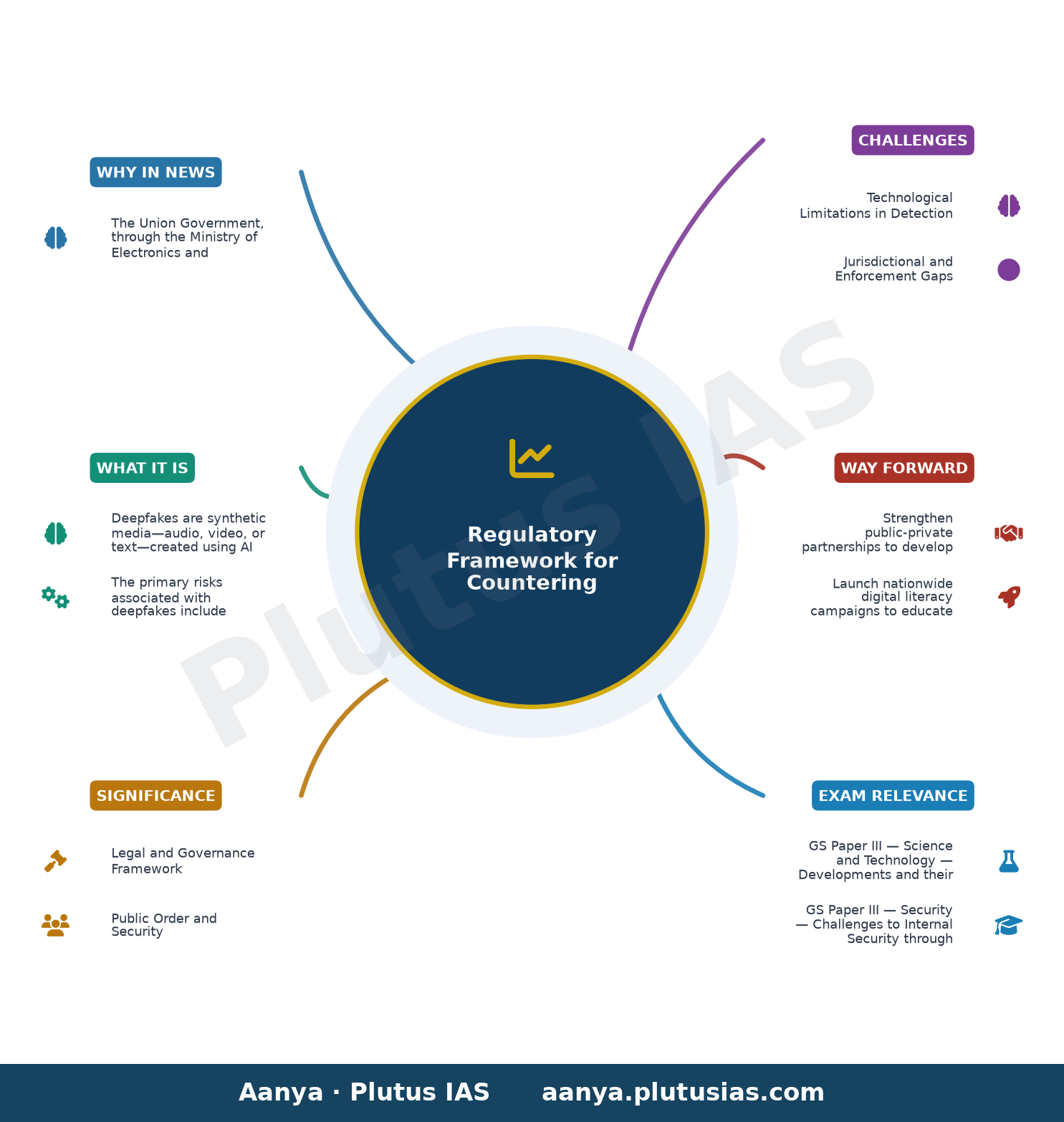
The Union Government, through the Ministry of Electronics and Information Technology (MeitY), has strengthened the regulatory framework to address the proliferation of AI-generated deepfakes by mandating AI content labelling under the IT Rules, 2021. This initiative underscores the urgent need to mitigate risks associated with synthetic media, including impersonation, misinformation, and threats to individual privacy and national security, in alignment with evolving technological threats and legal provisions.
Background
- The proliferation of deepfakes—synthetic media generated using artificial intelligence (AI) that can realistically mimic human voices, faces, and text—has emerged as a critical challenge to digital trust and public order in India and globally.
- Deepfakes are increasingly used to spread misinformation, commit financial fraud, damage reputations, and incite social unrest, necessitating robust legal and institutional responses.
- India’s legal framework to address digital harms has evolved through the Information Technology Act, 2000 (IT Act), and subsequent amendments, including the Information Technology (Intermediary Guidelines and Digital Media Ethics Code) Rules, 2021 (IT Rules 2021).
- The IT Act, 2000, provides the primary statutory basis for regulating digital content and intermediaries, while the IT Rules, 2021, operationalise these provisions with specific obligations for digital platforms.
- The Bharatiya Nyaya Sanhita, 2023 (BNS), replaces the Indian Penal Code and introduces specific provisions to address cyber-enabled offences, including impersonation and dissemination of false information.
- Global jurisdictions, including the European Union (EU) with the AI Act and the United States with the Executive Order on Safe, Secure, and Trustworthy AI, are also developing frameworks to regulate AI-generated content, reflecting a broader international consensus on the need for oversight.
What are AI-Generated Deepfakes and the Regulatory Framework to Counter Them?
- Deepfakes are synthetic media—audio, video, or text—created using AI techniques such as Generative Adversarial Networks (GANs) and diffusion models, which can convincingly replicate human likeness or speech patterns.
- The primary risks associated with deepfakes include identity theft, financial fraud, reputational damage, dissemination of misinformation, incitement to violence, and threats to democratic processes through election interference or propaganda.
- India’s regulatory response is anchored in the IT Act, 2000, which criminalises computer-related offences, including identity theft (Section 66C), cheating by impersonation (Section 66D), and publishing obscene or sexually explicit material (Sections 67, 67A).
- The Bharatiya Nyaya Sanhita, 2023 (BNS), introduces specific provisions to address deepfake-related crimes, such as fraud through impersonation (Section 319) and dissemination of false electronic records (Section 336), as well as offences related to rumour-mongering and public mischief (Section 353).
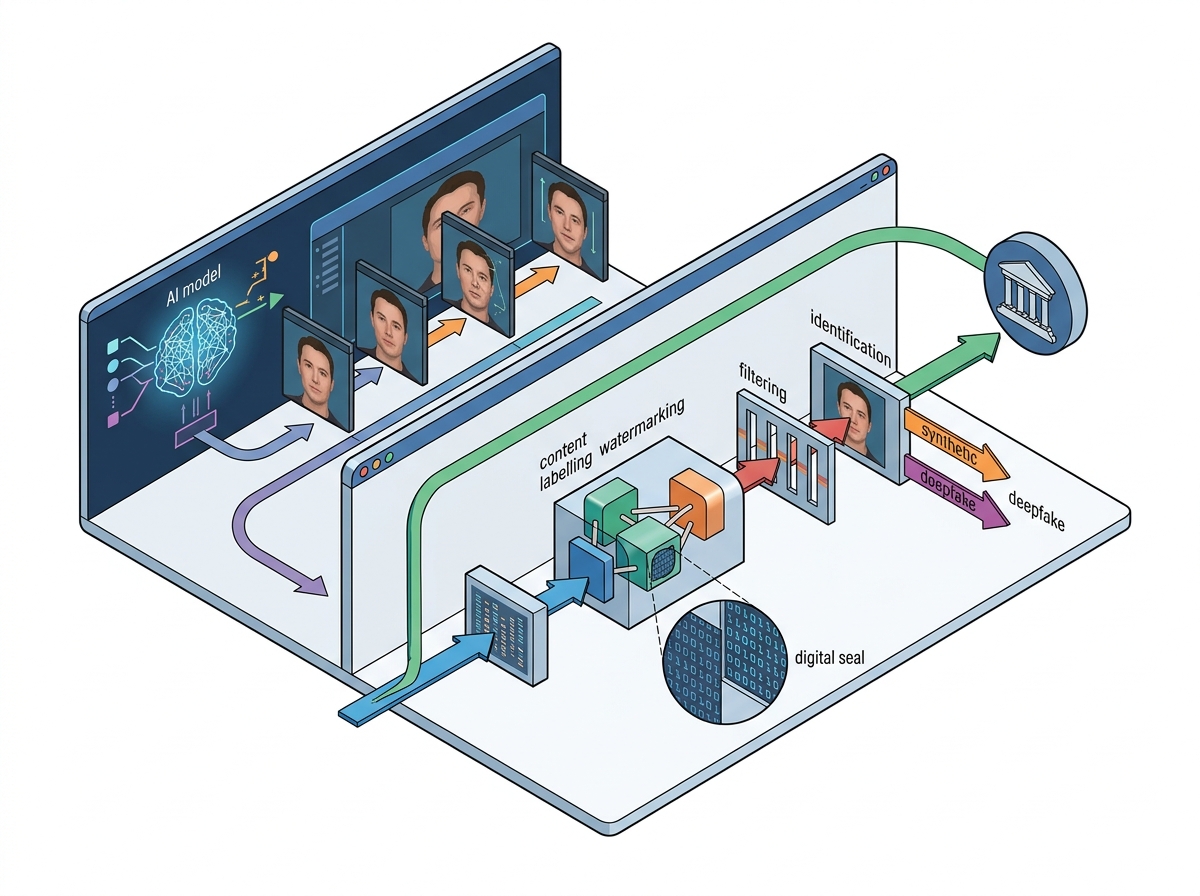
- The IT Rules, 2021, impose obligations on intermediaries—such as social media platforms, messaging services, and AI content generators—to ensure due diligence, including mandatory labelling of AI-generated content and swift removal of illegal material.
- Intermediaries are required to publish compliance reports, appoint local grievance officers, and maintain mechanisms for user verification and appeal, thereby enhancing accountability and transparency.
- The framework also empowers law enforcement agencies to trace creators of serious or sensitive content and utilise automated tools to detect and limit the spread of illegal deepfakes.
- The regulatory measures reflect a balance between fostering innovation in AI and safeguarding public interest, national security, and individual rights in the digital ecosystem.
Key Features
| Feature | Significance |
|---|---|
| Mandatory labelling of AI-generated content | Enables users to identify synthetic media, reducing misinformation risks and enhancing transparency in digital communication. |
| Reduction of takedown timelines from 36 to 3 hours | Accelerates removal of illegal deepfake content, mitigating immediate harm to individuals and public order. |
| Enhanced due diligence obligations for intermediaries | Ensures social media platforms proactively monitor and regulate AI-generated content, aligning with global best practices. |
| Stricter penalties under IT Act and BNS | Deters misuse of deepfakes through criminal liability for identity theft, fraud, and defamation. |
| Mandatory compliance reporting for large intermediaries | Strengthens accountability by requiring transparency in content moderation and law enforcement coordination. |
Why it Matters
Legal and Governance Framework
- Establishes a robust regulatory architecture to address the proliferation of deepfakes, balancing innovation with citizen protection.
- Expands the scope of existing laws (IT Act, 2000; BNS, 2023) to explicitly cover AI-generated misinformation and synthetic media.
- Clarifies intermediary liabilities, ensuring accountability without stifling digital innovation.
Public Order and Security
- Mitigates risks of AI-driven disinformation campaigns that could incite violence, communal tensions, or electoral interference.
- Reduces threats to individual privacy, reputation, and financial fraud through deepfake impersonation.
- Enhances national cybersecurity by curbing the use of synthetic media for malicious purposes.
Economic and Social Impact
- Protects digital trust, which is critical for India’s growing digital economy and e-governance initiatives.
- Supports the ethical development of AI technologies by discouraging malicious applications.
- Promotes a safer online ecosystem for businesses, creators, and citizens, fostering digital inclusion.
Challenges
1. Technological Limitations in Detection
- Deepfakes are increasingly sophisticated, making real-time detection and takedown challenging for intermediaries.
- False positives in automated content moderation may lead to censorship of legitimate content.
- Resource constraints for smaller platforms to deploy advanced AI-based detection tools.
UPSC Link: GS3: Cyber Security
2. Jurisdictional and Enforcement Gaps
- Cross-border nature of digital platforms complicates enforcement, especially for global social media intermediaries.
- Lack of standardized global regulations may lead to regulatory arbitrage by malicious actors.
- Delayed or inadequate response from intermediaries due to bureaucratic or operational hurdles.
UPSC Link: GS2: International Relations
3. Balancing Free Speech and Regulation
- Over-regulation risks stifling legitimate creative expression, satire, or parody using AI tools.
- Defining ‘illegal’ content in the context of deepfakes requires nuanced legal interpretation.
- Public perception of censorship may arise if enforcement is perceived as politically motivated.
UPSC Link: GS2: Fundamental Rights
4. Public Awareness and Digital Literacy
- Low awareness among users about the existence and risks of deepfakes limits the effectiveness of regulatory measures.
- Inadequate digital literacy programs hinder the ability of citizens to identify and report deepfakes.
- Misinformation about deepfakes themselves may lead to distrust in legitimate AI applications.
UPSC Link: GS4: Ethics
5. Ethical and Moral Dilemmas
- Determining the threshold for ‘harm’ caused by deepfakes is subjective and context-dependent.
- Balancing accountability between creators, platforms, and users in cases of deepfake misuse.
- Ethical concerns around the use of AI for surveillance or content moderation.
UPSC Link: GS4: Ethics
Challenges — UPSC Perspective
| Issue | Concern |
|---|---|
| Cross-border enforcement | Difficulty in prosecuting offenders or removing content hosted on foreign servers. |
| False positives in detection | Risk of legitimate content being wrongly flagged or removed. |
| Resource disparities among intermediaries | Smaller platforms may lack the infrastructure to comply with regulations. |
| Evolving deepfake technology | Continuous adaptation by malicious actors to bypass detection mechanisms. |
| Public trust in regulation | Perception of overreach or underreach in enforcement may undermine credibility. |
| Ethical use of AI in moderation | Risk of bias or misuse in automated content removal systems. |
Way Forward
- Strengthen public-private partnerships to develop indigenous AI-based deepfake detection tools.
- Launch nationwide digital literacy campaigns to educate citizens on identifying and reporting deepfakes.
- Establish a dedicated cybercrime unit with expertise in AI-driven misinformation for rapid response.
- Encourage intermediaries to adopt voluntary standards for AI content transparency and accountability.
- Enhance international cooperation to harmonize regulations and share best practices in combating deepfakes.
- Develop a grievance redressal mechanism with multi-stakeholder participation for fair and transparent adjudication.
- Invest in research and development to stay ahead of technological advancements in deepfake generation.
- Mandate regular audits of intermediaries’ compliance with takedown timelines and content moderation policies.
UPSC Value Addition
Keywords for Mains Answer-Writing
Deepfake regulation · Information Technology Rules 2021 · Artificial Intelligence governance · Cybercrime and AI · Intermediary Liability · Digital Media Ethics · Section 69A of IT Act · Section 79 of IT Act · BNS Section 353 · AI-generated content labeling
Constitutional & Policy Linkages
- [‘Article 19(1)(a) – Freedom of Speech’, ‘Balancing regulation with constitutional rights’]
- [‘Article 21 – Right to Privacy’, ‘Protection from unauthorized synthetic media’]
- [‘Article 14 – Equality before Law’, ‘Ensuring non-discriminatory enforcement’]
Concept Flow
Rise of AI-generated deepfakes → Spread of misinformation and identity theft → Threats to public order and individual rights → Government introduces regulatory measures (IT Rules, BNS) → Mandatory labelling and stricter takedown timelines → Intermediaries face enhanced due diligence obligations → Proactive monitoring and compliance reporting → Enforcement mechanisms strengthened → Faster removal of illegal content and criminal penalties for misuse → Public awareness and digital literacy initiatives launched → Empowering citizens to identify and report deepfakes → Ethical and technological safeguards developed → Balancing innovation with citizen protection
Prelims Practice Questions
Q1. Consider the following statements regarding the regulation of Deepfakes in India:
1. The Information Technology (Intermediary Guidelines and Digital Media Ethics Code) Rules, 2021 mandate that intermediaries must label AI-generated content.
2. The time limit for intermediaries to remove unlawful content has been reduced to 3 hours under the IT Rules.
3. The Bharatiya Nyaya Sanhita, 2023 does not criminalize the creation or dissemination of Deepfakes.
4. The IT Act, 2000 empowers the government to issue blocking orders under Section 69A.
How many of the above statements are correct?
- Only one
- Only two
- Only three
- All four
Answer: Only three — Statements 1, 2, and 4 are correct. Statement 3 is incorrect as the Bharatiya Nyaya Sanhita, 2023 includes provisions under Section 353 to penalize the creation and dissemination of false or misleading electronic records, which includes Deepfakes.
Q2. Assertion (A): The Information Technology Act, 2000 empowers the government to direct intermediaries to remove unlawful content within 36 hours.
Reason (R): The recent amendments to the IT Rules have reduced this time limit to 3 hours for greater accountability.
Options:
A. Both A and R are true, and R is the correct explanation of A.
B. Both A and R are true, but R is not the correct explanation of A.
C. A is true, but R is false.
D. A is false, but R is true.
Answer: ? — Assertion (A) is true as the IT Act, 2000 empowers the government to direct intermediaries to remove unlawful content. Reason (R) is also true and correctly explains the assertion, as the recent amendments to the IT Rules have indeed reduced the time limit to 3 hours.
Mains Practice Question
✍ Critically examine the regulatory framework established by the Government of India to address the challenges posed by Deepfakes. How effective are the provisions of the Information Technology Act, 2000, the Information Technology (Intermediary Guidelines and Digital Media Ethics Code) Rules, 2021, and the Bharatiya Nyaya Sanhita, 2023 in curbing the menace of AI-generated misinformation? Also, assess the challenges in enforcement and suggest measures to enhance the efficacy of these regulations. (15 Marks)
Approach: MODEL-ANSWER SKELETON:
1. **Introduction** (2 Marks):
– Define Deepfakes and their socio-political implications.
– Contextualize the urgency of regulation in India’s digital ecosystem.
2. **Regulatory Framework Analysis** (6 Marks):
– **Information Technology Act, 2000**:
– Sections 43, 66, 66C, 66D, 66E, 67, 67A, 69A, 79, 78, and 80.
– Role in penalizing cybercrimes, identity theft, and privacy violations.
– **IT Rules, 2021**:
– Mandatory labeling of AI-generated content.
– Reduced removal time for unlawful content to 3 hours.
– Duties of intermediaries (Section 79 compliance, grievance redressal, user verification).
– **Bharatiya Nyaya Sanhita, 2023**:
– Sections 319 (impersonation), 336 (fraud), 353 (false electronic records), and 111 (organized cybercrimes).
– Criminalization of Deepfakes under broader cybercrime provisions.
3. **Effectiveness and Challenges** (5 Marks):
– **Strengths**:
– Proactive amendments (e.g., reduced removal time, labeling requirements).
– Legal clarity on intermediary liability (Section 79).
– Criminalization of Deepfakes under BNS.
– **Challenges**:
– Technological limitations in detecting Deepfakes.
– Jurisdictional ambiguities (cross-border nature of AI tools).
– Enforcement gaps (e.g., anonymity, lack of global cooperation).
– Over-reliance on intermediaries for content moderation.
4. **Suggestions for Enhancement** (2 Marks):
– Strengthen AI-driven detection tools and collaborative frameworks (e.g., with CERT-In).
– Mandate transparency in AI algorithms used by platforms.
– Public awareness campaigns to educate users on identifying Deepfakes.
– International cooperation to address cross-border challenges.
Source: PIB (Press Information Bureau)
Generated by AanyaAi for educational purpose.

- विकलांग सैन्य कैडेटों को पेंशन देने से रोक रही सरकार की नीति: केंद्र ने सुप्रीम कोर्ट में बताया - September 23, 2026
- Centre Tells SC: Policy Blocks Disability Pension for Outboarded Cadets - September 23, 2026
- यूपीएससी तैयारी: स्कूलों में स्वच्छता सुविधाओं की कमी, 5 करोड़ बच्चे प्रभावित - September 23, 2026

No Comments