


06 Aug Lok Sabha Passes Bill to Allow UPI Transaction Charges: Key Details for UPSC
✎ The proposed amendment to the Payment and Settlement Systems Act, 2007, does not impose charges on UPI transactions immediately but empowers the government to permit banks and PSPs to levy such charges in the future, potentially…
Subject Relevance — Where This Topic Fits
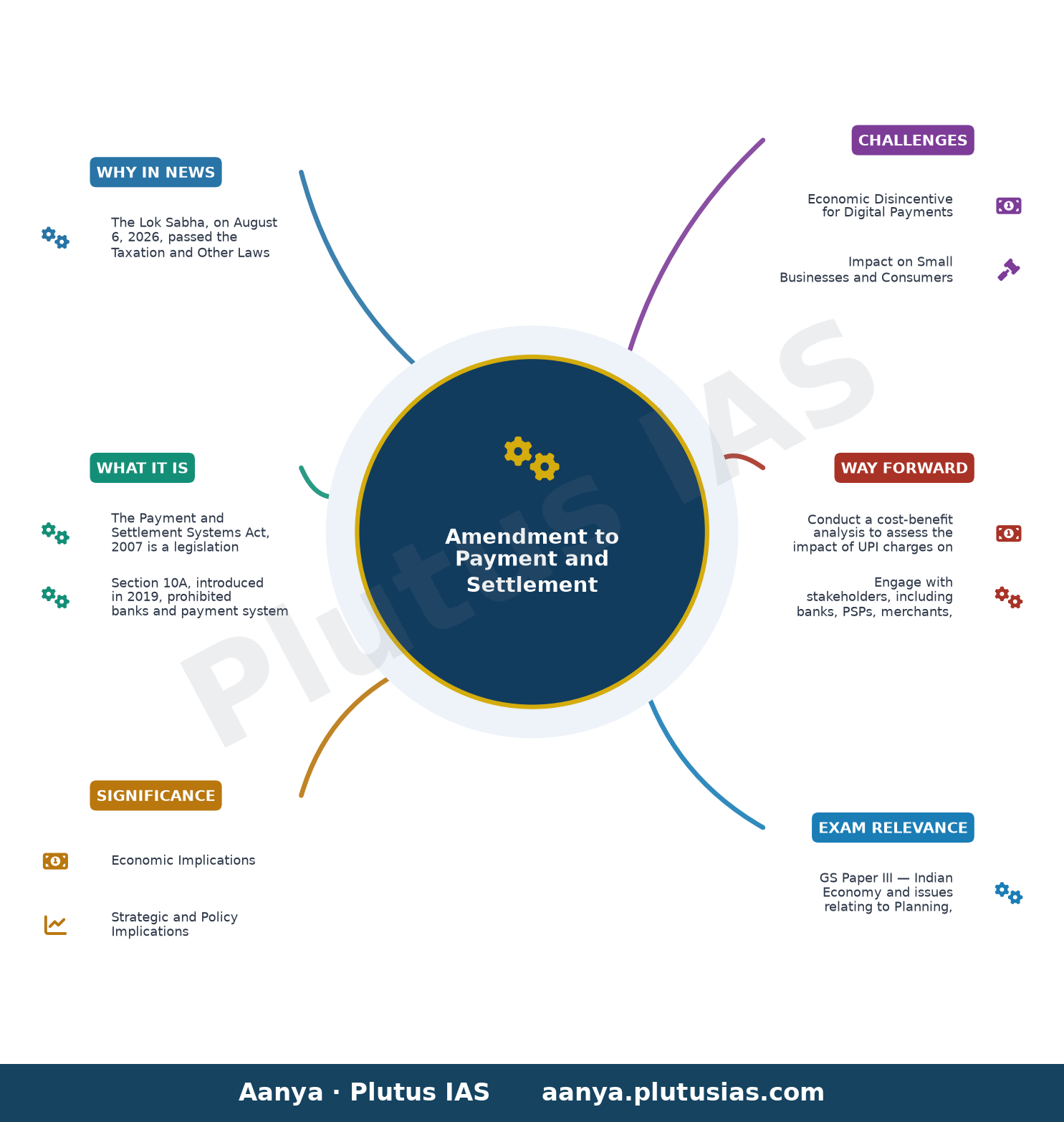
- GS Paper III — Indian Economy and issues relating to Planning, Mobilization of Resources, Growth, Development and Employment
- Prelims: Unified Payments Interface (UPI), Merchant Discount Rate (MDR), Payment and Settlement Systems Act, 2007, Section 10A, Section 269SU, digital payment infrastructure, real-time gross settlement (RTGS), national electronic funds transfer (NEFT)
- Essay: The future of digital public infrastructure in India: Balancing innovation with equitable access, Sustainability of digital payment ecosystems: Costs, benefits, and policy trade-offs
Quick Revision: The proposed amendment to the Payment and Settlement Systems Act, 2007, does not impose charges on UPI transactions immediately but empowers the government to permit banks and PSPs to levy such charges in the future, potentially ending the zero-MDR regime.
Why is this in the news?
The Lok Sabha, on August 6, 2026, passed the Taxation and Other Laws (Amendment) Bill, 2026, which includes provisions to amend the Payment and Settlement Systems Act, 2007. The amendment seeks to empower the government to permit banks and payment service providers to levy charges on UPI and other notified electronic payment modes, thereby potentially ending the zero-MDR regime for digital transactions. This legislative move has significant implications for the digital payment ecosystem, financial inclusion, and the sustainability of payment infrastructure providers.
Background
- The Payment and Settlement Systems Act, 2007 was enacted to regulate payment systems in India and provide a legal framework for electronic fund transfers, including UPI, RTGS, and NEFT.
- Section 10A of the Act, introduced in 2019, prohibited banks and payment system providers from imposing any charges on electronic payments, including those made through UPI, to promote digital transactions and financial inclusion.
- Section 269SU of the Income Tax Act, 1961, mandates large businesses (turnover exceeding ₹50 crore) to accept payments through specific electronic modes, including RuPay debit cards and BHIM-UPI QR codes, to curb cash transactions.
- The zero-MDR regime for UPI transactions has been a cornerstone of India’s push towards a cashless economy, driving rapid adoption of digital payments among merchants and consumers.
- The proposed amendment aligns with the government’s broader objective of creating a sustainable revenue model for banks, payment service providers (PSPs), and infrastructure firms to maintain and upgrade digital payment systems.
- The amendment was introduced as part of the Taxation and Other Laws (Amendment) Bill, 2026, which also includes changes to the Income Tax Act, 2025, and the Finance Act, 2026, indicating a comprehensive approach to fiscal and digital policy.
What is the Payment and Settlement Systems Act, 2007, and its proposed amendment?
- The Payment and Settlement Systems Act, 2007 is a legislation enacted to regulate payment systems in India, ensuring the safety and efficiency of electronic fund transfers, including UPI, RTGS, and NEFT.
- Section 10A, introduced in 2019, prohibited banks and payment system providers from imposing any charges on electronic payments, including UPI transactions, to incentivize digital payments and promote financial inclusion.
- The proposed amendment seeks to remove the prohibition under Section 10A, allowing the government to permit banks and PSPs to levy charges on UPI and other notified electronic payment modes through a notification process.
- The amendment replaces the reference to ‘electronic modes of payment prescribed under Section 269SU’ with ‘one or more electronic modes of payment as the central government may, by notification, specify’, providing flexibility in determining which payment modes may be subject to charges.
- The amendment does not immediately impose charges on UPI transactions but grants the government the authority to introduce such charges in the future, subject to notification and public consultation.
- The move is part of a broader effort to balance the sustainability of the digital payment ecosystem with the need to maintain affordability for consumers and small businesses.
Key Features
| Feature | Significance |
|---|---|
| Amendment to Payment and Settlement Systems Act, 2007 | Removes the statutory prohibition on banks and payment service providers from levying charges on UPI and other notified electronic payment modes. |
| Introduction of Merchant Discount Rate (MDR) on UPI | Enables banks and PSPs to charge MDR, potentially shifting the cost burden from the government to merchants or end-users. |
| Exemption of RTGS/NEFT from MDR | Maintains existing charges for RTGS and NEFT, ensuring parity with other electronic payment systems. |
| Government’s revenue model sustainability | Aims to create a sustainable revenue ecosystem for banks, PSPs, and infrastructure firms without disrupting the digital payments growth. |
| Section 10A substitution in Payment and Settlement Systems Act | Replaces the reference to Section 269SU of the Income Tax Act with a broader notification-based approach for electronic modes. |
Why it Matters
Economic Implications
- Potential reduction in the free usage of UPI, which has been a key driver of digital financial inclusion in India.
- Shift in cost burden from the exchequer to merchants or consumers, impacting small businesses and low-income users.
- Revenue generation for banks and PSPs to sustain digital payment infrastructure and innovation.
- Risk of reduced adoption of digital payments if charges are perceived as excessive, contrary to the government’s ‘Digital India’ objectives.
Strategic and Policy Implications
- Aligns with the government’s broader fiscal policy to diversify revenue streams while promoting digital transactions.
- May necessitate recalibration of the ‘zero MDR’ policy for UPI, which has been a cornerstone of India’s digital payment revolution.
- Could influence the Reserve Bank of India’s (RBI) regulatory stance on digital payment charges and interoperability.
Social and Inclusivity Concerns
- Impact on marginalised sections reliant on UPI for financial transactions, potentially increasing the cost of digital inclusion.
- Possible exacerbation of digital divide if small merchants and low-income users face higher transaction costs.
Legal and Regulatory Framework
- Clarifies the legal ambiguity around charging for UPI transactions, replacing the previous blanket exemption under Section 10A.
- Empowers the government to notify specific electronic modes for charge imposition, providing flexibility in policy implementation.
Challenges
1. Economic Disincentive for Digital Payments
- Risk of reduced adoption of UPI if charges are introduced, undermining the progress of digital financial inclusion.
- Potential increase in cash transactions, counter to the government’s push for a less-cash economy.
UPSC Link: GS3: Digital Economy
2. Impact on Small Businesses and Consumers
- Small merchants may face higher costs, reducing their competitiveness and profit margins.
- Low-income users may bear the brunt of transaction charges, exacerbating economic inequality.
UPSC Link: GS3: MSMEs and Inclusive Growth
3. Regulatory and Compliance Burden
- Banks and PSPs may face operational challenges in implementing and enforcing transaction charges.
- Need for clear guidelines to prevent arbitrary or discriminatory pricing.
UPSC Link: GS3: Financial Sector Reforms
4. Policy Coherence and Public Perception
- Risk of public backlash if charges are perceived as a regressive step in digital payment adoption.
- Need for transparent communication to ensure stakeholders understand the rationale behind the charges.
UPSC Link: GS2: Government Policies and Interventions
Challenges — UPSC Perspective
| Issue | Concern |
|---|---|
| Reduced UPI Adoption | Potential decline in digital payment usage due to perceived costs, undermining financial inclusion. |
| Increased Costs for Merchants | Small businesses may face higher transaction fees, impacting profitability and growth. |
| Regressive Impact on Low-Income Users | Higher charges may disproportionately affect economically weaker sections. |
| Regulatory Ambiguity | Lack of clarity on how charges will be implemented and enforced by banks and PSPs. |
| Policy Inconsistency | Contradiction with the government’s long-standing ‘zero MDR’ policy for UPI. |
Way Forward
- Conduct a cost-benefit analysis to assess the impact of UPI charges on digital payment adoption and financial inclusion.
- Engage with stakeholders, including banks, PSPs, merchants, and consumer groups, to design a fair and transparent pricing mechanism.
- Ensure that any charges imposed are minimal and do not deter the use of digital payments by low-income users.
- Strengthen the digital payment infrastructure to reduce the need for transaction charges, such as through subsidies or incentives.
- Monitor the implementation of charges to prevent monopolistic or discriminatory practices by banks and PSPs.
- Align the policy with broader digital economy goals to ensure coherence with the ‘Digital India’ initiative.
- Introduce safeguards to protect small businesses and consumers from excessive charges, such as caps or tiered pricing.
UPSC Value Addition
Keywords for Mains Answer-Writing
Unified Payments Interface (UPI) · Payment and Settlement Systems Act, 2007 · Merchant Discount Rate (MDR) · Digital Payment Ecosystem · Section 10A of Payment and Settlement Systems Act · Section 269SU of Income Tax Act · Taxation and Other Laws (Amendment) Bill, 2026 · Financial Inclusion · Sustainable Revenue Model for Banks · Electronic Modes of Payment · Digital Public Infrastructure · Regulatory Arbitrage in Digital Payments
Concept Flow
Introduction of UPI as a free digital payment mode -> Exponential growth in digital transactions and financial inclusion. → Government’s policy of zero MDR on UPI to promote digital payments -> Statutory exemption under Section 10A of the Payment and Settlement Systems Act, 2007. → Amendment to Payment and Settlement Systems Act, 2007 -> Removal of statutory exemption -> Empowerment of government to permit charges on UPI and other notified modes. → Potential imposition of Merchant Discount Rate (MDR) on UPI -> Shift in cost burden to merchants or consumers. → Impact on digital payment adoption and financial inclusion -> Possible decline in UPI usage and increased cash transactions. → Need for regulatory oversight and stakeholder engagement -> Design of fair and transparent pricing mechanisms. → Long-term implications for digital economy and government’s fiscal policy -> Balancing revenue generation with inclusive growth.
Prelims Practice Questions
Q1. Consider the following statements regarding the Payment and Settlement Systems Act, 2007:
1. Section 10A of the Act prohibits banks and system providers from imposing any charges on electronic payments.
2. The Taxation and Other Laws (Amendment) Bill, 2026 seeks to amend Section 10A to allow the levying of charges on UPI transactions.
3. Section 269SU of the Income Tax Act mandates large businesses to accept payments through RuPay debit cards and BHIM-UPI QR codes.
How many of the above statements are correct?
- Only one
- Only two
- All
- None
Answer: All — Statements 1, 2, and 3 are all correct. Section 10A explicitly prohibits charges on electronic payments, and the amendment Bill seeks to remove this prohibition. Section 269SU mandates large businesses to accept digital payments via specified modes, including UPI.
Q2. Assertion (A): The Payment and Settlement Systems Act, 2007, originally prohibited banks from levying charges on UPI transactions.
Reason (R): The amendment introduced by the Taxation and Other Laws (Amendment) Bill, 2026, seeks to remove this prohibition to enable banks to charge Merchant Discount Rate (MDR) on UPI transactions.
Options:
A. Both A and R are true, and R is the correct explanation of A.
B. Both A and R are true, but R is not the correct explanation of A.
C. A is true, but R is false.
D. A is false, but R is true.
- A
- B
- C
- D
Answer: C — Assertion (A) is true as Section 10A of the Payment and Settlement Systems Act, 2007, prohibits charges on electronic payments. Reason (R) is also true, but it does not explain why the prohibition exists; rather, it explains the amendment’s intent to remove it.
Q3. Match the following provisions with their respective Acts:
Column I:
1. Section 10A
2. Section 269SU
3. Merchant Discount Rate (MDR)
Column II:
A. Payment and Settlement Systems Act, 2007
B. Income Tax Act, 1961
C. Digital Payment Regulations, 2023
Options:
1-A, 2-B, 3-C
1-B, 2-A, 3-C
1-A, 2-B, 3-B
1-C, 2-A, 3-B
- 1-A, 2-B, 3-C
- 1-B, 2-A, 3-C
- 1-A, 2-B, 3-B
- 1-C, 2-A, 3-B
Answer: 1-A, 2-B, 3-C — Section 10A is from the Payment and Settlement Systems Act, 2007; Section 269SU is from the Income Tax Act, 1961; and Merchant Discount Rate (MDR) is a concept related to digital payments but not explicitly codified in a specific Act.
Mains Practice Question
✍ The Government of India has proposed amendments to the Payment and Settlement Systems Act, 2007, to permit banks to levy charges on UPI transactions. Critically examine the implications of this move for financial inclusion, digital public infrastructure, and the sustainability of the digital payments ecosystem in India. Also, analyse the legal and constitutional dimensions of such a policy shift. (15 Marks)
Approach: MODEL-ANSWER SKELETON:
1. **Introduction (2 Marks)**
– Briefly define UPI and its role in India’s digital payment revolution.
– Mention the existing legal framework under Section 10A of the Payment and Settlement Systems Act, 2007, prohibiting charges on electronic payments.
– State the proposed amendment’s objective: to enable banks to levy Merchant Discount Rate (MDR) on UPI transactions.
2. **Implications for Financial Inclusion (4 Marks)**
– **Positive:** Potential revenue for banks and payment service providers (PSPs) could enhance infrastructure investment, improving service quality and coverage in rural/remote areas.
– **Negative:** Charges may deter small merchants and low-income users from adopting digital payments, reversing gains in financial inclusion. Cite examples of UPI’s role in reducing cash dependency (e.g., PM Jan Dhan Yojana, Direct Benefit Transfers).
– **Balancing Act:** Need for tiered pricing (e.g., exemptions for small transactions) to mitigate adverse effects.
3. **Impact on Digital Public Infrastructure (4 Marks)**
– **Sustainability Argument:** Banks and PSPs require revenue streams to maintain and upgrade infrastructure (e.g., NPCI’s role in UPI). Charges could ensure long-term viability.
– **Regulatory Arbitrage:** Contrast with global models (e.g., Brazil’s Pix, EU’s SEPA Instant Credit Transfer) where digital payments remain largely free to users.
– **Interoperability:** Potential fragmentation if banks impose differential charges, undermining UPI’s seamless interoperability.
4. **Legal and Constitutional Dimensions (3 Marks)**
– **Constitutional Validity:** Examine if the amendment violates the right to equality (Article 14) or the directive principle of equal access to digital services (Article 38).
– **Parliamentary Authority:** Discuss the legislative competence under Entry 30 (Banking) and Entry 46 (Currency, coinage) of the Union List (Seventh Schedule).
– **Precedents:** Reference past judicial interventions in digital payment regulations (e.g., Supreme Court’s stance on data privacy in Puttaswamy case).
5. **Conclusion (2 Marks)**
– Weigh the trade-offs between sustainability and inclusion.
– Propose a middle path: phased implementation, exemptions for micro-transactions, and transparent pricing models.
– Emphasise the need for stakeholder consultations (RBI, NPCI, merchant associations) to align policy with ground realities.
Source: The Hindu
Generated by AanyaAi for educational purpose.

- हिमाचल में डिजिटल भुगतान क्रांति: बिलासपुर अव्वल, महिलाओं की भागीदारी 93% तक पहुंची - September 23, 2026
- Himachal Pradesh Leads in Digital Payments: Bilaspur Tops, Women’s Role Rises - September 23, 2026
- केरल लोक सेवा आयोग ने उच्च न्यायालय में दायर किया मामला, सदस्यों के खिलाफ मामला रद्द करने की मांग - September 23, 2026

No Comments