


06 Aug Lok Sabha Passes Bill Allowing Charges on UPI & Digital Payments: Key Details
✎ UPI charges bill empowers RBI to regulate digital payments, potentially ending zero-cost transactions.
Relevance for UPSC & State PCS: Polity
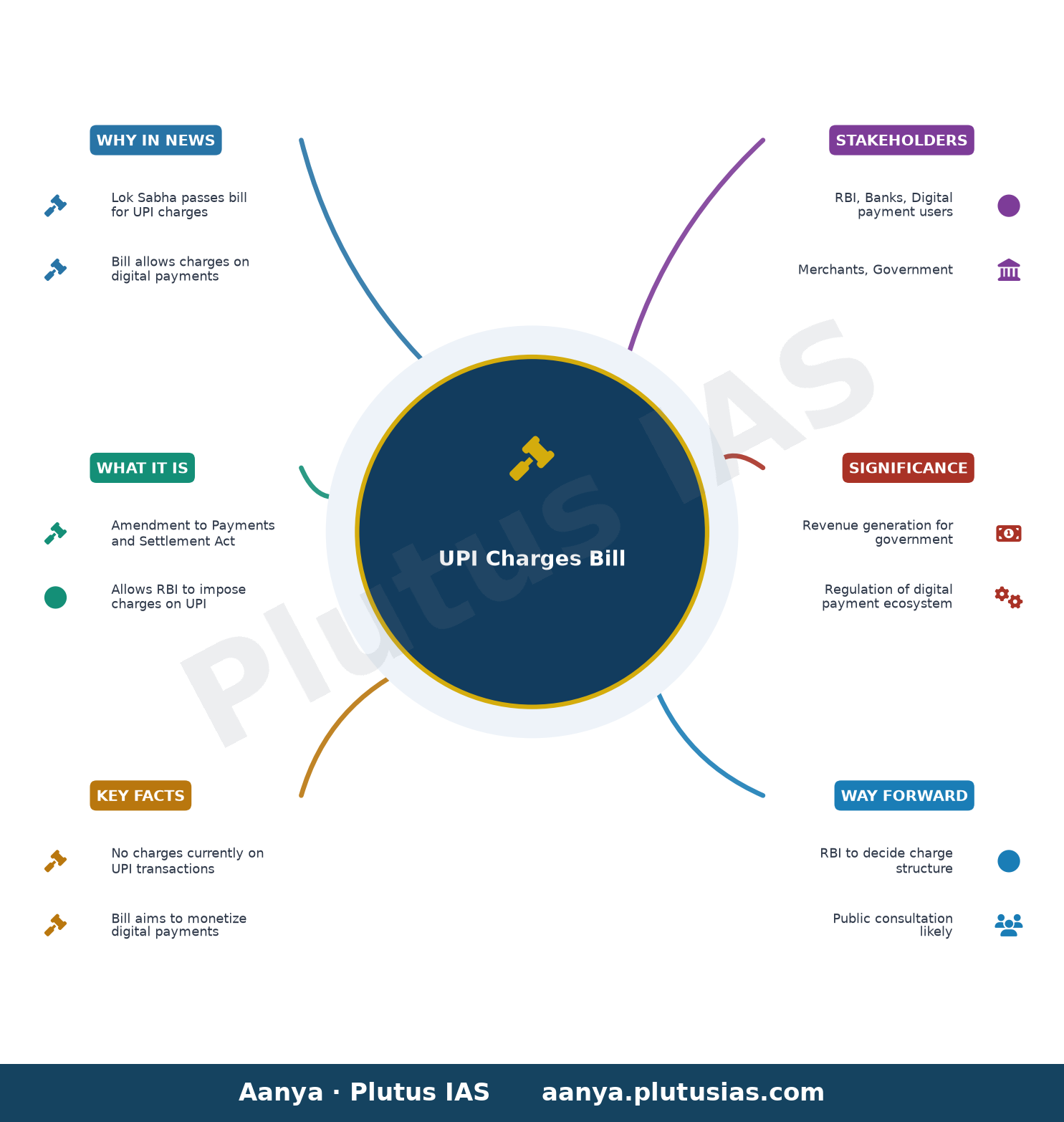
The Lok Sabha recently passed the *Payments and Settlement Systems Bill, 2024*, which grants the Reserve Bank of India (RBI) the authority to impose charges on Unified Payments Interface (UPI) and other digital payment transactions. The bill, introduced by Finance Minister Nirmala Sitharaman, aims to provide a legal framework for regulating digital payment systems, ensuring stability and security in the rapidly expanding fintech ecosystem. This move comes amid concerns over the sustainability of digital payment infrastructure, particularly as UPI, which has seen exponential growth, currently operates without any transaction charges. The bill’s passage reflects the government’s intent to balance innovation with regulatory oversight, especially as digital payments become a cornerstone of India’s financial inclusion strategy.
For UPSC and State PCS aspirants, this development holds significant relevance in the context of governance, financial policy, and constitutional provisions. The bill underscores the RBI’s evolving role in regulating digital payments, a subject that intersects with the *Reserve Bank of India Act, 1934*, and the *Payment and Settlement Systems Act, 2007*. Aspirants should note how the legislation empowers the central bank to introduce charges, potentially impacting users, merchants, and fintech companies. Additionally, the bill’s provisions may raise questions about the balance between financial inclusion and revenue generation, a key theme in India’s digital economy discourse.
The bill’s passage also highlights broader themes in Indian polity, such as the government’s push for a cashless economy and the challenges of regulating emerging technologies. For State PCS aspirants, understanding the implications of digital payment regulations is crucial, as state governments often collaborate with the RBI and financial institutions to promote digital transactions. The bill’s focus on stability and security in payment systems aligns with the *Digital India* initiative, making it a pertinent topic for mains answer writing and interview discussions. Aspirants should also consider the potential socio-economic impact, such as the effect on small businesses and rural users who rely heavily on UPI for transactions.
From a constitutional perspective, the bill raises questions about the RBI’s autonomy in framing regulations, a topic that has been debated in the context of fiscal federalism and cooperative federalism. The Lok Sabha’s approval of the bill without significant opposition suggests a consensus on the need for regulatory clarity in digital payments. However, the absence of detailed public consultations or stakeholder discussions may invite scrutiny, particularly from those advocating for a more inclusive approach to policy-making. For UPSC aspirants, this bill serves as a case study in how legislative and regulatory frameworks evolve to address technological advancements, a theme that could appear in both prelims and mains examinations.
Source: ndtv.com
Practice Questions
Q1. Which legislative body recently passed a bill to allow charges on UPI and other digital payment transactions?
- Rajya Sabha
- Lok Sabha
- President’s Office
- Supreme Court
Answer
Lok Sabha — The bill to allow charges on UPI and other digital payment transactions was passed by the Lok Sabha, as stated in the given current-affairs story.
Q2. What is the primary purpose of the bill passed by the Lok Sabha regarding digital payments?
- To ban all digital payment methods
- To allow charges on UPI and other digital payment transactions
- To mandate free transactions for all users
- To restrict digital payments to only government transactions
Answer
To allow charges on UPI and other digital payment transactions — The bill’s primary purpose is to allow charges on UPI and other digital payment transactions, as mentioned in the story.
Generated by AanyaAi for educational purpose.

- तमिलनाडु के लिए क्या है ‘एल नीनो’ और उत्तर-पूर्वी मानसून का खतरा? - September 23, 2026
- El Nino & Northeast Monsoon: Impact on Tamil Nadu for UPSC 2026 - September 23, 2026
- हिमाचल में डिजिटल भुगतान क्रांति: बिलासपुर अव्वल, महिलाओं की भागीदारी 93% तक पहुंची - September 23, 2026

No Comments