


06 Aug Lok Sabha Passes Bill to Allow UPI Transaction Charges: Key Implications for UPSC Aspirants
✎ The Taxation and Other Laws (Amendment) Bill, 2026, amends the Payment and Settlement Systems Act, 2007, to empower the Central Government to permit banks to levy charges on UPI transactions, potentially ending the zero-cost era…
Subject Relevance — Where This Topic Fits
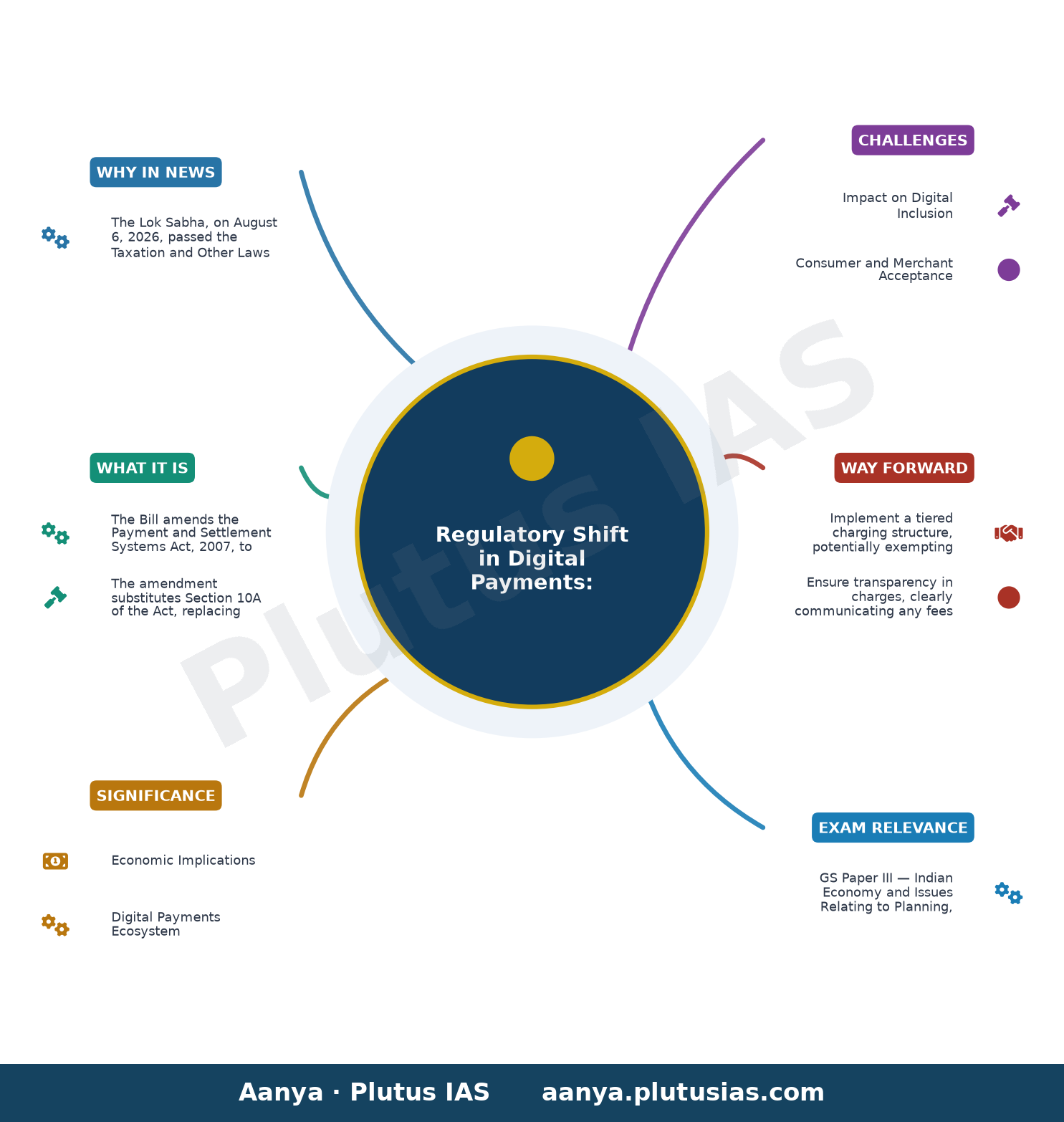
- GS Paper III — Indian Economy and Issues Relating to Planning, Mobilisation of Resources, Growth, Development and Employment
- Prelims: Unified Payments Interface (UPI), Merchant Discount Rate (MDR), Payment and Settlement Systems Act 2007, Digital Payment Ecosystem, Section 10A of Payment and Settlement Systems Act 2007, Section 269SU of Income Tax Act 1961
Quick Revision: The Taxation and Other Laws (Amendment) Bill, 2026, amends the Payment and Settlement Systems Act, 2007, to empower the Central Government to permit banks to levy charges on UPI transactions, potentially ending the zero-cost era of digital payments in India.
Why is this in the news?
The Lok Sabha, on August 6, 2026, passed the Taxation and Other Laws (Amendment) Bill, 2026, which amends the Payment and Settlement Systems Act, 2007 to empower the Central Government to permit banks and payment service providers to levy charges on UPI transactions. This legislative move, undertaken without parliamentary debate due to opposition sloganeering, marks a significant shift in India’s digital payment policy, potentially ending the zero-cost era of UPI transactions. The amendment seeks to introduce a revenue model for banks and payment infrastructure firms while addressing sustainability concerns in the digital payments ecosystem.
Background
- The Payment and Settlement Systems Act, 2007, was enacted to regulate payment systems in India and ensure the stability and efficiency of the financial system.
- UPI, launched in 2016, has revolutionised digital payments in India by enabling real-time, inter-bank transactions without intermediaries, fostering financial inclusion and reducing cash dependency.
- Banks and payment infrastructure firms have long argued for a sustainable revenue model to offset the high operational costs of maintaining UPI infrastructure, including server maintenance, fraud prevention, and customer support.
What is the Payment and Settlement Systems (Amendment) Bill, 2026?
- The Bill amends the Payment and Settlement Systems Act, 2007, to remove the prohibition on levying charges for UPI and other notified electronic payment modes, thereby enabling the Central Government to permit banks and payment service providers (PSPs) to impose Merchant Discount Rate (MDR) or other charges.
- The amendment substitutes Section 10A of the Act, replacing the reference to electronic modes under Section 269SU of the Income Tax Act with a broader provision empowering the government to notify any electronic payment mode for charge imposition.
- The proposed changes aim to balance the sustainability of the digital payments ecosystem with the need for financial inclusion, ensuring that banks and PSPs can recover costs without deterring small businesses and consumers.
- The government has indicated that the charges, if levied, will be minimal and structured to avoid burdening small merchants or low-value transactions, though the exact framework remains unspecified.
- The amendment does not immediately impose charges but grants the government the authority to do so via notification, allowing for a consultative and phased implementation process.
- The move aligns with global practices where digital payment systems often involve transaction fees to support infrastructure maintenance and innovation.
- Critics argue that introducing charges could undermine the growth of UPI, which has been a key driver of India’s digital transformation, while proponents highlight the need for a sustainable ecosystem to support future scalability.
Key Features
| Feature | Significance |
|---|---|
| Amendment to Payment and Settlement Systems Act, 2007 | Authorises the Central Government to permit banks and other service providers to levy charges on UPI and other notified electronic payment modes. |
| Removal of existing legal provision | Eliminates the prohibition on banks and payment service providers from charging Merchant Discount Rate (MDR) on specified electronic payment modes. |
| Scope of amendment | Specifically targets Section 10A of the Payment and Settlement Systems Act, 2007, which previously barred charges on electronic payments prescribed under Section 269SU of the Income-tax Act, 1961. |
| Government’s stated objective | Aims to establish a sustainable revenue model for banks, Payment Service Providers (PSPs), and payment infrastructure firms, while ensuring small charges for consumers and small businesses. |
| Context of the amendment | Part of the broader Taxation and Other Laws (Amendment) Bill, 2026, which also amends the Income Tax Act, 2025, and the Finance Act, 2026. |
Why it Matters
Economic Implications
- Facilitates a sustainable revenue model for payment ecosystem participants, potentially encouraging further investment in digital payment infrastructure and innovation.
- May lead to increased operational costs for consumers and small businesses, potentially impacting the adoption rate of digital payments, especially for micro-transactions.
- Addresses the financial sustainability concerns of banks and Payment Service Providers (PSPs) who have been bearing the costs of UPI transactions without direct revenue.
Digital Payments Ecosystem
- Introduces a mechanism for monetisation of UPI transactions, aligning it with other real-time payment systems like RTGS and NEFT which already levy service charges.
- Could lead to differentiation in service offerings and pricing strategies among various payment service providers, fostering competition.
- Impacts the ‘free’ nature of UPI, which has been a significant driver of its widespread adoption and success in India’s digital transformation journey.
Government Policy and Regulation
- Reflects a policy shift towards balancing the promotion of digital payments with the financial viability of the underlying infrastructure and service providers.
- Grants the Central Government greater flexibility to specify electronic payment modes and associated charges through notifications, allowing for adaptive policy responses.
- Underscores the government’s role in shaping the regulatory framework for digital financial services, balancing consumer interests with industry sustainability.
Challenges
1. Impact on Digital Inclusion
- Potential for increased transaction costs to disproportionately affect low-income individuals and small merchants, who rely heavily on free UPI transactions.
- Risk of slowing down the pace of digital adoption in rural and semi-urban areas where cost sensitivity is higher, potentially widening the digital divide.
UPSC Link: GS-II: Government policies and interventions
2. Consumer and Merchant Acceptance
- Possible backlash from consumers accustomed to free UPI services, leading to reduced usage or a shift back to cash transactions.
- Merchants, particularly small businesses, may resist additional charges, impacting their willingness to accept UPI payments.
UPSC Link: GS-III: Indian Economy and issues relating to planning
3. Regulatory Complexity and Implementation
- Developing a fair and transparent charging mechanism that balances the interests of all stakeholders (consumers, merchants, banks, PSPs) will be complex.
- Ensuring uniform application and preventing predatory pricing by dominant players will require robust regulatory oversight.
UPSC Link: GS-II: Statutory, regulatory and various quasi-judicial bodies
4. Sustainability of Payment Ecosystem
- While aiming for sustainability, an improperly structured charging model could inadvertently stifle innovation or create barriers to entry for new payment service providers.
- Balancing revenue generation for providers with the imperative of low-cost digital transactions for mass adoption remains a critical challenge.
UPSC Link: GS-III: Infrastructure: Energy, Ports, Roads, Airports, Railways etc.
Challenges — UPSC Perspective
| Issue | Concern |
|---|---|
| Cost Burden on Users | Levying charges may deter small transactions and impact financial inclusion for vulnerable populations. |
| Merchant Discount Rate (MDR) Impact | Reintroduction of MDR could increase operational costs for small businesses, potentially affecting their profitability and willingness to accept digital payments. |
| Maintaining UPI’s Popularity | The ‘free’ nature of UPI has been a key driver of its widespread adoption; introducing charges risks undermining its appeal. |
| Regulatory Framework Development | Establishing a fair, transparent, and equitable charging mechanism across diverse payment modes and service providers presents significant regulatory challenges. |
| Competition and Innovation | Care must be taken to ensure that charging policies do not stifle competition or disincentivise innovation in the digital payments sector. |
Way Forward
- Implement a tiered charging structure, potentially exempting micro-transactions or small value payments to protect financial inclusion.
- Ensure transparency in charges, clearly communicating any fees to users and merchants to build trust and avoid confusion.
- Establish a robust regulatory framework to monitor charges, prevent anti-competitive practices, and ensure fair pricing across the ecosystem.
- Invest in public awareness campaigns to educate users and merchants about the rationale behind charges and the benefits of a sustainable digital payment ecosystem.
- Explore alternative revenue models for payment service providers, such as value-added services or data monetisation, to reduce reliance on transaction fees.
- Continuously evaluate the impact of charges on digital payment adoption and adjust policies as needed to maintain momentum towards a cashless economy.
- Promote interoperability and open-source payment solutions to foster competition and keep transaction costs low through market forces.
UPSC Value Addition
Keywords for Mains Answer-Writing
Payment and Settlement Systems Act 2007 · Unified Payments Interface (UPI) · Merchant Discount Rate (MDR) · Digital payments ecosystem · Financial inclusion · Digital economy · Monetary policy · Reserve Bank of India (RBI) · Taxation and Other Laws (Amendment) Bill · Financial technology (FinTech) · Sustainable revenue model · Consumer protection
Concept Flow
Existing legal provision (Section 10A PSS Act, 2007) prohibits charges on notified electronic payments. → Taxation and Other Laws (Amendment) Bill, 2026, amends PSS Act, 2007. → Amendment removes prohibition, authorising government to permit charges. → Government can now notify specific electronic modes for charges. → Banks and PSPs may levy charges (e.g., MDR) on UPI transactions. → Aims for sustainable revenue model for payment ecosystem participants. → Potential impact on digital payment adoption and financial inclusion.
Prelims Practice Questions
Q1. Consider the following statements regarding the Payment and Settlement Systems Act, 2007:
1. The Act provides for the regulation and supervision of payment systems in India.
2. Section 10A of the Act, prior to recent amendments, prohibited banks and system providers from imposing charges on electronic payments prescribed under Section 269SU of the Income-tax Act, 1961.
3. The Reserve Bank of India (RBI) is the nodal authority for implementing the provisions of this Act.
How many of the above statements are correct?
- Only one
- Only two
- All three
- None
Answer: All three — Statement 1 is correct: The Payment and Settlement Systems Act, 2007, indeed provides for the regulation and supervision of payment systems in India, with the RBI as the primary regulator. Statement 2 is correct: Section 10A of the Payment and Settlement Systems Act, 2007, previously prohibited charges on electronic modes of payment prescribed under Section 269SU of the Income-tax Act, 1961, which included UPI. Statement 3 is correct: The Reserve Bank of India (RBI) is indeed the nodal authority for implementing the provisions of this Act, overseeing payment and settlement systems.
Q2. Which of the following electronic payment modes have historically been exempted from service charges in India, unlike RTGS and NEFT?
- Real-Time Gross Settlement (RTGS)
- National Electronic Funds Transfer (NEFT)
- Unified Payments Interface (UPI)
- Immediate Payment Service (IMPS)
Answer: Unified Payments Interface (UPI) — UPI transactions have historically been exempted from service charges, as explicitly mentioned in the news, unlike RTGS and NEFT which typically involve service charges. IMPS also generally involves charges.
Mains Practice Question
✍ Critically examine the implications of authorising banks and payment service providers to levy charges on UPI transactions for the digital payments ecosystem and financial inclusion in India. (15 Marks)
Approach: MODEL-ANSWER SKELETON:
1. **Introduction**: Briefly explain UPI’s role in India’s digital payments landscape and the recent legislative change (Taxation and Other Laws (Amendment) Bill amending PSS Act, 2007) allowing charges.
2. **Arguments for Levying Charges (Positive Implications)**:
* **Sustainability of Payment Infrastructure**: Discuss how MDR/charges can provide a sustainable revenue model for banks, Payment Service Providers (PSPs), and FinTech companies, fostering investment in technology and security.
* **Innovation and Competition**: Explain how a viable revenue stream can encourage further innovation in digital payment solutions and increase competition among providers.
* **Reduced Government Subsidy Burden**: Mention the potential reduction in government expenditure on subsidising zero-MDR policies.
* **Quality of Service**: Argue that revenue generation can lead to improved service quality, better customer support, and enhanced fraud prevention mechanisms.
3. **Arguments Against Levying Charges (Negative Implications/Concerns)**:
* **Impact on Financial Inclusion**: Discuss how charges, even small ones, could disincentivise low-income users and small businesses, potentially reversing gains in financial inclusion, especially in rural and semi-urban areas.
* **Reduced Digital Adoption**: Explain the risk of slowing down the adoption of digital payments, pushing users back to cash transactions, thereby hindering the ‘less-cash’ economy objective.
* **Consumer Burden**: Highlight the direct financial burden on consumers, particularly for frequent, small-value transactions.
* **Competitive Disadvantage**: Discuss how charges might make UPI less attractive compared to other payment methods or even cash, affecting its widespread acceptance.
* **Regulatory Challenges**: Mention the complexity of determining appropriate charge structures that balance sustainability with affordability and prevent predatory pricing.
4. **Balancing Act/Way Forward**: Suggest measures like tiered charging based on transaction value/type, government oversight to prevent excessive charges, continued awareness campaigns, and exploring alternative revenue models for FinTechs.
5. **Conclusion**: Summarise the dual challenge of ensuring ecosystem sustainability while safeguarding financial inclusion and digital adoption, emphasising the need for a calibrated approach.
Source: The Hindu
Generated by AanyaAi for educational purpose.

- केरल लोक सेवा आयोग ने उच्च न्यायालय में दायर किया मामला, सदस्यों के खिलाफ मामला रद्द करने की मांग - September 23, 2026
- KPSC Challenges Prosecution Sanction in Kerala High Court: Key UPSC Polity Insight - September 23, 2026
- केरल में एंटीमाइक्रोबियल रेजिस्टेंस: सरकारी रिपोर्ट में चौंकाने वाले आँकड़े सामने - September 23, 2026

No Comments