


07 Aug Rajya Sabha Passes ₹54,067 Crore Appropriation Bill: Key Highlights for UPSC
✎ The Appropriation Bill, 2026, authorises ₹54,067 crore of excess expenditure for 2022-23, including ₹53,871 crore for debt repayment and ₹196.44 crore due to a court order, as examined by the PAC.
Subject Relevance — Where This Topic Fits
- GS Paper III — Indian Economy: Public Finance and Budgetary Processes | GS Paper II — Parliament and State Legislatures — Structure, Functioning, Conduct of Business, Powers and Privileges
- Prelims: Appropriation Bill, Public Accounts Committee (PAC), Article 114 of the Constitution, Excess Grant, Fiscal Responsibility and Budget Management (FRBM) Act, Article 370 abrogation, Union Budget 2026-27, Parliamentary Financial Procedures
- Essay: The Role of Parliament in Fiscal Oversight: Balancing Accountability and Efficiency, Fiscal Federalism and Centre-State Financial Relations: Lessons from Jammu and Kashmir
Quick Revision: The Appropriation Bill, 2026, authorises ₹54,067 crore of excess expenditure for 2022-23, including ₹53,871 crore for debt repayment and ₹196.44 crore due to a court order, as examined by the PAC.
Why is this in the news?
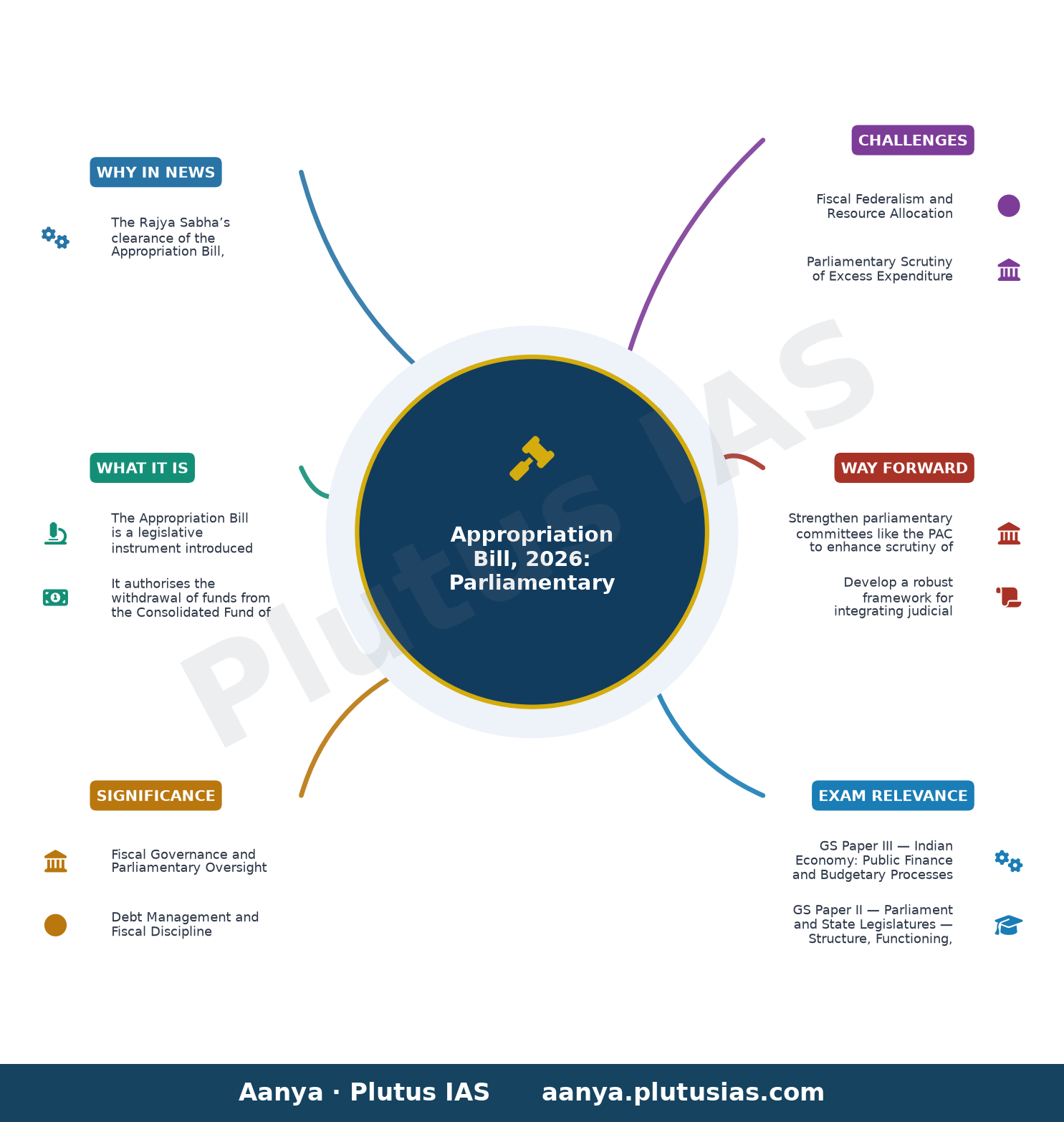
The Rajya Sabha’s clearance of the Appropriation Bill, 2026, authorising expenditure of ₹54,067 crore for the 2022-23 financial year, underscores the constitutional mechanism for parliamentary oversight of excess expenditure. The Bill’s passage amidst Opposition protests highlights procedural and political dynamics in fiscal governance, while the Finance Minister’s remarks on debt restructuring and financial support to Jammu and Kashmir provide insight into post-Article 370 fiscal federalism and debt management strategies.
Background
- The Appropriation Bill is a constitutional requirement under Article 114 of the Constitution, which mandates parliamentary approval for any excess expenditure incurred by the government beyond the amounts authorised by the original grants.
- Excess expenditure arises when the government spends more than the amount voted by Parliament during the financial year, necessitating retrospective approval through an Appropriation Bill.
- The Public Accounts Committee (PAC) examines excess expenditure and reports its findings to Parliament, as seen in the 39th Report presented to the Lok Sabha in April 2026.
- Debt restructuring and financial assistance to Union Territories like Ladakh and Jammu and Kashmir reflect the Centre’s role in ensuring fiscal stability and administrative continuity in regions undergoing constitutional and administrative transitions.
What is the Appropriation Bill?
- The Appropriation Bill is a legislative instrument introduced under Article 114 of the Constitution to seek Parliament’s approval for excess expenditure incurred by the government during a financial year.
- It authorises the withdrawal of funds from the Consolidated Fund of India (CFI) to meet expenditure that was not originally sanctioned by Parliament.
- The Bill is presented after the completion of the financial year, as excess expenditure is typically identified post facto.
- The Finance Minister’s statement in the Rajya Sabha indicated that the excess expenditure of ₹54,067 crore arose from two primary sources: a court-ordered liability of ₹196.44 crore (Ministry of Railways) and a debt repayment obligation of ₹53,871 crore.
- The Appropriation Bill is distinct from the Annual Financial Statement (Budget) and the Finance Bill; it does not propose new taxation or policy changes but merely ratifies past expenditure.
- Parliament’s approval of the Appropriation Bill is a critical step in maintaining fiscal accountability, as it ensures that the executive’s expenditure aligns with legislative intent and constitutional provisions.
- The process involves a brief discussion in both Houses of Parliament, followed by voting, before the Bill is returned to the President for assent.
- The PAC’s examination of excess expenditure provides an additional layer of scrutiny, ensuring that deviations from the approved budget are justified and accounted for.
Key Features
| Feature | Significance |
|---|---|
| Appropriation Bill, 2026 | Authorises expenditure of ₹54,067 crore incurred during 2022-23, ensuring compliance with constitutional provisions for parliamentary control over public finance. |
| Excess expenditure of ₹53,871 crore | Primarily attributed to debt repayment obligations, reflecting the Union government’s fiscal commitments and debt management strategy. |
| Excess demand of ₹196.44 crore | Arises from a court order related to the Ministry of Railways, demonstrating the impact of judicial interventions on executive expenditure. |
| Public Accounts Committee (PAC) scrutiny | The PAC’s 39th Report examined the excess demands, underscoring the role of parliamentary committees in financial oversight. |
| Union government’s financial support to Jammu and Kashmir | Covers ₹13,000 crore annually for salaries and pensions of J&K Police, ₹5,000 crore each for 2024-25 and 2025-26, and restructuring of J&K’s debt post-Article 370 abrogation. |
Why it Matters
Fiscal Governance and Parliamentary Oversight
- The Appropriation Bill exemplifies the constitutional principle of parliamentary control over public expenditure, as enshrined in Articles 112-117 of the Constitution.
- Excess expenditure necessitates post-facto parliamentary approval, reinforcing accountability in fiscal management.
- The PAC’s role in scrutinising excess demands highlights the importance of legislative oversight in financial governance.
Debt Management and Fiscal Discipline
- The ₹53,871 crore excess expenditure for debt repayment underscores the Union government’s commitment to fiscal discipline and debt sustainability.
- Debt repayment obligations reflect long-term fiscal planning and the government’s ability to meet contractual financial commitments.
- Parliament’s approval of such expenditure ensures transparency and legitimacy in debt management strategies.
Judicial Impact on Executive Expenditure
- The ₹196.44 crore excess demand due to a court order illustrates how judicial decisions can influence executive expenditure and fiscal planning.
- Parliament’s role in approving such expenditure ensures that judicial interventions are integrated into the broader fiscal framework.
- This highlights the need for executive-legislative coordination in addressing judicial directives with financial implications.
Union Government’s Financial Support to Jammu and Kashmir
- The Union government’s assumption of J&K Police salaries and pensions (₹13,000 crore annually) reflects its commitment to fiscal federalism and administrative support post-Article 370 abrogation.
- The additional ₹5,000 crore each for 2024-25 and 2025-26 demonstrates proactive financial assistance to address developmental and administrative needs.
- Debt restructuring for J&K and Ladakh underscores the Union government’s role in stabilising the fiscal health of Union Territories.
Challenges
1. Fiscal Federalism and Resource Allocation
- Balancing the financial needs of Union Territories like J&K and Ladakh with the Union government’s fiscal priorities remains a challenge.
- Ensuring equitable resource allocation while addressing historical fiscal imbalances requires careful planning and parliamentary scrutiny.
- The Union government’s assumption of state-like responsibilities (e.g., police salaries) in UTs necessitates robust fiscal frameworks.
UPSC Link: GS-II: Functions and responsibilities of the Union and the States
2. Parliamentary Scrutiny of Excess Expenditure
- Ensuring timely and thorough scrutiny of excess expenditure by parliamentary committees like the PAC is critical for fiscal accountability.
- Delays or gaps in oversight can undermine public trust in financial governance and lead to fiscal mismanagement.
- Parliament’s ability to address disruptions and ensure meaningful discussions on financial bills is a persistent challenge.
UPSC Link: GS-II: Parliament and State Legislatures
3. Judicial Interventions and Fiscal Planning
- Court orders mandating additional expenditure (e.g., ₹196.44 crore) can disrupt fiscal planning and budgetary allocations.
- The executive must proactively align its policies with judicial directives to avoid unforeseen financial burdens.
- Parliament’s role in integrating judicial decisions into fiscal frameworks ensures coherence in governance.
UPSC Link: GS-II: Judiciary and Executive Relations
4. Political Disruptions and Legislative Efficiency
- Frequent disruptions in Parliament, such as walkouts and adjournments, can delay critical financial legislation like the Appropriation Bill.
- Ensuring constructive debates and consensus-building in Parliament is essential for efficient fiscal governance.
- The Opposition’s demand for the Home Minister’s presence highlights the need for bipartisan cooperation in legislative processes.
UPSC Link: GS-II: Parliament and State Legislatures
Challenges — UPSC Perspective
| Issue | Concern |
|---|---|
| Fiscal federalism in UTs | Resource allocation and administrative support for J&K and Ladakh without compromising Union priorities. |
| Parliamentary oversight gaps | Timely and effective scrutiny of excess expenditure by committees like the PAC. |
| Judicial impact on finance | Alignment of executive policies with court orders to avoid fiscal disruptions. |
| Political disruptions | Ensuring legislative efficiency amid protests and walkouts during financial debates. |
| Debt sustainability | Balancing debt repayment obligations with developmental expenditure. |
| Equitable resource distribution | Addressing historical fiscal imbalances while supporting Union Territories. |
Way Forward
- Strengthen parliamentary committees like the PAC to enhance scrutiny of excess expenditure and ensure fiscal accountability.
- Develop a robust framework for integrating judicial decisions into fiscal planning to avoid unforeseen financial burdens.
- Promote bipartisan cooperation in Parliament to minimise disruptions and expedite critical financial legislation.
- Enhance transparency in debt management strategies to maintain fiscal discipline and public trust.
- Establish a dedicated mechanism for monitoring and addressing the fiscal needs of Union Territories like J&K and Ladakh.
- Encourage proactive fiscal planning to align executive policies with judicial directives and parliamentary expectations.
- Foster dialogue between the executive, legislature, and judiciary to streamline financial governance and reduce conflicts.
- Invest in capacity-building for parliamentary committees to improve their oversight capabilities in financial matters.
UPSC Value Addition
Keywords for Mains Answer-Writing
Appropriation Bill · Parliamentary financial control · Public Accounts Committee (PAC) · Article 114 of the Constitution · excess grant · debt repayment · Jammu and Kashmir fiscal policy · Article 370 abrogation · Union Budget · Parliamentary scrutiny of expenditure · Rajya Sabha legislative process · Fiscal federalism · Comptroller and Auditor General (CAG) · Parliamentary debates on fiscal matters · Union Finance Minister powers · Parliamentary accountability mechanisms
Constitutional & Policy Linkages
- Article 112: Annual Financial Statement (Budget)
- Article 113: Procedure in Parliament with respect to estimates
- Article 114: Appropriation Bills
- Article 115: Supplementary, additional or excess grants
- Article 116: Votes on account, votes of credit and exceptional grants
Concept Flow
Excess expenditure incurred during 2022-23 → Requires parliamentary approval via Appropriation Bill → PAC scrutinises demands → PAC’s 39th Report examines excess demands → Parliament debates and clears the Bill → Judicial orders (e.g., Railways case) add to excess expenditure → Union government provides financial support to J&K (salaries, pensions, debt restructuring) → Fiscal federalism challenges emerge → Parliamentary oversight and judicial-legislative coordination become critical → Way forward involves strengthening committees, transparency, and bipartisan cooperation.
Prelims Practice Questions
Q1. Consider the following statements regarding the Appropriation Bill in India:
1. The Appropriation Bill authorises the withdrawal of money from the Consolidated Fund of India for meeting the expenditure charged on the Fund.
2. The Appropriation Bill is introduced in the Rajya Sabha after the Finance Bill.
3. The excess grant mentioned in the Appropriation Bill is examined by the Public Accounts Committee (PAC).
How many of the above statements are correct?
- Only one
- Only two
- Only three
- None
Answer: Only three — Statement 1 is correct as the Appropriation Bill authorises withdrawal from the Consolidated Fund. Statement 2 is incorrect because the Appropriation Bill is introduced in the Lok Sabha, not the Rajya Sabha. Statement 3 is correct as the PAC examines excess grants as part of its oversight function.
Q2. Assertion (A): The Appropriation Bill is a money bill under Article 110 of the Constitution.
Reason (R): The Appropriation Bill does not require the certification of the Speaker of the Lok Sabha as a money bill.
- Both A and R are true and R is the correct explanation of A
- Both A and R are true but R is NOT the correct explanation of A
- A is true but R is false
- A is false but R is true
Answer: A is false but R is true — Assertion (A) is false because the Appropriation Bill is not a money bill; only the Finance Bill is a money bill under Article 110. Reason (R) is true as the Appropriation Bill does not require the Speaker’s certification.
Q3. Which of the following is NOT a function of the Public Accounts Committee (PAC) in India?
A. To examine the appropriation accounts of the government
B. To examine the finance accounts of the government
C. To examine the report of the Comptroller and Auditor General (CAG)
D. To approve the Appropriation Bill before it is introduced in Parliament
- A
- B
- C
- D
Answer: D — The Public Accounts Committee examines the appropriation accounts (A), finance accounts (B), and the CAG report (C), but it does NOT approve the Appropriation Bill (D). The Appropriation Bill is approved by Parliament, not the PAC.
Mains Practice Question
✍ The Rajya Sabha’s clearance of the Appropriation Bill for expenditure of ₹54,067 crore underscores the critical role of parliamentary oversight in fiscal governance. In this context, critically examine the mechanisms of parliamentary control over executive expenditure in India. Also, analyse the significance of the Public Accounts Committee (PAC) in ensuring fiscal accountability. (15 Marks)
Approach: MODEL-ANSWER SKELETON:
1. **Introduction (2 marks)**: Define the Appropriation Bill and its constitutional basis under Article 114. Highlight the role of Parliament in authorising expenditure from the Consolidated Fund of India.
2. **Mechanisms of Parliamentary Control (6 marks)**:
– **Pre-legislative Scrutiny**: Role of the Lok Sabha in introducing the Appropriation Bill and the Finance Bill; the requirement for prior parliamentary approval for withdrawal from the Consolidated Fund.
– **Post-facto Scrutiny**: Examination of excess grants and supplementary demands for grants by the PAC and the Estimates Committee.
– **Constitutional Provisions**: Article 114 (Appropriation Bills), Article 115 (Supplementary, additional, or excess grants), and Article 116 (votes on account, votes of credit, and exceptional grants).
– **Parliamentary Debates**: The role of debates in the Rajya Sabha and Lok Sabha in scrutinising expenditure, as seen in the recent clearance of the Appropriation Bill.
3. **Role of the Public Accounts Committee (PAC) (5 marks)**:
– **Composition and Functions**: Members from both Houses, chaired by an Opposition leader; examination of CAG reports, appropriation accounts, and audit objections.
– **Oversight Mechanisms**: Review of excess grants (e.g., ₹53,871 crore for debt repayment and ₹196.44 crore for a court order in the given case) and recommendations for corrective actions.
– **Accountability**: The PAC’s role in ensuring that executive actions align with parliamentary approvals and constitutional provisions.
4. **Challenges and Limitations (2 marks)**:
– **Executive Dominance**: The tendency of the executive to bypass parliamentary scrutiny through supplementary grants or excess withdrawals.
– **Delayed Scrutiny**: The PAC’s reports often come after the expenditure has already occurred, limiting its corrective impact.
– **Political Polarisation**: Instances like walkouts or adjournments in Parliament (e.g., the Opposition walkout in the Rajya Sabha) that disrupt fiscal oversight.
5. **Conclusion (2 marks)**: Summarise the importance of parliamentary control in maintaining fiscal discipline and democratic accountability. Emphasise the need for strengthening post-facto scrutiny mechanisms like the PAC to ensure transparency and efficiency in public expenditure.
Source: The Hindu
Generated by AanyaAi for educational purpose.

- मध्य प्रदेश: हाईकोर्ट ने बलात्कार मामले में आरोपी को डीएनए सबूत के आधार पर किया दोषमुक्त - September 21, 2026
- MP High Court Acquits Rape Convict Due to Negative DNA Evidence - September 21, 2026
- Odisha Launches Shree Jagannath Darshan Yojana for Senior Citizens Pilgrimage - September 21, 2026

No Comments