


07 Aug Kerala’s Rising POCSO Cases: 4,765 Reported in 2025, Highest in Thiruvananthapuram
✎ The POCSO Act, 2012, mandates child-friendly trial procedures, stringent punishments for offenders, and rehabilitation for survivors, while Kerala’s rising POCSO cases reflect improved reporting and persistent vulnerabilities in…
Subject Relevance — Where This Topic Fits
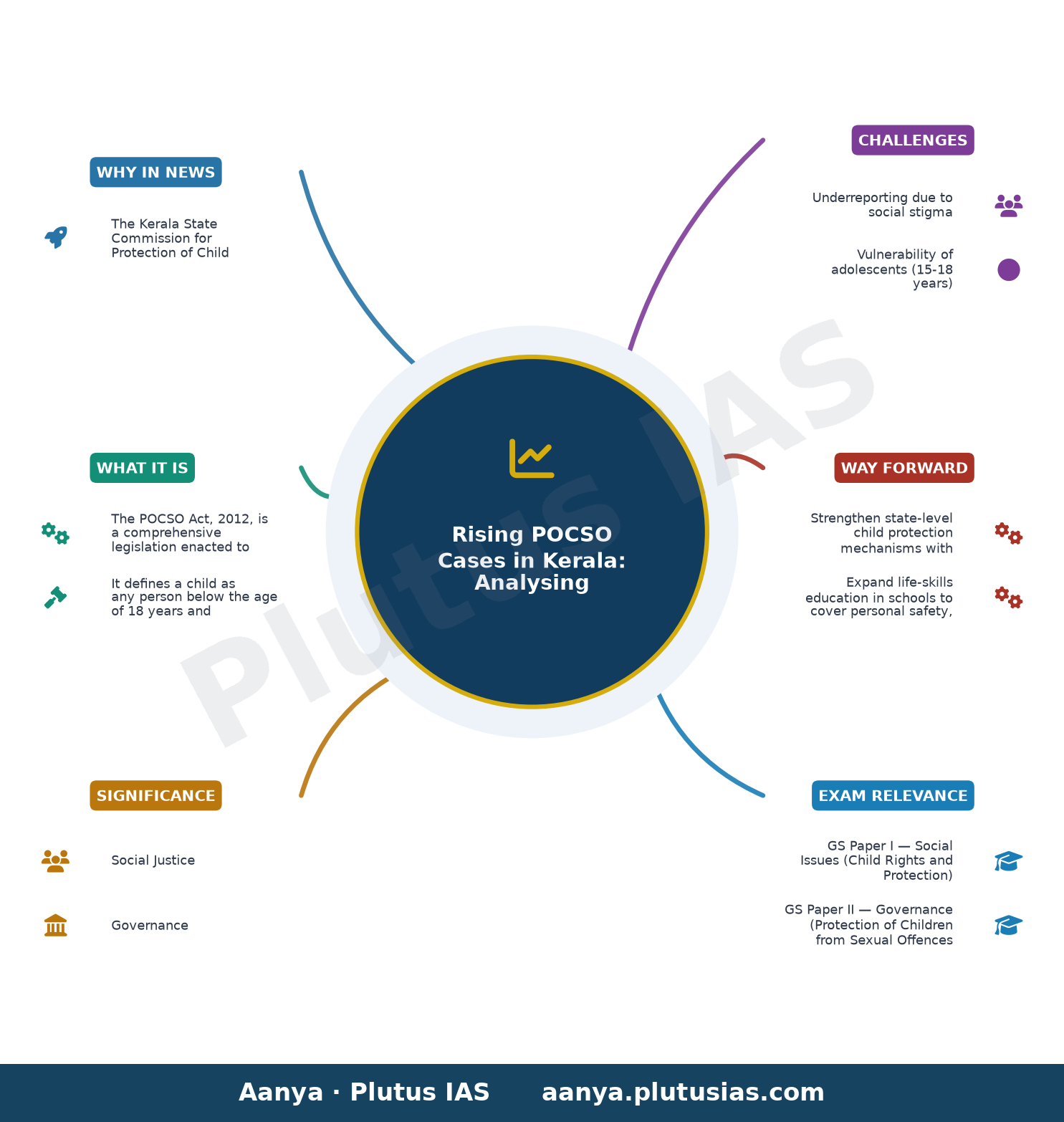
- GS Paper I — Social Issues (Child Rights and Protection) | GS Paper II — Governance (Protection of Children from Sexual Offences Act, 2012)
- Prelims: POCSO Act, 2012, Kerala State Commission for Protection of Child Rights, State Crime Records Bureau, Thiruvananthapuram district, Differently-abled children, Cyber sexual offences against minors
- Essay: The rising vulnerability of children in contemporary Indian society, Balancing child protection with societal awareness: A multi-stakeholder approach
Quick Revision: The POCSO Act, 2012, mandates child-friendly trial procedures, stringent punishments for offenders, and rehabilitation for survivors, while Kerala’s rising POCSO cases reflect improved reporting and persistent vulnerabilities in private and familiar spaces.
Why is this in the news?
The Kerala State Commission for Protection of Child Rights’ annual report for 2025-26 highlights a persistent rise in POCSO cases in Kerala, with 4,765 offences reported in 2025 compared to 4,607 in 2024. While this trend may reflect improved reporting mechanisms and reduced underreporting, it also underscores systemic vulnerabilities in child protection, particularly in familiar and private spaces. The data, released in August 2026, provides critical insights into the demographics of survivors, the nature of offences, and the socio-legal challenges in addressing child sexual abuse in the state.
Background
- The Protection of Children from Sexual Offences (POCSO) Act, 2012, was enacted to address sexual offences against persons below 18 years of age, providing stringent penalties and a child-friendly legal framework.
- Kerala established the State Commission for Protection of Child Rights in 2013 to monitor child rights violations, including those under the POCSO Act, and to recommend policy interventions.
- The State Crime Records Bureau (SCRB) data, cited in the report, serves as the primary source for tracking POCSO cases, enabling district-wise and demographic analysis.
- Kerala’s high literacy rates and robust institutional mechanisms contrast with the rising POCSO cases, suggesting that improved reporting—rather than a surge in actual crimes—may partly explain the trend.
- The vulnerability of children in private and familiar spaces (e.g., homes, relatives’ houses) highlights the need for preventive measures beyond legal frameworks, including life skill education and community awareness.
- The report’s emphasis on gender disparities (86% of survivors being girls) and age-specific vulnerabilities (55% in the 15-18 age group) aligns with national trends in child sexual abuse cases.
What is the Protection of Children from Sexual Offences (POCSO) Act, 2012?
- The POCSO Act, 2012, is a comprehensive legislation enacted to protect children from offences of sexual assault, sexual harassment, and pornography, while providing a child-friendly system for the trial of these offences.
- It defines a child as any person below the age of 18 years and criminalises penetrative and non-penetrative assault, sexual harassment, and pornographic acts involving children.
- The Act mandates the establishment of Special Courts for the speedy trial of POCSO cases, with provisions for in-camera proceedings and the use of child-friendly language in legal processes.
- It introduces the concept of ‘child-friendly procedures’ during investigation and trial, including the presence of support persons and the prohibition of confronting the child with the accused.
- The Act prescribes stringent punishments, ranging from a minimum of 2 years to life imprisonment, and even the death penalty for aggravated penetrative assault in certain cases.
- POCSO cases are cognizable and non-bailable, ensuring immediate action by law enforcement agencies upon receipt of a complaint.
- The Act also includes provisions for the rehabilitation and compensation of child survivors, with the State Government responsible for providing interim and final compensation.
- Kerala’s implementation of the POCSO Act is monitored by the State Commission for Protection of Child Rights, which conducts awareness campaigns, reviews case data, and recommends systemic reforms.
Key Features
| Feature | Significance |
|---|---|
| Rising POCSO cases in Kerala (2024-25) | Indicates improved reporting mechanisms and legal literacy, not necessarily an increase in actual crimes. |
| Highest cases in Thiruvananthapuram district | Reflects urbanisation, population density, and better access to reporting mechanisms. |
| 86% of survivors are girls | Highlights gendered vulnerability and the need for targeted protection measures. |
| 55% of survivors in 15-18 age group | Adolescents are the most vulnerable, requiring age-specific interventions. |
| Most offences in familiar/private spaces | Underscores the need for life-skills training and awareness within families. |
Why it Matters
Social Justice
- Exposes systemic gaps in child protection despite legal frameworks like POCSO Act, 2012.
- Highlights the role of social stigma in underreporting, now mitigated by awareness campaigns.
- Reinforces the need for victim-centric approaches in justice delivery.
Governance
- Demonstrates the efficacy of state-level commissions in monitoring child rights violations.
- Shows the importance of data-driven policy formulation in addressing child safety.
Human Rights
- Violations of Article 21 (Right to Life and Dignity) and Article 39(f) (Child Protection) of the Constitution.
- Emphasises the state’s obligation to ensure a safe environment for children under international conventions like the UNCRC.
Challenges
1. Underreporting due to social stigma
- Historical hesitation in reporting sexual crimes against children, now partially addressed.
- Cultural taboos and fear of social ostracisation persist, particularly in rural areas.
UPSC Link: GS2: Social Justice
2. Vulnerability of adolescents (15-18 years)
- Increased exposure to risk due to independence, peer pressure, and digital interactions.
- Lack of age-appropriate life-skills education to recognise and resist abuse.
UPSC Link: GS1: Vulnerable Sections
3. Offences in private/familiar spaces
- Majority of perpetrators are known to the child, including family members.
- Failure of guardianship roles within households and communities.
UPSC Link: GS2: Governance
4. Regional disparities in reporting
- Urban districts like Thiruvananthapuram report higher cases due to better awareness.
- Rural areas may have lower reporting due to limited access to mechanisms.
UPSC Link: GS2: Social Justice
5. Differently-abled children at higher risk
- 3% of survivors in 2025 were differently-abled, up from 2% in 2024.
- Systemic barriers in reporting and accessing justice for marginalised groups.
UPSC Link: GS1: Vulnerable Sections
Challenges — UPSC Perspective
| Issue | Concern |
|---|---|
| Social stigma | Discourages reporting, particularly in conservative communities. |
| Urban-rural divide | Limited access to reporting mechanisms in rural areas. |
| Adolescent vulnerability | Lack of tailored interventions for the 15-18 age group. |
| Private space offences | Perpetrators are often trusted individuals, complicating evidence collection. |
| Differently-abled children | Barriers in reporting and accessing justice due to communication gaps. |
| Data gaps | Unclear place of occurrence in 27% of cases hinders targeted interventions. |
Way Forward
- Strengthen state-level child protection mechanisms with real-time data integration for rapid response.
- Expand life-skills education in schools to cover personal safety, consent, and reporting mechanisms.
- Enhance awareness campaigns in rural areas to address stigma and improve reporting rates.
- Establish dedicated support centres for adolescent survivors with psychological and legal aid.
- Mandate gender-sensitive training for law enforcement and judiciary to handle POCSO cases sensitively.
- Implement community-based monitoring systems to identify and report high-risk households.
- Promote digital literacy programmes to mitigate risks in cyberspace for children.
- Conduct periodic audits of POCSO cases to identify systemic failures and corrective measures.
UPSC Value Addition
Keywords for Mains Answer-Writing
Protection of Children from Sexual Offences (POCSO) Act, 2012 · Kerala State Commission for Protection of Child Rights · Child sexual abuse in India · Gender disparity in POCSO cases · Vulnerability of children in familiar spaces · Life skills education for children · Reporting mechanisms for child abuse · Prevalence of POCSO cases in Kerala · Age-wise distribution of POCSO survivors · Differently-abled children and POCSO · Legal literacy and child rights · Role of State Crime Records Bureau
Constitutional & Policy Linkages
- Article 21 (Right to Life and Personal Liberty)
- Article 39(f) (Children’s Right to Protection)
- Article 45 (Directive Principle: Child Development)
- Article 15(3) (Special Provisions for Women and Children)
Concept Flow
Increased legal literacy and awareness → Higher reporting of POCSO cases → Data reveals systemic gaps → Identification of vulnerable groups (girls, adolescents, differently-abled) → Recognition of offences in private spaces → Need for life-skills education and victim-centric interventions → Strengthening of child protection mechanisms → Policy reforms and targeted interventions.
Prelims Practice Questions
Q1. Consider the following statements regarding the Protection of Children from Sexual Offences (POCSO) Act, 2012:
1. The Act defines a child as any person below the age of 18 years.
2. It mandates the establishment of Special Courts for the trial of offences under the Act.
3. The Act does not provide for mandatory reporting of sexual offences against children.
4. The Act includes provisions for the rehabilitation and welfare of child survivors.
How many of the above statements are correct?
- Only one
- Only two
- Only three
- All four
Answer: Only three — Statements 1, 2, and 4 are correct. Statement 3 is incorrect as the POCSO Act, 2012 mandates reporting of sexual offences against children under Section 19.
Q2. Assertion (A): The rise in reported POCSO cases in Kerala indicates a proportional increase in the incidence of child sexual abuse.
Reason (R): Improved legal literacy, awareness activities, and reduced hesitation in reporting have contributed to better reporting of POCSO cases.
Options:
A. Both A and R are true, and R is the correct explanation of A.
B. Both A and R are true, but R is not the correct explanation of A.
C. A is true, but R is false.
D. A is false, but R is true.
- A
- B
- C
- D
Answer: ? — Assertion (A) is false because the rise in reported cases is attributed to better reporting mechanisms, not necessarily an increase in actual incidents. Reason (R) is true as it correctly explains the improved reporting of cases.
Q3. Match the following districts of Kerala with the number of POCSO cases reported in 2025 as per the Kerala State Commission for Protection of Child Rights report:
Column I (District) | Column II (Number of Cases)
— | —
A. Thiruvananthapuram | 1. 502
B. Kollam | 2. 465
C. Malappuram | 3. 689
D. Kozhikode | 4. 460
Options:
A. A-3, B-1, C-2, D-4
B. A-2, B-3, C-1, D-4
C. A-3, B-2, C-4, D-1
D. A-1, B-4, C-3, D-2
- A
- B
- C
- D
Answer: A — The correct match is: A-3 (Thiruvananthapuram: 689), B-1 (Kollam: 502), C-2 (Malappuram: 465), D-4 (Kozhikode: 460).
Mains Practice Question
✍ The rising trend in reported POCSO cases in Kerala, as highlighted in the Kerala State Commission for Protection of Child Rights report, reflects both the prevalence of child sexual abuse and the effectiveness of reporting mechanisms. Critically examine the socio-legal implications of this trend, with particular reference to the POCSO Act, 2012, and the role of state institutions in addressing child sexual abuse. (15 Marks)
Approach: MODEL-ANSWER SKELETON:
1. **Introduction (2 marks)**
– Define the POCSO Act, 2012, its objectives, and key provisions (Sections 4, 6, 8, 19, 22, 33).
– Mention the rise in POCSO cases in Kerala (4,765 in 2025 vs. 4,607 in 2024) and its attribution to better reporting mechanisms.
2. **Socio-legal implications (6 marks)**
– **Prevalence vs. Reporting**: Explain that the rise does not necessarily indicate an increase in incidents but reflects improved awareness, legal literacy, and reduced stigma (cite Kerala State Commission for Protection of Child Rights report).
– **Gender Disparity**: Highlight the over-representation of girls (86% of survivors) and its socio-cultural roots (patriarchal norms, vulnerability of adolescent girls).
– **Age-wise Vulnerability**: Emphasise the high vulnerability of children aged 15-18 (55% of survivors) and the need for age-specific interventions.
– **Offender Proximity**: Discuss the prevalence of offences in familiar spaces (22% in survivors’ homes, 13% in offenders’ homes) and the role of life skills education in preventing abuse.
3. **Role of State Institutions (5 marks)**
– **Kerala State Commission for Protection of Child Rights**: Discuss its mandate, functions, and recommendations (e.g., strengthening reporting mechanisms, awareness campaigns).
– **State Crime Records Bureau**: Highlight its role in data collection, analysis, and dissemination to inform policy.
– **Judicial and Executive Measures**: Mention the establishment of Special Courts under the POCSO Act, fast-track trials, and rehabilitation schemes (e.g., ‘One Stop Centres’, ‘Childline 1098’).
– **Challenges**: Discuss systemic issues such as underreporting in rural areas, delays in trials, and lack of child-friendly infrastructure in courts.
4. **Conclusion (2 marks)**
– Summarise the dual narrative: rising reports as a sign of progress in reporting mechanisms and the persistent challenge of child sexual abuse.
– Suggest a multi-pronged approach: strengthening legal literacy, life skills education, community engagement, and institutional capacity-building.
Source: The Hindu
Generated by AanyaAi for educational purpose.

- विदेश मंत्री जयशंकर की यूरोप के चार विदेश मंत्रियों से द्विपक्षीय वार्ता, भारत-ईयू एफटीए पर चर्चा - September 24, 2026
- मद्रास उच्च न्यायालय ने अनामलाई के खिलाफ मामले को रद्द किया: राजनीतिक टिप्पणियों पर न्यायिक फैसला - September 24, 2026
- Madras HC quashes case against Annamalai over Thevar remarks: UPSC Polity Analysis - September 24, 2026

No Comments