


07 Aug Kashmiri Pandits Rehabilitation Bill 2025: Key Features & UPSC Perspective
✎ The Kashmiri Pandits Rehabilitation Bill, 2025, is a private member’s initiative seeking to provide a legal framework for the restitution, rehabilitation, and resettlement of displaced Kashmiri Pandits, addressing property…
Subject Relevance — Where This Topic Fits
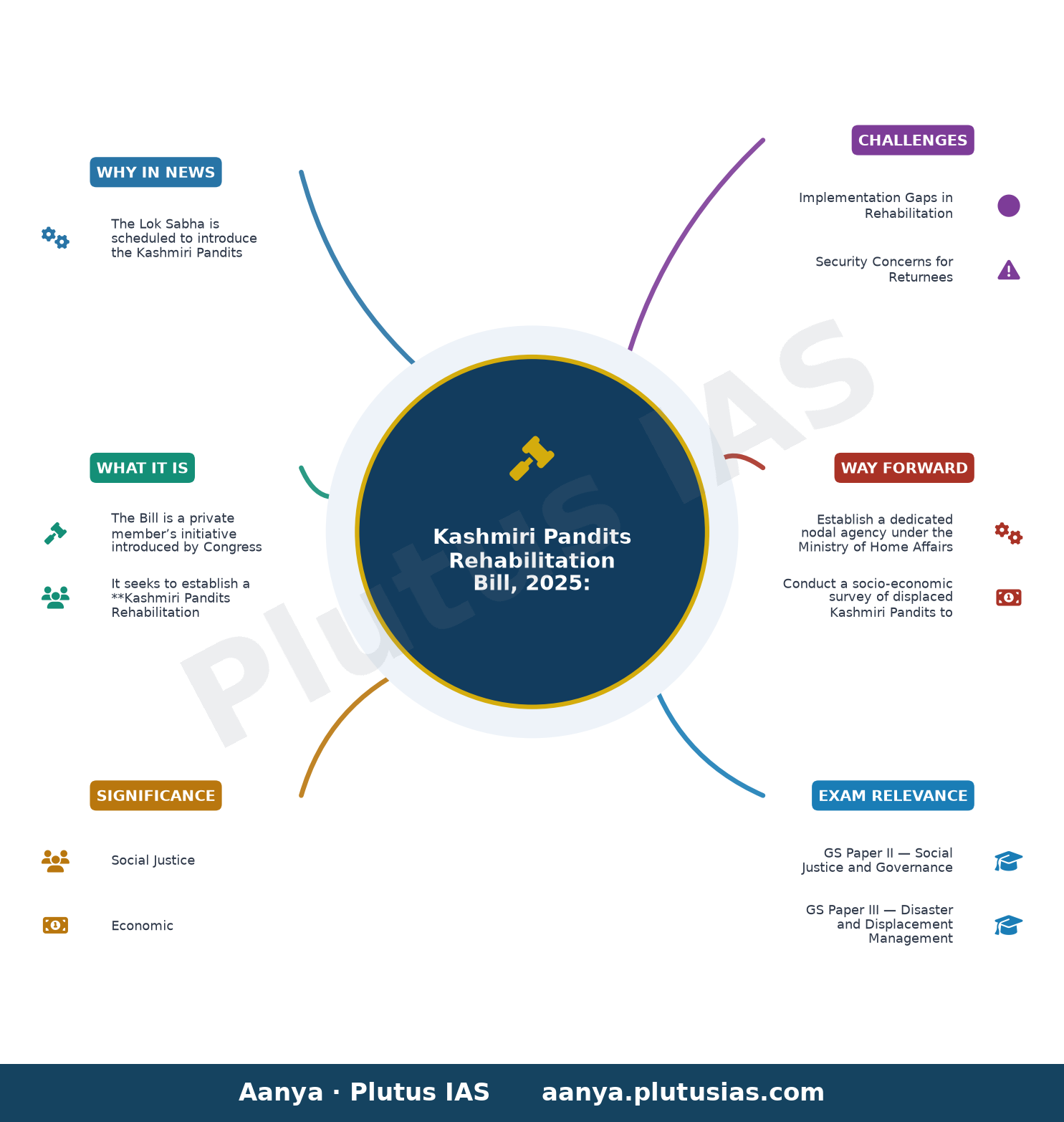
- GS Paper II — Social Justice and Governance | GS Paper III — Disaster and Displacement Management
- Prelims: Article 370, Displacement and Rehabilitation Policy, Right to Return, Jammu and Kashmir Reorganisation Act 2019, Fundamental Rights (Articles 14, 19, 21)
- Essay: Ethics of restitution in post-conflict societies: lessons from Kashmiri Pandits, The role of constitutional guarantees in protecting minority rights in India
Quick Revision: The Kashmiri Pandits Rehabilitation Bill, 2025, is a private member’s initiative seeking to provide a legal framework for the restitution, rehabilitation, and resettlement of displaced Kashmiri Pandits, addressing property rights, livelihood restoration, cultural preservation, and safety guarantees.
Why is this in the news?
The Lok Sabha is scheduled to introduce the Kashmiri Pandits (Recourse, Restitution, Rehabilitation and Resettlement) Bill, 2025, on Day 14 of the Monsoon Session, 2026. The Bill seeks to provide a legal framework for the rehabilitation of displaced Kashmiri Pandits, addressing their social, political, economic, and cultural rights, and ensuring their safe return to the Valley. This legislative initiative assumes significance against the backdrop of prolonged displacement spanning over three decades, compounded by recent political and security developments in Jammu and Kashmir.
Background
- Kashmiri Pandits, a Hindu minority community in the Kashmir Valley, faced mass exodus in 1989–1990 due to targeted violence, insurgency, and political instability, leading to the displacement of approximately 3.5 lakh individuals.
- The Jammu and Kashmir Reorganisation Act, 2019, bifurcated the erstwhile state into two Union Territories—Jammu and Kashmir, and Ladakh—altering the constitutional and administrative landscape for the displaced community.
- Successive governments have implemented rehabilitation schemes, including the Prime Minister’s Reconstruction Plan (2008) and the Prime Minister’s Development Package (2015), but challenges persist in ensuring sustainable return, security, and livelihood restoration.
- The Bill aligns with India’s obligations under international law, including the United Nations Guiding Principles on Internal Displacement (1998), which emphasize restitution, compensation, and return for internally displaced persons.
- Recent protests in Parliament over the NEET paper leak and the Ram Mandir donation controversy have overshadowed legislative discussions, yet the introduction of this Bill signals renewed focus on minority rights and restitution.
What is the Kashmiri Pandits (Recourse, Restitution, Rehabilitation and Resettlement) Bill, 2025?
- The Bill is a private member’s initiative introduced by Congress MP Shashi Tharoor, aiming to provide a comprehensive legal framework for the rehabilitation of displaced Kashmiri Pandits.
- It seeks to establish a **Kashmiri Pandits Rehabilitation Authority** to oversee the implementation of rehabilitation measures, including housing, employment, education, and healthcare.
- The Bill mandates the **restoration of property rights** for displaced Kashmiri Pandits, including land, homes, and businesses, with provisions for legal recourse in case of encroachment or denial of access.
- It proposes a **rehabilitation package** comprising financial assistance, skill development, and livelihood support to facilitate sustainable return and integration into the Valley.
- The Bill emphasizes **cultural preservation**, including the restoration of temples, shrines, and traditional institutions, and the promotion of Kashmiri Pandit heritage and identity.
- It includes **safety and security guarantees**, such as police protection, anti-terrorism measures, and legal safeguards against harassment or intimidation upon return.
- The Bill aligns with constitutional principles of **equality (Article 14)**, **freedom of movement (Article 19)**, and **right to life and dignity (Article 21)**, ensuring non-discrimination and protection of minority rights.
- It draws from precedents such as the **Punjab Rehabilitation of Refugees Act, 1948**, and the **Assam (Protection of Rights of Indigenous People) Act, 2005**, which address displacement and restitution.
Key Features
| Feature | Significance |
|---|---|
| Kashmiri Pandits (Recourse, Restitution, Rehabilitation and Resettlement) Bill, 2025 | Seeks to provide a statutory framework for the comprehensive rehabilitation of displaced Kashmiri Pandits, addressing their socio-economic, cultural, and security concerns. |
| Protection of Property Rights | Includes provisions for the restoration and protection of immovable and movable properties of displaced Kashmiri Pandits, ensuring legal recourse against encroachments. |
| Rehabilitation Package | Proposes financial and non-financial assistance to facilitate resettlement, including housing, employment, and educational support for returnees. |
| Cultural Heritage Restoration | Aims to revive and safeguard the cultural and religious heritage of Kashmiri Pandits, including temples, manuscripts, and traditions. |
| Fishermen (Protection and Welfare) Bill, 2024 | Introduces institutional mechanisms (Fishermen Welfare Board and Fund) to address the vulnerabilities of coastal fishing communities. |
Why it Matters
Social Justice
- Addresses historical injustices faced by Kashmiri Pandits, ensuring their right to return and live with dignity in their ancestral homeland.
- Highlights the state’s obligation under Article 21 to provide a safe and secure environment for all citizens, including minorities.
- Emphasises the need for inclusive governance and reconciliation in conflict-affected regions.
Economic
- Rehabilitation packages can stimulate local economies in Jammu & Kashmir by reviving traditional occupations and promoting tourism.
- Fishermen Welfare Bill seeks to mitigate economic losses due to overfishing, climate change, and regulatory challenges in coastal states.
- MSME Amendment Bill aims to enhance the competitiveness of small-scale industries, fostering job creation and industrial growth.
Political
- Demonstrates Parliament’s commitment to addressing minority rights and regional grievances, reinforcing democratic pluralism.
- The introduction of the Kashmiri Pandits Bill by a Congress MP underscores bipartisan consensus on the issue, despite political differences.
- Protests over police action and Ram Mandir donations reflect broader concerns about institutional accountability and governance.
Legal
- Provides a legal framework to operationalise the Jammu & Kashmir Reorganisation Act, 2019, and its provisions for displaced persons.
- The Fishermen Welfare Bill aligns with the constitutional directive under Article 48 to protect and improve livestock and fisheries.
Challenges
1. Implementation Gaps in Rehabilitation
- Historical displacement of Kashmiri Pandits (1989–1990s) requires long-term commitment beyond legislative intent.
- Land disputes and encroachments may hinder property restoration efforts despite legal provisions.
- Lack of a centralised database of displaced families complicates targeted rehabilitation.
UPSC Link: GS2: Welfare schemes for vulnerable sections
2. Security Concerns for Returnees
- Continued militancy and targeted attacks in Jammu & Kashmir pose risks to the safe return of Kashmiri Pandits.
- Inadequate protection mechanisms may deter potential returnees, undermining the Bill’s objectives.
- Community trust-building measures are essential to ensure voluntary resettlement.
UPSC Link: GS3: Internal security challenges
3. Economic Viability of Fisheries Sector
- Overfishing, climate change, and regulatory non-compliance threaten the sustainability of coastal fisheries.
- Lack of access to credit and modern technology limits the competitiveness of small-scale fishermen.
- Fishermen Welfare Fund may face funding constraints without robust public-private partnerships.
UPSC Link: GS3: Food security and agriculture
4. Political Polarisation and Governance
- Opposition protests over NEET paper leak and Ram Mandir donations reflect deep societal divisions and trust deficits in institutions.
- Parliamentary disruptions hinder legislative productivity, delaying critical bills like the FCRA Amendment Bill.
- Need for consensus-building mechanisms to address contentious issues without undermining democratic processes.
UPSC Link: GS2: Parliament and State Legislatures
5. Legal Ambiguities in FCRA Amendments
- Proposed amendments to the Foreign Contribution (Regulation) Act, 2010, may impact NGOs and civil society organisations working in conflict zones.
- Concerns over transparency and accountability in foreign funding could stifle grassroots initiatives for minority welfare.
- Lack of clarity on exemptions for humanitarian and developmental activities.
UPSC Link: GS2: Role of civil society
Challenges — UPSC Perspective
| Issue | Concern |
|---|---|
| Land and Property Disputes | Legal and administrative hurdles in restoring properties to displaced Kashmiri Pandits. |
| Security Vacuum in J&K | Persistent militancy and inadequate protection mechanisms for returnees. |
| Funding for Rehabilitation | Sustainable financing for long-term resettlement and welfare packages. |
| Fisheries Sector Decline | Overfishing, climate change, and lack of modernisation in coastal states. |
| Parliamentary Disruptions | Ongoing protests and adjournments delaying legislative business. |
| FCRA Amendment Impact | Potential restrictions on NGOs and civil society affecting minority welfare initiatives. |
Way Forward
- Establish a dedicated nodal agency under the Ministry of Home Affairs to oversee the implementation of the Kashmiri Pandits Rehabilitation Bill, with periodic review mechanisms.
- Conduct a socio-economic survey of displaced Kashmiri Pandits to create a centralised database for targeted rehabilitation.
- Strengthen security infrastructure in vulnerable districts of Jammu & Kashmir to ensure safe return and resettlement of Kashmiri Pandits.
- Introduce a time-bound grievance redressal mechanism for property disputes, with fast-track courts for resolution.
- Formulate a National Fisheries Policy to address overfishing, climate resilience, and market access for small-scale fishermen.
- Enhance transparency in FCRA compliance by mandating digital tracking of foreign contributions and exemptions for humanitarian activities.
- Promote bipartisan dialogue in Parliament to minimise disruptions and expedite the passage of pending bills.
- Leverage corporate social responsibility (CSR) funds for rehabilitation and welfare initiatives in conflict-affected regions.
UPSC Value Addition
Keywords for Mains Answer-Writing
Kashmiri Pandits Rehabilitation Bill 2025 · Article 370 abrogation · Internal displacement in India · Restitution and rehabilitation framework · Ministry of Home Affairs · Jammu and Kashmir Reorganisation Act 2019 · Right to life and dignity (Article 21) · Union Territories (UTs) administration · Cultural heritage preservation · Social security measures for displaced communities · Parliamentary procedures for private members’ bills · Role of Opposition in legislative process · Disaster Management Act 2005 · National Commission for Minorities
Constitutional & Policy Linkages
- {‘Article 14’: ‘Equality before law and equal protection of laws.’}
- {‘Article 15’: ‘Prohibition of discrimination on grounds of religion, race, caste, sex, or place of birth.’}
- {‘Article 21’: ‘Protection of life and personal liberty, including the right to live with dignity.’}
- {‘Article 29’: ‘Protection of interests of minorities and their right to conserve distinct culture.’}
- {‘Article 30’: ‘Right of minorities to establish and administer educational institutions.’}
Concept Flow
Displacement of Kashmiri Pandits (1989–1990s) → Constitutional obligation to protect minority rights (Articles 14, 15, 21, 29, 30) → Legislative response via Kashmiri Pandits Rehabilitation Bill, 2025 → Implementation challenges (security, property disputes, funding) → Need for institutional mechanisms (nodal agency, grievance redressal) → Long-term reconciliation and inclusive governance. → Overfishing and climate change in coastal states → Economic vulnerabilities of fishermen → Fishermen (Protection and Welfare) Bill, 2024 → Institutional support via Fishermen Welfare Board and Fund → Challenges in funding and modernisation → Policy interventions (National Fisheries Policy, CSR funding). → Parliamentary disruptions during Monsoon Session → Delay in legislative business (FCRA Amendment Bill, MSME Amendment Bill) → Impact on governance and economic reforms → Need for consensus-building and transparency.
Prelims Practice Questions
Q1. Consider the following statements regarding the Kashmiri Pandits Rehabilitation Bill, 2025:
1. The Bill seeks to provide social, political, and economic rehabilitation of Kashmiri Pandits.
2. It mandates the restoration of cultural heritage and protection of property rights.
3. The Bill proposes the creation of a Rehabilitation Commission under the Ministry of Culture.
4. It includes provisions for safety and security measures for the community.
How many of the above statements are correct?
- Only one
- Only two
- Only three
- All four
Answer: Only three — Statements 1, 2, and 4 are correct as per the Bill’s stated objectives. Statement 3 is incorrect as the Bill does not explicitly mention a Rehabilitation Commission under the Ministry of Culture.
Q2. Assertion (A): The Jammu and Kashmir Reorganisation Act, 2019, facilitated the abrogation of Article 370 and paved the way for the integration of Jammu and Kashmir as a Union Territory.
Reason (R): Article 370 granted special autonomous status to Jammu and Kashmir, which was revoked through a Presidential Order under Article 370(3).
- Both A and R are true, and R is the correct explanation of A
- Both A and R are true, but R is not the correct explanation of A
- A is true, but R is false
- A is false, but R is true
Answer: Both A and R are true, and R is the correct explanation of A — Assertion (A) is correct as the Act reorganisation J&K into two UTs. Reason (R) is also correct and directly explains the assertion, as Article 370(3) provided the constitutional pathway for its abrogation.
Q3. Which of the following is NOT a provision typically associated with the rehabilitation of internally displaced persons (IDPs) in India?
- Compensation for loss of property
- Provision of alternative housing
- Restoration of civil and political rights
- Mandatory military conscription for displaced youth
Answer: Mandatory military conscription for displaced youth — Mandatory military conscription is not a provision associated with IDP rehabilitation frameworks in India. The other options are standard measures in such policies.
Mains Practice Question
✍ The Kashmiri Pandits Rehabilitation Bill, 2025, seeks to address the long-standing issue of internal displacement of the community. Critically examine the constitutional and legislative framework governing the rehabilitation of internally displaced persons (IDPs) in India. Also, assess the efficacy of such measures in ensuring durable solutions for IDPs, with reference to the challenges faced by Kashmiri Pandits. (15 Marks)
Approach: MODEL-ANSWER SKELETON:
1. **Constitutional Framework**:
– Article 21 (Right to life and dignity) as the foundational basis for rehabilitation.
– Directive Principles of State Policy (DPSP) under Articles 38, 39, and 41 for securing welfare and social justice.
– Role of the Supreme Court in interpreting Article 21 to include rehabilitation (e.g., *Olga Tellis v. Bombay Municipal Corporation*).
2. **Legislative Framework**:
– National Disaster Management Act, 2005: Provides for relief and rehabilitation in disaster-induced displacement.
– Right to Fair Compensation and Transparency in Land Acquisition, Rehabilitation and Resettlement Act, 2013: Applicable to displacement caused by land acquisition.
– Specific schemes for Kashmiri Pandits: Prime Minister’s Package for Return and Rehabilitation of Kashmiri Migrants (2008, 2015) and the current Bill’s provisions.
3. **Challenges in Implementation**:
– **Legal Gaps**: Absence of a comprehensive national IDP policy; reliance on ad-hoc schemes.
– **Socio-Economic Barriers**: Lack of livelihood opportunities, security concerns, and property disputes in Kashmir.
– **Bureaucratic Hurdles**: Delayed disbursal of compensation, inadequate monitoring of rehabilitation schemes.
– **Political and Administrative Challenges**: Overlapping jurisdictions between Centre, UT administration, and local bodies.
4. **Efficacy of Measures for Kashmiri Pandits**:
– **Successes**: Financial assistance, employment quotas, and housing schemes have enabled some returns.
– **Failures**: Persistent security threats, lack of political will for sustained rehabilitation, and inadequate restoration of cultural heritage.
– **Comparative Insight**: Lessons from international frameworks (e.g., UN Guiding Principles on Internal Displacement) and India’s obligations under international law.
5. **Way Forward**:
– Enactment of a National Rehabilitation Policy for IDPs.
– Strengthening institutional mechanisms (e.g., a dedicated Rehabilitation Commission).
– Ensuring participatory planning with affected communities.
– Addressing root causes of displacement (e.g., conflict resolution in Kashmir).
Source: The Indian Express
Generated by AanyaAi for educational purpose.

- किशाऊ परियोजना विवाद: पंजाब सुप्रीम कोर्ट पहुंचेगा, जानें पूरा मामला - September 22, 2026
- Punjab to Challenge Kishau Project in Supreme Court: Key Polity & Governance Issue for UPSC - September 22, 2026
- दिल्ली हाईकोर्ट ने बदले ‘वरिष्ठ अधिवक्ता’ के नियम, 100-प्वाइंट प्रणाली हुई खत्म - September 22, 2026

No Comments