


07 Aug Congress Whip on FCRA Bill: Key Polity Updates for UPSC & State PCS Aspirants
✎ The FCRA (Amendment) Bill, 2026, is poised to further regulate foreign contributions in India, with the Congress party opposing it on grounds of potential curtailment of civil society freedoms; parliamentary whips ensure party…
Subject Relevance — Where This Topic Fits
- GS Paper II — Polity and Governance (Parliamentary Procedures, Whips, Opposition Strategies) | GS Paper III — Economy (Foreign Contributions, NGO Regulations, Economic Impact of CSR)
- Prelims: Foreign Contribution (Regulation) Act, 2010, FCRA Amendment Bill, 2026, Parliamentary Whip, Monsoon Session of Parliament, INDIA bloc, Constitution (Amendment) Bill on Delimitation
- Essay: The role of parliamentary opposition in a vibrant democracy: A case study of the FCRA Amendment Bill, 2026, Balancing national security and civil liberties: The ethical dilemma of regulating foreign contributions in India
Quick Revision: The FCRA (Amendment) Bill, 2026, is poised to further regulate foreign contributions in India, with the Congress party opposing it on grounds of potential curtailment of civil society freedoms; parliamentary whips ensure party discipline during legislative discussions.
Why is this in the news?
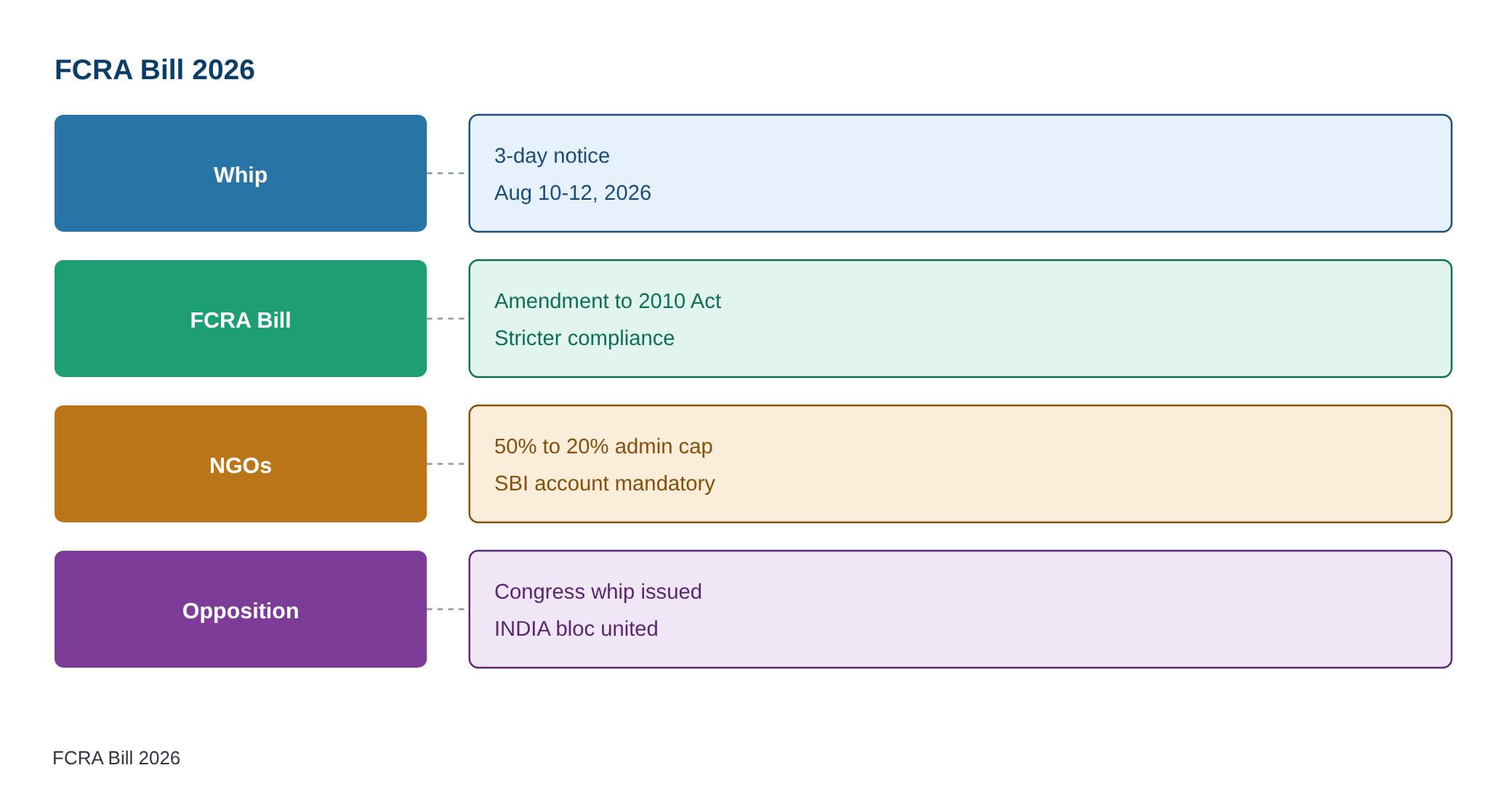
The Congress party has issued a three-day whip to its Members of Parliament (MPs) in both the Rajya Sabha and Lok Sabha, directing them to attend sessions on August 10, 11, and 12, 2026, ahead of the discussion on the Foreign Contribution (Regulation) Amendment (FCRA) Bill, 2026. This legislative move has drawn significant attention due to its potential implications for non-governmental organisations (NGOs), civil society, and India’s international commitments on foreign funding. The timing coincides with broader parliamentary discussions, including the possible reintroduction of the Constitution (Amendment) Bill on delimitation, further amplifying the political significance of the session.
Background
- The Foreign Contribution (Regulation) Act (FCRA), enacted in 2010, regulates the receipt and utilisation of foreign contributions by individuals, associations, and companies in India. It aims to ensure that such contributions do not adversely affect the sovereignty, integrity, or security of the nation.
- The FCRA was amended in 2020, introducing stricter provisions such as reducing the administrative expenses limit for NGOs from 50% to 20% of total foreign contributions, mandatory opening of FCRA accounts in the State Bank of India (SBI), Delhi, and enhanced scrutiny of NGOs receiving foreign funds.
- The 2020 amendments faced criticism from civil society organisations, who argued that the provisions were overly restrictive and could stifle legitimate humanitarian and developmental work.
- The Congress party’s issuance of a whip reflects its strategic opposition to the Bill, aligning with its broader stance on civil liberties and governance. The INDIA bloc, an opposition coalition, has also been urged to ensure its MPs’ presence, indicating a united front against the Bill.
- Parliamentary whips are formal directives issued by political parties to ensure discipline among their MPs, particularly during crucial votes or discussions. Non-compliance with a whip can lead to disciplinary action, including expulsion from the party.
What is the Foreign Contribution (Regulation) Act (FCRA)?
- The FCRA, enacted in 2010 and amended in 2020, is a regulatory framework governing the receipt and utilisation of foreign contributions by individuals, associations, and companies in India.
- The Act defines ‘foreign contribution’ as any donation, subscription, or transfer of funds from a foreign source, including donations from foreign companies, trusts, or individuals.
- Key objectives of the FCRA include preventing foreign interference in India’s internal affairs, ensuring transparency in the utilisation of foreign funds, and safeguarding national security.
- The Act mandates NGOs and other entities receiving foreign contributions to register with the Ministry of Home Affairs (MHA) and obtain prior permission for receiving such funds.
- Registered entities must utilise foreign contributions exclusively for the purposes for which they were received and are prohibited from transferring funds to other organisations without prior approval.
- The FCRA also imposes restrictions on the use of foreign contributions for activities deemed detrimental to public interest, such as religious conversion or political activities.
- The 2020 amendments introduced several changes, including a cap on administrative expenses (20% of total foreign contributions), mandatory opening of FCRA accounts in SBI, Delhi, and enhanced scrutiny of NGOs.
- Violations of the FCRA can result in penalties, including cancellation of registration, fines, or even imprisonment, as outlined in Section 37 of the Act.
Key Features
| Feature | Significance |
|---|---|
| Issue of a whip by the Congress party | Ensures party discipline and collective voting behaviour among Congress MPs during the Monsoon Session of Parliament, particularly on contentious legislative items such as the FCRA Amendment Bill. |
| Timing of the whip (August 10–12, 2026) | Aligns with the scheduled discussion of the FCRA Amendment Bill in both Houses of Parliament, indicating the party’s prioritisation of the issue and strategic preparation for legislative scrutiny. |
| Coordination with INDIA bloc allies | Demonstrates inter-party consensus-building within the opposition alliance, enhancing the collective bargaining power against government legislative proposals. |
| Absence of FCRA Bill in government’s tentative business list | Highlights potential procedural ambiguity or strategic delay by the government in formally announcing the Bill’s consideration, prompting opposition to preemptively mobilise. |
| Role of the Chief Whip (Jairam Ramesh) | Central to enforcing party discipline and ensuring MPs’ presence and participation in legislative proceedings, which is critical for opposition effectiveness. |
Why it Matters
Legislative Process
- The FCRA Amendment Bill, if passed, would amend the Foreign Contribution (Regulation) Act, 2010, which regulates the receipt and utilisation of foreign contributions by individuals, associations, and companies in India.
- The Bill is likely to introduce stricter compliance requirements, reduce administrative discretion, and potentially impact the operational freedom of non-governmental organisations (NGOs) and civil society organisations.
- The opposition’s whip reflects the Bill’s contentious nature and the perceived risks to democratic pluralism and civil society engagement in policy discourse.
Political Strategy
- The Congress party’s proactive stance, including coordination with allies, underscores the opposition’s attempt to project a united front against the government’s legislative agenda.
- The timing of the whip issuance suggests a tactical move to counter the government’s potential procedural advantages in Parliament, particularly in the Rajya Sabha where the opposition holds significant influence.
- The absence of the FCRA Bill in the government’s tentative business list may indicate either a deliberate delay or a lack of consensus within the ruling dispensation on the Bill’s immediate prioritisation.
Civil Society and Governance
- The FCRA Amendment Bill is a critical governance instrument that balances national security concerns with the need to preserve the autonomy of civil society organisations.
- Stricter FCRA regulations could impact the funding and operational capacity of NGOs, particularly those engaged in advocacy, human rights, and grassroots development work.
- The Bill’s discussion in Parliament highlights the tension between regulatory oversight and the preservation of democratic freedoms, a recurring theme in India’s governance discourse.
Parliamentary Dynamics
- The Monsoon Session of Parliament is a key legislative calendar event where major Bills and policy discussions are scheduled, making it a focal point for political contestation.
- The opposition’s whip issuance reflects the institutional role of party whips in maintaining legislative discipline and ensuring MPs’ participation in critical debates.
- The procedural ambiguity surrounding the FCRA Bill’s inclusion in the business list underscores the complexities of parliamentary governance and the interplay between government and opposition.
Challenges
1. Regulatory Overreach vs. Civil Society Autonomy
- The FCRA Amendment Bill risks imposing excessive regulatory burdens on NGOs, potentially stifling their ability to function effectively and engage in advocacy.
- Balancing national security concerns with the need to preserve democratic freedoms remains a persistent challenge in India’s regulatory framework.
- The Bill’s provisions may inadvertently criminalise legitimate civil society activities, leading to a chilling effect on advocacy and public interest litigation.
UPSC Link: GS-II: Role of Civil Society in Governance
2. Parliamentary Disruptions and Legislative Gridlock
- Frequent disruptions in Parliament, driven by opposition protests or procedural disputes, can delay critical legislative agendas and undermine governance efficiency.
- The absence of the FCRA Bill in the government’s tentative business list may signal procedural delays or strategic hesitation, complicating the legislative process.
- Opposition unity, while strategically advantageous, may also lead to prolonged debates and legislative stagnation, particularly on contentious Bills.
UPSC Link: GS-II: Parliament and State Legislatures
3. Coordination Challenges within Opposition Alliances
- Maintaining cohesion within opposition alliances, such as the INDIA bloc, is challenging due to diverse political ideologies and strategic priorities.
- Differences in approach to legislative opposition may weaken the collective bargaining power of the opposition, particularly on Bills like the FCRA Amendment.
- Ensuring disciplined voting behaviour across allies requires robust coordination mechanisms, which can be resource-intensive and politically sensitive.
UPSC Link: GS-II: Pressure Groups and Formal/Informal Associations
4. Procedural Ambiguities in Legislative Business
- The lack of clarity in the government’s tentative business list regarding the FCRA Amendment Bill raises questions about the Bill’s legislative trajectory and potential delays.
- Parliamentary procedures, including the listing of Bills for discussion, are often subject to political negotiations, which can lead to procedural ambiguities.
- Such ambiguities may erode public trust in the legislative process and undermine the transparency of governance.
UPSC Link: GS-II: Salient Features of the Representation of People’s Act
5. Balancing Security and Democratic Freedoms
- The FCRA Amendment Bill must strike a delicate balance between national security imperatives and the preservation of democratic freedoms, including the right to association and expression.
- Overly restrictive provisions may violate constitutional guarantees under Article 19(1)(c) (right to form associations) and Article 19(1)(g) (right to practise any profession or carry on any occupation).
- The Bill’s provisions must be tested against judicial precedents to ensure they do not infringe upon fundamental rights.
UPSC Link: GS-II: Fundamental Rights
Challenges — UPSC Perspective
| Issue | Concern |
|---|---|
| Regulatory Overreach | Risk of excessive restrictions on NGOs, stifling civil society engagement in governance. |
| Parliamentary Disruptions | Potential delays in legislative agendas due to opposition protests or procedural disputes. |
| Opposition Cohesion | Difficulty in maintaining unity within opposition alliances like the INDIA bloc on contentious Bills. |
| Procedural Ambiguities | Lack of clarity in the government’s business list may lead to legislative delays or strategic hesitations. |
| Security vs. Freedom | Balancing national security concerns with democratic freedoms remains a persistent challenge. |
Way Forward
- Parliament must ensure transparent and timely listing of Bills in the business agenda to avoid procedural ambiguities.
- The opposition should prioritise constructive engagement over disruptions, leveraging parliamentary forums for robust debate.
- Civil society organisations must proactively engage with policymakers to highlight the potential impact of the FCRA Amendment Bill on their operations.
- The government should conduct wide-ranging consultations with stakeholders, including NGOs, to address concerns and refine the Bill’s provisions.
- Parliamentary committees should be tasked with scrutinising the FCRA Amendment Bill to ensure it aligns with constitutional guarantees and democratic principles.
- Political parties must strengthen intra-alliance coordination mechanisms to present a united front against legislative gridlock.
- Judicial review should be encouraged to test the constitutionality of the FCRA Amendment Bill, particularly its provisions on civil society autonomy.
UPSC Value Addition
Keywords for Mains Answer-Writing
Foreign Contribution (Regulation) Act, 2010 · FCRA Amendment Bill · Parliamentary whip · Monsoon Session 2026 · India bloc · Constitution Amendment Bill on delimitation · Parliamentary procedures · Money Bills and financial legislation · Role of opposition in legislative scrutiny · Executive-legislature relations
Constitutional & Policy Linkages
- [‘Article 19(1)(c): Right to form associations’, ‘Core constitutional guarantee potentially impacted by FCRA regulations.’]
- [‘Article 19(1)(g): Right to practise any profession’, “Relevant to NGOs’ operational freedom under FCRA.”]
- [‘Article 21: Protection of life and personal liberty’, ‘May be invoked if FCRA provisions lead to arbitrary restrictions.’]
- [‘Article 14: Equality before law’, ‘Ensures non-discriminatory application of FCRA regulations.’]
Concept Flow
Government introduces FCRA Amendment Bill to Parliament → → Opposition perceives Bill as restrictive to civil society → → Congress issues whip to MPs to ensure disciplined participation → → Coordination with INDIA bloc allies to present united opposition → → Government’s tentative business list omits FCRA Bill → → Opposition mobilises to counter procedural ambiguity → → Parliamentary debate ensues, with potential judicial review of Bill’s provisions.
Prelims Practice Questions
Q1. Consider the following statements regarding the Foreign Contribution (Regulation) Act, 2010 (FCRA):
1. The Act regulates the acceptance and utilisation of foreign contributions by individuals, associations, and companies.
2. The Act empowers the government to prohibit foreign contributions if they are detrimental to the sovereignty and integrity of India.
3. The Act mandates that foreign contributions must be received only through designated banks and accounts.
4. The Act allows political parties to accept foreign contributions without any restrictions.
How many of the above statements are correct?
- Only one
- Only two
- Only three
- All four
Answer: Only three — Statements 1, 2, and 3 are correct as per the FCRA, 2010. Statement 4 is incorrect because political parties are explicitly prohibited from accepting foreign contributions under Section 3(1)(c) of the Act.
Q2. Assertion (A): The issuance of a whip by a political party in Parliament is a directive to its members to vote in a particular manner on a matter before the House.
Reason (R): The Constitution of India explicitly empowers the Speaker of the Lok Sabha to issue whips to Members of Parliament.
Options:
A. Both A and R are true, and R is the correct explanation of A.
B. Both A and R are true, but R is not the correct explanation of A.
C. A is true, but R is false.
D. A is false, but R is true.
Answer: ? — Assertion (A) is true as whips are issued to ensure party discipline. Reason (R) is false because the Constitution does not empower the Speaker to issue whips; this power vests with political parties.
Q3. Which of the following is NOT a function of the Parliament of India?
A. To pass the Budget of the Union Government
B. To approve the President’s rule in a State
C. To amend the Constitution
D. To appoint the Chief Justice of India
- A
- B
- C
- D
Answer: D — The Parliament does not appoint the Chief Justice of India; this power lies with the President of India under Article 124(2) of the Constitution.
Mains Practice Question
✍ Critically examine the significance of the Foreign Contribution (Regulation) Act (FCRA) Amendment Bill, 2026, in the context of contemporary debates on civil society autonomy, national security, and parliamentary scrutiny. Also, analyse the implications of issuing a whip by the Congress party during the Monsoon Session, 2026. (15 Marks)
Approach: MODEL-ANSWER SKELETON:
**Introduction (2 Marks):**
– Briefly define the FCRA, 2010, and its objectives (regulation of foreign contributions to ensure transparency and national security).
– Mention the context: Monsoon Session 2026, Congress whip, and the FCRA Amendment Bill.
**Body (10 Marks):**
1. **FCRA Amendment Bill: Key Provisions and Debates (4 Marks):**
– Highlight proposed amendments (e.g., stricter compliance, reduced administrative expenses, Aadhaar linkage for office-bearers).
– Cite arguments for: national security, preventing misuse of foreign funds, and transparency.
– Cite arguments against: stifling civil society, curbing dissent, and excessive executive discretion.
– Reference recent Supreme Court observations (e.g., *Indian Social Action Forum v. Union of India*, 2020) on FCRA.
2. **Parliamentary Scrutiny and Opposition Role (3 Marks):**
– Explain the role of opposition in legislative scrutiny (e.g., debates, amendments, delays).
– Discuss the significance of a whip: party discipline vs. individual conscience.
– Reference constitutional provisions (e.g., Article 105 for freedom of speech in Parliament).
3. **Executive-Legislature Relations (3 Marks):**
– Analyse the balance of power: government’s push for amendments vs. opposition’s scrutiny.
– Discuss the role of parliamentary committees (e.g., Standing Committee on Home Affairs) in examining such bills.
**Conclusion (3 Marks):**
– Weigh the trade-offs between national security and civil liberties.
– Suggest a balanced approach: stricter oversight without stifling legitimate dissent.
– Reference global best practices (e.g., FCRA-like laws in the US or UK).
Source: Times of India
Generated by AanyaAi for educational purpose.

- Gurugram’s groundwater extraction exceeds limit by 212%; HC seeks ban - October 4, 2026
- स्वतंत्रता सेनानी श्यामजी कृष्ण वर्मा की जन्म जयंती पर पीएम का श्रद्धांजलि - October 4, 2026
- KWML’s Feasibility Reports for Water Metro in 18 Cities: UPSC & PCS Insights - October 3, 2026

No Comments