


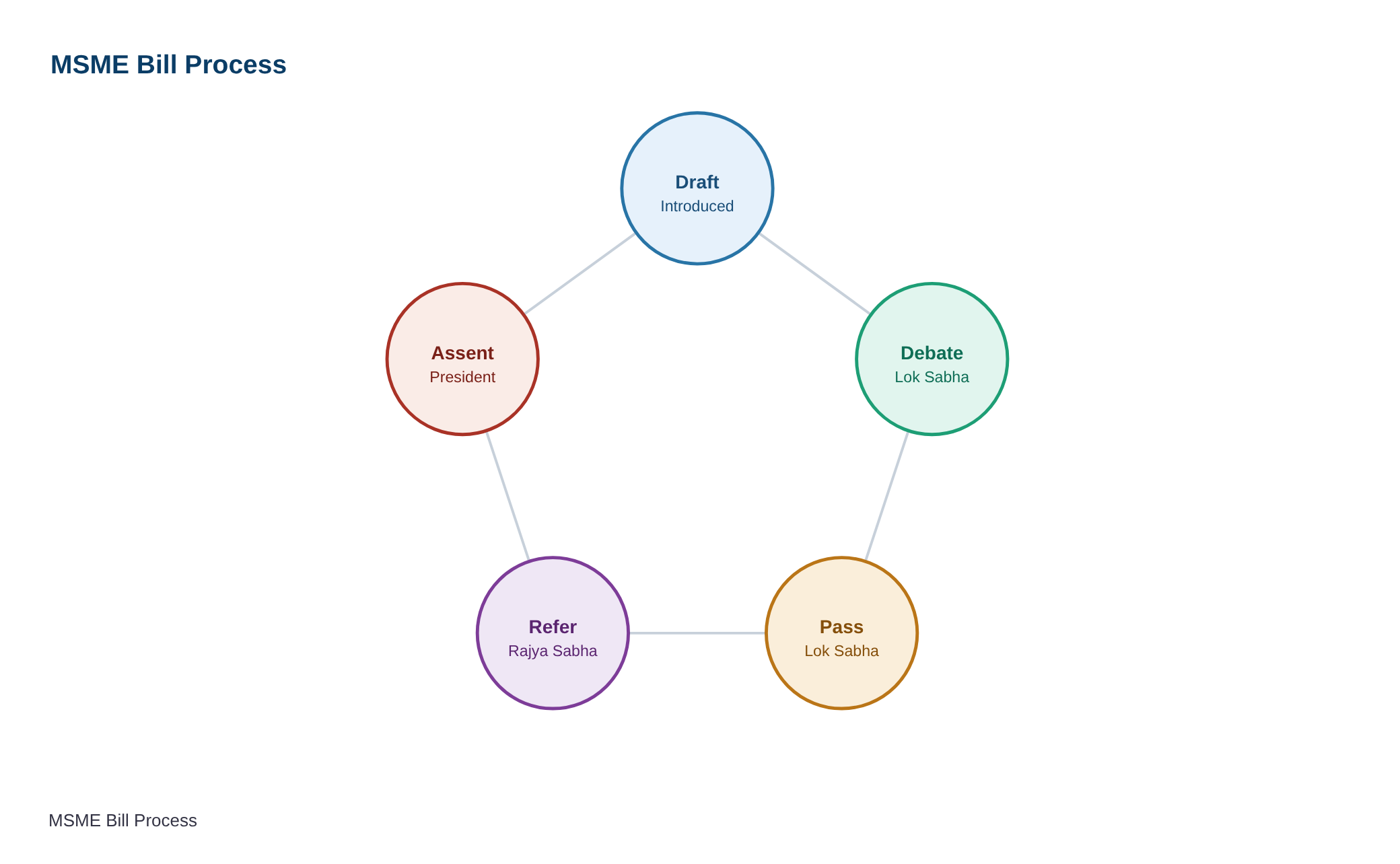
07 Aug Lok Sabha Passes MSME Bill 2024: Key Provisions for UPSC Exam
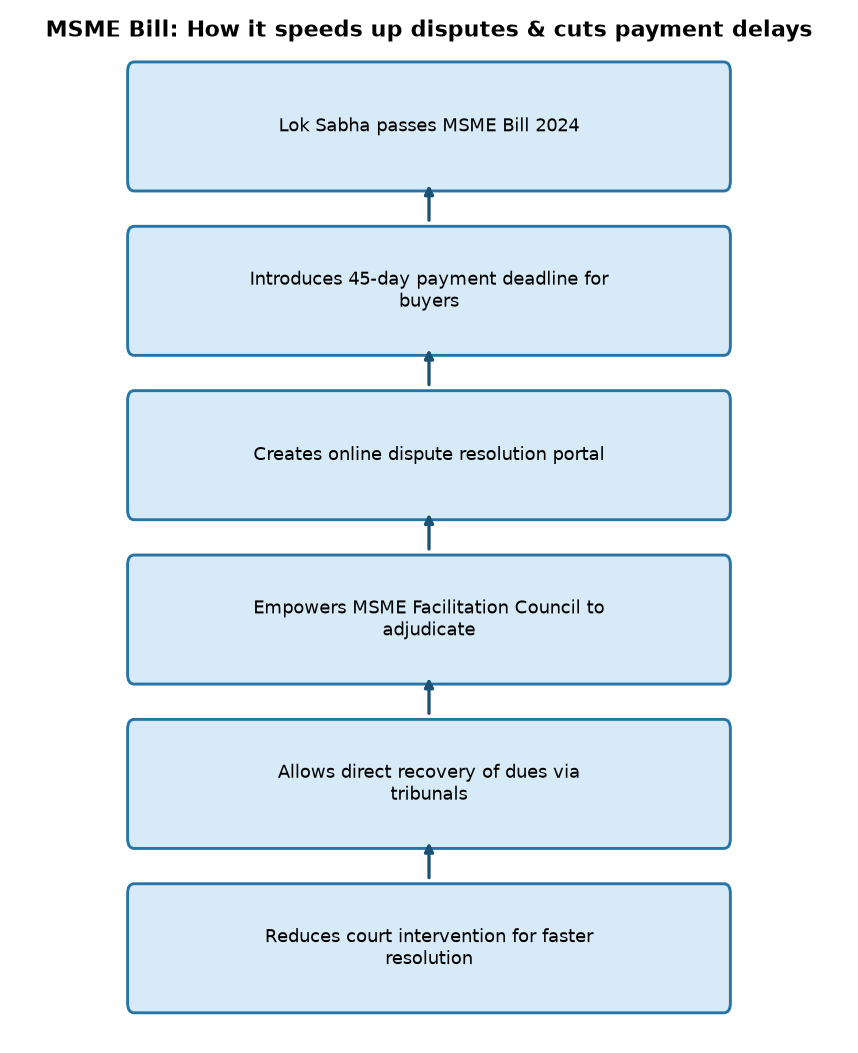
✎ MSME Bill 2024 aims to curb payment delays and disputes via 15-day deadlines and 3x MCLR interest on defaults.
Relevance for UPSC & State PCS: Polity
The Lok Sabha recently passed the Micro, Small and Medium Enterprises (MSME) Development (Amendment) Bill, 2024, aimed at addressing chronic payment delays and expediting dispute resolution for MSMEs. The Bill introduces key amendments to the MSME Development Act, 2006, including stricter timelines for settling dues from buyers—mandating payments within 45 days for transactions exceeding ₹50 lakh, down from the previous 120 days. It also empowers the Micro and Small Enterprises Facilitation Council (MSEFC) to impose penalties on delayed payments and allows MSMEs to approach the council without prior court intervention for disputes up to ₹10 lakh. These changes seek to enhance liquidity for small businesses, which often struggle with cash flow issues due to protracted payment cycles.
For UPSC and State PCS aspirants, the Bill’s provisions highlight the government’s focus on MSMEs, a sector that contributes significantly to India’s GDP (about 30%) and employment (over 110 million workers). The amendments reflect constitutional principles of economic justice (Article 38) and the Directive Principles of State Policy (Article 43), emphasizing fair trade practices and equitable growth. The Bill also underscores the role of statutory bodies like the MSEFC, which aspirants should link to governance mechanisms for MSME welfare. Questions in prelims or mains could probe the Bill’s impact on ease of doing business, or compare it with global models like the UK’s Prompt Payment Code.
The Bill’s emphasis on dispute resolution aligns with judicial reforms aimed at reducing pendency in commercial courts. By enabling MSMEs to bypass lengthy court processes for smaller claims, the government is leveraging quasi-judicial bodies—a trend seen in other policies like the Insolvency and Bankruptcy Code (IBC). For State PCS exams, aspirants should analyze how state-level MSME policies interact with central legislation, such as Tamil Nadu’s MSME policy or Maharashtra’s single-window clearance system. The Bill’s focus on penalties also raises questions about enforcement challenges, a potential topic for essays or ethics case studies.
The amendments come amid rising NPAs in MSME loans (₹1.5 lakh crore as of March 2023) and a 2023 RBI report flagging payment delays as a major hurdle. For UPSC mains, candidates could discuss the Bill’s role in addressing financial inclusion gaps or its synergy with schemes like the Credit Guarantee Fund Trust for Micro and Small Enterprises (CGTMSE). The Bill’s passage also reflects broader trends in ease of doing business reforms, where administrative efficiency and legal clarity are prioritized to attract investment. Aspirants should track its implementation, as real-world outcomes—such as the number of disputes resolved or penalty impositions—could feature in future prelim
Source: ndtv.com
Practice Questions
Q1. What is the primary objective of the MSME Bill recently passed by the Lok Sabha?
- To provide financial subsidies to MSMEs for export promotion
- To tackle payment delays and speed up dispute resolution for MSMEs
- To increase the tax burden on large corporations to support MSMEs
- To mandate a minimum wage for all MSME employees
Answer
To tackle payment delays and speed up dispute resolution for MSMEs — The MSME Bill passed by the Lok Sabha aims to address payment delays faced by Micro, Small, and Medium Enterprises (MSMEs) and expedite the resolution of disputes related to payments, thereby improving their financial stability and operational efficiency.
Q2. Which of the following issues is directly addressed by the MSME Bill passed in the Lok Sabha?
- Reduction in corporate tax rates for MSMEs
- Streamlining of insolvency proceedings for large companies
- Tackling payment delays and disputes for MSMEs
- Expansion of foreign direct investment (FDI) limits in MSMEs
Answer
Tackling payment delays and disputes for MSMEs — The MSME Bill specifically focuses on tackling payment delays and speeding up dispute resolution mechanisms for MSMEs, ensuring timely payments and reducing financial strain on these enterprises.
Generated by AanyaAi for educational purpose.

- Tamil Nadu Expands Breakfast Scheme to Classes 6-8: 15.30 Lakh Students Benefit - September 22, 2026
- राज्यसभा उपचुनाव उत्तराखंड: 16 अक्तूबर को मतदान, जानें पूरा कार्यक्रम और महत्व - September 22, 2026
- राज्यसभा उपचुनाव उत्तराखंड: 16 अक्टूबर को मतदान, जानें प्रक्रिया और महत्व - September 22, 2026

No Comments