


07 Aug Tamil Nadu’s Cess on Liquor Sales: UPSC Perspective on Environmental & Social Impact
✎ The Environmental and Social Welfare Cess on liquor sales in Tamil Nadu is a fiscal policy tool designed to internalise the externalities of alcohol consumption while funding environmental restoration and social welfare…
Subject Relevance — Where This Topic Fits
- GS Paper II — Governance, Transparency and Accountability | GS Paper III — Environment and Sustainable Development, Public Finance
- Prelims: Environmental Cess, Value Added Tax (VAT), TASMAC, De-addiction programmes, Extended Producer Responsibility (EPR), Polluter Pays Principle
- Essay: The role of fiscal policy in addressing public health and environmental challenges, Balancing economic revenue with social welfare imperatives
Quick Revision: The Environmental and Social Welfare Cess on liquor sales in Tamil Nadu is a fiscal policy tool designed to internalise the externalities of alcohol consumption while funding environmental restoration and social welfare programmes, in line with the Polluter Pays Principle and Extended Producer Responsibility.
Why is this in the news?
On August 7, 2026, the Tamil Nadu government introduced a legislative amendment to the Tamil Nadu Value Added Tax Act, 2006, proposing an Environmental and Social Welfare Cess on the sale of alcoholic liquor. This initiative is a pioneering attempt to internalise the externalities of alcohol consumption—both social (addiction and family welfare) and environmental (waste from liquor containers)—through a targeted fiscal measure. The Bill reflects a growing trend among Indian states to utilise revenue instruments for correcting market failures while advancing sustainable development goals.
Background
- The Tamil Nadu State Marketing Corporation (TASMAC) monopolises the retail sale of alcoholic beverages in the state, making it a key revenue source under the Tamil Nadu Value Added Tax Act, 2006.
- Alcohol consumption in India has been associated with significant public health burdens, including liver diseases, accidents, and social disruptions, particularly in vulnerable communities.
- The improper disposal of liquor bottles—predominantly made of glass and plastic—contributes to environmental degradation, including soil and water pollution, and poses risks to wildlife through ingestion or entanglement.
- Globally, fiscal instruments such as cess and taxes have been employed to address negative externalities; for instance, the ‘sin tax’ on tobacco and alcohol in several countries.
- The concept of Extended Producer Responsibility (EPR) is gaining traction in India’s environmental policy framework, mandating producers to manage post-consumer waste, which is mirrored in the cess’s focus on recycling and safe disposal.
What is the Environmental and Social Welfare Cess on Liquor Sales?
- The cess is a supplementary tax levied on the sale of alcoholic liquor in Tamil Nadu, calculated as a percentage of the value of the transaction under the Tamil Nadu Value Added Tax Act, 2006.
- The primary objective is to internalise the external costs of alcohol consumption, including environmental pollution from discarded liquor containers and the social costs of addiction.
- Revenue generated from the cess will be earmarked exclusively for environmental and social welfare initiatives, ensuring transparency and accountability in utilisation.
- Key environmental initiatives include recycling and safe disposal of liquor bottles and containers, restoration of ecosystems affected by pollution, and public awareness campaigns on environmental hazards.
- Social welfare measures encompass de-addiction and rehabilitation programmes for individuals with alcohol use disorders, livelihood support for affected families, and community-based interventions.
- The policy aligns with the ‘Polluter Pays Principle’, which holds that those generating pollution should bear the costs of managing it, thereby incentivising responsible consumption and disposal.
- The cess is expected to complement existing schemes such as the National Action Plan for Drug Demand Reduction (NAPDDR) and the Swachh Bharat Mission, enhancing their outreach and effectiveness.
- The legislative framework allows for periodic review and adjustment of the cess rate, ensuring responsiveness to evolving environmental and social challenges.
Key Features
| Feature | Significance |
|---|---|
| Environmental and Social Welfare Cess | Introduces a levy on liquor sales to fund ecological restoration and social welfare programmes. |
| Revenue Utilisation for Recycling | Proceeds earmarked for recycling, safe disposal, and reuse of liquor bottles and containers to mitigate environmental degradation. |
| De-addiction and Rehabilitation Programmes | Allocates funds for rehabilitation and de-addiction initiatives targeting individuals affected by alcohol addiction. |
| Public Awareness Campaigns | Supports campaigns to educate the public on the harmful effects of alcohol consumption and environmental hazards of improper disposal. |
| Livelihood Assistance for Affected Families | Provides welfare measures and livelihood support to families impacted by alcohol addiction. |
| Forest and Wildlife Restoration | Finances protection and restoration of forests, wildlife, and broader ecological systems. |
Why it Matters
Economic
- Introduces a novel revenue stream for the state exchequer, diversifying income sources beyond conventional taxes.
- Potential to reduce long-term public expenditure on healthcare and environmental remediation by addressing root causes of alcohol-related harm.
- May incentivise behavioural change in consumption patterns, indirectly boosting demand for non-alcoholic alternatives.
Social
- Directly targets the reduction of alcohol addiction through targeted de-addiction and rehabilitation programmes.
- Supports vulnerable families impacted by alcoholism, aligning with social justice and welfare objectives.
- Promotes public health by funding awareness campaigns on the dangers of alcohol consumption.
Environmental
- Addresses ecological degradation caused by improper disposal of liquor containers, particularly glass and plastic waste.
- Encourages circular economy principles through recycling and reuse of discarded materials.
- Contributes to broader environmental sustainability goals by funding forest and wildlife restoration.
Governance and Policy
- Demonstrates proactive policy innovation in leveraging fiscal tools for social and environmental objectives.
- Sets a precedent for other states to adopt similar cess mechanisms for targeted welfare and ecological interventions.
- Highlights the role of state governments in addressing cross-cutting issues like public health and environmental protection.
Challenges
1. Implementation and Enforcement
- Risk of tax evasion and underreporting of liquor sales, necessitating robust monitoring mechanisms.
- Potential administrative burden on the state machinery to ensure equitable and efficient utilisation of cess proceeds.
- Challenges in tracking the impact of funded programmes to ensure transparency and accountability.
UPSC Link: GS-II: State Governance
2. Equity and Regressivity
- Criticism that the cess disproportionately affects lower-income consumers, who may spend a higher proportion of income on liquor.
- Need to balance revenue generation with social equity to avoid penalising vulnerable sections of society.
UPSC Link: GS-II: Social Justice
3. Public Acceptance and Behavioural Change
- Resistance from stakeholders in the liquor industry, including vendors and manufacturers, due to increased costs.
- Difficulty in altering deep-rooted social norms and consumption patterns related to alcohol.
UPSC Link: GS-IV: Ethics and Human Interface
4. Environmental Impact Measurement
- Challenges in quantifying the environmental benefits of recycling and waste management programmes funded by the cess.
- Need for scientific assessment to validate the efficacy of funded ecological restoration initiatives.
UPSC Link: GS-III: Environmental Conservation
5. Inter-State Coordination
- Potential for cross-border liquor sales to neighbouring states to circumvent the cess, necessitating inter-state cooperation.
- Risk of market distortion if other states do not adopt similar measures, affecting local liquor industries.
UPSC Link: GS-II: Federalism
Challenges — UPSC Perspective
| Issue | Concern |
|---|---|
| Tax Evasion | Risk of underreporting liquor sales to avoid cess payment. |
| Industry Resistance | Opposition from liquor vendors and manufacturers due to increased costs. |
| Equity Concerns | Potential disproportionate impact on lower-income consumers. |
| Behavioural Resistance | Difficulty in changing societal attitudes towards alcohol consumption. |
| Implementation Costs | Administrative and logistical expenses in monitoring and fund utilisation. |
| Environmental Impact Measurement | Challenges in assessing the ecological benefits of funded programmes. |
Way Forward
- Establish a dedicated monitoring authority to oversee the collection, utilisation, and impact assessment of the cess proceeds.
- Develop a transparent digital platform for real-time tracking of revenue utilisation and programme outcomes.
- Conduct periodic audits and third-party evaluations to ensure accountability and effectiveness of funded initiatives.
- Launch targeted public awareness campaigns in collaboration with NGOs, educational institutions, and local bodies.
- Strengthen inter-state coordination to prevent tax evasion through cross-border liquor sales.
- Introduce graded cess rates based on the environmental impact of liquor packaging to incentivise sustainable practices.
- Allocate a portion of the cess revenue to research and development for low-waste, eco-friendly packaging alternatives.
- Engage with liquor industry stakeholders to foster voluntary adoption of sustainable practices and reduce resistance.
UPSC Value Addition
Keywords for Mains Answer-Writing
Environmental and Social Welfare Cess · Tamil Nadu Value Added Tax (Amendment) Bill 2026 · Alcohol consumption and ecological degradation · Rehabilitation and de-addiction programmes · Polluter Pays Principle · Fiscal federalism and state taxation powers · Public health and alcohol policy · Sustainable waste management · Social cost of alcohol addiction · State legislative competence under Article 246 · Goods and Services Tax (GST) and state cess · Environmental Protection Act, 1986
Concept Flow
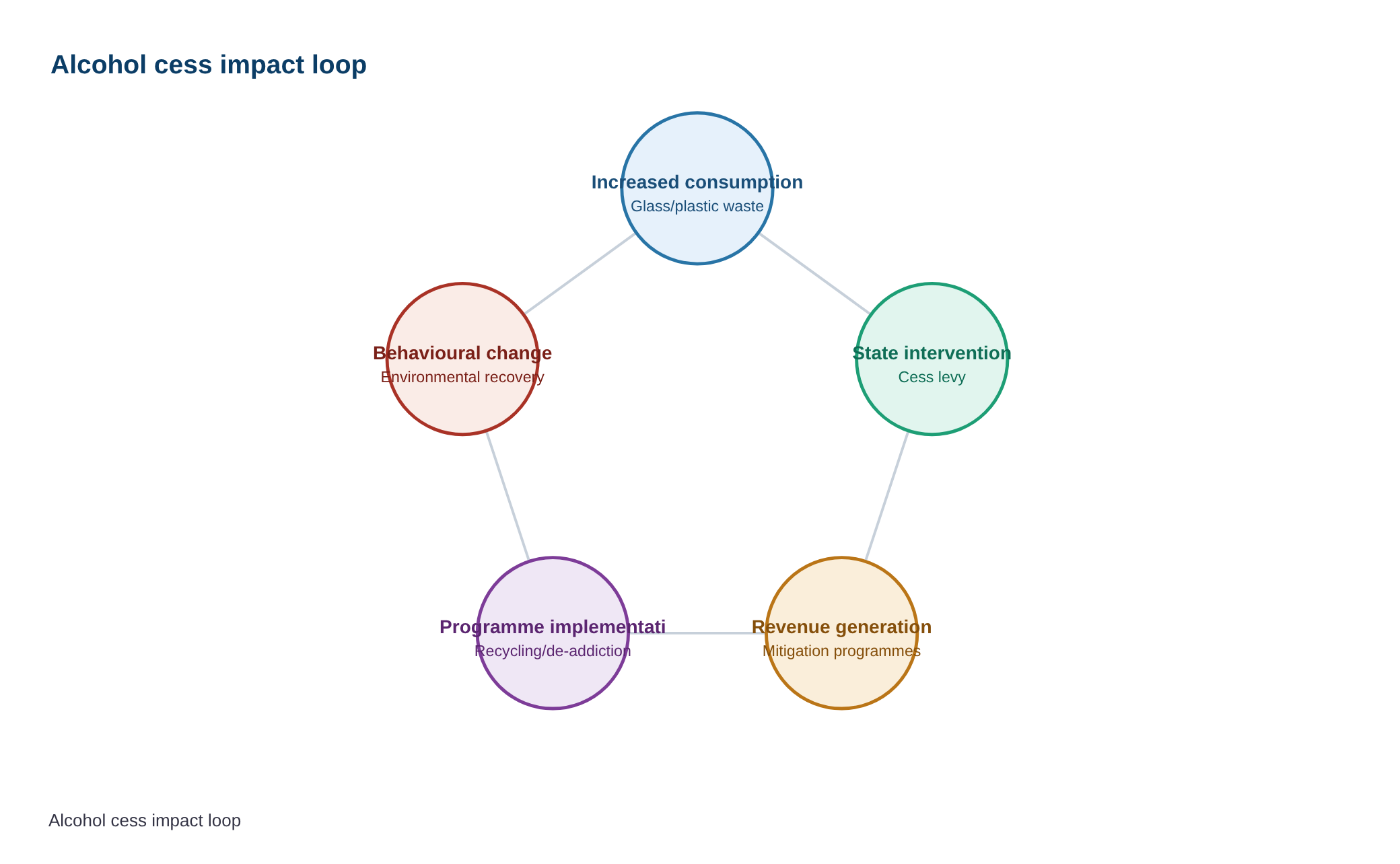
Increased liquor consumption → Environmental degradation (glass/plastic waste) and social harm (addiction) → State intervention via cess levy → Revenue generation for mitigation programmes → Implementation of recycling, de-addiction, and ecological restoration initiatives → Behavioural change and environmental recovery.
Prelims Practice Questions
Q1. Consider the following statements regarding the Environmental and Social Welfare Cess proposed in Tamil Nadu:
1. The cess is levied on the sale of alcoholic liquor under the Tamil Nadu Value Added Tax Act, 2006.
2. The revenue generated will exclusively fund forest conservation projects.
3. The cess aims to address social issues such as alcohol addiction and environmental hazards from liquor waste.
How many of the above statements are correct?
- Only one
- Only two
- All three
- None
Answer: All three — Statements 1 and 3 are correct. Statement 2 is incorrect as the revenue is allocated to a broader range of initiatives including recycling, de-addiction programmes, and public awareness campaigns, not exclusively forest conservation.
Q2. Assertion (A): The Environmental and Social Welfare Cess proposed by Tamil Nadu is an example of the Polluter Pays Principle.
Reason (R): The cess internalises the external costs of alcohol consumption, including environmental degradation and social harm, by imposing a tax on liquor sales.
In the context of the above two statements, which one of the following is correct?
- Both A and R are true, and R is the correct explanation of A
- Both A and R are true, but R is not the correct explanation of A
- A is true, but R is false
- A is false, but R is true
Answer: Both A and R are true, and R is the correct explanation of A — Both the Assertion and Reason are true, and the Reason correctly explains the Assertion. The cess aligns with the Polluter Pays Principle by making producers and consumers bear the costs of environmental and social harm.
Q3. Which of the following initiatives is NOT directly funded by the Environmental and Social Welfare Cess proposed in Tamil Nadu?
- Recycling and safe disposal of liquor bottles
- Rehabilitation and de-addiction programmes for alcohol addiction
- Construction of new highways
- Public awareness campaigns on harmful effects of alcohol
Answer: Construction of new highways — The cess funds environmental and social welfare initiatives such as recycling, de-addiction programmes, and awareness campaigns. Construction of new highways is not mentioned as a funded activity.
Mains Practice Question
✍ Critically examine the rationale behind the Environmental and Social Welfare Cess proposed by Tamil Nadu on liquor sales. Also, discuss its constitutional validity under the framework of fiscal federalism and the Goods and Services Tax regime. (15 Marks)
Approach: MODEL-ANSWER SKELETON:
1. **Introduction (2 marks)**
– Define the Environmental and Social Welfare Cess as a fiscal measure to internalise externalities of alcohol consumption.
– Contextualise with Tamil Nadu’s Bill (August 2026) amending the Tamil Nadu Value Added Tax Act, 2006.
2. **Rationale for the Cess (5 marks)**
– **Environmental Dimension**: Link to the Polluter Pays Principle; discuss ecological degradation from improper disposal of liquor containers (glass/plastic), citing the Environmental Protection Act, 1986.
– **Social Dimension**: Address public health impacts, alcohol addiction, and socio-economic costs (e.g., family welfare, livelihood loss). Reference WHO reports on alcohol-related harm.
– **Fiscal Dimension**: Highlight revenue generation for targeted welfare programmes, contrasting with general taxation.
3. **Constitutional Validity and Fiscal Federalism (5 marks)**
– **Legislative Competence**: Article 246 read with State List (Entry 54) and Concurrent List (Entry 46). Discuss the scope of state taxation powers post-GST.
– **GST Framework**: Analyse compatibility with GST (Article 279A) and the prohibition on state cess on GST supplies (Section 17(5) of CGST Act). Reference constitutional debates on ‘cess’ vs ‘tax’.
– **Judicial Precedents**: Cite cases like *State of West Bengal v. Kesoram Industries* (2004) on legislative competence and *Union of India v. Mohit Minerals* (2022) on GST cess.
4. **Critique and Challenges (3 marks)**
– **Regressivity**: Argue that the cess may disproportionately burden lower-income groups.
– **Implementation**: Highlight administrative challenges in tracking liquor waste and addiction programmes.
– **Alternatives**: Discuss whether direct regulation (e.g., bottle deposit schemes) or national-level policies (e.g., uniform alcohol taxation) would be more effective.
Source: The Hindu
Generated by AanyaAi for educational purpose.

- अरुणाचल में सियांग मेगा बाँध सर्वेक्षण के लिए कैबिनेट ने किया पैनल का गठन - September 24, 2026
- Arunachal Cabinet Forms Panel for Siang Mega Dam Survey: Key Facts for UPSC - September 24, 2026
- सुप्रीम कोर्ट का ‘अंपायर’ वाला फैसला: चुनाव आयोग मामले में न्यायमूर्ति दत्ता की भूमिका - September 24, 2026

No Comments