


07 Aug UPSC Focus: PLI Scheme for Pharma Sector & Key Challenges Explained
✎ The PLI scheme for pharmaceuticals disburses incentives based on incremental sales of domestically manufactured drugs and bulk drugs, with ₹6,659 crore already released under the drug manufacturing component as of March 2026.
Subject Relevance — Where This Topic Fits
- GS Paper II — Government Policies and Interventions for Development in various sectors | GS Paper III — Issues relating to Growth and Development, Industrial Policy
- Prelims: Production-Linked Incentive (PLI) Scheme, Pharmaceutical Sector, Bulk Drugs (Active Pharmaceutical Ingredients – APIs), Fermentation-based Manufacturing, Environmental Clearances, Land Acquisition, Component-Linked Incentive (CLI)
- Essay: The Role of Government Incentives in Industrial Transformation, Balancing Economic Growth with Environmental and Social Governance in India
Quick Revision: The PLI scheme for pharmaceuticals disburses incentives based on incremental sales of domestically manufactured drugs and bulk drugs, with ₹6,659 crore already released under the drug manufacturing component as of March 2026.
Why is this in the news?
The Press Information Bureau (PIB) released an official update on the progress of the Production-Linked Incentive (PLI) Scheme for the pharmaceutical sector, highlighting disbursement figures, implementation challenges, and sector-specific constraints, particularly in fermentation-based bulk drug manufacturing. This development is significant as it underscores the efficacy of production-linked incentives in fostering domestic manufacturing while also revealing systemic bottlenecks that impede timely project execution.
Background
- The PLI scheme was introduced by the Government of India as a flagship initiative under the Atmanirbhar Bharat Abhiyan to boost domestic manufacturing across key sectors, including pharmaceuticals.
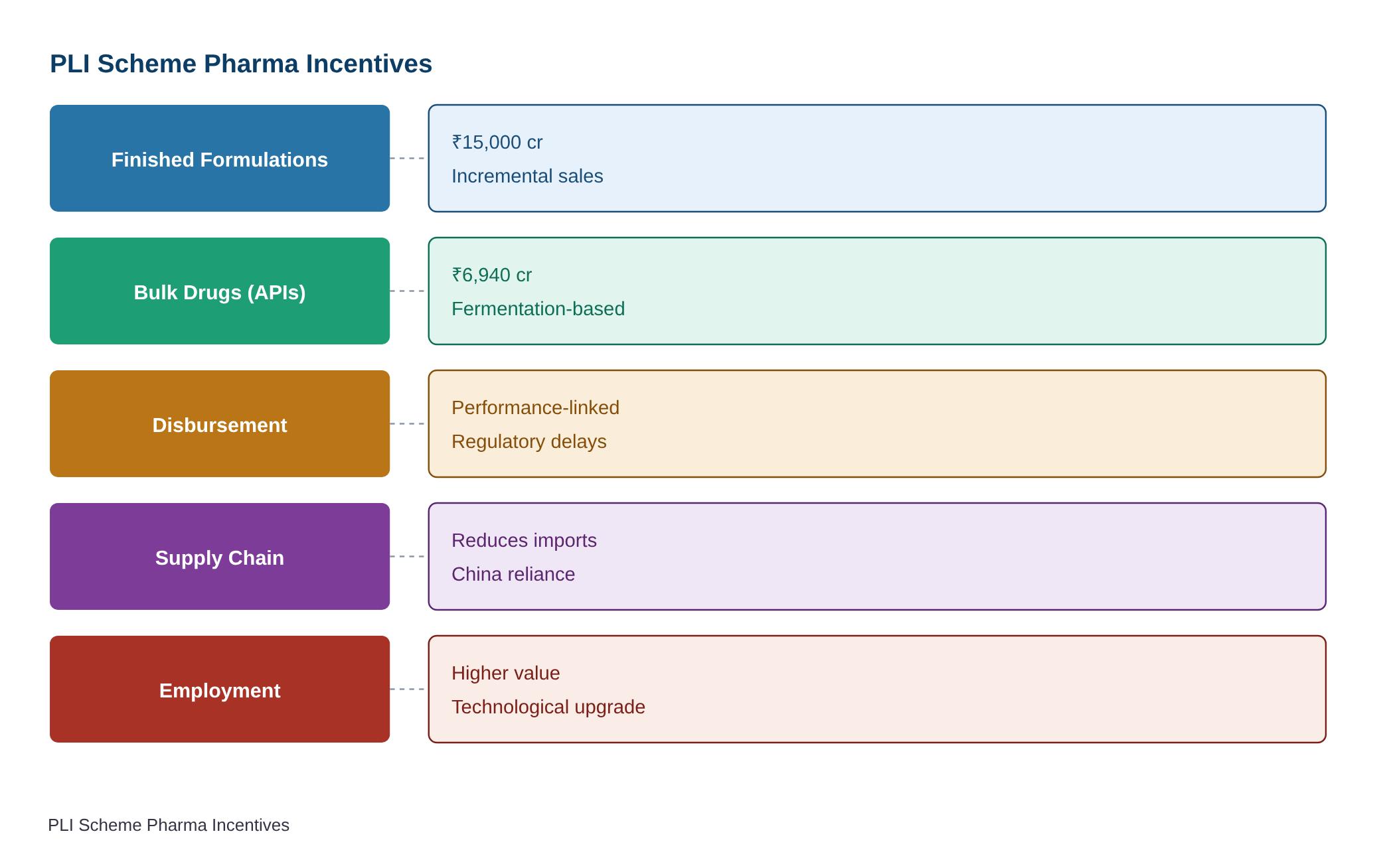
- The pharmaceutical PLI scheme was launched in FY 2022-23 with a total financial outlay of ₹15,000 crore for the drug manufacturing sector.
- A separate PLI scheme for bulk drugs (Active Pharmaceutical Ingredients – APIs) was also notified with a financial outlay of ₹6,940 crore to reduce India’s reliance on imported APIs.
- The scheme mandates disbursement of incentives based on incremental sales of domestically manufactured products, ensuring a performance-linked approach.
- India’s pharmaceutical sector contributes significantly to global generic medicine supply, yet faces structural challenges such as high utility costs, regulatory delays, and land acquisition hurdles.
What is the Production-Linked Incentive (PLI) Scheme for Pharmaceuticals?
- The PLI scheme for pharmaceuticals is a performance-based subsidy mechanism designed to incentivise domestic manufacturing of drugs and bulk drugs (APIs) by linking financial support to incremental sales.
- The scheme aims to enhance India’s self-reliance in critical pharmaceutical inputs, particularly APIs, which are essential for drug formulation and are predominantly imported from China.
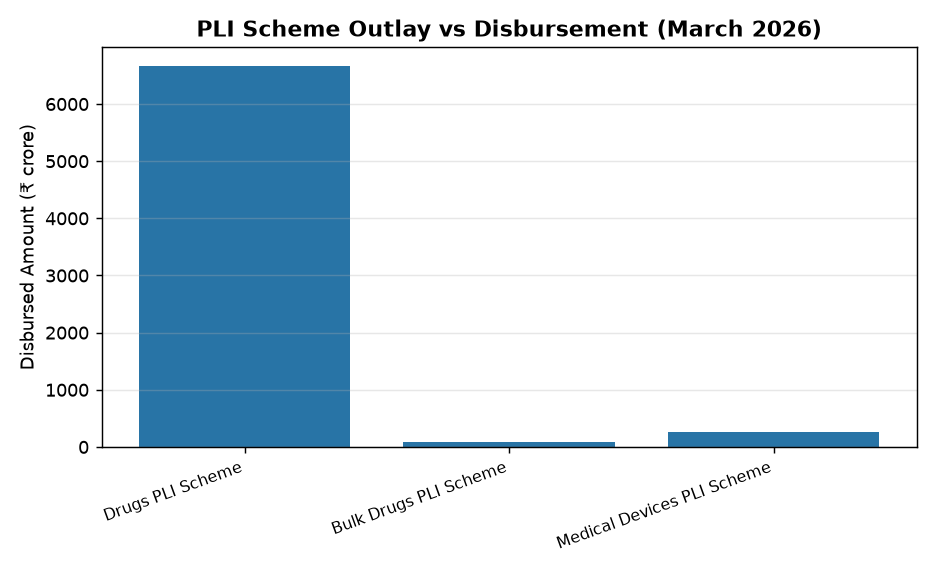
- The financial outlay for the drug manufacturing PLI scheme is ₹15,000 crore, with ₹6,659 crore disbursed as of March 2026, indicating substantial utilisation of allocated funds.
- The bulk drugs PLI scheme, with a ₹6,940 crore outlay, has seen only ₹87.70 crore disbursed due to sector-specific operational challenges, including fermentation-based manufacturing constraints.
- Incentives are disbursed post-production and sales, ensuring that subsidies are tied to actual economic contribution rather than mere investment commitments.
- The scheme operates under a multi-year framework, with disbursements spread across the tenure of approved projects, typically ranging from 4 to 6 years.
- The scheme aligns with India’s broader industrial policy objectives, including the promotion of high-value manufacturing, job creation, and technological upgradation in the pharmaceutical value chain.
Key Features
| Feature | Significance |
|---|---|
| Financial Outlay | A total outlay of ₹15,000 crore for the Pharmaceutical PLI Scheme, with ₹6,659 crore disbursed by March 2026, indicating substantial fiscal commitment to incentivise domestic pharmaceutical manufacturing. |
| Dual PLI Schemes | Two distinct PLI schemes: one for finished formulations (₹15,000 crore) and another for bulk drugs (₹6,940 crore), reflecting a targeted approach to address critical gaps in the pharmaceutical value chain. |
| Performance-Linked Disbursement | Incentives are released based on sales of products manufactured under the PLI schemes, ensuring alignment with actual production outcomes and market demand. |
| Sectoral Coverage | Inclusion of medical devices under a separate PLI scheme (₹266.64 crore disbursed), broadening the scope to enhance self-reliance in critical healthcare infrastructure. |
| Operational Flexibility | No proposed shift from the PLI framework to a component-linked incentive model for medical devices, maintaining consistency in the incentive structure while allowing for sector-specific adaptations. |
Why it Matters
Economic Resilience
- Reduces import dependence on essential pharmaceuticals and bulk drugs, particularly from China, thereby strengthening India’s position as the ‘Pharmacy of the World’ while mitigating supply chain vulnerabilities.
- Enhances value addition within the domestic pharmaceutical sector, fostering higher employment generation and technological upgradation in high-skilled manufacturing processes.
- Stimulates ancillary industries such as packaging, logistics, and R&D, creating a multiplier effect across the pharmaceutical ecosystem.
Strategic Autonomy
- Supports the vision of ‘Atmanirbhar Bharat’ by reducing reliance on imported active pharmaceutical ingredients (APIs) and critical intermediates, ensuring uninterrupted access to essential medicines during geopolitical or logistical disruptions.
- Promotes indigenous innovation in fermentation-based drug manufacturing, a high-value segment where India historically lags behind global leaders like China and the EU.
Global Competitiveness
- Encourages large-scale investments in high-tech pharmaceutical manufacturing, positioning India as a preferred destination for global pharmaceutical majors seeking to diversify supply chains post-COVID-19.
- Facilitates compliance with global quality standards (e.g., WHO-GMP, USFDA), enhancing India’s export competitiveness in regulated markets.
Public Health Impact
- Ensures steady supply of affordable essential medicines, particularly in the aftermath of the COVID-19 pandemic, where disruptions in global supply chains exposed vulnerabilities in India’s healthcare system.
- Supports the production of critical drugs, including those used in cancer treatment, diabetes, and infectious diseases, thereby improving public health outcomes and reducing out-of-pocket expenditures.
Challenges
1. Operational Bottlenecks in Bulk Drug Manufacturing
- Land acquisition delays and protracted environmental clearances impede the timely establishment of manufacturing facilities, particularly for fermentation-based bulk drugs.
- High utility costs, including energy and water, escalate operational expenses, reducing the viability of bulk drug production in India compared to competitors like China or Europe.
- Extended gestation periods for fermentation-based processes (due to biological growth constraints) delay revenue generation, thereby deferring the disbursement of PLI incentives tied to sales.
UPSC Link: GS-III: Industrial Policy & Manufacturing
2. Disbursement Lag Due to Performance-Linked Incentives
- The PLI scheme’s reliance on sales-based disbursement creates a cash-flow mismatch for manufacturers, as incentives are released only after products enter the market, straining liquidity during the initial phases of production.
- Delays in project implementation (e.g., due to regulatory hurdles) further postpone the realisation of sales-linked incentives, discouraging participation from risk-averse investors.
UPSC Link: GS-III: Public Finance & Subsidies
3. Limited Adoption in Medical Devices Sector
- The medical devices PLI scheme has disbursed only ₹266.64 crore by March 2026, significantly lower than the pharmaceutical PLI schemes, indicating slower uptake and potential structural barriers in the sector.
- The absence of a component-linked incentive model, unlike in other sectors, may reduce the scheme’s attractiveness for manufacturers of high-value medical devices.
UPSC Link: GS-III: Technology & Innovation
4. Competition from Established Global Players
- India’s pharmaceutical sector faces stiff competition from countries like China, which dominate the bulk drug and API markets due to lower production costs and established supply chains.
- The lack of a level playing field in global trade (e.g., non-tariff barriers, subsidies in competitor nations) undermines the competitiveness of Indian manufacturers despite PLI incentives.
UPSC Link: GS-III: International Trade
5. Skill and Infrastructure Gaps
- The fermentation-based manufacturing segment requires specialised human resources and advanced infrastructure, which are currently in short supply in India, leading to higher training and operational costs.
- Inadequate R&D collaboration between industry and academia hinders the development of cost-effective fermentation technologies, limiting India’s ability to innovate in this niche.
UPSC Link: GS-III: Skill Development & R&D
Challenges — UPSC Perspective
| Issue | Concern |
|---|---|
| Land Acquisition & Regulatory Delays | Protracted approval processes and land acquisition hurdles delay project implementation, particularly for bulk drug manufacturing units. |
| High Utility Costs | Escalating energy and water costs reduce the cost-competitiveness of Indian bulk drug manufacturers compared to global peers. |
| Biological Constraints in Fermentation | The slow growth rate of living cells in fermentation-based processes extends production timelines, delaying revenue generation and incentive disbursement. |
| Sales-Linked Disbursement Model | Performance-linked incentives create liquidity constraints for manufacturers, as funds are released only after product sales, straining cash flows during initial phases. |
| Low Uptake in Medical Devices | The medical devices PLI scheme has seen limited participation, with disbursements far below targets, indicating structural barriers in the sector. |
| Global Competition | India’s pharmaceutical sector faces unfair competition from countries like China, which benefit from lower production costs and established supply chains. |
Government Initiatives — Must-Memorise for Prelims
- Production-Linked Incentive (PLI) Scheme for Pharmaceuticals (2022-23 onwards)
- Production-Linked Incentive (PLI) Scheme for Bulk Drugs (2022-23 onwards)
- Production-Linked Incentive (PLI) Scheme for Medical Devices (2022-23 onwards)
Way Forward
- Streamline land acquisition and environmental clearance processes through single-window clearance mechanisms and faster dispute resolution, particularly for bulk drug manufacturing units.
- Introduce partial upfront disbursement of PLI incentives (e.g., 30-40% on project commissioning) to alleviate liquidity constraints and encourage greater participation from manufacturers.
- Expand R&D collaboration between industry and institutions like CSIR and IITs to develop cost-effective fermentation technologies and reduce dependence on imported intermediates.
- Enhance skill development initiatives through targeted programmes in fermentation-based manufacturing, bioprocess engineering, and quality control to address the talent gap.
- Explore the feasibility of a component-linked incentive model for the medical devices sector to attract higher investments in high-value manufacturing.
- Strengthen trade negotiations to address non-tariff barriers and subsidies in competitor nations, ensuring a level playing field for Indian pharmaceutical exporters.
- Promote cluster-based development for bulk drug manufacturing, with shared infrastructure (e.g., common effluent treatment plants, energy utilities) to reduce operational costs.
- Monitor and periodically review the disbursement mechanisms of PLI schemes to identify bottlenecks and introduce corrective measures, such as performance-based milestones for incentive release.
UPSC Value Addition
Keywords for Mains Answer-Writing
Production-Linked Incentive Scheme (PLI) for Pharmaceuticals · Pharma PLI Scheme 2022-23 · Production-linked incentive for bulk drugs · Pharmaceutical sector reforms · Fermentation-based bulk drug manufacturing · Land acquisition and environmental clearances in PLI · Component-Linked Incentive (CLI) for medical devices · Department of Pharmaceuticals under Ministry of Chemicals and Fertilizers · PLI scheme financial outlay and disbursement · Challenges in PLI implementation for bulk drugs · Policy bottlenecks in pharmaceutical manufacturing · Biological synthesis vs chemical synthesis in drug production
Concept Flow
COVID-19 pandemic exposes vulnerabilities in global pharmaceutical supply chains → Government launches PLI schemes (2022-23) to incentivise domestic manufacturing → Dual schemes: finished formulations (₹15,000 cr) and bulk drugs (₹6,940 cr) → Delays in bulk drug projects due to regulatory and biological constraints → Performance-linked disbursement model creates liquidity challenges → Limited uptake in medical devices sector → Need for structural reforms in land acquisition, R&D, and incentive disbursement → Way forward: single-window clearances, upfront disbursements, skill development, and trade policy reforms.
Prelims Practice Questions
Q1. Consider the following statements regarding the Production-Linked Incentive (PLI) Scheme for Pharmaceuticals: 1. The PLI Scheme for Pharmaceuticals was launched in the fiscal year 2022-23. 2. The total financial outlay for the PLI Scheme for Pharmaceuticals is ₹15,000 crore. 3. The PLI Scheme for bulk drugs has faced delays due to fermentation-based manufacturing processes. 4. The PLI Scheme for medical devices follows a mixed incentive framework combining PLI and Component-Linked Incentive (CLI). How many of the above statements are correct?
- Only one
- Only two
- Only three
- All four
Answer: All four — Statements 1, 2, and 3 are correct. Statement 4 is incorrect as the medical devices PLI scheme does not adopt a mixed incentive framework; it continues under the PLI structure.
Q2. Assertion (A): Fermentation-based bulk drug manufacturing relies on the slow biological growth of living cells. Reason (R): The PLI Scheme for bulk drugs has faced delays primarily due to environmental clearances and land acquisition issues.
- Both A and R are true, and R is the correct explanation of A
- Both A and R are true, but R is NOT the correct explanation of A
- A is true, but R is false
- A is false, but R is true
Answer: A is true, but R is false — Assertion (A) is true as fermentation-based manufacturing depends on the biological activity of living cells, which grows slowly. Reason (R) is also true but does not explain the assertion; the delays are due to regulatory and land acquisition issues, not the fermentation process itself.
Q3. Match the following columns with respect to the PLI Scheme for Pharmaceuticals and its components:
Column I
1. PLI Scheme for Pharmaceuticals
2. PLI Scheme for Bulk Drugs
3. PLI Scheme for Medical Devices
Column II
A. ₹15,000 crore financial outlay
B. ₹6,940 crore financial outlay
C. ₹6,659 crore disbursed by March 2026
D. ₹266.64 crore disbursed by March 2026
- 1-A, 2-B, 3-D
- 1-C, 2-B, 3-D
- 1-A, 2-C, 3-B
- 1-C, 2-A, 3-B
Answer: 1-C, 2-B, 3-D — Column I (1) matches Column II (A and C) as the PLI Scheme for Pharmaceuticals has a total outlay of ₹15,000 crore and ₹6,659 crore has been disbursed. Column I (2) matches Column II (B) as the PLI Scheme for Bulk Drugs has a ₹6,940 crore outlay. Column I (3) matches Column II (D) as ₹266.64 crore has been disbursed under the PLI Scheme for Medical Devices.
Mains Practice Question
✍ Critically examine the implementation challenges faced by the Production-Linked Incentive (PLI) Scheme for Pharmaceuticals, particularly in the context of bulk drug manufacturing. Also, assess the efficacy of the PLI framework in achieving its stated objectives of enhancing domestic pharmaceutical production and reducing import dependence. (15 Marks)
Approach: MODEL-ANSWER SKELETON:
1. **Introduction (2 Marks)**: Define the PLI Scheme for Pharmaceuticals, its launch year (2022-23), and its objectives (boost domestic manufacturing, reduce import dependence, enhance competitiveness). Mention the financial outlay (₹15,000 crore) and the disbursement status (₹6,659 crore by March 2026).
2. **Implementation Challenges in Bulk Drug Manufacturing (5 Marks)**:
– **Regulatory and Land Acquisition Issues**: Delays in environmental clearances and land acquisition as highlighted in the PIB release.
– **Technological Constraints**: Fermentation-based bulk drug production relies on slow biological processes, unlike chemical synthesis, leading to extended project timelines.
– **High Utility Costs**: Elevated operational costs impacting profitability and scalability.
– **Disbursement Mechanism**: Incentives are linked to sales of manufactured products, causing delays in fund disbursement due to project execution lags.
3. **Efficacy of the PLI Framework (5 Marks)**:
– **Progress and Achievements**: High disbursement under the general pharmaceutical PLI scheme (₹6,659 crore) indicates initial success in incentivizing production.
– **Gaps in Bulk Drug PLI**: Low disbursement (₹87.70 crore) for bulk drugs suggests systemic inefficiencies or misalignment between incentives and ground realities.
– **Comparison with Medical Devices PLI**: The medical devices PLI scheme has disbursed ₹266.64 crore, indicating better implementation or sector-specific advantages.
– **Policy Recommendations**: Suggest reforms such as streamlining approvals, addressing utility cost burdens, and revisiting the disbursement mechanism for bulk drugs.
4. **Conclusion (3 Marks)**: Balance between the PLI scheme’s potential and the need for targeted interventions to address sector-specific challenges. Emphasize the importance of reducing import dependence in critical pharmaceutical ingredients to enhance self-reliance.
Source: PIB (Press Information Bureau)
Generated by AanyaAi for educational purpose.

- Tamil Nadu Expands Breakfast Scheme to Classes 6-8: 15.30 Lakh Students Benefit - September 22, 2026
- राज्यसभा उपचुनाव उत्तराखंड: 16 अक्तूबर को मतदान, जानें पूरा कार्यक्रम और महत्व - September 22, 2026
- राज्यसभा उपचुनाव उत्तराखंड: 16 अक्टूबर को मतदान, जानें प्रक्रिया और महत्व - September 22, 2026

No Comments