


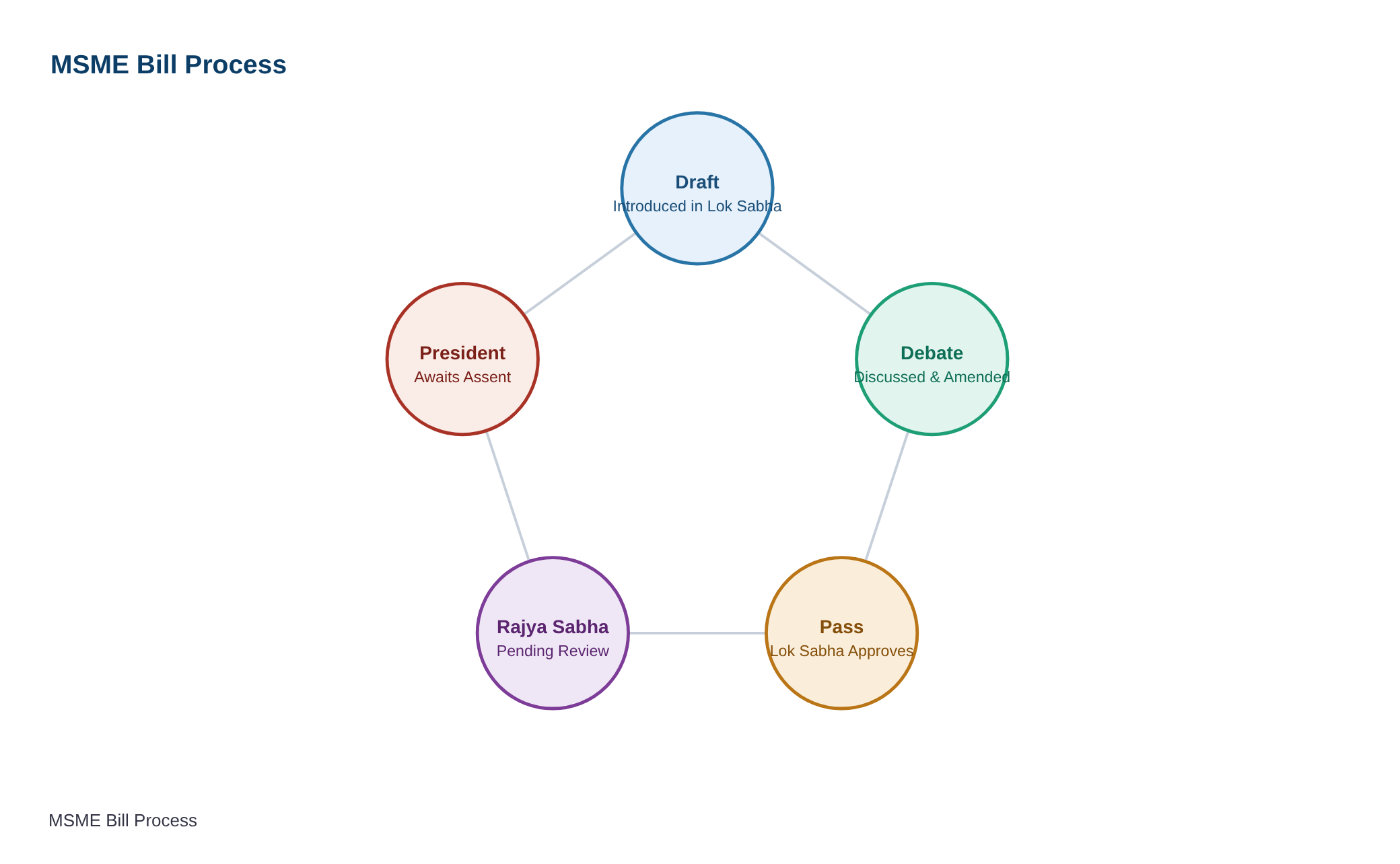
07 Aug Lok Sabha Passes MSME Bill 2024: Key Provisions for UPSC State PCS
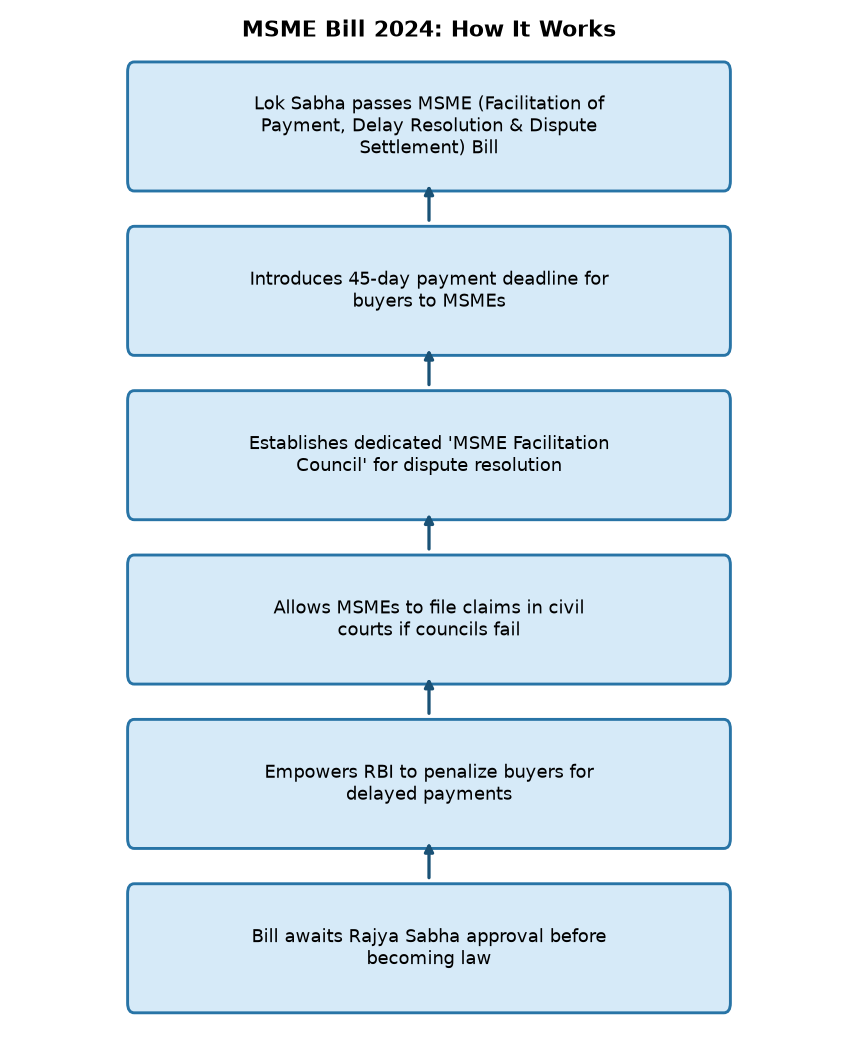
✎ MSME Payment Bill 2024 mandates 30-day payments to MSMEs with 3x RBI repo rate interest on delays.
Relevance for UPSC & State PCS: Polity
The Lok Sabha recently passed the Micro, Small and Medium Enterprises (MSME) Development (Amendment) Bill, 2024, aimed at addressing chronic payment delays and expediting dispute resolution for MSMEs. The bill introduces stricter timelines for payments to MSMEs by buyers, mandating that payments must be made within 45 days of acceptance of goods or services, failing which buyers will be liable to pay compound interest at three times the bank rate notified by the Reserve Bank of India. This move seeks to alleviate the financial strain on MSMEs, which often face liquidity crunches due to delayed payments from larger corporations and government entities. The bill also empowers the Micro and Small Enterprises Facilitation Council (MSEFC) to act as an arbitrator in disputes, reducing the burden on courts and ensuring quicker resolution.
For UPSC and State PCS aspirants, this bill is a critical example of how legislative interventions can shape the economic landscape, particularly for a sector that employs over 11 crore people and contributes significantly to India’s GDP. The amendment reflects the government’s commitment to fostering a more conducive business environment for MSMEs, which are the backbone of India’s industrial ecosystem. Understanding the nuances of such bills—such as the role of MSEFC, the penalties for non-compliance, and the broader implications for financial inclusion—can provide valuable insights into India’s policy framework for economic growth and ease of doing business. Moreover, questions on MSMEs often appear in prelims and mains, making this a relevant topic for both stages of the examination.
The bill’s emphasis on dispute resolution through arbitration rather than litigation is particularly noteworthy, as it aligns with the government’s broader push for alternative dispute resolution mechanisms. This shift not only reduces the pendency of cases in overburdened judicial systems but also ensures that MSMEs, which lack the resources to engage in prolonged legal battles, receive timely justice. For State PCS aspirants, this highlights the importance of understanding how state-level institutions like MSEFC function and their role in implementing central policies. Additionally, the bill’s provisions on interest rates and penalties could be linked to broader topics like financial regulation, monetary policy, and the role of the RBI, which are frequently tested in UPSC examinations.
The passage of this bill also underscores the government’s recognition of the MSME sector’s vulnerabilities, especially in the wake of economic disruptions like the COVID-19 pandemic. By addressing payment delays—a long-standing grievance of MSMEs—the bill aims to enhance their competitiveness and sustainability. For aspirants, this presents an opportunity to explore related themes such as the informal sector’s integration into the formal economy, the challenges of credit access for small businesses, and the role of government schemes like the Credit Guarantee Fund Scheme for Micro and Small Enterprises (CGS). These interconnected topics are often featured in mains answers and can help
Source: ndtv.com
Practice Questions
Q1. What is the primary objective of the MSME Bill recently passed by the Lok Sabha?
- To provide financial subsidies to MSMEs for technological upgrades
- To tackle payment delays and expedite dispute resolution for MSMEs
- To mandate a minimum wage for all MSME employees
- To increase the tax exemptions for MSMEs
Answer
To tackle payment delays and expedite dispute resolution for MSMEs — The MSME Bill passed by the Lok Sabha aims to address payment delays faced by Micro, Small, and Medium Enterprises (MSMEs) and to speed up the resolution of disputes related to these delays.
Q2. Which of the following issues is specifically addressed by the MSME Bill?
- Reduction in corporate tax rates for MSMEs
- Streamlining of insolvency processes for MSMEs
- Expediting dispute resolution and addressing payment delays
- Mandating a fixed percentage of exports for MSMEs
Answer
Expediting dispute resolution and addressing payment delays — The MSME Bill focuses on expediting dispute resolution and tackling payment delays, which are critical challenges for MSMEs.
Generated by AanyaAi for educational purpose.

- कर्नाटक में ‘वंदे मातरम’ विवाद: राज्यपाल ने सीएम से आदेश वापस लेने को कहा - September 22, 2026
- Karnataka Governor vs CM: Vande Mataram GO row explained for UPSC - September 22, 2026
- मध्यप्रदेश कैबिनेट का बड़ा फैसला: हर विधानसभा में स्पोर्ट्स कॉम्प्लेक्स, 15 हजार बसें 2030 तक - September 22, 2026

No Comments