


07 Aug PLI Scheme for Bulk Drugs: 48 Projects Approved to Boost API Production
✎ The PLI Scheme for bulk drugs is a strategic intervention to reduce India’s import dependence on critical pharmaceutical inputs by incentivising domestic production of 41 identified KSMs/DIs/APIs, with a sanctioned outlay of…
Subject Relevance — Where This Topic Fits
- GS Paper II — Government Policies and Interventions for Development in various sectors | GS Paper III — Industrial Policy, Investment Models, and Pharmaceutical Sector
- Prelims: Production-Linked Incentive (PLI) Scheme, Active Pharmaceutical Ingredients (APIs), Bulk Drugs, Import Substitution, Pharmaceutical Policy
- Essay: India’s pharmaceutical self-reliance: Balancing cost-competitiveness with strategic autonomy, The role of industrial policy in reducing import dependence: Lessons from the PLI scheme for bulk drugs
Quick Revision: The PLI Scheme for bulk drugs is a strategic intervention to reduce India’s import dependence on critical pharmaceutical inputs by incentivising domestic production of 41 identified KSMs/DIs/APIs, with a sanctioned outlay of ₹6,940 crore and progress showing ₹5,070.45 crore in investments by March 2026.
Why is this in the news?
On 7 August 2026, the Department of Pharmaceuticals, Government of India, issued a press release detailing the progress of the Production-Linked Incentive (PLI) Scheme for bulk drugs. The scheme has approved 48 projects with a sanctioned outlay of ₹6,940 crore, of which ₹87.70 crore in incentives has been disbursed by March 2026. The initiative aims to boost domestic production of Key Starting Materials (KSMs), Drug Intermediates (DIs), and Active Pharmaceutical Ingredients (APIs) to reduce import dependency and enhance India’s pharmaceutical manufacturing capabilities.
Background
- India is the world’s third-largest pharmaceutical market by volume and the largest supplier of generic medicines globally, yet it remains heavily dependent on imports for critical APIs and bulk drugs, particularly from China.
- The COVID-19 pandemic exposed vulnerabilities in supply chains, prompting the government to prioritise self-reliance in critical pharmaceutical inputs.
- The PLI Scheme for bulk drugs, notified in March 2020, is part of the broader Atmanirbhar Bharat initiative to foster domestic manufacturing and reduce import dependence in strategic sectors.
- As of March 2026, the scheme has facilitated an investment of ₹5,070.45 crore against a committed investment of ₹4,329.95 crore, indicating robust private sector participation.
- The scheme’s design links financial incentives directly to incremental production, ensuring accountability and efficiency in fund utilisation.
What is the Production-Linked Incentive (PLI) Scheme for Bulk Drugs?
- Objective: To incentivise domestic manufacturing of KSMs, DIs, and APIs to reduce import dependence and enhance India’s pharmaceutical self-reliance.
- Financial Outlay: A total sanctioned outlay of ₹6,940 crore, with disbursement of ₹87.70 crore in incentives by March 2026.
- Coverage: The scheme covers 41 identified products, including KSMs/DIs/APIs.
- Incentive Structure: Financial incentives are linked to incremental production, with disbursement based on verified sales and production data.
- Eligibility: Applicants must propose projects for the manufacture of specified KSMs/DIs/APIs and meet minimum investment and production thresholds.
- Implementation: The scheme is implemented by the Department of Pharmaceuticals under the Ministry of Chemicals and Fertilizers, with monitoring by the Empowered Group of Secretaries (EGoS).
- Progress: As of March 2026, 48 projects have been approved, with investments totalling ₹5,070.45 crore and production capacity established for 28 products.
Key Features
| Feature | Significance |
|---|---|
| Approved Projects (48) | Expands domestic production of bulk drugs, reducing import dependency in critical pharmaceutical intermediates. |
| Investment Commitment (₹5,070.45 cr) | Demonstrates private sector confidence in domestic API manufacturing, aligning with self-reliance goals. |
| Production Capacity (28 APIs/KSM/DIs) | Enhances India’s pharmaceutical supply chain resilience, particularly for high-demand drugs. |
| Incentive Disbursement (₹87.70 cr) | Provides financial support to offset production costs, ensuring viability of new ventures. |
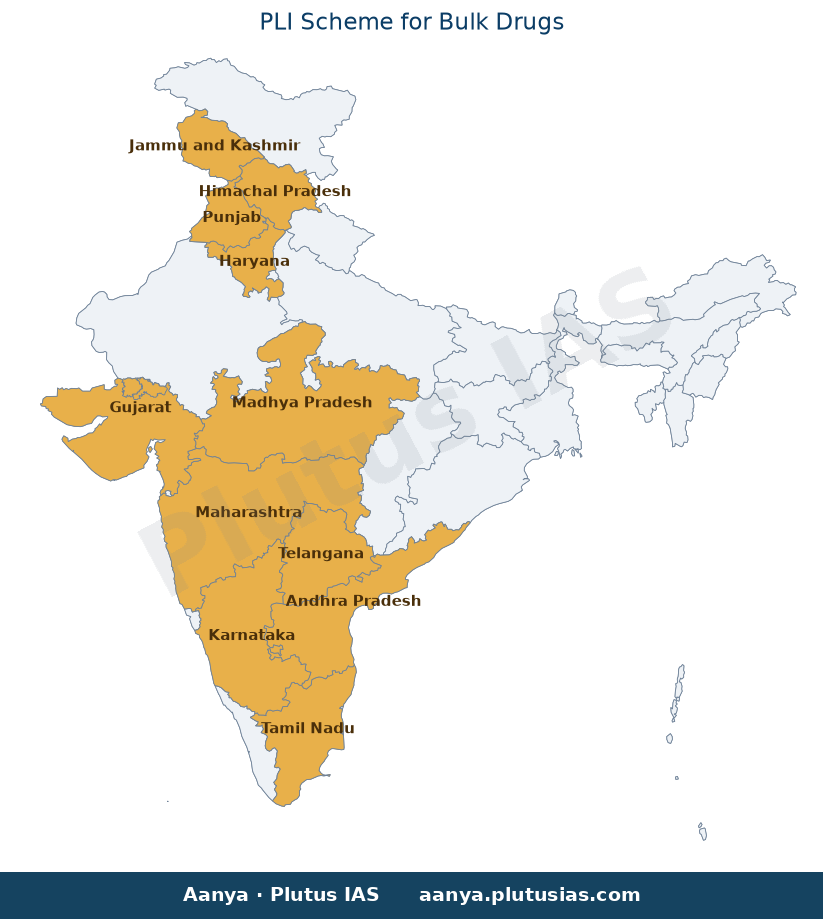
| State-wise Distribution (10 states) | Reflects balanced regional development, with Andhra Pradesh and Gujarat leading in approved projects. |
Why it Matters
Economic
- Reduces foreign exchange outflow by substituting imports of 18 APIs, including Penicillin G, Dexamethasone, and Atorvastatin.
- Boosts ancillary industries (e.g., chemical intermediates, packaging) through backward linkages.
- Enhances export competitiveness by lowering input costs for finished dosage forms.
Strategic
- Strengthens India’s position as a global pharmacy hub by securing critical API supply chains.
- Mitigates geopolitical risks associated with concentrated API production in a few countries.
- Supports pandemic preparedness by ensuring domestic availability of essential drugs like Artemisunate.
Industrial Policy
- Demonstrates efficacy of Production-Linked Incentive (PLI) schemes in achieving import substitution.
- Encourages innovation in fermentation and chemical synthesis-based API production.
- Promotes cluster-based development in pharmaceutical manufacturing hubs.
Challenges
1. Technology and R&D Gaps
- Limited domestic expertise in fermentation-based API production compared to global leaders like China.
- High capital expenditure for setting up dedicated manufacturing units for niche APIs.
UPSC Link: GS-III: Industrial Policy
2. Regulatory and Compliance Hurdles
- Stringent Good Manufacturing Practices (GMP) compliance requirements delay project timelines.
- Delays in environmental clearances for chemical synthesis units.
UPSC Link: GS-II: Health Governance
3. Market Competitiveness
- Price volatility in raw material markets (e.g., penicillin base) affects profitability.
- Competition from subsidized API imports from countries with lower production costs.
UPSC Link: GS-III: Trade Policy
4. Infrastructure Bottlenecks
- Inadequate logistics for transporting hazardous chemicals in certain states.
- Power supply inconsistencies in industrial clusters (e.g., Himachal Pradesh).
UPSC Link: GS-III: Infrastructure
Challenges — UPSC Perspective
| Issue | Concern |
|---|---|
| Fermentation-based APIs | Dependence on imported microbial strains and enzymes. |
| Chemical Synthesis APIs | High energy consumption and effluent management challenges. |
| State-wise Disparities | Uneven distribution of projects, with some states yet to operationalize units. |
| Cost of Compliance | Regulatory approvals and certifications add 15-20% to project costs. |
| Skilled Manpower | Shortage of trained personnel for advanced API manufacturing processes. |
Way Forward
- Expand PLI outlay for niche APIs (e.g., oncology drugs) to diversify production base.
- Establish common effluent treatment plants (CETPs) in pharmaceutical clusters.
- Promote public-private partnerships for R&D in fermentation technologies.
- Fast-track environmental and industrial clearances via single-window portals.
- Incentivize state governments to develop dedicated pharmaceutical parks.
- Strengthen IPR protection for indigenous API processes to encourage innovation.
- Conduct periodic reviews to assess actual vs. projected production capacities.
UPSC Value Addition
Keywords for Mains Answer-Writing
Production-Linked Incentive (PLI) Scheme for Bulk Drugs · Active Pharmaceutical Ingredients (APIs) · Key Starting Materials (KSM) · Drug Intermediates (DI) · Import substitution in pharmaceuticals · Atmanirbhar Bharat in pharmaceutical sector · Pharmaceutical Promotion and Development Scheme (PPDS) · Self-reliance in critical drugs · Pharmaceutical Policy 2020 · Union Budget 2021-22 and pharmaceutical incentives
Concept Flow
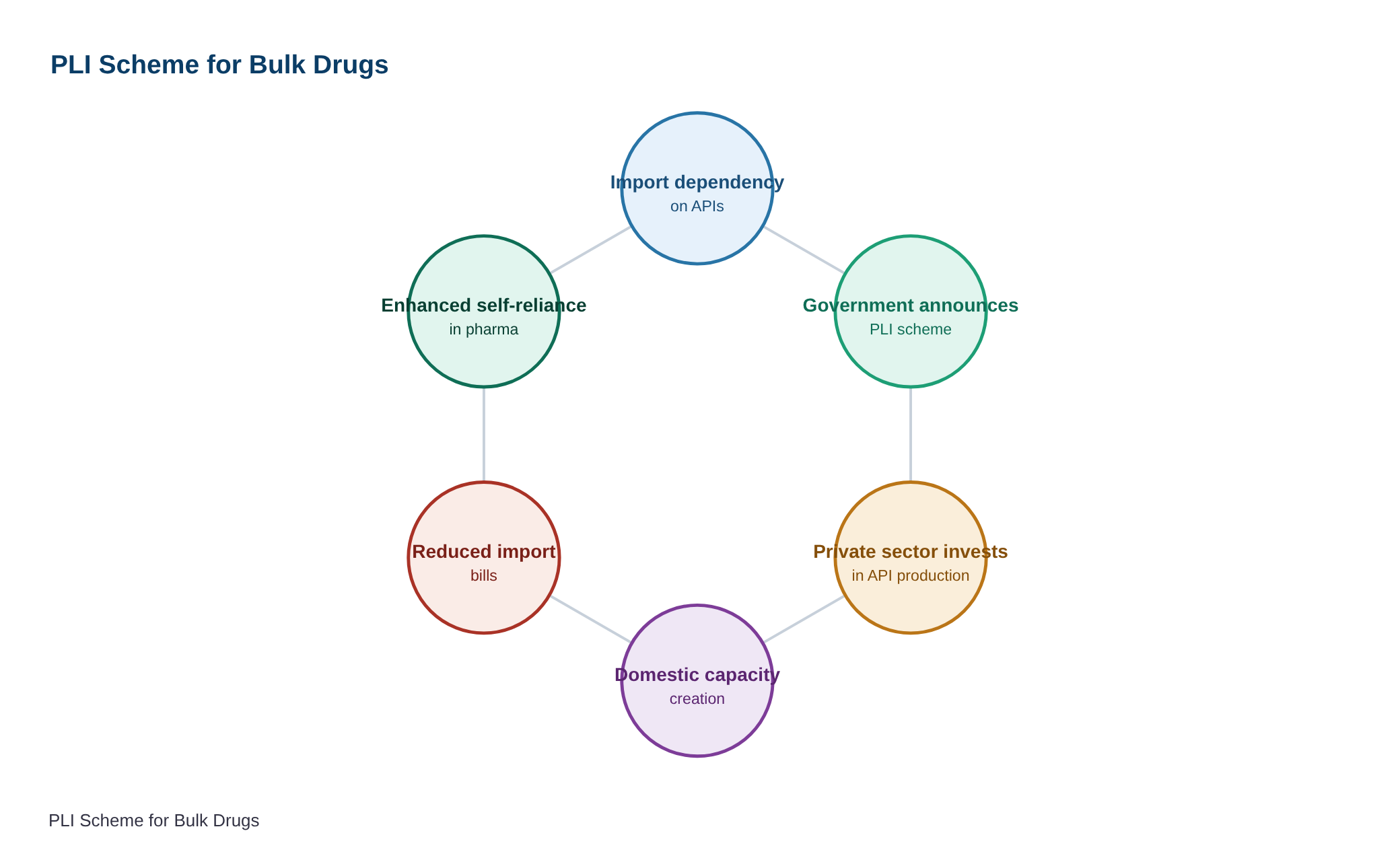
Import dependency on APIs → Government announces PLI scheme for bulk drugs → Private sector invests in API production → Domestic capacity creation → Reduced import bills → Enhanced pharmaceutical self-reliance.
Prelims Practice Questions
Q1. Consider the following statements regarding the Production-Linked Incentive (PLI) Scheme for Bulk Drugs in India:
1. The scheme aims to promote domestic production of Active Pharmaceutical Ingredients (APIs) and Key Starting Materials (KSM).
2. The scheme provides financial incentives linked to incremental sales achieved by the applicant over a period of six years.
3. The scheme was launched under the aegis of the Ministry of Chemicals and Fertilizers.
4. The scheme does not cover Drug Intermediates (DI) for production incentives.
How many of the above statements are correct?
- Only one
- Only two
- Only three
- All four
Answer: Only three — Statements 1 and 3 are correct. Statement 2 is incorrect as the PLI scheme provides incentives linked to incremental sales over a period of six years, but the scheme does cover Drug Intermediates (DI) for production incentives, making statement 4 incorrect.
Q2. Assertion (A): The PLI Scheme for Bulk Drugs aims to reduce India’s dependence on imports of critical pharmaceutical ingredients.
Reason (R): The scheme provides production-linked incentives only to those manufacturers who achieve a minimum threshold of export sales.
Options:
A. Both A and R are true, and R is the correct explanation of A.
B. Both A and R are true, but R is not the correct explanation of A.
C. A is true, but R is false.
D. A is false, but R is true.
Answer: ? — Assertion (A) is true as the scheme is designed to boost domestic production of APIs, KSMs, and DIs to reduce import dependency. However, Reason (R) is false because the PLI scheme provides incentives based on incremental sales, not export sales.
Q3. Match the following pharmaceutical ingredients with their respective categories under the PLI Scheme for Bulk Drugs:
Column I (Ingredient) Column II (Category)
A. Penicillin G 1. Key Starting Material (KSM)
B. Dexamethasone 2. Active Pharmaceutical Ingredient (API)
C. Cyclohexane Diacetic Acid (CDA) 3. Drug Intermediate (DI)
D. Paracetamol 4. Not covered under the scheme
Options:
A. A-1, B-2, C-3, D-4
B. A-2, B-1, C-3, D-4
C. A-1, B-2, C-4, D-3
D. A-2, B-1, C-4, D-3
- A
- B
- C
- D
Answer: A — Penicillin G is a Key Starting Material (KSM), Dexamethasone is an Active Pharmaceutical Ingredient (API), Cyclohexane Diacetic Acid (CDA) is a Drug Intermediate (DI), and Paracetamol is not covered under the PLI Scheme for Bulk Drugs as it is a formulation, not an API/KSM/DI.
Mains Practice Question
✍ The Production-Linked Incentive (PLI) Scheme for Bulk Drugs represents a strategic intervention to enhance India’s pharmaceutical self-reliance. Critically examine the scheme’s objectives, implementation challenges, and its potential impact on reducing import dependence in the pharmaceutical sector. Also, analyse how this scheme aligns with the broader goals of Atmanirbhar Bharat. (15 Marks)
Approach: 1. **Objectives of the PLI Scheme for Bulk Drugs**:
– Outline the scheme’s primary goal: to boost domestic production of Active Pharmaceutical Ingredients (APIs), Key Starting Materials (KSMs), and Drug Intermediates (DIs).
– Highlight the financial outlay (₹6,940 crore) and the number of approved projects (48).
– Mention the specific products covered (e.g., Penicillin G, Dexamethasone, Atorvastatin) and their strategic importance.
2. **Implementation Challenges**:
– **Regulatory and Compliance Issues**: Discuss the complexities of regulatory approvals for bulk drug manufacturing, including environmental and safety norms.
– **Infrastructure Gaps**: Highlight the need for dedicated manufacturing clusters, R&D facilities, and skilled workforce development.
– **Market Dynamics**: Address challenges such as global competition, price volatility of raw materials, and the dominance of Chinese APIs in the global market.
– **Financial Viability**: Critically assess the disbursement of incentives (₹87.70 crore utilised by March 2026) and the actual investment realised (₹5,070.45 crore against a commitment of ₹4,329.95 crore).
3. **Impact on Import Dependence**:
– **Quantitative Impact**: Reference the creation of production capacity for 28 APIs/KSMs/DIs, with 18 already in commercial production, reducing reliance on imports.
– **Qualitative Impact**: Discuss the shift from import dependency to self-sufficiency in critical drugs like Penicillin G, Dexamethasone, and Atorvastatin.
– **Sectoral Benefits**: Explain how reduced import dependence can stabilise drug prices, ensure uninterrupted supply, and enhance India’s global competitiveness in pharmaceuticals.
4. **Alignment with Atmanirbhar Bharat**:
– **Policy Synergy**: Link the scheme to the broader Atmanirbhar Bharat initiative, emphasising its role in reducing India’s trade deficit in pharmaceuticals.
– **Supply Chain Resilience**: Discuss how the scheme contributes to building resilient supply chains, particularly post-COVID-19 disruptions.
– **Economic and Strategic Benefits**: Highlight the potential for job creation, technological upgradation, and reduced geopolitical vulnerabilities in the pharmaceutical sector.
5. **Critical Evaluation and Way Forward**:
– **Successes**: Acknowledge the scheme’s early successes, such as the approval of 48 projects and the commencement of production for 18 APIs.
– **Gaps**: Identify gaps such as the slow pace of project implementation in certain states (e.g., Haryana, Jammu & Kashmir) and the need for stronger industry-academia collaboration.
– **Recommendations**: Suggest measures like streamlining regulatory processes, providing additional fiscal incentives for R&D, and fostering public-private partnerships to accelerate growth.
Source: PIB (Press Information Bureau)
Generated by AanyaAi for educational purpose.

- आंध्र प्रदेश में चार नए पुलिस आयुक्तालयों को कैबिनेट की मंजूरी, जानिए क्या होंगे फायदे - September 23, 2026
- Andhra Pradesh to get 4 new Police Commissionerates: Key UPSC insights - September 23, 2026
- AI आधारित ‘HEADS’ से भारत में अवसाद जांच में क्रांति: जानिए कैसे होगा मदद - September 23, 2026

No Comments