


08 Aug Ebola Outbreak in DR Congo: Rising Child Deaths & New Vaccine Hope for UPSC 2026
✎ The Ervebo vaccine, while licensed for the Zaire ebolavirus species, is being evaluated for potential cross-protection against the Bundibugyo species, a critical development for controlling the current DRC outbreak and future…
Subject Relevance — Where This Topic Fits
- GS Paper II — International Relations: Global Health Governance and WHO’s Role | GS Paper III — Science and Technology: Epidemiology, Vaccine Development, and Public Health Interventions | GS Paper III — Disaster Management: Health Emergencies and Humanitarian Crises
- Prelims: Ebola Virus Disease (EVD), Bundibugyo ebolavirus, Public Health Emergency of International Concern (PHEIC), Ervebo vaccine, Africa Centres for Disease Control (Africa CDC), Democratic Republic of the Congo (DRC), Ituri Province, zoonotic disease, maternal mortality, herd immunity
- Essay: The intersection of public health emergencies and humanitarian crises: Lessons from the Ebola outbreak in the DRC, Vaccine diplomacy and global health security: The role of WHO and international agencies in combating emerging infectious diseases
Quick Revision: The Ervebo vaccine, while licensed for the Zaire ebolavirus species, is being evaluated for potential cross-protection against the Bundibugyo species, a critical development for controlling the current DRC outbreak and future outbreaks caused by less common Ebola virus strains.
Why is this in the news?
The ongoing Ebola outbreak in the eastern Democratic Republic of the Congo (DRC), caused by the Bundibugyo ebolavirus species, has escalated with over 300 childhood deaths since May 2026, disproportionately affecting women and children in a conflict-ridden region. Concurrently, the World Health Organization (WHO) has recommended the evaluation of the Ervebo vaccine—currently licensed for the Zaire ebolavirus species—in a randomised clinical trial for potential cross-protection against Bundibugyo, offering a critical breakthrough in outbreak control and vaccine diplomacy.
Background
- The Democratic Republic of the Congo (DRC) has experienced recurrent Ebola outbreaks since the first recorded case in 1976, with the Zaire ebolavirus species being the most common cause of prior epidemics.
- The current outbreak is caused by the Bundibugyo ebolavirus species, a less common but equally lethal strain with a case fatality rate of approximately 50%.
- The eastern DRC, particularly Ituri Province, is a conflict-affected region with nearly one million internally displaced persons (IDPs), where women and children constitute 80% of the displaced population, exacerbating vulnerability to infectious diseases.
- Historical challenges in Ebola control in the DRC include community mistrust, misinformation, and the disruption of essential healthcare services due to conflict and resource constraints.
- The Ervebo vaccine, developed by Merck, is the first and only licensed vaccine for Ebola Virus Disease (EVD), specifically targeting the Zaire ebolavirus species, and has been instrumental in controlling previous outbreaks in the DRC and West Africa.
What is Ebola Virus Disease (EVD)?
- Ebola Virus Disease (EVD) is a severe, often fatal zoonotic disease caused by the Ebola virus, a member of the Filoviridae family, with five known species: Zaire, Bundibugyo, Sudan, Taï Forest, and Reston.
- The virus is transmitted to humans through direct contact with the blood, secretions, organs, or other bodily fluids of infected animals (e.g., fruit bats, primates) or humans, with human-to-human transmission occurring via bodily fluids or contaminated environments.
- The Bundibugyo ebolavirus species, first identified in Uganda in 2007, has a case fatality rate of approximately 50% and is associated with severe haemorrhagic fever, gastrointestinal symptoms, and multi-organ failure.
- Symptoms of EVD include sudden onset of fever, intense weakness, muscle pain, headache, sore throat, vomiting, diarrhoea, and in severe cases, internal and external bleeding (e.g., haemorrhagic manifestations).
- The disease has an incubation period of 2 to 21 days, during which infected individuals may unknowingly spread the virus, complicating containment efforts.
- EVD is classified as a Category A Priority Pathogen by the WHO due to its high fatality rate, potential for human-to-human transmission, and lack of approved treatments for most species, including Bundibugyo.
- Diagnosis is confirmed through laboratory tests such as PCR, antigen detection, or antibody detection, while treatment primarily involves supportive care, including rehydration, symptom management, and experimental therapies like monoclonal antibodies (e.g., mAb114, REGN-EB3).
- Preventive measures include infection control practices, safe burial protocols, contact tracing, and vaccination campaigns, with the Ervebo vaccine being the only licensed preventive measure for the Zaire species.
Key Features
| Feature | Significance |
|---|---|
| Bundibugyo Ebola species outbreak in eastern DRC | A rare and lethal strain of Ebola virus, distinct from the Zaire species, causing a concentrated outbreak in Ituri Province since mid-May 2026. |
| Disproportionate impact on children and women | Children constitute nearly 25% of confirmed cases but account for 30% of deaths; pregnant women face near-universal fetal loss and rising maternal mortality. |
| Collapse in essential healthcare utilisation | Health service utilisation in worst-affected areas has declined by over 40% due to fear of infection, exacerbating maternal and child health crises. |
| Community engagement via 13,000 workers | Deployment of health workers to counter misinformation, conduct household visits, and restore trust in healthcare systems amid conflict-displaced populations. |
| Ervebo vaccine trial recommendation | WHO advisory group recommends evaluating the licensed Ervebo vaccine for cross-protection against Bundibugyo Ebola, following preliminary animal study data. |
Why it Matters
Public Health Emergency
- The outbreak is classified as a Public Health Emergency of International Concern (PHEIC), necessitating global coordination and resource mobilisation under the International Health Regulations (2005).
- The rare Bundibugyo species poses unique challenges due to limited prior vaccine efficacy data, requiring rapid research to curb transmission.
Humanitarian Crisis
- The outbreak exacerbates an existing conflict-driven displacement crisis in Ituri, where nearly 1 million people are displaced, 80% of whom are women and children.
- Disruption of maternal and child health services threatens to reverse decades of progress in reducing maternal and under-five mortality in the region.
Global Health Governance
- The WHO’s role in convening expert panels and recommending vaccine trials underscores the organisation’s function as a global health authority under the WHO Constitution.
- The Africa CDC’s involvement highlights regional cooperation in managing cross-border health threats, aligning with the Africa Health Strategy and the Abuja Declaration.
Vaccine Diplomacy and Equity
- The trial of Ervebo for Bundibugyo Ebola reflects the principle of equitable access to medical countermeasures, a core tenet of global health security frameworks.
- Rapid vaccine evaluation in low-resource settings demonstrates the need for international partnerships to ensure timely deployment in outbreak zones.
Challenges
1. Healthcare System Collapse
- Over 40% decline in health service utilisation due to fear of infection, leading to untreated non-Ebola conditions and secondary health crises.
- Pregnant women’s avoidance of care has doubled maternal deaths, indicating systemic failure in maintaining essential services during outbreaks.
UPSC Link: GS2: Health Infrastructure
2. Conflict and Displacement
- Nearly 1 million displaced persons in Ituri, 80% women and children, creating logistical barriers to outbreak containment and healthcare delivery.
- Armed conflict disrupts surveillance, vaccination campaigns, and community engagement efforts.
UPSC Link: GS2: Internal Security
3. Vaccine Efficacy Uncertainty
- Ervebo’s efficacy against Bundibugyo Ebola remains unproven; reliance on cross-protection data from animal studies introduces scientific uncertainty.
- Limited vaccine stockpiles and logistical constraints in conflict zones delay rapid immunisation even if trials confirm efficacy.
UPSC Link: GS3: Science and Technology
4. Misinformation and Trust Deficit
- Widespread misinformation about Ebola transmission and treatment fuels avoidance of health services and resistance to vaccination.
- Community workers face challenges in countering deep-seated beliefs and stigma, particularly in areas with low literacy and high conflict trauma.
UPSC Link: GS2: Social Justice
5. Resource Mobilisation Gaps
- Insufficient funding and logistical support for outbreak response, including personal protective equipment (PPE), diagnostics, and cold-chain maintenance.
- Dependence on external agencies (UNICEF, WHO, Africa CDC) highlights structural gaps in domestic health financing and preparedness.
UPSC Link: GS2: International Organisations
Challenges — UPSC Perspective
| Issue | Concern |
|---|---|
| High case fatality rate among children | 30% of confirmed cases in children result in death, significantly higher than the overall case fatality rate. |
| Maternal health crisis | Near doubling of maternal deaths and near-universal fetal loss due to Ebola infection during pregnancy. |
| Displacement-induced vulnerability | 80% of displaced persons are women and children, increasing exposure to disease and barriers to healthcare access. |
| Vaccine trial logistical hurdles | Conducting randomised trials in conflict zones with limited infrastructure and security risks. |
| Community resistance to health services | Fear and misinformation leading to avoidance of treatment centres and vaccination campaigns. |
| Limited diagnostic capacity | Inadequate laboratory infrastructure in Ituri to rapidly confirm Bundibugyo Ebola cases, delaying outbreak response. |
Way Forward
- Conduct accelerated, randomised clinical trials of Ervebo for Bundibugyo Ebola in DRC, leveraging existing health infrastructure and community networks.
- Scale up community engagement programmes to counter misinformation, using local leaders, religious figures, and survivor testimonies to rebuild trust in health services.
- Prioritise maternal and child health services by integrating Ebola surveillance with routine antenatal and paediatric care to mitigate secondary health crises.
- Strengthen cross-border surveillance with neighbouring countries (Uganda, South Sudan, Central African Republic) to prevent regional spread of the Bundibugyo strain.
- Mobilise additional funding from international donors (World Bank, Global Fund, Gavi) to address gaps in PPE, diagnostics, and vaccine cold-chain logistics.
- Enhance domestic health financing in DRC to reduce reliance on external agencies and improve outbreak preparedness and response capabilities.
- Deploy mobile health units to conflict-affected and hard-to-reach areas to ensure continuous access to essential services and outbreak control measures.
- Establish a regional stockpile of Ebola vaccines and therapeutics, with equitable distribution mechanisms to ensure rapid deployment during future outbreaks.
UPSC Value Addition
Keywords for Mains Answer-Writing
Ebola virus disease (EVD), Bundibugyo ebolavirus, Public Health Emergency of International Concern (PHEIC), WHO Technical Advisory Group, Ervebo vaccine, zoonotic diseases, health system resilience, humanitarian crisis in DR Congo, maternal and child health, community-based health interventions, Africa Centres for Disease Control and Prevention (Africa CDC), UNICEF, UNFPA, OCHA, vaccine trials, cross-protection in vaccines, health service disruption · Epidemiology of Ebola, International Health Regulations (IHR) 2005, One Health approach, global health security, vaccine hesitancy, health inequities in conflict zones, WHO’s role in public health emergencies, ethical dimensions of vaccine trials, health workforce deployment, misinformation in health crises
Concept Flow
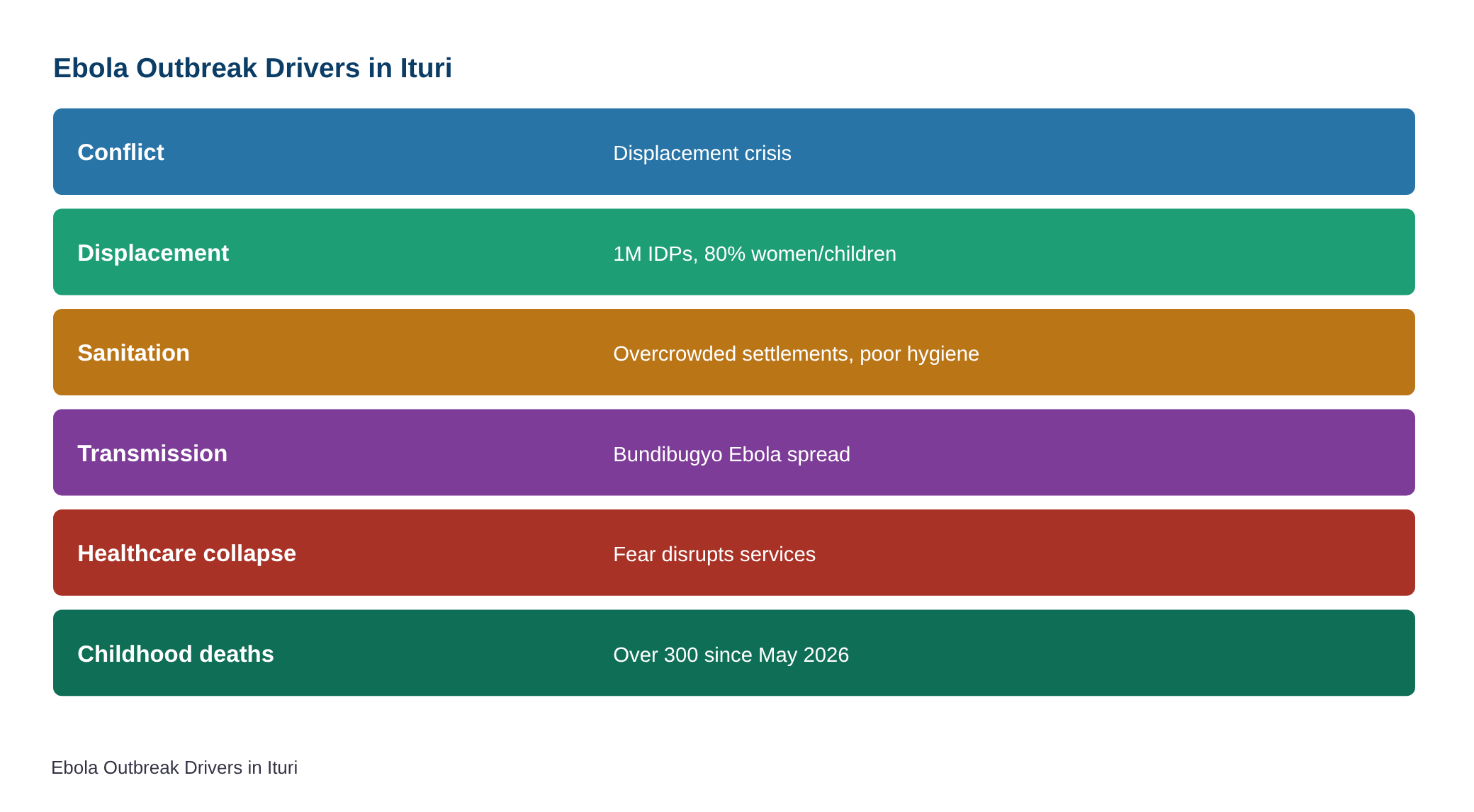
Conflict-driven displacement in Ituri → Overcrowded settlements with poor sanitation → Increased transmission of infectious diseases including Bundibugyo Ebola → Collapse of healthcare utilisation due to fear → Rising maternal and child mortality → WHO declares PHEIC → Urgent need for vaccine efficacy data → Recommendation for Ervebo trial → Community engagement to restore trust → Potential reduction in transmission → Stabilisation of health services.
Prelims Practice Questions
Q1. Consider the following statements regarding the Ebola virus disease (EVD) outbreak in the Democratic Republic of the Congo (DRC) as reported in August 2026:
1. The outbreak is caused by the Bundibugyo species of Ebola virus.
2. The Ervebo vaccine, licensed for the Zaire species, is being evaluated for potential cross-protection against Bundibugyo ebolavirus.
3. The outbreak has been declared a Public Health Emergency of International Concern (PHEIC) under the International Health Regulations (IHR) 2005.
4. Over 300 children have died in the outbreak, accounting for nearly a third of all confirmed cases.
How many of the above statements are correct?
- Only one
- Only two
- Only three
- All
Answer: All — Statements 1, 2, and 3 are correct. Statement 4 is incorrect: children account for nearly a quarter of confirmed cases but almost a third of all deaths, not a third of all confirmed cases.
Q2. Assertion (A): The Ervebo vaccine, licensed for Ebola Zaire, is the only licensed vaccine against Ebola virus disease.
Reason (R): The WHO Technical Advisory Group has recommended its evaluation for potential cross-protection against the Bundibugyo species in a randomised clinical trial.
In the context of the above statements, which of the following is correct?
- Both A and R are true, and R is the correct explanation of A.
- Both A and R are true, but R is not the correct explanation of A.
- A is true, but R is false.
- A is false, but R is true.
Answer: A is true, but R is false. — Assertion (A) is true: Ervebo is the only licensed vaccine against Ebola Zaire. Reason (R) is also true: the WHO advisory group recommended its evaluation for cross-protection against Bundibugyo. However, R does not explain A, as the licensure pertains to Zaire, not Bundibugyo.
Q3. Match the following international organisations with their respective roles in the Ebola outbreak response in the Democratic Republic of the Congo (DRC) as reported in August 2026:
Organisation | Role
1. UNICEF | A. Coordination of humanitarian aid and protection of civilians
2. WHO | B. Deployment of community health workers and health education
3. OCHA | C. Technical leadership in global health emergencies and vaccine evaluation
4. Africa CDC | D. Provision of vaccines and health system support
Select the correct match:
- 1-A, 2-B, 3-C, 4-D
- 1-B, 2-C, 3-A, 4-D
- 1-D, 2-C, 3-A, 4-B
- 1-C, 2-D, 3-B, 4-A
Answer: 1-D, 2-C, 3-A, 4-B — 1-B: UNICEF deployed community health workers and conducted health education. 2-C: WHO provided technical leadership and vaccine evaluation. 3-A: OCHA coordinated humanitarian aid. 4-D: Africa CDC provided vaccines and health system support.
Mains Practice Question
✍ Critically examine the challenges posed by the Ebola virus disease (EVD) outbreak in the Democratic Republic of the Congo (DRC) to global health security and the ethical dimensions of deploying the Ervebo vaccine in a new context. Also, analyse the role of international organisations in mitigating the outbreak. (15 Marks)
Approach: MODEL-ANSWER SKELETON:
1. **Introduction (2 marks)**: Define EVD and its significance as a zoonotic disease under the International Health Regulations (IHR) 2005. Mention the declaration of the outbreak as a Public Health Emergency of International Concern (PHEIC) in May 2026.
2. **Challenges to Global Health Security (4 marks)**:
– **Zoonotic spillover and cross-species transmission**: Explain the role of the Bundibugyo species and its implications for vaccine efficacy.
– **Health system resilience**: Discuss the disruption of essential healthcare services (e.g., 40% drop in service utilisation) due to fear and overstretched resources.
– **Vulnerable populations**: Highlight the disproportionate impact on children (25% of cases, 30% of deaths) and pregnant women (doubling of maternal deaths).
– **Humanitarian crisis**: Link to the displacement of nearly 1 million people in Ituri province, exacerbating health inequities.
3. **Ethical Dimensions of Vaccine Deployment (4 marks)**:
– **Licensure and cross-protection**: Discuss the ethical imperative of evaluating Ervebo for Bundibugyo, balancing expedited trials with informed consent and community trust.
– **Vaccine hesitancy and misinformation**: Analyse the role of community workers in countering misinformation and restoring confidence.
– **Equity in access**: Address the challenge of equitable vaccine distribution in conflict zones and among marginalised groups.
– **Precautionary principle**: Weigh the risks of deploying an untested vaccine against the urgency of controlling the outbreak.
4. **Role of International Organisations (3 marks)**:
– **WHO**: Technical leadership, vaccine evaluation, and declaration of PHEIC.
– **UNICEF and UNFPA**: Deployment of community health workers, maternal and child health interventions.
– **Africa CDC and OCHA**: Coordination of regional responses and humanitarian aid.
5. **Conclusion (2 marks)**: Summarise the interplay between global health security, ethical considerations, and the need for a One Health approach. Emphasise the importance of community engagement and international cooperation in mitigating such outbreaks.
Source: news.un.org
Generated by AanyaAi for educational purpose.

- तमिलनाडु के लिए क्या है ‘एल नीनो’ और उत्तर-पूर्वी मानसून का खतरा? - September 23, 2026
- El Nino & Northeast Monsoon: Impact on Tamil Nadu for UPSC 2026 - September 23, 2026
- हिमाचल में डिजिटल भुगतान क्रांति: बिलासपुर अव्वल, महिलाओं की भागीदारी 93% तक पहुंची - September 23, 2026

No Comments