


08 Aug Karnataka Bike Taxi Crackdown: Association Seeks Policy Clarity for Gig Workers
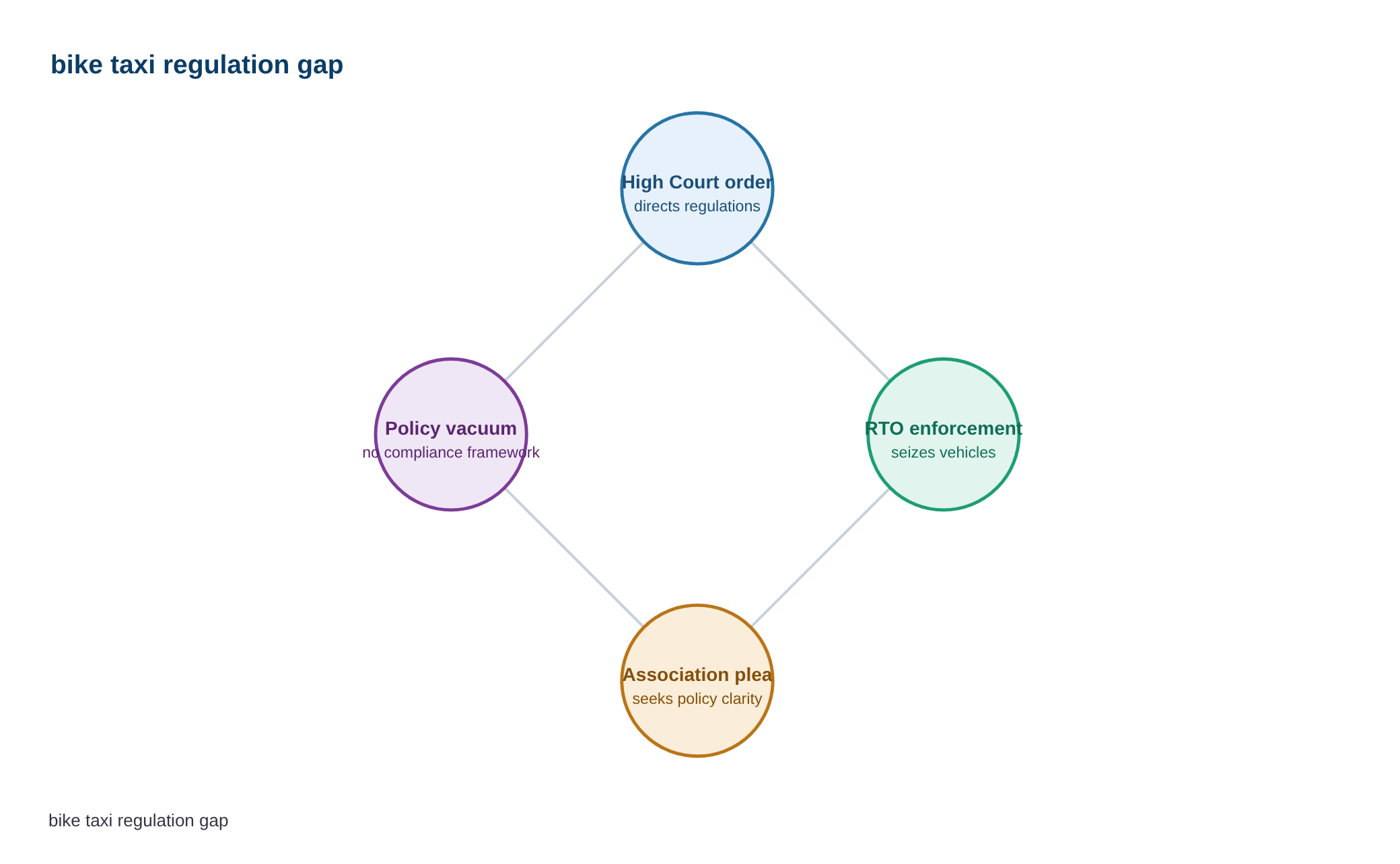
✎ The Karnataka High Court’s directive to frame regulations for bike taxis has exposed regulatory gaps, necessitating immediate executive action to provide a transparent compliance framework for gig workers.
Subject Relevance — Where This Topic Fits
- GS Paper III — Economy: Issues relating to Planning, Mobilisation of Resources, Growth, Development and Employment | GS Paper III — Infrastructure: Transport and Services Sector | GS Paper II — Governance: Government Policies and Interventions for Development in various sectors and Issues arising out of their Design and Implementation
- Prelims: Gig economy, Bike taxis, Regional Transport Office (RTO), Commercial vehicle permits, Karnataka High Court, White-board and yellow-board vehicles, Public transport regulation
- Essay: The role of technology in transforming traditional sectors: Challenges and opportunities, Balancing regulation and innovation in emerging economic models
Quick Revision: The Karnataka High Court’s directive to frame regulations for bike taxis has exposed regulatory gaps, necessitating immediate executive action to provide a transparent compliance framework for gig workers.
Why is this in the news?
The Namma Bike Taxi Association has petitioned the Karnataka government to halt enforcement actions against bike taxi operators, citing the absence of a legal compliance framework despite a Karnataka High Court order. The association represents over one lakh gig workers whose livelihoods are threatened by arbitrary penalties and vehicle seizures, highlighting a critical gap between judicial directives and executive implementation in regulating the gig economy.
Background
- Bike taxis have emerged as a popular last-mile connectivity solution in urban India, particularly in Bengaluru, due to their affordability and accessibility.
- The Karnataka High Court, in a recent order, directed the state government to frame regulations for bike taxis, prompting the Transport Department to initiate enforcement drives.
- The Namma Bike Taxi Association, representing over 1,00,000 drivers and gig workers, alleges that the Transport Department and RTOs have failed to provide clear guidelines on registration, commercial permits, and safety norms for legal operation.
- Enforcement actions in Bengaluru have intensified, with 54 suspected bike taxis inspected on a single day, resulting in 18 vehicles being booked and seized across various RTO jurisdictions.
- The association argues that penalising drivers without a prior compliance framework is unjust and disproportionately impacts gig workers who lack institutional support or legal recourse.
- This issue underscores broader challenges in regulating the gig economy, where technological disruption outpaces legislative and administrative responses.
What are Bike Taxis and the Regulatory Framework Governing Them?
- Bike taxis are two-wheeler vehicles used for point-to-point passenger transport, typically for short distances, and operate through digital platforms or as informal services.
- In India, bike taxis are classified as commercial vehicles, requiring commercial permits (yellow-board registration) and adherence to safety norms such as helmets, insurance, and driver licensing.
- The Motor Vehicles Act, 1988, and the Central Motor Vehicles Rules, 1989, govern the operation of commercial vehicles, including bike taxis, while state governments frame supplementary regulations.
- State transport authorities, such as RTOs, are responsible for enforcing compliance, issuing permits, and conducting inspections, but their actions are often constrained by ambiguous or absent guidelines.
- The gig economy, characterised by short-term contracts and freelance work, has expanded rapidly with the rise of app-based services, necessitating adaptive regulatory frameworks to protect workers and consumers.
- Regulatory ambiguity in the gig economy can lead to exploitation, unfair penalties, and legal disputes, as seen in the case of bike taxi operators in Karnataka.
- Stakeholder consultations with unions, platform aggregators, and transport authorities are essential to design inclusive and practical regulations that balance innovation with public safety.
- The Karnataka High Court’s intervention highlights the judiciary’s role in ensuring that executive actions align with constitutional and statutory mandates, particularly in emerging sectors.
Key Features
| Feature | Significance |
|---|---|
| Namma Bike Taxi Association representation | Represents over one lakh bike taxi drivers and gig workers in Karnataka, providing a collective bargaining platform for policy engagement and grievance redressal. |
| Karnataka High Court order (implied context) | Triggered renewed scrutiny of bike taxi operations, necessitating legal compliance frameworks for commercial vehicle registration and operation. |
| RTO enforcement drives | Intensified checks and seizures of unregistered bike taxis, reflecting regulatory ambiguity and lack of prior notification of legal compliance pathways. |
| White-board to yellow-board conversion | Proposed mechanism for transitioning private motorcycles to commercial vehicles, critical for legalising bike taxi operations under existing motor vehicle laws. |
| Stakeholder consultations | Inclusion of bike taxi unions in policy formulation ensures equitable representation and mitigates livelihood risks for gig workers. |
Why it Matters
Economic
- Gig economy employment: Bike taxis provide livelihood to over one lakh drivers in Karnataka, contributing to the informal sector’s economic dynamism.
- Urban mobility solution: Addresses last-mile connectivity gaps in Bengaluru, reducing dependency on private vehicles and public transport inefficiencies.
- Tax revenue potential: Legalisation could formalise the sector, enabling GST registration, commercial permit fees, and insurance compliance, broadening the tax base.
Regulatory
- Policy vacuum: Absence of a clear regulatory framework for bike taxis creates uncertainty, undermining both operator compliance and consumer safety.
- Judicial intervention: High Court orders necessitate executive action, highlighting the need for proactive policy formulation to align with judicial expectations.
- Enforcement asymmetry: Disproportionate penalties imposed without prior guidance violate principles of natural justice and procedural fairness.
Social
- Livelihood protection: Immediate suspension of enforcement is critical to prevent economic disenfranchisement of gig workers reliant on bike taxi incomes.
- Worker agency: Collective representation through associations empowers gig workers to negotiate policy terms and demand procedural transparency.
- Urban equity: Legal bike taxis can democratise access to affordable transport, particularly for low-income commuters in peri-urban Bengaluru.
Challenges
1. Regulatory Ambiguity
- Lack of standardised guidelines for converting private motorcycles to commercial vehicles under the Motor Vehicles Act, 1988.
- No clear definition of bike taxis as a distinct category of commercial transport, leading to inconsistent enforcement by RTOs.
- Delayed issuance of commercial permits and safety norms, exacerbating operational uncertainties for drivers.
UPSC Link: GS2: Regulatory bodies and governance
2. Enforcement Disproportionality
- Seizure of vehicles without prior notice or opportunity for compliance violates Article 19(1)(g) (right to profession) and principles of natural justice.
- Selective targeting in Bengaluru (e.g., Bengaluru East RTO) raises concerns of arbitrary enforcement and lack of uniform policy application.
- Penalties imposed without a defined appeals mechanism, leaving drivers vulnerable to financial and operational hardships.
UPSC Link: GS2: Fundamental Rights and DPSP
3. Gig Economy Vulnerabilities
- Absence of social security nets (e.g., health insurance, provident fund) for bike taxi drivers, compounding livelihood risks.
- Precarious employment status: Drivers lack formal employer-employee relationships, limiting access to labour protections and dispute resolution.
- Digital platform dependency: Over-reliance on app-based aggregators for income exposes workers to algorithmic control and sudden deactivation risks.
UPSC Link: GS3: Inclusive growth and employment
4. Urban Mobility Governance
- Fragmented transport policies: Bike taxis operate in a regulatory grey area, while traditional public transport (e.g., BMTC) faces its own challenges.
- Traffic management: Unregulated bike taxis contribute to congestion and road safety concerns, necessitating integrated urban transport planning.
- Environmental trade-offs: While bike taxis reduce carbon emissions compared to cars, their proliferation without safety norms may increase accident risks.
UPSC Link: GS3: Infrastructure and urban development
Challenges — UPSC Perspective
| Issue | Concern |
|---|---|
| Absence of legal definition | Bike taxis lack recognition as a distinct commercial transport category, leading to inconsistent enforcement. |
| No conversion mechanism | White-board to yellow-board transition lacks procedural clarity, impeding legalisation of existing vehicles. |
| Selective enforcement | Disproportionate penalties in specific RTO zones (e.g., Bengaluru East) undermine procedural fairness. |
| Livelihood insecurity | Enforcement drives threaten the economic stability of gig workers without prior safety nets or alternatives. |
| Regulatory overlap | Conflict between state transport policies and municipal urban planning creates governance vacuums. |
Way Forward
- The Karnataka government must issue an immediate moratorium on enforcement actions until a transparent conversion mechanism for white-board to yellow-board registration is notified.
- Constitute a multi-stakeholder committee, including bike taxi unions, RTO officials, and urban planners, to draft a comprehensive policy framework for bike taxi operations.
- Define safety norms and commercial permit criteria under the Motor Vehicles Act, 1988, ensuring alignment with national guidelines while addressing state-specific needs.
- Establish a grievance redressal mechanism for drivers facing penalties, including an appeals process and compensation for seized vehicles pending legal compliance.
- Integrate bike taxis into Bengaluru’s urban transport policy by mapping high-demand routes, setting fare regulations, and mandating insurance coverage for drivers and passengers.
- Launch a public awareness campaign to educate drivers on legal compliance, safety protocols, and the benefits of formalisation, in collaboration with driver associations.
- Explore pilot projects for bike taxi zones in areas with high last-mile demand, using data-driven insights to optimise route allocation and reduce congestion.
- Strengthen social security measures for gig workers, such as subsidised insurance schemes and skill development programs, to mitigate livelihood risks.
UPSC Value Addition
Keywords for Mains Answer-Writing
Gig economy regulation · Bike taxi policy framework · Regional Transport Offices (RTOs) · Karnataka High Court order · Commercial vehicle registration · Gig workers’ livelihood · Transport policy ambiguity · Public transport integration · Regulatory enforcement challenges · Stakeholder consultations
Constitutional & Policy Linkages
- Article 19(1)(g): Right to practise any profession or occupation, subject to reasonable restrictions.
- Article 21: Right to livelihood, read with principles of natural justice and procedural fairness.
- Article 14: Equality before law, highlighting the need for uniform enforcement across RTO jurisdictions.
Concept Flow
Karnataka High Court order → Renewed scrutiny of bike taxi operations → RTO enforcement drives → Seizure of unregistered vehicles → Association’s representation → Absence of legal compliance framework → Livelihood threats to gig workers → Gig economy growth → Informal employment surge → Policy vacuum → Regulatory ambiguity → Enforcement disproportion → Legal challenges → Demand for stakeholder consultations → Urban mobility gaps → Last-mile connectivity demand → Bike taxi proliferation → Traffic management issues → Safety concerns → Need for integrated transport policy → White-board motorcycles → Commercial yellow-board conversion → Motor Vehicles Act compliance → Permit issuance → Legalisation of bike taxis → Formal sector integration → Driver associations → Collective bargaining → Policy engagement → Transparent framework → Legal operation → Economic empowerment of gig workers
Prelims Practice Questions
Q1. Consider the following statements regarding bike taxi operations in Karnataka:
1. The Namma Bike Taxi Association represents over one lakh bike taxi drivers in Karnataka.
2. The Karnataka High Court recently directed the state government to immediately halt enforcement action against bike taxi riders.
3. Regional Transport Offices (RTOs) in Karnataka have issued clear guidelines for converting white-board motorcycles into commercial yellow-board vehicles.
How many of the above statements are correct?
- Only one
- Only two
- All three
- None
Answer: Only one — Statement 1 is correct as the association claims to represent over one lakh bike taxi drivers. Statement 2 is incorrect; the High Court did not direct an immediate halt but the association has urged it. Statement 3 is incorrect; RTOs have not issued clear guidelines.
Q2. Assertion (A): The Namma Bike Taxi Association has demanded the suspension of enforcement action against bike taxi riders until a legal compliance framework is established.
Reason (R): The association argues that penalising drivers without providing a mechanism for legal compliance is unjust and threatens the livelihoods of gig workers.
- Both A and R are true, and R is the correct explanation of A
- Both A and R are true, but R is not the correct explanation of A
- A is true, but R is false
- A is false, but R is true
Answer: Both A and R are true, and R is the correct explanation of A — Both the assertion and reason are true, and the reason correctly explains the assertion as the association’s demand is rooted in the lack of a compliance framework.
Q3. Match the following columns regarding transport policy and enforcement in Karnataka:
Column I
A. Namma Bike Taxi Association
B. Karnataka High Court
C. Regional Transport Offices (RTOs)
D. Gig workers
Column II
1. Issued directives to halt enforcement action
2. Represented by the association in policy consultations
3. Alleged to have failed to provide compliance guidelines
4. Threatened by enforcement drives without legal clarity
Select the correct match:
- A-2, B-1, C-3, D-4
- A-1, B-2, C-3, D-4
- A-4, B-1, C-2, D-3
- A-3, B-4, C-1, D-2
Answer: A-2, B-1, C-3, D-4 — A matches with 2 as the association represents gig workers. B matches with 1 as the High Court is referenced in the demand to halt enforcement. C matches with 3 as RTOs are alleged to have failed to provide guidelines. D matches with 4 as gig workers are threatened by enforcement drives.
Mains Practice Question
✍ The absence of a clear regulatory framework for gig economy platforms such as bike taxis has led to enforcement actions that threaten the livelihoods of thousands of workers. Critically examine the challenges in regulating the gig economy in India, with particular reference to the Karnataka bike taxi issue. Also, suggest measures to balance regulatory compliance with the protection of gig workers’ rights. (15 Marks)
Approach: Introduction: Define the gig economy and its significance in India’s urban transport sector. Mention the Karnataka bike taxi issue as a case study. Regulatory Challenges: Discuss the ambiguity in existing laws (e.g., Motor Vehicles Act, 1988; state transport policies) and the lack of clear guidelines for gig platforms. Highlight the role of RTOs and the Karnataka High Court’s role in the absence of legislative clarity. Gig Workers’ Vulnerabilities: Explain the precarious nature of gig work, lack of social security, and the impact of arbitrary enforcement actions on livelihoods. Reference the Namma Bike Taxi Association’s demands. Balancing Act: Discuss the need for a multi-stakeholder approach involving unions, platform operators, and government. Highlight successful models (e.g., Delhi’s draft gig policy, Kerala’s gig worker welfare board). Suggested Measures: Propose a clear policy framework with defined registration processes, commercial permits, safety norms, and grievance redressal mechanisms. Emphasise social security inclusion (e.g., ESIC, PMSBY) and periodic policy reviews. Conclusion: Stress the importance of regulatory certainty and worker-centric policies to ensure sustainable growth of the gig economy.
Source: The Hindu
Generated by AanyaAi for educational purpose.

- यूपीएससी/पीसीएस: 25 सितंबर 2026 को सरकारी प्रतिभूतियों की बोली प्रक्रिया, ₹34,000 करोड़ का पुनर्प्रस्ताव - September 24, 2026
- RBI to Auction ₹34,000 Crore Govt Securities on Sept 25, 2026: Key Details for UPSC & PCS - September 24, 2026
- भारत सेमीकंडक्टर उद्योग में ‘सकारात्मक चक्र’ की ओर: अशोक चंदक - September 24, 2026

No Comments