


08 Aug Madras HC directs BCI to collect data on lawyers with criminal records
✎ Advocates facing criminal prosecutions undermine the credibility of the justice system; Bar Councils must collect empirical data on such cases to frame appropriate regulatory measures under the Advocates Act, 1961.
Subject Relevance — Where This Topic Fits
- GS Paper II — Judiciary and Legal System | GS Paper IV — Ethics and Integrity in Governance
- Prelims: Bar Council of India (BCI), Bar Council of Tamil Nadu and Puducherry (BCTNP), Section 24 of the Advocates Act, 1961, suo motu cognizance, criminal antecedents of advocates, judicial ethics, contempt of court, professional misconduct, justice delivery system
- Essay: Ethical governance in public institutions: The role of self-regulation in professional bodies, The interplay between individual integrity and institutional credibility in the justice system
Quick Revision: Advocates facing criminal prosecutions undermine the credibility of the justice system; Bar Councils must collect empirical data on such cases to frame appropriate regulatory measures under the Advocates Act, 1961.
Why is this in the news?
On 8 August 2026, the Madras High Court, while hearing a criminal case quash petition involving a practicing advocate, suo motu observed an alarming trend of advocates facing criminal prosecutions and directed the Bar Council of India (BCI) and the Bar Council of Tamil Nadu and Puducherry (BCTNP) to collect empirical data on such cases. The Court highlighted the potential erosion of public trust in the justice system if advocates with criminal antecedents occupy leadership roles in Bar Associations, warranting immediate institutional intervention.
Background
- The Advocates Act, 1961, under Section 24, empowers State Bar Councils to regulate the legal profession and maintain standards of professional conduct among advocates.
- Bar Councils are statutory bodies responsible for enrolling advocates, disciplining errant members, and ensuring adherence to the Rules of Professional Conduct and Etiquette.
- The legal profession in India operates under a self-regulatory framework, where Bar Councils function as both regulators and representatives of the legal community.
- Recent judicial observations have underscored concerns about the increasing criminalisation of the legal profession, with instances of advocates facing multiple prosecutions.
- The Madras High Court’s intervention follows a pattern of suo motu judicial activism in matters concerning the integrity of the justice delivery system.
- The case reflects broader debates on professional ethics, institutional credibility, and the need for transparency in the legal fraternity.
What is the Legal Framework Governing Criminal Antecedents of Advocates?
- The Advocates Act, 1961, is the primary legislation governing the legal profession in India, with Section 24 defining the powers and functions of State Bar Councils, including disciplinary jurisdiction over advocates.
- Section 35 of the Advocates Act, 1961, empowers State Bar Councils to initiate disciplinary proceedings against advocates for professional misconduct, which may include criminal conduct if it impinges on their professional integrity.
- The Bar Council of India (BCI) is the apex statutory body under the Advocates Act, 1961, tasked with laying down standards of professional conduct, promoting legal education, and regulating the legal profession at the national level.
- State Bar Councils, including the Bar Council of Tamil Nadu and Puducherry (BCTNP), are responsible for enrolling advocates, maintaining rolls, and disciplining members for misconduct, including criminal offences that reflect on their professional standing.
- The Rules on Professional Standards issued by the BCI under Section 49(1)(c) of the Advocates Act, 1961, prescribe ethical obligations for advocates, including the duty to uphold the dignity of the profession and avoid conduct unbecoming of an officer of the court.
- Advocates are considered ‘officers of the court’ and are bound by the principles of judicial ethics, which include maintaining personal integrity and avoiding conflicts of interest that may undermine public trust in the justice system.
- The Supreme Court, in *In re: Vinay Chandra Mishra* (1995), held that advocates must adhere to the highest standards of probity, and any criminal conduct may constitute professional misconduct warranting disciplinary action.
- The concept of ‘collective responsibility’ in professional bodies like Bar Councils implies that the entire legal fraternity bears the burden of maintaining the profession’s reputation, necessitating proactive measures to address systemic issues.
Key Features
| Feature | Significance |
|---|---|
| Suo Motu Judicial Intervention | Highlights the proactive role of the judiciary in addressing systemic issues within the legal profession, ensuring accountability and transparency. |
| Empirical Data Collection Mandate | Emphasises the necessity of quantifiable data to formulate evidence-based policies for regulating the legal profession. |
| Criminalisation of Legal Profession | Raises concerns about the integrity of the justice delivery system when advocates facing criminal cases occupy leadership roles in Bar Associations. |
| Statutory Authority Involvement | Directs the Bar Council of India (BCI) and Bar Council of Tamil Nadu and Puducherry (BCTNP) to address the issue, underscoring their regulatory responsibility. |
| Institutional Concern Over Image | Links the credibility of the legal profession to public trust in the justice delivery system, necessitating systemic reforms. |
Why it Matters
Judicial Integrity & Professional Ethics
- Advocates are officers of the court and must uphold the highest ethical standards to maintain the dignity of the legal profession.
- Criminal allegations against lawyers undermine public confidence in the justice system and the Bar’s ability to self-regulate.
- Leadership roles in Bar Associations by individuals with criminal records pose a conflict of interest, potentially compromising client interests.
Regulatory Framework & Governance
- The BCI and BCTNP are statutorily mandated to regulate the legal profession; their failure to address criminalisation reflects governance gaps.
- Empirical data collection is a prerequisite for framing policies that can effectively deter criminal elements from entering or rising within the profession.
- The judgment underscores the need for proactive measures rather than reactive responses to systemic issues.
Public Trust & Justice Delivery
- The credibility of the justice delivery system is contingent on the integrity of its practitioners, including advocates.
- Widespread criminalisation among lawyers erodes public trust, which is essential for the effective functioning of the judiciary.
- The judgment serves as a reminder that the legal profession must be free from criminal influences to ensure fair and impartial justice.
Challenges
1. Criminalisation of the Legal Profession
- The increasing number of advocates facing criminal cases poses a direct threat to the ethical foundation of the legal system.
- Leaders of Bar Associations with criminal records may influence policy decisions, further entrenching unethical practices.
- Isolation of individual cases is insufficient; systemic reforms are required to address the scale of the issue.
UPSC Link: GS2: Regulatory bodies (BCI) and their functions
2. Data Collection & Policy Formulation
- Lack of empirical data hinders the ability of regulatory bodies to design targeted interventions.
- The judiciary’s intervention highlights the inadequacy of existing mechanisms to monitor and regulate the profession.
- Policy formulation must be evidence-based to ensure effectiveness and avoid arbitrary measures.
UPSC Link: GS2: Role of judiciary in policy-making
3. Conflict of Interest in Leadership Roles
- Advocates with criminal records occupying leadership positions in Bar Associations create conflicts of interest.
- Such leaders may prioritise personal or group interests over the welfare of the legal profession and clients.
- The judgment underscores the need for stricter eligibility criteria for leadership roles in professional bodies.
UPSC Link: GS4: Ethics in public life and conflict of interest
4. Public Perception & Systemic Credibility
- Widespread criminalisation among lawyers damages the public’s trust in the justice delivery system.
- The perception of impunity for criminal acts within the legal profession undermines the rule of law.
- Restoring public confidence requires visible and sustained efforts by regulatory bodies.
UPSC Link: GS2: Judiciary and public trust
Challenges — UPSC Perspective
| Issue | Concern |
|---|---|
| Criminalisation of Advocates | Undermines the ethical foundation of the legal profession and the justice delivery system. |
| Lack of Empirical Data | Hampers evidence-based policy formulation and targeted interventions. |
| Leadership with Criminal Records | Creates conflicts of interest and compromises the integrity of Bar Associations. |
| Regulatory Gaps | Highlights the failure of statutory bodies to proactively address systemic issues. |
| Public Trust Erosion | Damages the credibility of the legal system and the judiciary. |
Way Forward
- BCI and BCTNP must commission empirical studies to quantify the extent of criminalisation among advocates.
- Formulate clear eligibility criteria for leadership roles in Bar Associations, excluding individuals with criminal records.
- Develop a robust grievance redressal mechanism within Bar Councils to address ethical violations.
- Conduct regular audits and inspections of Bar Associations to ensure compliance with ethical standards.
- Enhance transparency by publishing annual reports on disciplinary actions taken against errant advocates.
- Collaborate with law enforcement agencies to expedite the disposal of criminal cases against lawyers.
- Introduce mandatory ethics training and certification for advocates seeking leadership positions.
- Establish a national-level task force to monitor and address the criminalisation of the legal profession.
UPSC Value Addition
Keywords for Mains Answer-Writing
Bar Council of India · Bar Council of Tamil Nadu and Puducherry · Advocates Act, 1961 · Madras High Court · Criminalisation of legal profession · Judicial ethics · Regulation of legal profession · Justice D. Bharatha Chakravarthy · Empirical data on advocates · Bar Associations leadership · Professional integrity · Justice delivery system · Statutory regulation of lawyers · Institutional credibility · Ethical standards in legal profession
Constitutional & Policy Linkages
- [‘Article 14: Equality before law’, ‘Ensures fair treatment of advocates facing criminal allegations.’]
- [‘Article 21: Right to life and personal liberty’, ‘Protects the rights of advocates while upholding judicial integrity.’]
- [‘Article 50: Separation of judiciary’, ‘Highlights the need for an independent and ethical legal profession.’]
Concept Flow
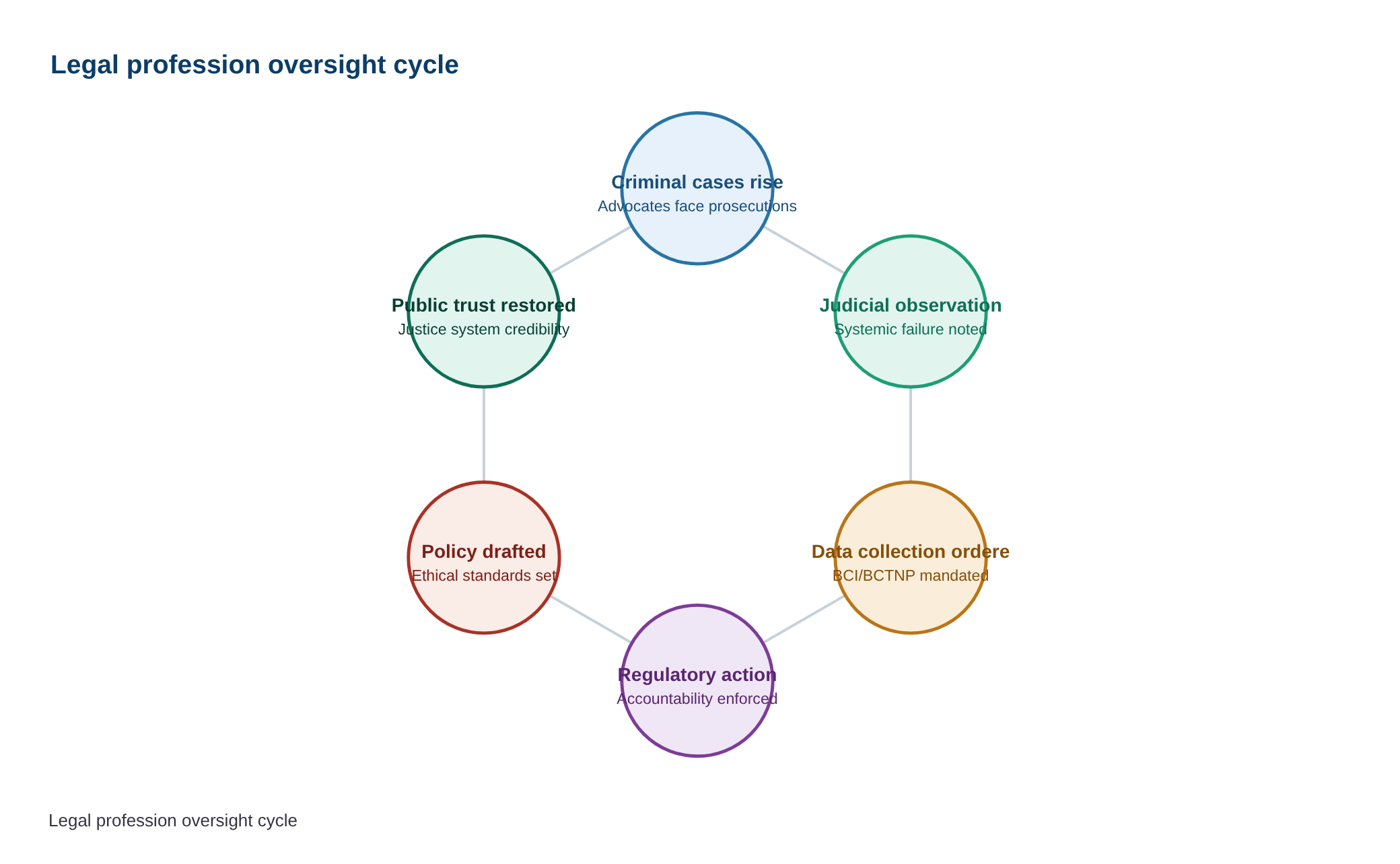
Increasing criminal cases against advocates → Judicial observation on systemic failure → Mandate for empirical data collection → Regulatory bodies (BCI/BCTNP) held accountable → Policy formulation for ethical standards → Restoration of public trust in the justice system.
Prelims Practice Questions
Q1. Consider the following statements regarding the regulation of the legal profession in India:
1. The Bar Council of India (BCI) is a statutory body established under the Advocates Act, 1961.
2. The Bar Council of Tamil Nadu and Puducherry (BCTNP) is empowered to collect data on advocates facing criminal cases.
3. The Madras High Court has suo motu impleaded the BCI and BCTNP in a case regarding criminalisation of the legal profession.
How many of the above statements are correct?
- Only one
- Only two
- Only three
- None
Answer: Only three — Statements 1 and 3 are correct. Statement 2 is incorrect as the BCI and BCTNP are being directed by the Madras High Court to collect such data, but they are not currently empowered to do so under existing provisions.
Q2. Assertion (A): The Advocates Act, 1961, vests the power to regulate the legal profession exclusively with the Bar Council of India (BCI).
Reason (R): The BCI is a constitutional body established under Article 324 of the Constitution of India.
Options:
A. Both A and R are true, and R is the correct explanation of A.
B. Both A and R are true, but R is not the correct explanation of A.
C. A is true, but R is false.
D. A is false, but R is true.
Answer: ? — Assertion (A) is true as the Advocates Act, 1961, vests regulatory powers in the BCI. Reason (R) is false because the BCI is not a constitutional body under Article 324; it is a statutory body established under the Advocates Act, 1961.
Q3. Match the following bodies with their respective jurisdictions:
Column I
1. Bar Council of India (BCI)
2. Bar Council of Tamil Nadu and Puducherry (BCTNP)
3. Supreme Court of India
4. High Courts
Column II
A. Regulates legal profession at the national level
B. Regulates legal profession at the state level
C. Adjudicates disputes related to the legal profession
D. Implements policies for the legal profession
Options:
1-A, 2-B, 3-C, 4-D
1-B, 2-A, 3-C, 4-D
1-A, 2-B, 3-D, 4-C
1-D, 2-B, 3-C, 4-A
Answer: ? — The correct match is: 1-A (BCI regulates legal profession at the national level), 2-B (BCTNP regulates legal profession at the state level), 3-C (Supreme Court adjudicates disputes), 4-D (High Courts implement policies for the legal profession).
Mains Practice Question
✍ The Madras High Court has observed that the increasing trend of advocates facing criminal cases, including those who later assume leadership positions in Bar Associations, poses a serious threat to the credibility of the legal profession and the justice delivery system. Critically examine the institutional safeguards available under the Advocates Act, 1961, to address this issue. Also, suggest measures to enhance the ethical standards and professional integrity of the legal fraternity. (15 Marks)
Approach: MODEL-ANSWER SKELETON:
1. **Institutional Safeguards under the Advocates Act, 1961**:
– **Section 7**: Powers and functions of the Bar Council of India (BCI), including laying down standards of professional conduct and etiquette (Section 7(1)(b)).
– **Section 24**: Disqualification of advocates for misconduct, including criminal convictions (Section 24A).
– **Section 35**: Disciplinary jurisdiction of the BCI and State Bar Councils over advocates for professional misconduct.
– **Section 36B**: Power of the BCI to make rules for regulating legal education and professional standards.
– **Role of Bar Associations**: Voluntary associations, but their leadership is not statutorily regulated under the Act.
2. **Judicial Pronouncements and Ethical Frameworks**:
– **R. K. Anand v. Delhi High Court (2009)**: Emphasised the duty of advocates to uphold the dignity of the profession.
– **V. Sudeer v. Bar Council of India (2012)**: Highlighted the responsibility of Bar Councils to take suo motu action against advocates involved in criminal activities.
– **International Standards**: Comparison with the International Bar Association (IBA) Guidelines on Conflicts of Interest and the American Bar Association (ABA) Model Rules of Professional Conduct.
3. **Gaps in the Existing Framework**:
– Lack of **mandatory data collection** on criminal cases involving advocates (as highlighted by the Madras High Court).
– **Weak enforcement mechanisms**: Delayed disciplinary proceedings and lack of transparency in disciplinary actions.
– **Leadership in Bar Associations**: No statutory bar on advocates facing criminal cases from holding leadership positions.
4. **Suggested Measures**:
– **Empirical Data Collection**: Mandate Bar Councils to maintain a **real-time database** of advocates facing criminal cases, updated annually.
– **Statutory Bar on Leadership Roles**: Amend the Advocates Act to disqualify advocates facing serious criminal charges from holding office in Bar Associations.
– **Strengthened Disciplinary Mechanisms**: Fast-track disciplinary proceedings and publish decisions publicly to enhance accountability.
– **Ethics Education**: Mandatory continuing legal education (CLE) on professional ethics and integrity.
– **Judicial Oversight**: Empower High Courts to suo motu monitor the functioning of Bar Councils in addressing misconduct.
5. **Conclusion**:
– Balance between **professional autonomy** and **public trust** in the legal system.
– Need for **proactive regulatory reforms** to align with global best practices and judicial expectations.
Source: The Hindu
Generated by AanyaAi for educational purpose.


No Comments