


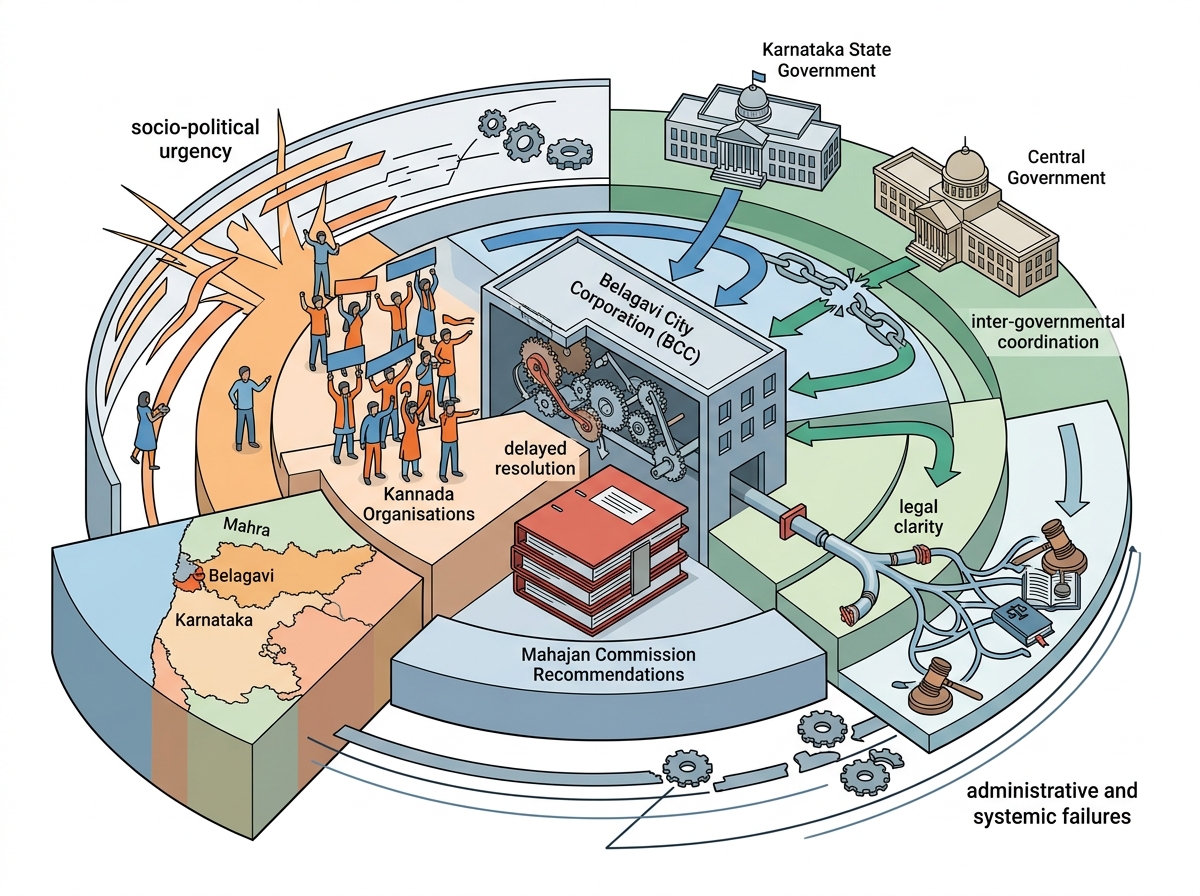
08 Aug Kannada orgs demand action against BCC over Mahajan Commission delay
Belagavi City CorporationMahajan CommissionState governmentBorder disputeKarnataka governmentMaharashtra government✎ The Mahajan Commission’s 1967 report unequivocally recommends Belagavi’s retention within Karnataka, and the State government’s repeated legislative affirmations of this stance leave no room for administrative or legal ambiguity.
Subject Relevance — Where This Topic Fits
- GS Paper II — Federalism and Centre-State Relations | GS Paper II — Role of Civil Services in a Democracy | GS Paper IV — Ethical Governance and Public Accountability
- Prelims: Mahajan Commission, Belagavi border dispute, Article 371-J, Urban Local Bodies (ULB), Karnataka State Border and River Protection Commission, Supreme Court Advocate Mohan Kataraki, Justice Nagamohan Das, Yathindra Siddaramaiah
- Essay: Federalism: The bedrock of India’s unity in diversity, Administrative inertia and its consequences on public trust
Quick Revision: The Mahajan Commission’s 1967 report unequivocally recommends Belagavi’s retention within Karnataka, and the State government’s repeated legislative affirmations of this stance leave no room for administrative or legal ambiguity.
Why is this in the news?
The delay by the Belagavi City Corporation (BCC) in passing a resolution affirming Belagavi as an integral part of Karnataka, despite the State government’s explicit endorsement of the Mahajan Commission recommendations, has reignited the long-standing border dispute between Karnataka and Maharashtra. The issue highlights systemic failures in administrative compliance, legal clarity, and inter-governmental coordination, thereby raising questions about the efficacy of constitutional and statutory mechanisms in resolving inter-state disputes. The controversy has also sparked protests, arrests, and demands for administrative action against the BCC, underscoring the socio-political urgency of resolving the matter.
Background
- The Belagavi (formerly Belgaum) border dispute between Karnataka and Maharashtra dates back to the linguistic reorganisation of states in 1956, when the city was transferred to Karnataka under the States Reorganisation Act, 1956.
- The Mahajan Commission, constituted in 1966 under the chairmanship of Justice Mehr Chand Mahajan, was tasked with examining the border dispute and submitted its report in 1967, recommending that Belagavi be retained within Karnataka.
- The Karnataka State government has consistently upheld the Mahajan Commission’s recommendations, passing resolutions in the State legislature in 2006 and 2013 affirming Belagavi’s status as part of Karnataka.
- Article 371-J of the Constitution grants special status to the Hyderabad-Karnataka region, including provisions for equitable development and administrative safeguards, though it does not directly address the Belagavi dispute.
- The Karnataka State Border and River Protection Commission, chaired by Justice Nagamohan Das, has reiterated the legal and constitutional validity of the Mahajan Commission’s findings.
- The Belagavi City Corporation, as an urban local body, is constitutionally mandated under the 74th Constitutional Amendment Act, 1992, to function as a self-governing institution, though its actions remain subject to State government oversight.
What is the Mahajan Commission and its relevance to the Belagavi dispute?
- The Mahajan Commission was constituted by the Government of India in 1966 to resolve the inter-state border dispute between Karnataka and Maharashtra, particularly concerning the Belagavi region.
- The Commission submitted its report in 1967, recommending that Belagavi and 264 surrounding villages remain part of Karnataka, while 247 villages be transferred to Maharashtra.
- The Commission’s findings were based on linguistic, administrative, and demographic considerations, with a focus on preserving the integrity of the Kannada-speaking regions.
- The Karnataka State government has repeatedly affirmed its commitment to the Mahajan Commission’s recommendations, including through legislative resolutions in 2006 and 2013.
- The Commission’s report is not legally binding but carries significant moral and political weight.
- The dispute resurfaced periodically due to political mobilisation by regional organisations, particularly in Belagavi, which has a significant Marathi-speaking population.
- The role of urban local bodies like the BCC in passing resolutions on inter-state disputes is limited but symbolically important, as it reflects local political will and administrative compliance.
- Legal opinions, including those from senior advocates like Mohan Kataraki and the Karnataka State Border and River Protection Commission, have consistently affirmed the absence of legal barriers to passing such resolutions.
Key Features
| Feature | Significance |
|---|---|
| Mahajan Commission Recommendations | The Commission, constituted in 1966, determined Belagavi (then Belgaum) as an integral part of Karnataka, resolving the border dispute with Maharashtra. Its recommendations carry historical and legal weight in asserting Karnataka’s territorial integrity. |
| Belagavi City Corporation (BCC) Delay | The BCC’s failure to pass a resolution endorsing the Mahajan Commission’s findings undermines Karnataka’s official stance and emboldens separatist narratives, despite the State government’s clear position. |
| Legal Opinion from State Government | The Karnataka government, through the Chief Secretary’s office, has explicitly stated that there are no legal impediments to the BCC passing such a resolution, reinforcing the State’s constitutional authority over the matter. |
| Protests by Kannada Organisations | The sustained agitation by Kannada organisations, including arrests during demonstrations, reflects public sentiment and pressure on the government to uphold Karnataka’s territorial claims. |
| Mayor’s Referral to State Government | The BCC Mayor’s decision to seek a legal opinion from the State government, despite the absence of legal hurdles, demonstrates institutional reluctance and procedural delays in resolving the issue. |
UPSC Value Addition
Keywords for Mains Answer-Writing
Karnataka-Belagavi border dispute · Mahajan Commission recommendations · Belagavi City Corporation (BCC) · inter-state boundary disputes · Article 263 of the Constitution · local self-government · federalism in India · inter-state relations · constitutional provisions for border disputes · urban local bodies and state policy · Karnataka State Border and River Protection Commission · federal governance and cooperative federalism · resolution of inter-state disputes · public policy and administrative delays · legal opinion on inter-state matters
Prelims Practice Questions
Q1. Consider the following statements regarding the Mahajan Commission and its recommendations on the Belagavi border dispute:
1. The Mahajan Commission was constituted to resolve the inter-state border dispute between Karnataka and Maharashtra.
2. The Commission recommended that Belagavi be declared an integral part of Karnataka.
3. The Commission’s recommendations were legally binding on both states.
4. The Karnataka State legislature has previously passed resolutions endorsing the Commission’s findings.
How many of the above statements are correct?
- Only one
- Only two
- Only three
- All four
Answer: All four — Statements 1, 2, and 4 are correct. Statement 3 is incorrect as the Commission’s recommendations are not legally binding unless accepted by the states and Parliament under Article 263.
Q2. Assertion (A): The Belagavi City Corporation (BCC) is constitutionally mandated to pass resolutions endorsing the Mahajan Commission’s recommendations.
Reason (R): The recommendations of the Mahajan Commission are binding on all local bodies within the disputed region.
In the context of the above statements, which of the following is correct?
- Both A and R are true, and R is the correct explanation of A
- Both A and R are true, but R is not the correct explanation of A
- A is true, but R is false
- A is false, but R is true
Answer: A is false, but R is true — Assertion (A) is true as the BCC is a local body under Karnataka’s jurisdiction and can pass resolutions endorsing state policy. However, Reason (R) is false because the Mahajan Commission’s recommendations are not binding on local bodies unless adopted by the state legislature or executive.
Q3. Match the following pairs related to inter-state disputes and constitutional provisions:
Column I (Committee/Commission) Column II (Purpose)
A. Mahajan Commission 1. Resolving inter-state river water disputes
B. Sarkaria Commission 2. Assessing the impact of Article 370 on J&K
C. Justice R.S. Sarkaria Commission 3. Examining Centre-State relations
D. Justice B.N. Srikrishna Commission 4. Resolving the Belagavi border dispute
Choose the correct match:
- A-4, B-3, C-2, D-1
- A-4, B-2, C-3, D-1
- A-1, B-3, C-2, D-4
- A-3, B-1, C-4, D-2
Answer: A-4, B-3, C-2, D-1 — A-4 (Mahajan Commission was constituted to resolve the Belagavi border dispute), B-3 (Justice R.S. Sarkaria Commission examined Centre-State relations), C-2 (Sarkaria Commission assessed the impact of Article 370 on J&K), D-1 (Justice B.N. Srikrishna Commission was constituted to resolve inter-state river water disputes).
Mains Practice Question
✍ The refusal of the Belagavi City Corporation (BCC) to pass a resolution endorsing the Mahajan Commission’s recommendations on Belagavi’s status as an integral part of Karnataka raises critical questions about the interplay between local self-government, federalism, and inter-state relations in India. Critically examine the constitutional and administrative dimensions of this issue. Also, analyse the implications of such delays for cooperative federalism and the resolution of inter-state disputes. (15 Marks)
Approach: MODEL-ANSWER SKELETON:
1. **Constitutional Framework for Inter-State Disputes**
– Article 263 of the Constitution: Role of Inter-State Councils and mechanisms for resolving disputes.
– Doctrine of ‘cooperative federalism’ and its relevance in inter-state relations.
– Powers and limitations of local bodies (BCC) under the 74th Constitutional Amendment Act, 1992.
2. **Legal and Administrative Dimensions**
– Status of the Mahajan Commission’s recommendations: Non-binding nature unless adopted by state legislature or Parliament.
– Role of the Karnataka State legislature in endorsing the Commission’s findings (precedents).
– Legal opinion provided by the State government and Chief Secretary’s office: No legal hurdles to passing the resolution.
– Administrative delays and their impact on public policy and federal trust.
3. **Federalism and Cooperative Governance**
– Concept of ‘federal morality’ and the duty of states to respect inter-state agreements.
– Role of the Union government in facilitating resolution (e.g., reference to Article 263 or Article 355).
– Case studies of other inter-state disputes (e.g., Cauvery, Krishna) and their resolution mechanisms.
4. **Implications of Delays**
– Erosion of trust between states and local bodies.
– Potential for political mobilisation and protests (e.g., involvement of organisations like Kannada organisations).
– Impact on governance efficiency and citizen trust in institutions.
5. **Way Forward**
– Strengthening mechanisms under Article 263 for dispute resolution.
– Role of the judiciary in resolving deadlocks (e.g., Supreme Court’s stance on inter-state disputes).
– Need for proactive measures by state governments to address local body resolutions promptly.
Balance of views: Highlight the tension between local autonomy and state/federal policy, the need for constitutional compliance, and the role of political will in resolving disputes.
Source: The Hindu
Generated by AanyaAi for educational purpose.

- मद्रास हाईकोर्ट का बड़ा फैसला: रिटायरमेंट के बाद भी जाती प्रमाण पत्र की जांच संभव - August 8, 2026
- Madras HC: Caste Certificate Verification Permissible Even After Retirement - August 8, 2026
- 13 वर्ष से कम उम्र के बच्चों को सोशल मीडिया, गेमिंग प्लेटफॉर्म पर प्रतिबंध लगाने वाला विधेयक संसद में प्रस्तावित - August 8, 2026

No Comments